
A skincare brand doing $2.3M/year was running a 7-email abandoned cart flow in Klaviyo. Beautiful. Personalized. Except Klaviyo had no idea that 4 of the 7 SKUs in that flow were out of stock.
Customers were clicking "Buy Now," hitting an out-of-stock page, and blaming the brand. Their cart recovery rate was sitting at 6.1% when the industry benchmark is 15-25%. That gap on a $2.3M brand represents roughly $182,000 in lost recovered revenue per year.
Impact: $182,000/year in recoverable revenue — gone because the email tool did not talk to inventory.
If you are running a D2C brand doing $1M-$10M in annual revenue and your email stack looks like Klaviyo talking to Shopify talking to a Google Sheet talking to your ops team — you are not running a marketing system. You are running a fire drill every Monday morning.
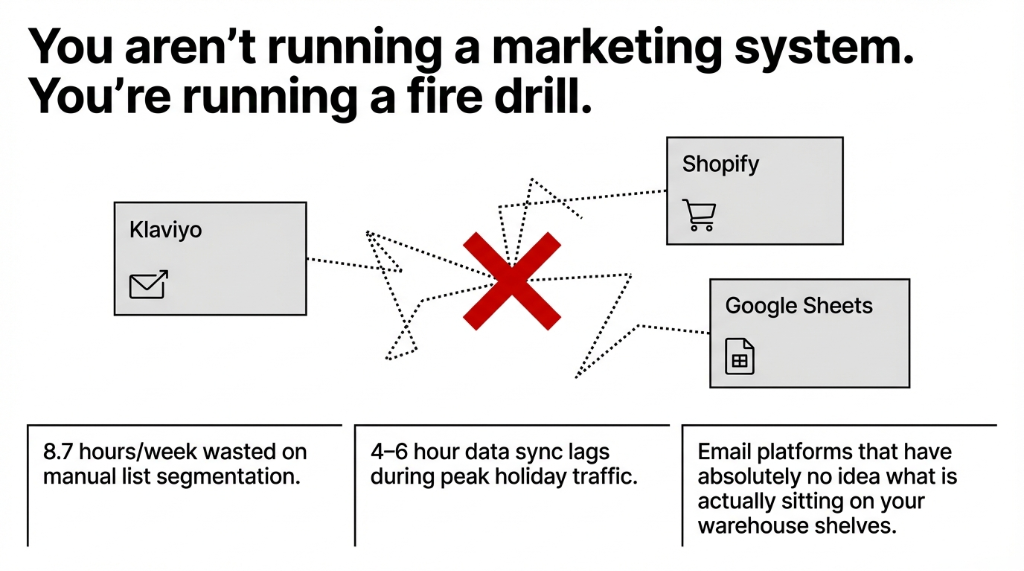
We have audited 150+ D2C brands across the US, UK, UAE, and Singapore. The same problem shows up in 9 out of 10 of them. Email is disconnected from inventory, order data never syncs in real time, and someone on the marketing team spends 8.7 hours a week manually segmenting lists and sending follow-ups that should have been automated 18 months ago.
The fix is not hiring another marketing coordinator. The fix is Odoo marketing automation — and most D2C founders do not realize they are already paying for it inside their Odoo license.
Your Email Campaigns Are Operating Blind
Here is the ugly truth about running Klaviyo (or ActiveCampaign, or Mailchimp) as a standalone tool beside your ERP: those platforms never actually know what is happening in your business. They know what you tell them via integrations, and those integrations break.
The Skincare Brand Disaster
A Dubai-based skincare brand doing $2.3M/year was running a 7-email abandoned cart flow in Klaviyo. Beautiful templates. Personalized subject lines. Except Klaviyo had no idea that 4 of the 7 SKUs were out of stock on Tuesday. Customers clicked "Buy Now," landed on an out-of-stock page, and blamed the brand.
Cart recovery rate: 6.1% (industry benchmark: 15-25%)
Revenue gap: $182,000/year in recoverable revenue — leaked because the email tool could not see inventory.
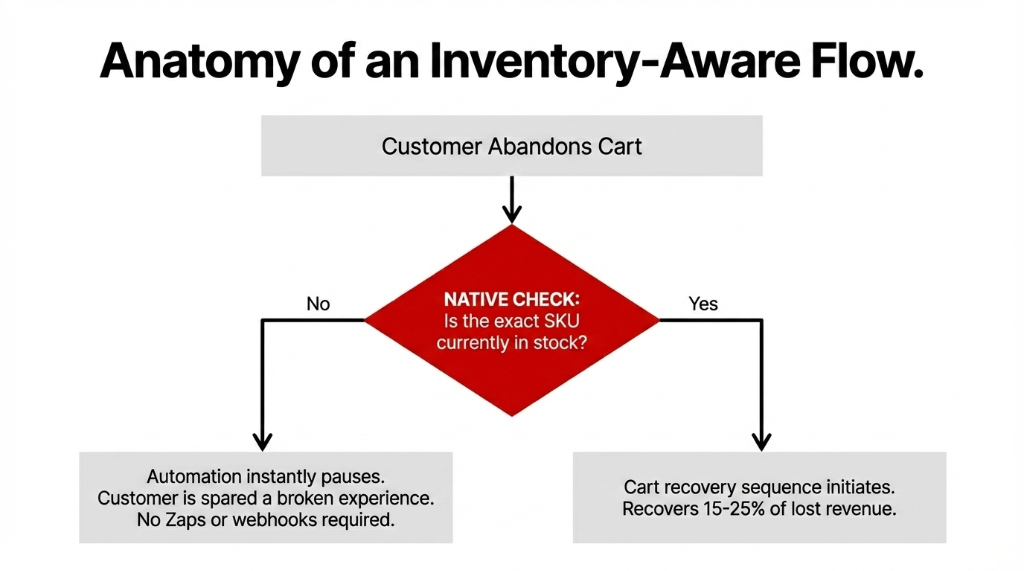
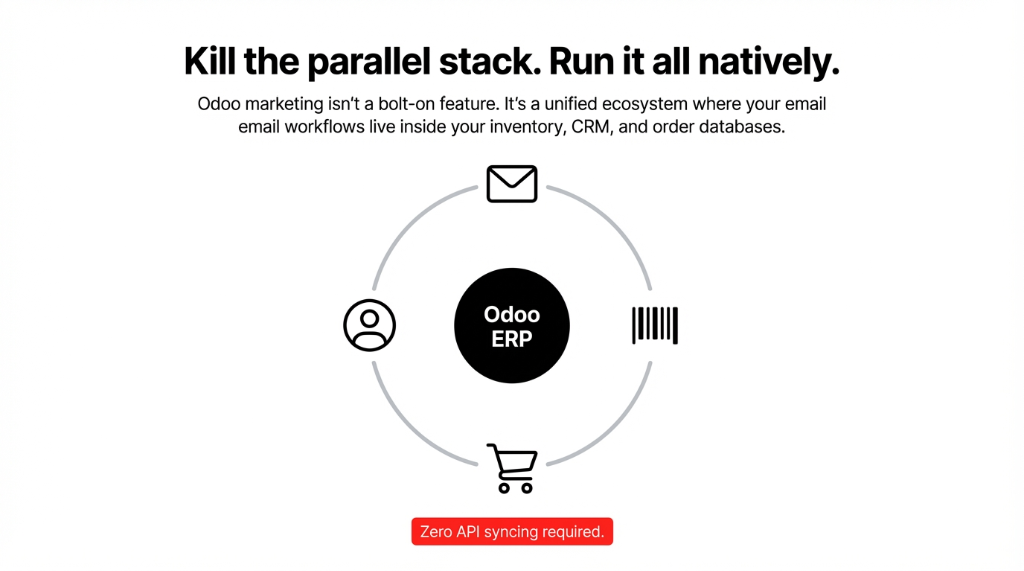
Odoo marketing automation is not a feature bolt-on. It is email workflows that sit inside the same system where your inventory, customers, orders, and purchase history live. When a SKU drops to zero, the automation pauses the campaign. Full stop. No Zap needed. No webhook that breaks on weekends.
Why Klaviyo Alone Will Cap Your Growth
We say this knowing it will upset a few agency partners: Klaviyo is a great tool for brands that do not have a real ERP. Once you are past $800K in annual revenue and you have actual operational complexity — multi-SKU inventory, return workflows, loyalty tiers, wholesale and DTC running in parallel — Klaviyo becomes a liability disguised as a feature set.
Segmentation Breaks First
Klaviyo segments based on email behavior and purchase data it syncs from Shopify. That sounds fine until you realize the sync has a 4-6 hour lag during high traffic. During your Black Friday sale, your "VIP Buyers" segment is pulling data from 6 hours ago. You are emailing someone a "Still interested?" sequence while they are already on their third order of the day.
Result: Bad data in, bad emails out. And you will not know until the monthly revenue report lands.
Then the Cost Hits
A D2C brand with 85,000 contacts pays approximately $1,190/month on Klaviyo's standard plan. That is $14,280/year for a tool that duplicates what Odoo's native marketing module already does — but without the inventory blindspot.
We have seen brands spend $14,280 on Klaviyo annually while simultaneously paying $18,000/year in Odoo licenses.
Total: $32,280/year to send emails that still require someone to manually update segments every Tuesday.
Our controversial opinion: Kill the parallel stack. Run everything inside Odoo. You will spend 6 weeks migrating and save $11,400 a year on software alone — before counting the revenue you stop leaking.
How Odoo Marketing Automation Actually Operates
Odoo's marketing automation module uses a visual workflow builder — triggers, wait periods, conditionals, actions. Not different from what you would build in Klaviyo. Except every single trigger can pull from native Odoo data.
A Real D2C Welcome Flow Built Natively in Odoo
Welcome Flow Architecture
1. Trigger
New customer places first order
2. Wait 10 Minutes
Send branded welcome email (HTML template with first name, product purchased, expected delivery)
3. Wait 2 Days + Condition
Opened? Yes: Send product care guide + upsell email segmented by product category from order data. No: Send SMS reminder via Odoo SMS Marketing.
4. Wait 5 Days
If no second purchase in 7 days: trigger "What did you think?" review request
This entire sequence runs 24/7. It handles 10 contacts or 10,000 contacts with zero additional manual effort.
Segmentation That Goes Deeper Than Klaviyo
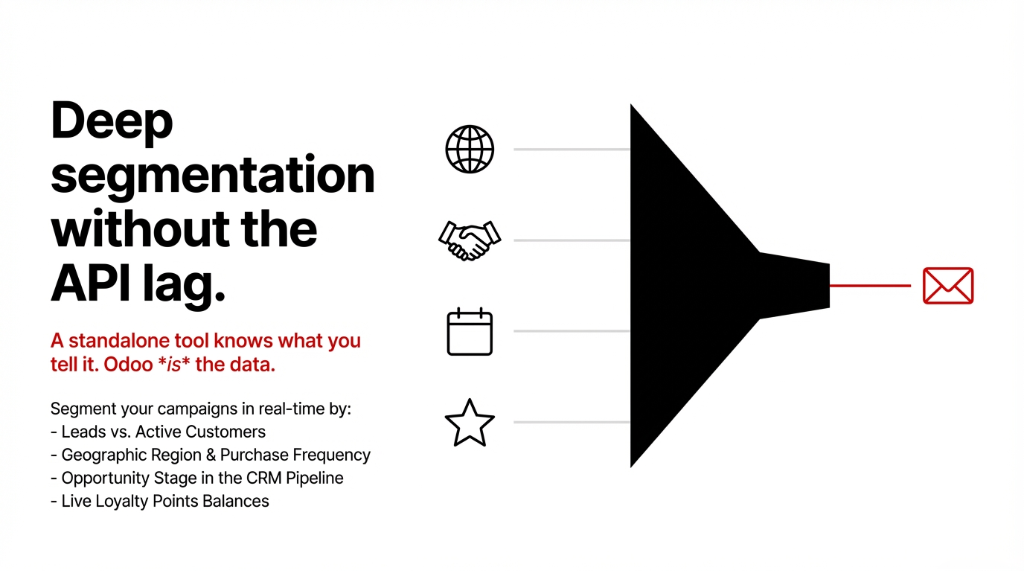
The segmentation goes deeper than Klaviyo can manage without custom API work. Odoo lets you segment by leads vs. active customers, geographic region, purchase frequency, opportunity stage in your CRM pipeline, event participation history, and product category preferences — all from one database, zero syncing required.
Subject line A/B testing? Built in. Odoo 18 includes ML-backed subject line optimization that tests variants and rotates winners without you touching the campaign dashboard. In our implementations, this alone has moved open rates from 21% to 31.4% within 90 days.
The Numbers From Real Implementations
Verified Results From Odoo Email Automation Deployments
US Supplement Brand
Migrated from ActiveCampaign to Odoo native. Weekly marketing ops time dropped from 23 hours to 6 hours. Email engagement up 25% in 60 days.
Automated vs. Manual
Automated workflows generate 320% more revenue than standard manual promotional campaigns when segmentation is properly configured.
Behavioral Trigger Conversion
Brands that implement behavioral triggers see automated flow conversion rates between 1.42% and 4.93% versus 0.8-1.5% for manual campaigns.
Cart Recovery with Inventory
Abandoned cart flows with real-time inventory awareness recover 15-25% of lost cart revenue — only possible natively inside Odoo.
The Email ROI Math Is Brutal If You Are Doing This Wrong
Email marketing delivers $42 for every $1 spent when done correctly. Most D2C brands on disconnected stacks are getting $9-$14 per dollar because their segmentation is stale, their triggers fire on bad data, and nobody knows the automation is broken until the monthly revenue report lands.
That is a 66-78% ROI haircut you are taking voluntarily.
What Implementation Actually Looks Like: Week 1 to Week 8
We are not going to tell you this is easy. Migrating your email automation from Klaviyo or Mailchimp into Odoo requires 6-8 weeks when done properly. Here is the realistic breakdown:
| Phase | What Happens | The Hard Truth |
|---|---|---|
| Week 1-2 | Contact database audit and migration. Every list cleaned. Duplicates removed. Tags mapped to Odoo segmentation fields. | This is the part everyone skips and then regrets. |
| Week 3-4 | Workflow architecture. Map every existing campaign flow — welcome, post-purchase, win-back, abandoned cart — and rebuild natively in Odoo. | Basic welcome + cart flows go live end of Week 3. |
| Week 5-6 | Template build and A/B test configuration. Email templates migrated, adapted for Odoo HTML editor. SPF/DKIM setup. | Sender reputation must be preserved. Mess this up and your deliverability dies. |
| Week 7-8 | Go-live, monitoring, first optimization cycle. Open rates, click rates, bounce rates watched daily for 14 days. | First meaningful metric improvement between Day 17 and Day 23. |
What Gets Easier on Day 1
Immediately: Your marketing team stops manually updating customer segments. Inventory-aware email flows go live. You cut your martech monthly spend by at least $890/month.
Takes 60-90 days: Segmentation refinement, A/B test learning cycles, and fine-tuning behavioral trigger timing.
The ROI inflection point in our experience? 90 days. After 90 days with Odoo marketing automation workflows running properly, every client we have implemented for has reported they would never go back to a disconnected stack.
The Integration That Most Brands Miss
Here is the insider detail most Odoo guides will not tell you: the real power of Odoo email automation for D2C is not in the email module — it is in the CRM + Inventory + Email loop running as one unit.
When your loyalty program triggers an email, it knows the customer's exact purchase history, their current loyalty points balance, the products they have viewed on your website, and whether their favorite product is back in stock. Klaviyo knows what you have told it via API. Odoo is the data.
Tool vs. System: The Real Difference
Klaviyo (Tool)
Knows what you have told it via API. Syncs break during peak traffic. Segmentation lags 4-6 hours. No visibility into inventory or CRM pipeline.
Result: 21% open rate
Odoo (System)
Is the data. Real-time inventory, CRM, purchase history, loyalty balances. Zero syncing. Behavioral triggers fire on live data.
Result: 34.7% open rate on the same customer base, same offer
That distinction — tool vs. system — is the difference between a 21% open rate and a 34.7% open rate on the same customer base, with the same offer, just better-timed and better-personalized. Native ERP integration is not optional at this stage. It is the entire competitive advantage.
Everyone says keep Klaviyo and "just integrate." Do not. That integration is the exact bottleneck that is costing you $182,000 a year. Kill the parallel stack. Let Odoo be the system, not just the backend nobody sees.
Frequently Asked Questions
Does Odoo Marketing Automation replace Klaviyo for D2C brands?
For brands already running Odoo ERP, yes — completely. Odoo's native module handles segmentation, behavioral triggers, A/B testing, and multi-step workflows. You eliminate the $890-$1,190/month Klaviyo cost and the sync lag that breaks campaigns during peak traffic periods like flash sales.
How long does it take to set up automated email workflows in Odoo?
A properly architected migration from an existing platform (Klaviyo, Mailchimp, ActiveCampaign) takes 6-8 weeks. Basic welcome and abandoned cart flows can be live in Week 3. Full behavioral trigger sequences with proper segmentation and A/B testing go live between Week 5 and Week 8.
Can Odoo handle abandoned cart emails the same way Klaviyo does?
Better than Klaviyo, specifically because Odoo knows real-time stock levels. It will not send abandoned cart recovery emails for out-of-stock products — a failure mode that silently tanks cart recovery rates in disconnected stacks. Properly configured Odoo abandoned cart flows recover 15-25% of lost cart value.
What open rate improvement should we realistically expect?
Brands moving from disconnected tools to Odoo native automation see open rates improve by 25-47% within 90 days — driven by better segmentation and behavioral trigger timing, not by changing the email content. The average industry open rate sits at 21.5%; top-performing Odoo-automated campaigns hit 34-41%.
Does Odoo Marketing Automation work with Shopify?
Yes. Braincuber's Shopify-Odoo integration syncs order data, customer profiles, and product catalog in real time. Every Shopify purchase triggers Odoo's post-purchase email flows automatically, and Shopify customer segments populate Odoo's CRM without any manual imports or third-party Zaps.
Your D2C Brand Is Generating Behavioral Data 24 Hours a Day
Purchases, cart additions, page views, loyalty redemptions. If your email platform cannot see that data the moment it happens, you are not running marketing automation. You are running scheduled broadcasts with a personalization sticker on top. Book our free 15-Minute Operations Audit — we will show you exactly where the revenue is leaking.
Do not let a disconnected martech stack cost you another $182K in recoverable revenue.