
If you're running a D2C fashion brand selling on your own website, Amazon, Myntra, and a handful of physical stores—and you're still reconciling inventory in a Google Sheet—you are likely sitting on top of $11,400 to $14,800 in stock discrepancies right now. Bewakoof figured this out the hard way. And what they built to fix it should be the operational blueprint for every fashion brand scaling past $6.1 million ARR.
The Multi-Channel Trap Fashion Brands Fall Into
Here's what the first 3 years of a growing D2C fashion brand looks like operationally.
You start on your own website. Traffic is coming, orders are flowing. Then someone says, "Let's list on Amazon and Myntra." Revenue jumps 23.4% in the next quarter. Smart move, right?
Wrong. Or rather—right product strategy, catastrophically wrong execution.
Because now you have three inventory pools that don't talk to each other. Your warehouse team ships 140 units of the "galaxy print hoodie" to Amazon FBA. Your Shopify store still shows 200 units available. A flash sale fires on your own website. You oversell 60 units.
Your customer support team gets 60 angry emails. You manually cancel 60 orders. You refund $5,140. You lose 3.1% of that month's revenue—not to competition, not to bad product—to bad plumbing.
This is the multi-channel trap. And Bewakoof, now at $21.3 million revenue in FY25 with 22 offline stores and presence on every major marketplace, is one of the few Indian fashion D2C brands to have genuinely cracked it.
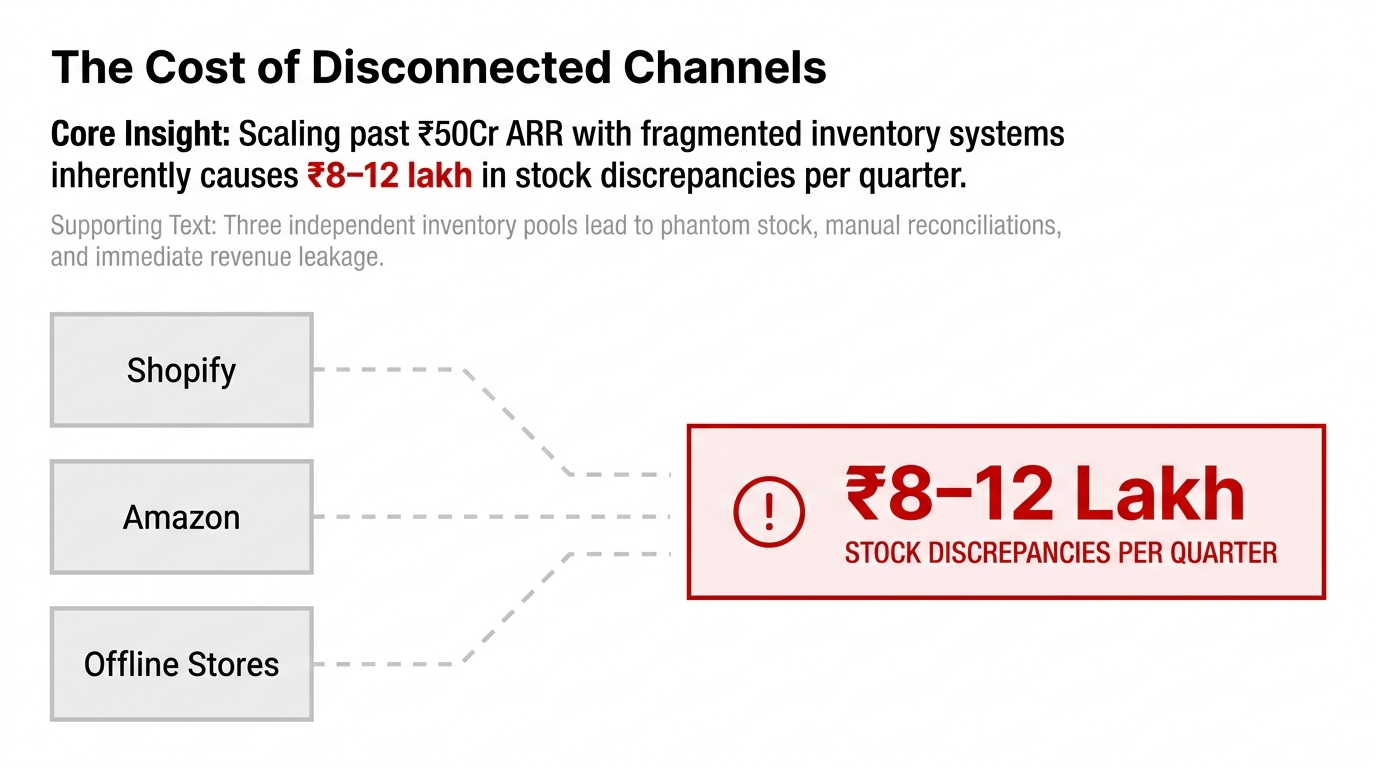
The Multi-Channel Desync Problem
Hidden cost: $11,400 to $14,800 in phantom inventory per quarter.
What Bewakoof Actually Built
Bewakoof didn't start with perfect infrastructure. Launched in 2012 by Prabhkiran Singh, the brand spent its first five years living dangerously close to the exact problems we described above.
The turning point was structural. When Aditya Birla Fashion and Retail (ABFRL) acquired Bewakoof through its TMRW roll-up arm, the brand didn't just get capital—it got operational discipline. ABFRL's omnichannel framework became the backbone.
Here's what that framework actually contains—layer by layer:
Layer 1: Centralized Inventory Brain
Bewakoof's multi-channel operation runs on a single inventory truth. Whether a unit of a $7.23 graphic tee is sitting in their Raipur store, in an Amazon FBA warehouse in Bhiwandi, or listed on their own website—one system knows exactly where it is.
When you don't have this, you're managing three spreadsheets that lie to each other. We've seen brands leaking $7,350 to $10,950 per quarter in phantom inventory—stock that exists on paper but has already shipped, been returned, or gotten lost between courier handoffs.
Layer 2: Channel-Specific Pricing Without Channel-Specific Chaos
Here's the dirty secret of multi-channel fashion retail: your margins on Amazon are not the same as your margins on your own D2C site. Amazon takes 15% to 18% commission on apparel.
Bewakoof prices differently per channel—$7.23 on their site, $7.87 on Myntra, $8.21 on Amazon—to preserve per-unit economics. But they manage this from a single product master catalog. The moment a brand tries to do this manually across five channels, one team member updates the wrong SKU, and suddenly your hero product is selling at cost on Flipkart for three days before anyone notices.
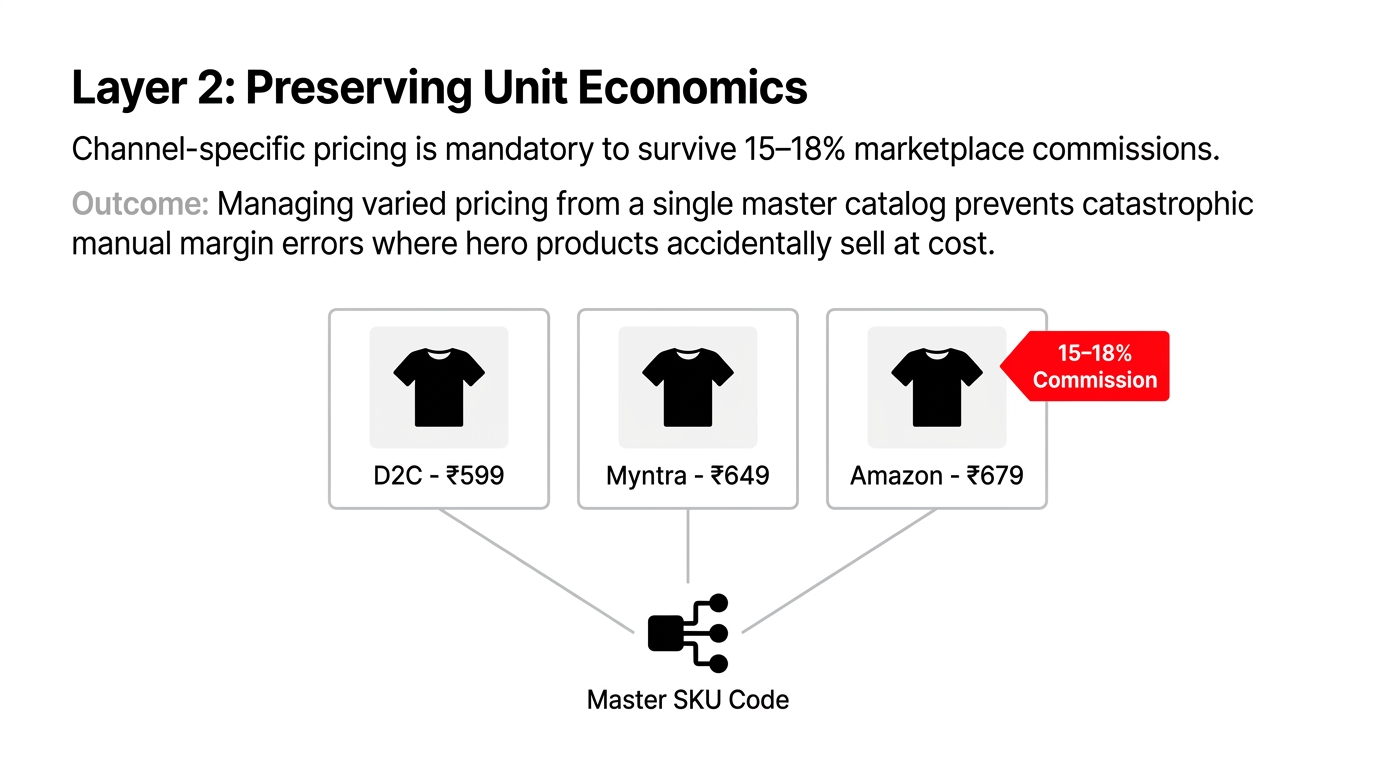
Layer 3: Offline-Online Synchronization at Store Level
This is where most D2C brands fail hardest. They open physical stores thinking it's just a rent-and-staff problem. It is not.
Bewakoof opened its first 12 stores in approximately 12 months—slow, deliberate. Then they opened 4 stores in 4 weeks. That acceleration isn't confidence. That's what happens when your operational playbook is validated.
Their offline stores now function as inventory nodes, not just storefronts. A customer walks into the Bengaluru store, finds their size missing—the staff can check online stock and place a home delivery order on the spot. That stops a $9.65 sale from walking out the door.
The Real Operational Machinery: What ERP + Integrations Are Doing
Let's talk about what's running under the hood—because this is where brands get sold on buzzwords and buy the wrong stack.
Most fashion brands in the $2.4 million to $12.1 million range make one of three infrastructure mistakes:
Infrastructure Pitfalls
The ERP Bloat: They buy NetSuite at $42,300 implementation cost before they have the volume to justify it. Cash flow crisis in month 4.
The Disconnect: They run Unicommerce or Increff for warehouse management but don't connect it to their finance or CRM layer. So returns are tracked in ops but not in accounting, and you're discovering the discrepancy during your CA's quarterly audit—three months too late.
The Glue and Tape: They use Shopify + three Zaps and call it "integrated." (Yes, we've seen a $4.85 million brand run on this.)
What Bewakoof's operational model—and ABFRL's backing—enables is different. It's a connected system where inventory management (WMS layer) speaks directly to the marketplace listing tool, order routing logic decides automatically which warehouse ships which order based on pincode proximity, and returns data feeds back into demand forecasting.
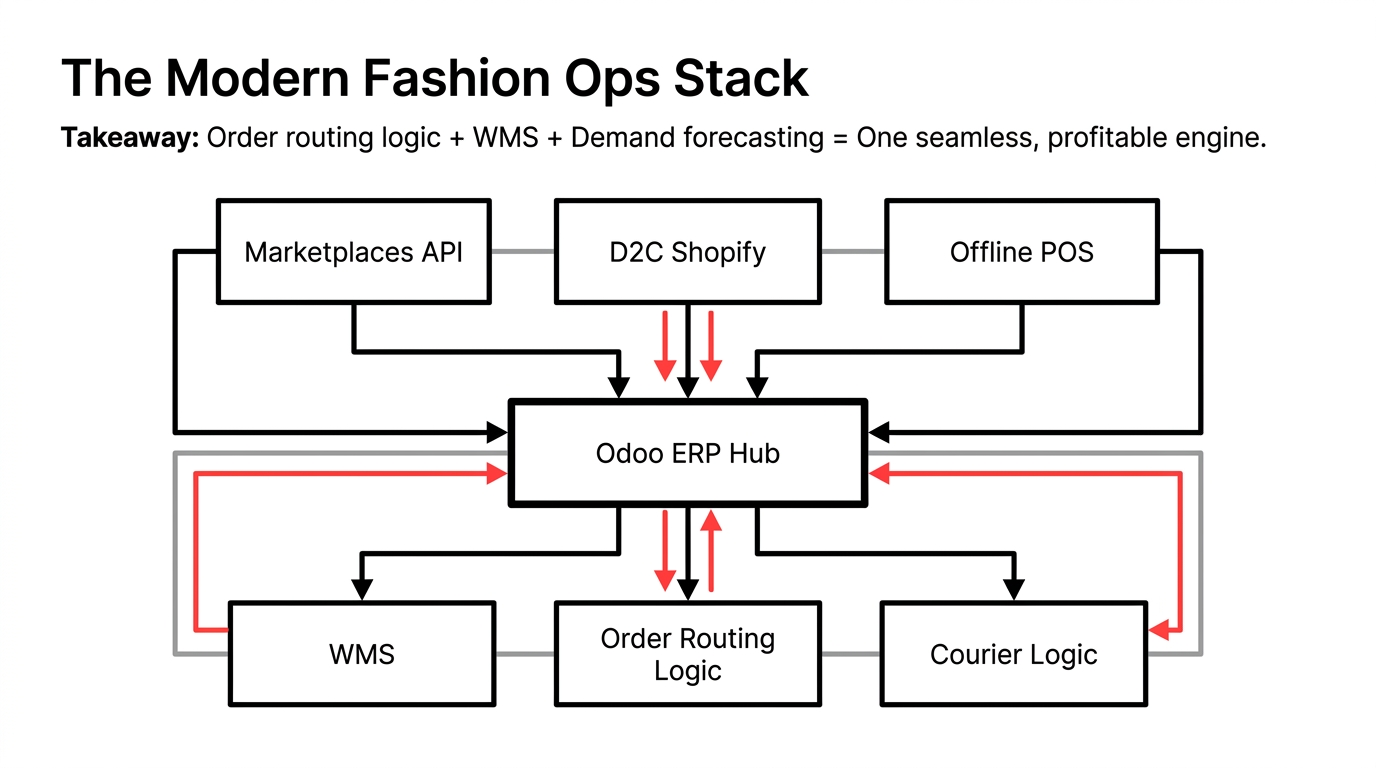
The tool stack matters less than the integration logic. Odoo ERP with custom Shopify and marketplace connectors achieves this for $3,650 to $9,750 implementation cost for a mid-size brand. The same outcome via SAP or Oracle is $30,200 to $48,400. Do the math.
Why the "Just Hire More Operations Staff" Advice Is Dead Wrong
Frankly, this is the biggest lie the startup ecosystem tells fashion founders.
Adding a 5th operations executive to manage your Flipkart listings manually is not scaling. It's bloating. Every human touchpoint in your order-to-dispatch chain is a potential $15.40 to $61.30 error per incident—wrong SKU picked, wrong courier assigned, wrong return address printed.
Bewakoof's operational leap—8.3% revenue growth in FY25 with a 29.1% reduction in net loss and 38.2% improvement in EBITDA loss—didn't come from hiring 30 more people. It came from removing human decisions from the places where human decisions create errors.
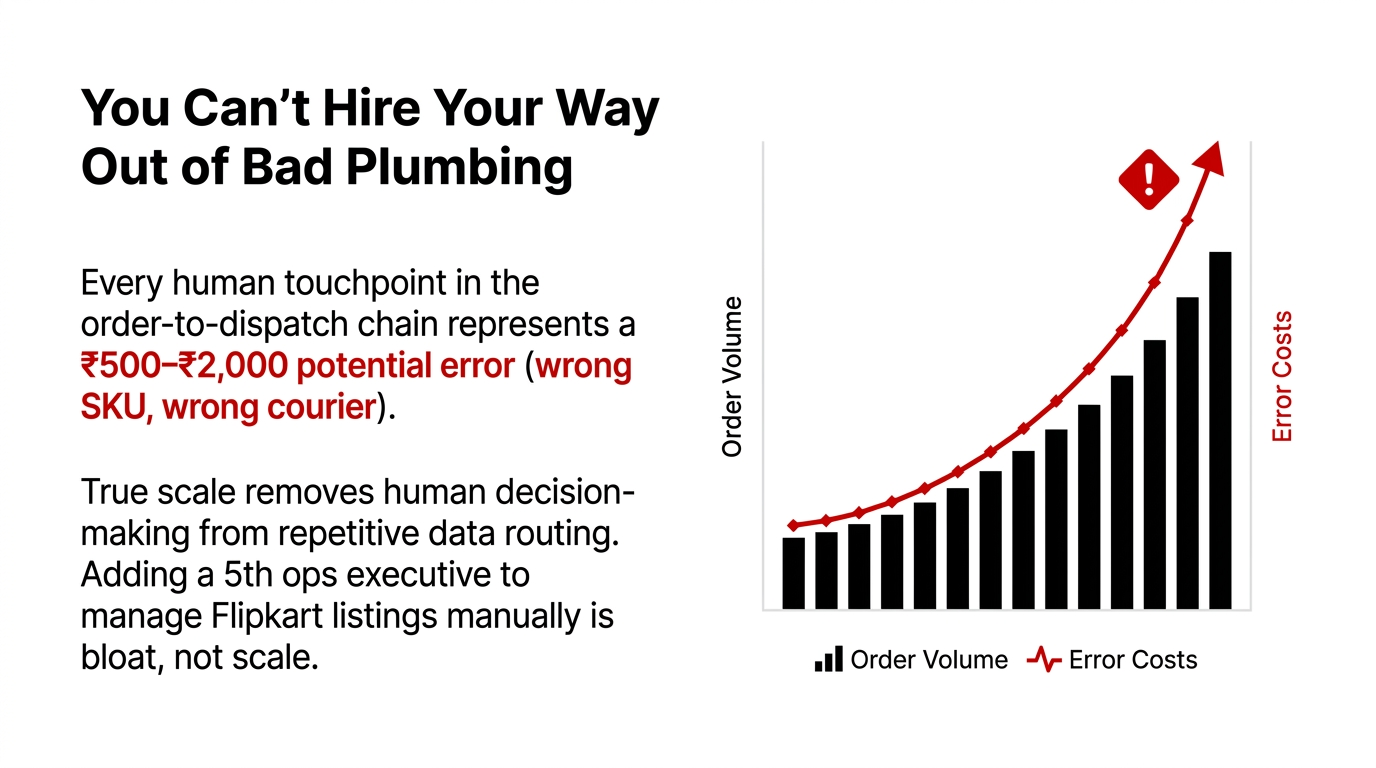
When your system auto-assigns the right courier partner based on real-time delivery performance scores per pincode, your COD remittance reconciliation stops being a Friday nightmare. When your POS at the Hubli store syncs with your central catalog every 11 minutes, your store manager isn't calling the warehouse to check if the olive green cargo pants in size 32 are available.
That's the compound effect of multi-channel infrastructure done right. Not one big win. 47 small wins per day that add up to $253,000 in recovered revenue per quarter.
What Brands Scaling $1.2M to $12.1M Should Do Right Now
We work with D2C fashion brands at exactly this stage—past initial PMF, hitting channel expansion walls. Here is the honest sequence:
- Audit your current inventory accuracy rate: If it's below 94%, you have a data problem before you have a technology problem. No ERP fixes bad input habits.
- Map your channel margin waterfall: Know exactly what you net after fees, returns, and shipping on each platform. Most brands don't know this until they're at $6.1 million and the numbers look ugly.
- Implement centralized order and inventory management: Do this before opening your third sales channel. The cost of retrofitting a system into an already-messy operation is 3.4x the cost of building it right the first time.
- Build your offline-online sync at store #1: Standardize the playbook during the slow first year so you can scale when the time is right.
- Automate your returns processing loop first: Returns in fashion run at 18.5% to 31.2% on marketplaces. Every unprocessed return is cash sitting in a warehouse that your balance sheet thinks is gone.
Sync Strategy
The Mandate: Automating the checkout-to-dispatch inventory loop recovers 15.4% to 24.8% of lost margins from sync errors and stockouts.
The ABFRL Effect: What Institutional Omnichannel Backing Actually Buys
There's a reason Bewakoof grew TMRW's portfolio by 55.4% YoY in FY25. It's not just capital. It's access to ABFRL's 13+ years of omnichannel retail infrastructure—the same infrastructure running brands like Van Heusen and Pantaloons across 3,000+ touchpoints.
When Bewakoof plugs into that ecosystem, they inherit:
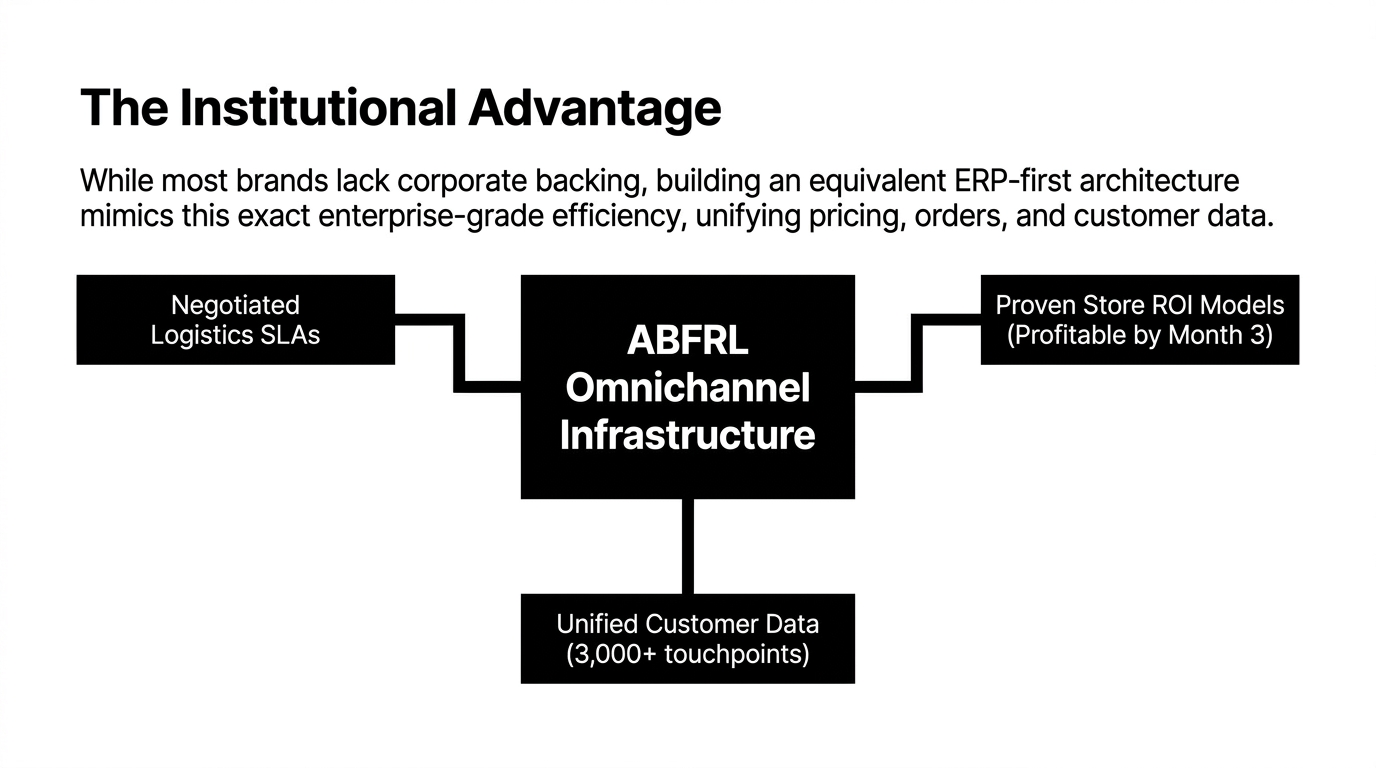
Most D2C brands will never have ABFRL backing. But they can build an equivalent operational architecture at their scale using the right multi-channel inventory sync approach. The goal is the same: one source of truth for inventory, pricing, orders, and customer data—regardless of where the sale happens.
The Brands Getting This Wrong Right Now
Look, we're going to name what we see.
Brands using Shopify + manual Myntra/Flipkart CSV uploads: You're losing 2.3% to 4.1% of revenue per month to sync lag errors. That's $27,850 to $49,350 annually on a $1.2 million top line.
Brands with separate WhatsApp catalog, website, and offline store inventory: You have three businesses, not one. Your CAC is being wasted because you can't attribute correctly. Your loyal customer who bought offline and now shops on your website looks like a new acquisition in your dashboard.
Brands launching on quick commerce without a WMS update: Quick commerce requires 2-hour inventory commitment. If your warehouse management system doesn't support sub-2-hour slot allocation by SKU, your SLA breach rate will exceed 17.3% within 60 days. That's a $3,370 penalty exposure per quarter for a mid-size brand.
The Real Cost of ERP Plumbing
NetSuite Implementations
$42,300+
High setup fees and slow ROI for mid-size D2C brands.
Odoo Custom Hub
$3,650 - $9,750
Gold Partner implementation with native API sync.
Revenue Recovery
15.4% - 24.8%
Recovered cash from leakage, RTOs, and sync errors.
Stop Bleeding Multi-Channel Revenue
Don't let sync lag, phantom stockouts, and manual CSV uploads eat your margins. We'll help you plug the leaks with Odoo inventory automation.