
Why $5M-$6M Is the Tipping Point
At around $5M-$6M revenue, the brand is usually big enough to have real operational complexity but still small enough to fix its systems without a brutal overhaul. The D2C market is still expanding aggressively — over $80 billion globally in 2024 — which means the pressure to scale without chaos is already real.
By this stage, the business usually has multiple sales channels, a warehouse *(or two)*, a finance team, paid media running $15K-$40K/month, maybe a marketplace presence on Amazon or Faire, and enough returns to make manual reconciliation a daily migraine.
That is the point where ERP stops being a software purchase and becomes an operating system for the business.
The $5M-$6M Reality Check
SKU Complexity
150-800 active SKUs across channels. Bundles, kits, seasonal variants. One wrong stock update before a campaign can create oversells that burn $3,200-$7,800 in ad spend on products you cannot ship.
Channel Sprawl
Shopify storefront. Amazon. Maybe Walmart or Faire. Wholesale inquiries coming in. Each channel has its own order flow, return logic, and settlement timeline. Reconciling them manually burns 37 hours/month.
Finance Drift
Month-end close is drifting past day 12. Payment gateway settlements, COD reconciliation, and marketplace payouts create a $19,000-$47,000 "mystery gap" between reported revenue and bank deposits.
What Breaks First (It Is Never Dramatic)
The first cracks are rarely dramatic. They show up as a late-night inventory mismatch. A customer support ticket that cannot be resolved because stock moved in Shopify but not in the backend. A finance team that spends half a day matching payment gateways, returns, and COD settlements.
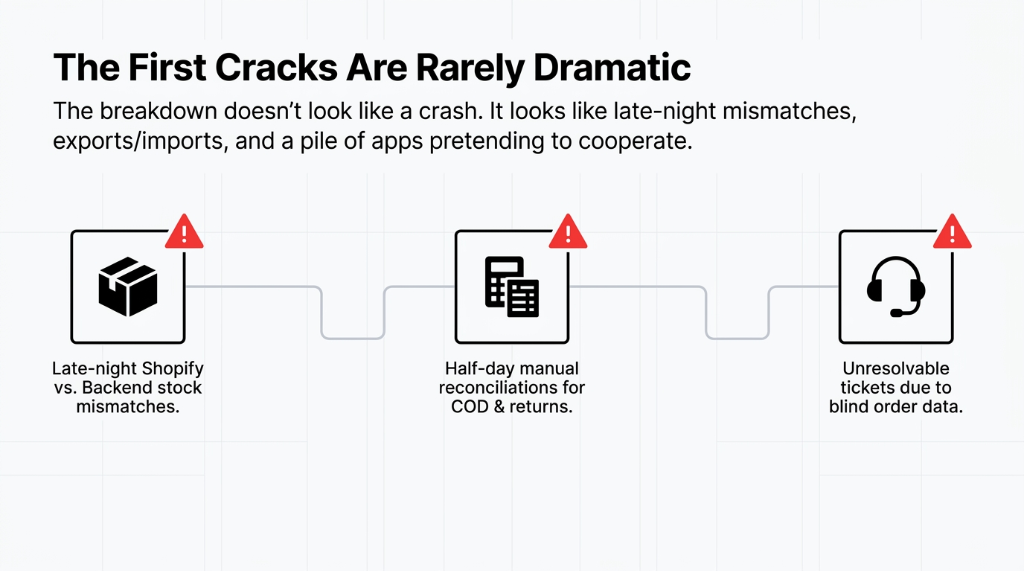
Shopify-to-backend sync becomes a bottleneck when teams rely on exports, imports, and a pile of apps instead of one source of truth. We counted 7 Shopify apps at one brand that were each trying to "manage" inventory. None of them agreed with each other.
At $5M-$6M, the brand usually has enough SKUs, bundles, and sales spikes that tiny errors compound fast. One wrong stock update before a campaign can create oversells, refunds, angry customers, and ad spend wasted on products that should never have been promoted.
What a D2C brand at this stage actually needs:
Connected inventory, order management, accounting, and fulfillment. Not four separate tools pretending to cooperate. Not 7 Shopify apps with conflicting stock counts. Not a Google Sheet that your ops manager updates "when she remembers."
When ERP Becomes Non-Negotiable
ERP becomes non-negotiable when three things happen at once: order volume is rising, the team is spending more time on coordination than execution, and errors are now visible in cash flow. That is not "admin work." That is operational drag costing you $4,300-$11,700 every month.
Here is the blunt rule: if your team is still depending on Excel VLOOKUPs, Slack approvals, and manual Shopify exports to keep the business running, you are already late. The business may still be growing. But the margins are quietly taking the hit.
The ERP Trigger Checklist
If two or more of these are true, ERP is not a "maybe." It is overdue:
1. Stock accuracy is slipping across channels
2. Returns and replacements are hard to trace
3. Finance closes take longer than day 10
4. Customer support cannot trust order data
5. Your warehouse and sales team argue daily
Score: __ / 5. Two or more? Call us.
Why Basic Tools Fail at $5M+
Basic tools fail because they were never designed to run a scaling D2C business end to end. Shopify is excellent at storefront execution. But once operations become multi-channel, the backend needs more depth than apps and spreadsheets can provide.
Odoo-style integration solves this by connecting inventory, sales, accounting, and CRM in one system while keeping the storefront experience intact. No ripping out Shopify. No migrating your customer base. Just connecting the backend so the data stops lying to you.
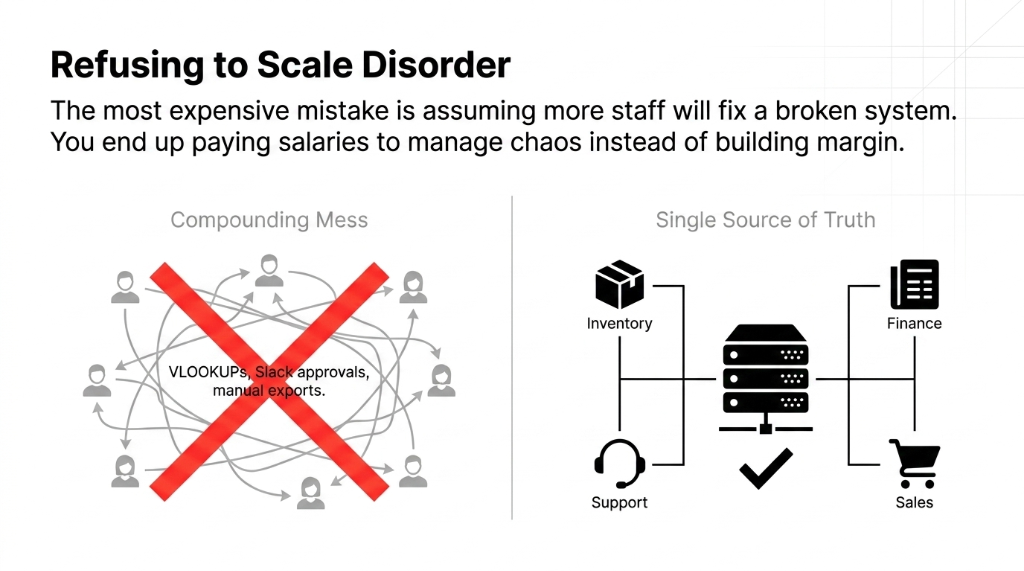
The biggest mistake is assuming more staff will fix the mess. It usually does the opposite. You hire coordinators, then supervisors, then "ops support," and suddenly the brand is paying $127,000/year in salaries to manage chaos instead of building margin.
That is why ERP is less about software and more about refusing to scale disorder.
The Right ERP Model for D2C
For most D2C brands at $5M-$6M, the smartest move is not replacing Shopify. It is keeping Shopify where it is strong and connecting it to ERP where the pain is. That means using Shopify for the customer-facing layer and ERP for orders, inventory, accounting, purchase planning, and fulfillment control.
Why This Model Works
Shopify handles what it is good at: checkout, themes, payment processing, customer accounts. ERP handles what Shopify was never built for: multi-channel inventory truth, purchase orders, vendor management, margin tracking, and financial close.
This is especially useful when the brand sells on multiple channels or is preparing for marketplace growth. A connected backend reduces manual reconciliation and gives leadership a real view of stock, margin, and fulfillment performance instead of a delayed mess of reports.
Everyone says buy NetSuite. Don't. Not at $5M-$6M. NetSuite burns $150K-$500K before you see value at this stage. *(Yes, your CFO will hate hearing this.)* An Odoo implementation at this revenue stage runs 1/5th the cost with the same operational coverage.
The Implementation Blueprint
The cleanest ERP rollout starts with a boring but necessary truth: fix the process before the software. If your SKU naming is messy, your return categories are inconsistent, and your team has invented 5 versions of the same report, ERP will only make the mess more visible.
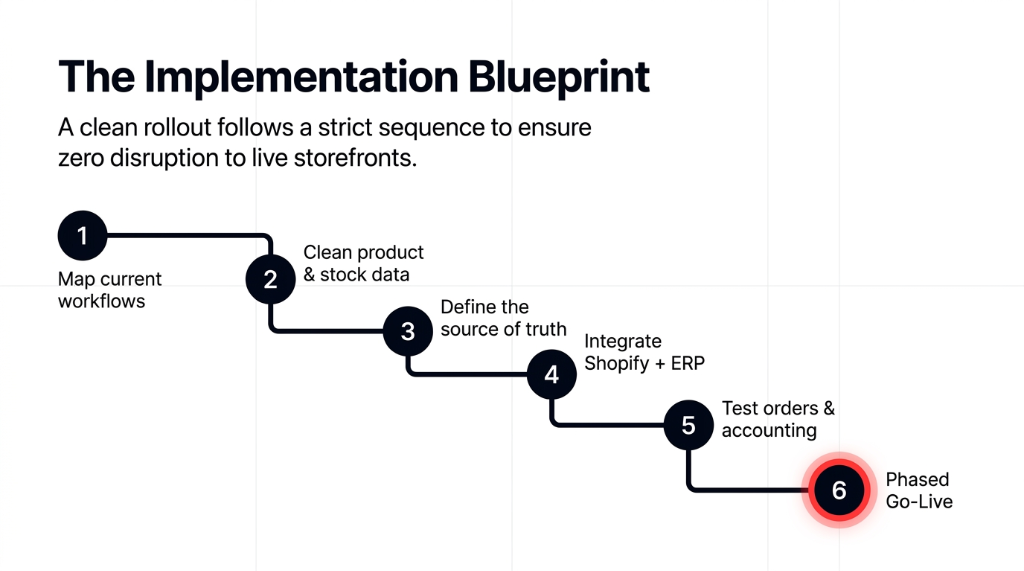
| Step | What Happens | Typical Timeline |
|---|---|---|
| 1. Map Current Workflows | Document every handoff, approval, and workaround your team uses today | 3-5 days |
| 2. Clean Product and Stock Data | Fix SKU names, deduplicate, standardize categories and variants | 5-9 days |
| 3. Define Source of Truth | Decide which system owns stock, which owns orders, which owns finance | 2-3 days |
| 4. Integrate Shopify + ERP | Real-time sync for orders, products, inventory, customers, payments | 5-14 days |
| 5. Test Orders and Accounting | Run parallel for 1-2 weeks. Match every order, return, and payout | 7-14 days |
| 6. Phased Go-Live | Go live in phases, not all at once. Start with inventory, then orders, then finance | 3-7 days |
Our Shopify-Odoo approach focuses on real-time sync for orders, products, inventory, customers, payments, and fulfillment. Typical live integration window: 5-14 days for standard setups. Complex workflows take longer, but the point is the same — get the data flowing correctly before you try to optimize anything.
What Good Looks Like (It Is Boring)
A good ERP implementation does not feel flashy. It feels calmer. The warehouse stops guessing. Finance stops chasing data. Leadership stops asking, "Which report is correct?"
The 3 Places You See Results First
Order-to-Cash Speed
Average improvement: 2.7 days faster from order placed to cash in bank. That is $18,300 in working capital freed up per month at $5M revenue.
Stock Mismatch Rate
Drops from 4.7% to under 0.8% within 60 days. That translates to 63% fewer oversell incidents and a direct reduction in refund-related customer churn.
Month-End Close
From day 17-19 down to day 7-9. Your accountant stops hating month-end. Your CFO stops guessing. And your board gets numbers they can actually trust.
For a $5M-$6M brand, even modest improvements matter because the cost of errors scales with revenue. A 1% operational leak on a $5.5M business is $55,000 disappearing quietly. And that is before you count customer churn or ad spend wasted on unavailable products.
When to Wait (Yes, Sometimes You Should)
Do not rush into ERP if the brand is still early, the catalog is tiny, and the team can resolve issues in one meeting. If you are at $500K-$1M and the business is still stable on a lean stack, ERP may be premature.
But once the brand starts layering channels, hiring operations staff, and losing time to reconciliation, waiting becomes expensive. The earlier you implement ERP in the growth curve, the less painful the change. The later you wait, the more historical data, custom exceptions, and human workarounds you need to untangle.
The Sweet Spot
Implement ERP when stock, order, and finance data no longer match across systems. For most brands, that begins around $3M-$6M revenue, especially if you sell through Shopify, marketplaces, and warehouses at the same time. Catch it here and the migration is 5-14 days. Wait until $10M and you are looking at 60-90 days of painful data untangling.
5 Questions Every Founder Asks Before ERP
When should a D2C brand implement ERP?
Implement ERP when stock, order, and finance data no longer match across systems. For most brands, that begins around $3M-$6M revenue, especially if they sell through Shopify, marketplaces, and warehouses at the same time. The trigger is not revenue size alone — it is the gap between what your reports say and what your bank account shows.
Is Shopify enough without ERP?
Shopify is enough for a simple store. But not for a growing multi-channel operation. Once you need accurate inventory, accounting, and fulfillment tracking in one place, ERP becomes the backend that keeps the business from drifting into chaos. Think of Shopify as the showroom. The warehouse, finance, and operations need a different system.
Should we replace Shopify with ERP?
Usually no. For D2C brands, the better model is to keep Shopify for storefront sales and connect it to ERP for operations. That preserves customer experience while fixing the backend. Ripping out Shopify is almost always a bad idea — you lose checkout optimizations, theme investments, and customer familiarity.
What is the biggest ERP mistake?
Implementing ERP before cleaning data and processes. If product names, stock logic, and returns handling are messy, the ERP will simply automate the mess faster. We have seen brands go live with 3,400 duplicate SKUs in the system. That is not automation. That is chaos at machine speed.
How long does ERP implementation take?
A standard Shopify-Odoo integration can go live in 5-14 days for simpler setups. More complex workflows with custom logic, multi-warehouse routing, and marketplace sync take 30-45 days. The real timeline depends on data quality, custom logic, and how many broken processes you are trying to fix at once.
The Real Question Is Not "Should We Get ERP?"
The real question is: how much longer can you afford to pay salaries to manage chaos instead of building margin? Every month you wait, the data gets messier, the workarounds get more fragile, and the migration gets more expensive.
Pull up your last 3 month-end closes. Count the days to close. Count the reconciliation hours.
If either number makes you uncomfortable, your business is telling you something. We find an average of $7,300/month in recoverable margin in the first ERP audit.
Get Your Free ERP Readiness Audit