
Why the Valuation Multiple Is Not Just a Revenue Story
Founders love topline vanity numbers. Buyers do not. A buyer is purchasing future cash flow, and they pay a premium when that cash flow is stable, structured, and easily transferable after the acquisition. If your D2C brand is growing fast but your backend is a collection of messy data silos, your growth is actually creating valuation drag.
When strategic buyers look at your business, they run it through a rigorous operational stress test. They want to know: how much of this revenue survives when the founder steps away? If your operations rely on tribal knowledge, WhatsApp coordination, and spreadsheets, buyers assume massive execution risk.
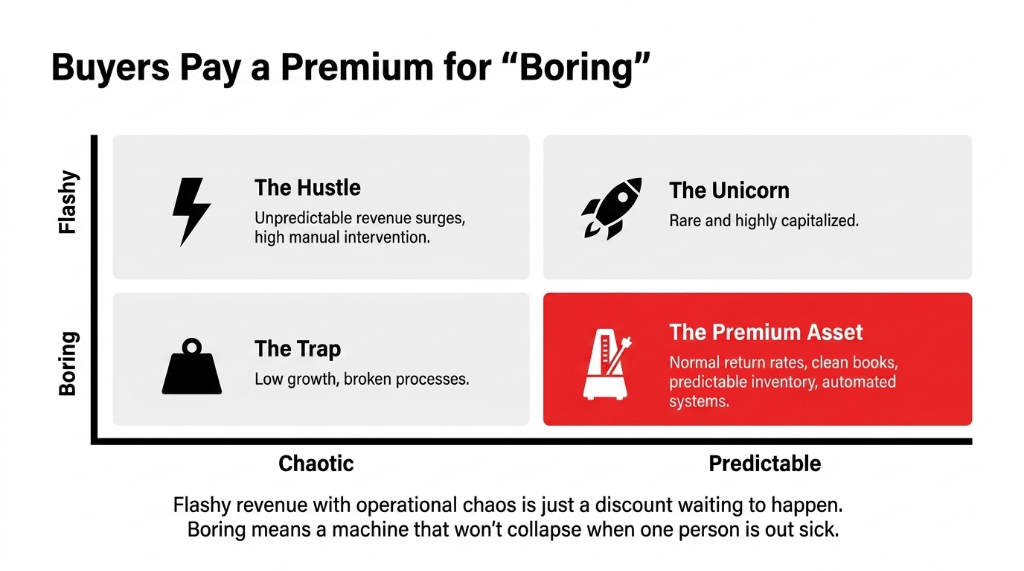
In D2C acquisitions, buyers pay a premium for "boring." Boring means predictable inventory cycles, low customer return rates, clean financial reconciliation, and systems that do not collapse when a key employee is out sick. Operational efficiency turns your business from a volatile hustle into a high-value transferable asset.
The Five Channels of Operational Efficiency
Operations don't just cut costs. They trigger margin growth, liberate capital, and actively reduce execution risk across five distinct channels:
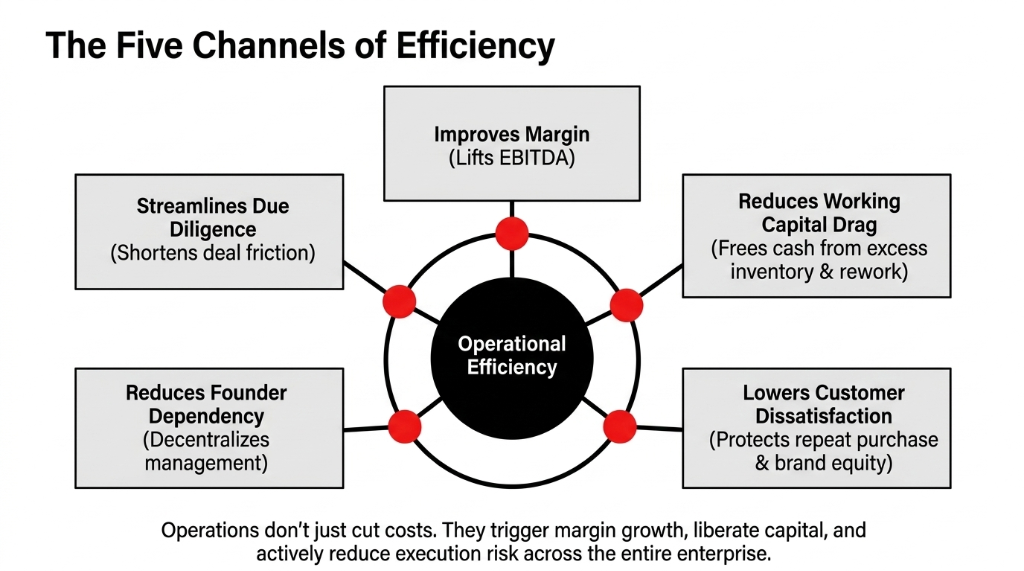
Channel 1: Margins & EBITDA Expansion
Tight fulfillment workflows reduce picking errors, shipping chargebacks, and product write-offs. Every rupee saved in fulfillment cost goes straight to your EBITDA line. Because valuation multiples are applied directly to EBITDA, a 2% margin recovery can increase your exit valuation by 15% to 25%.
Channel 2: Working Capital Drag Reduction
When your inventory is synced in real time, you run a shorter Cash Conversion Cycle. Cash that would have been locked in slow-moving warehouse pallets is freed up to fund customer acquisition or sit on your balance sheet as real cash reserves.
Channel 3: Customer Satisfaction & LTV Protection
Fulfillment accuracy protects your repeat purchase rates. Buyers look closely at cohort retention; a brand whose customer return rate is contained and whose order fill rate stays above 99.1% presents a low-risk recurring revenue profile that commands higher multiples.
Channel 4: Founder Dependency Reduction
If the founder is the planner, fixer, and firefighter, the business is fragile. Systems-led operations transfer operational accountability to workflows, allowing a new owner to take over the brand with zero transition friction.
Channel 5: Clean Due Diligence
When your books, inventory ledgers, and sales reports match automatically, you shorten the diligence cycle. Friction-free diligence prevents deal fatigue and stops buyers from chipping away at your valuation multiple during the closing window.
The Margin Leakage Pipeline: How Valuation Bleeds Out
Most D2C brands do not lose valuation in a single catastrophic event. They bleed it out slowly in small, unmonitored places. When due diligence begins, buyers look for these leaks to build their discount case.
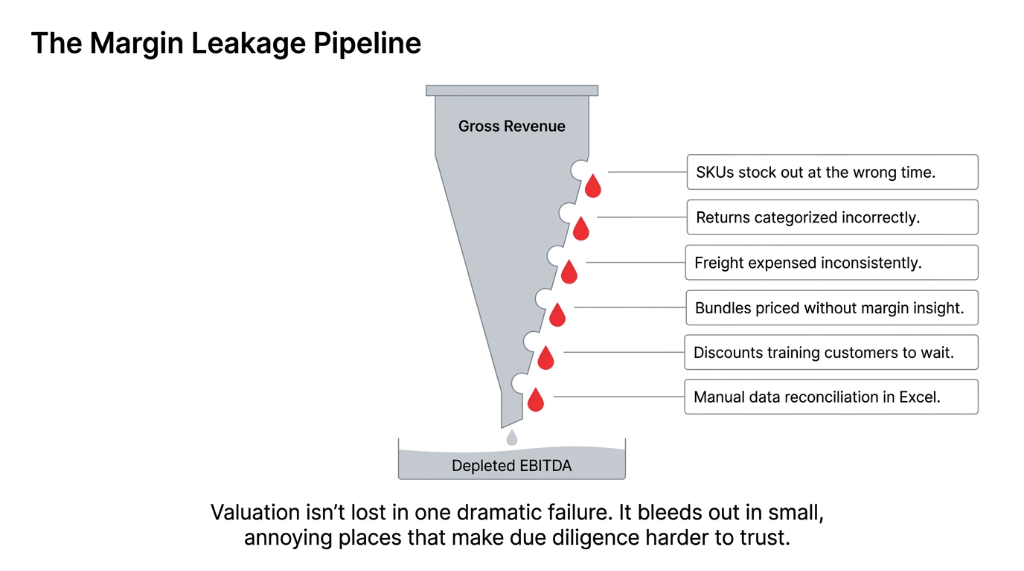
Common leaks include selling stockouts, mis-categorized returns, inconsistent freight allocation, margin-blind bundle pricing, and manual Excel reconciliation. Together, these leaks tell a buyer that your financial reporting cannot be fully trusted — leading to compressed valuation offers.
Why Connected Systems Create Repeatable Value
Software systems do not create value by themselves; they create the repeatability that buyers pay for. When your storefront, warehouse management, procurement, and general ledger are disconnected, you introduce manual hand-offs. Manual hand-offs introduce noise.
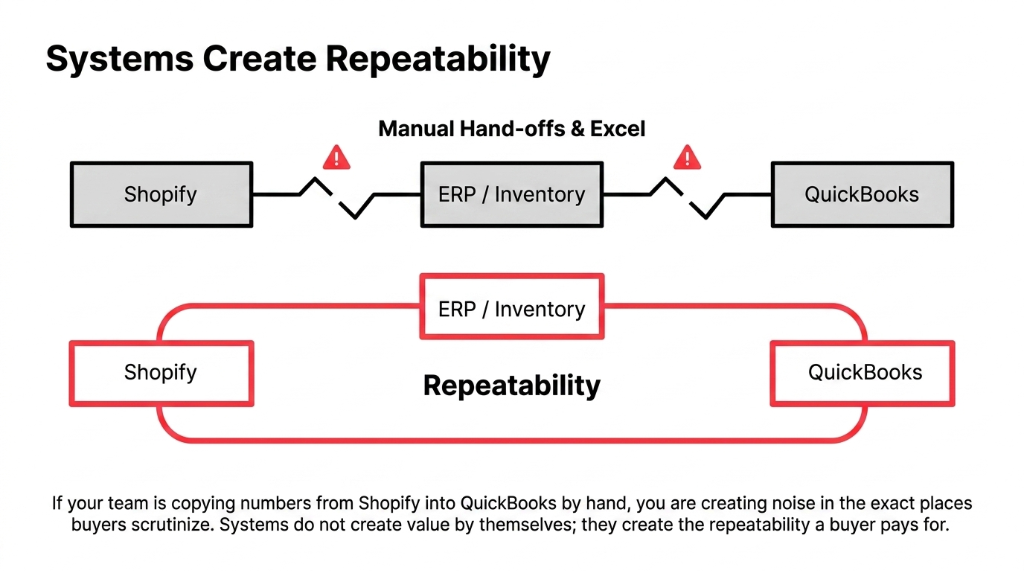
If your team is copying sales figures from Shopify into QuickBooks or tallying inventory levels in standalone spreadsheets, your operational data is noisy. Serious acquirers notice these seams instantly. An integrated Odoo ERP backbone eliminates this operational noise, ensuring that your financial data matches your physical stock movements at any given moment.
Transitioning From Fragile to Transferable Value
To achieve a premium exit multiple, you must actively transition your brand from founder-led and fragile to system-led and transferable. The buyer wants to acquire a machine, not a job.
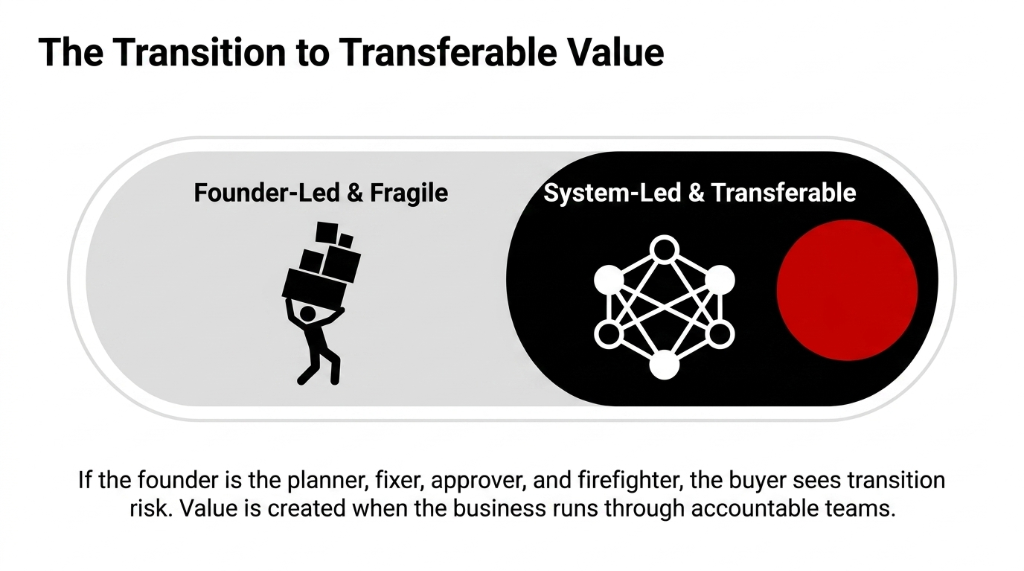
By automating your core replenishment, shipping logic, and financial reconciliation workflows, you prove to a buyer that the business runs on rails. This reduces transition risk and increases the multiple they are willing to write into the Letter of Intent (LOI).
Operational Performance vs. Buyer Multiple
| Operational Health | Typical Multiple (EBITDA) | Buyer Assessment & Risk Profile |
|---|---|---|
| Fragile (Spreadsheets, stockouts, founder-dependent) | 2.5x - 3.8x | High Risk: Manual data sources are hard to audit. High post-sale churn risk. |
| Standard (Basic integrations, siloed tools, delayed books) | 4.0x - 5.5x | Medium Risk: Normal margins, but operational bottlenecks slow post-acquisition scaling. |
| Institutional (Odoo ERP, automated workflows, AI forecasting) | 6.0x - 8.5x+ | Low Risk: High quality of earnings. Transferable systems. Ready to scale instantly. |
How to Raise Your Valuation Multiple: The 30-Day Operational Checklist
- Unify your product SKU master. Eliminate duplicate variants and mapping conflicts across Shopify, Amazon, and your warehouse systems
- Automate order-to-ledger reconciliation. Stop manual CSV downloads and map gateway deposits directly to your ERP general ledger daily
- Document operational standard operating procedures (SOPs). Map workflows so that customer support, returns, and inventory counts run through systems, not founder approvals
- Implement predictive replenishment rules. Use real-time sell-through data to trigger purchase order drafts instead of manual warehouse counts
Strategic buyers pay for durable operating margins, not short-term sales campaigns. By investing in clean operational infrastructure, you turn your brand's growth into a highly capitalize-able asset.
The Valuation Reality Check
Do not let NetSuite agencies sell you a $250,000 ERP roadmap just because you are preparing for an exit. A mid-market D2C brand doing $3M-$10M ARR needs execution speed, not multi-year consultant cycles. Our custom AI-driven Odoo integrations achieve complete operational transparency and system independence in 9 to 14 weeks — delivering clean, auditable data that buyers trust from Day 1 of due diligence.
Frequently Asked Questions
Does efficiency always increase valuation?
Usually, yes, because it lowers risk and improves profit quality. But the effect is strongest when efficiency is durable, measurable, and visible in the books. Temporary cost cutting without better systems does not move the multiple much.
What operations metric matters most?
There is no single metric, but contribution margin and cash conversion are usually the most important. They tell a buyer how much money the business truly keeps and how much cash gets trapped in the operating cycle.
Do buyers care about founder dependence?
Very much. If the founder is the planner, fixer, approver, and firefighter, the buyer sees transition risk. The more the business runs through systems and accountable teams, the better it looks in diligence.
Can better systems raise a multiple fast?
Yes, if they improve reporting quality, reduce manual work, and stabilize fulfillment. Buyers notice clean data and cleaner execution quickly. The valuation uplift, though, usually comes when those improvements show up consistently over time.
What is the fastest operational fix before a sale?
Clean financial reporting and inventory visibility. If a buyer cannot trust your numbers, every other strength becomes harder to price. Reliable reporting removes friction and makes the rest of the business easier to believe in.
Stop Let Operational Chaos Eat Your Exit Multiple
Strategic buyers will discount your brand valuation by 20% to 30% if they find manual data reconciliation, unmonitored return reserves, or high founder dependence. We build connected, automated operational stacks that clean up your data, protect margins, and drive exit readiness. The implementation takes 9-14 weeks. The valuation impact lasts forever.