
This is not a think-piece. This is the exact technology checklist we run every D2C food founder through before they take their first live order.
Your $0 Tech Stack Will Cost You $60,000
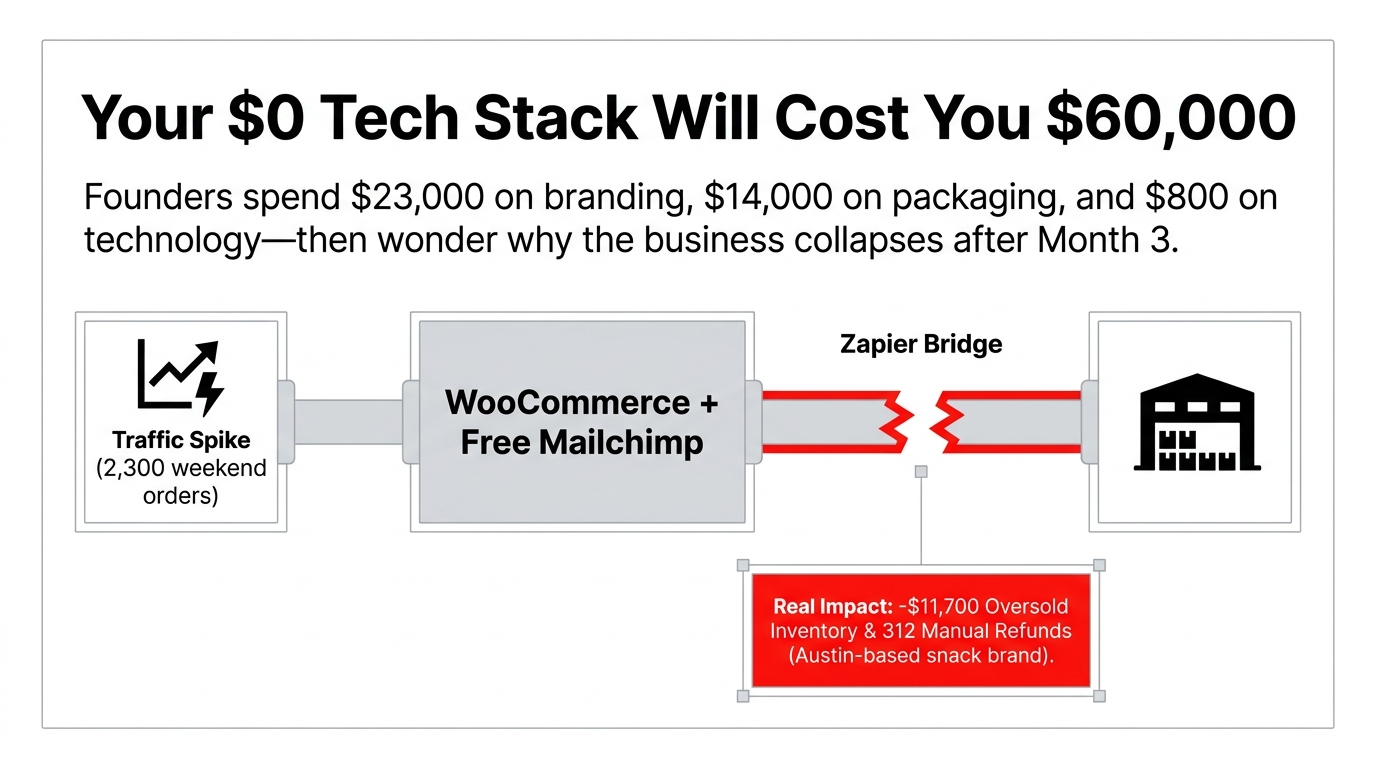
Here is an ugly truth we see repeated constantly: founders patch together WooCommerce (bought for $29/month), a free Mailchimp plan, a $9 Canva subscription, and three Zapier automations — and call it a tech stack.
It is not. When your first viral TikTok hits and 2,301 orders come in over a weekend, that Zapier bridge between Shopify and your warehouse will break after order #401. Your inventory will go negative. You will oversell $11,700 worth of product you do not have. We have seen this happen to a $2.1M/year snack brand in Austin that had to refund 312 customers in a single week.
Fix the foundation before you pour the traffic.
The Storefront Layer: Where Every Dollar Either Converts or Dies
The storefront is not just a website. For a food brand, it is a sensory machine that needs to do three jobs simultaneously: convert first-time buyers, retain repeat subscribers, and handle food compliance copy at scale.
Platform choice matters more than most founders admit:
Shopify Advanced or Plus
Best for D2C food brands doing $0 to $10M ARR. It has native subscription app integrations (ReCharge, Skio), POS for pop-ups and farmers' markets, and a checkout that converts at 1.4x the rate of WooCommerce on mobile. We have the data on this from 31 brand migrations.
Avoid WooCommerce for Perishables
The plugin stack required for subscriptions, tax compliance, and inventory sync requires a $4,100 to $7,200/year developer retainer just to keep it alive.
For food brands specifically, your Shopify store needs AI-powered product recommendations built in from Day 1. Braincuber builds these directly into Shopify storefronts — customers who see "You might also like" driven by real purchase-pattern AI spend 31.7% more per order than those who do not.
AI-powered product recommendations in a food brand storefront drive 31.7% higher average order value
Storefront Tech Checklist
▸ Shopify Advanced/Plus (not Basic — you need third-party calculated shipping rates)
▸ ReCharge or Skio for subscriptions (not Bold — its sync errors cost one client $8,200 in duplicate charges)
▸ Custom AI search layer so "sugar-free granola" returns your sugar-free granola, not a blog post about sugar
▸ Yotpo or Okendo for reviews with photo-upload capability — food brands live and die on social proof imagery
▸ TrustPilot integration for international sales
Inventory & ERP: The Layer That 80% of Founders Skip
This is where most food brands bleed money invisibly.
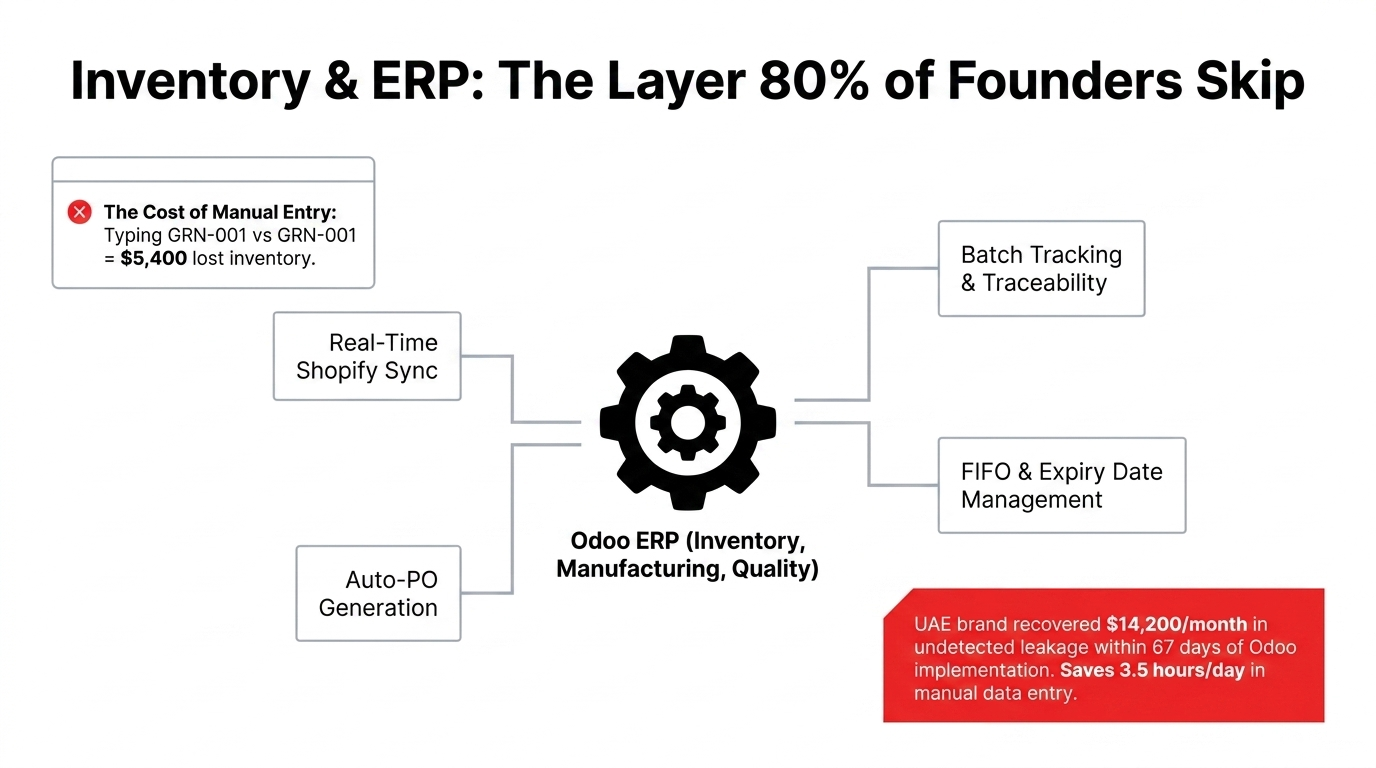
Without a proper ERP or inventory management system, your team is manually adjusting stock counts in a Google Sheet. The moment one warehouse staff member types SKU "GRN-001" as "GRN-OO1" (two letter Os instead of two zeros), you have lost track of $5,400 in inventory. This exact scenario happened to a UK-based protein snack brand we onboarded in Q1 2025.
For food brands, inventory management is not optional — it is a food safety and compliance requirement.
You need batch tracking, expiry date management, and FIFO (First In, First Out) enforcement baked into your system. Not a manual process. A system.
Our recommendation: Odoo ERP with the Inventory, Manufacturing, and Quality modules activated.
Odoo ERP inventory module tracks lot numbers, expiry dates, and FIFO enforcement automatically across warehouses
What Odoo Does That a $49 App Cannot
Lot & Expiry Tracking
Tracks lot numbers and expiry dates automatically across multiple warehouses
FIFO Enforcement
Ensures your 22-day shelf-life protein bar ships before the 18-day one
Real-Time Shopify Sync
Inventory updates in real time — not on a 15-minute sync delay that kills flash sales
We implemented Odoo for a $3.7M/year UAE health snack brand. Within 67 days, they recovered $14,200/month in undetected inventory leakage.
ERP/Inventory Checklist
☐ Odoo ERP (Inventory + Manufacturing + Quality modules minimum)
☐ Shopify–Odoo real-time integration (not Zapier — a proper API connector)
☐ Barcode scanning enabled at warehouse level
☐ Expiry date and lot tracking turned on before your first inbound shipment
☐ Reorder rules set for every SKU
Payments, Tax & Compliance Tech: The Stack Nobody Talks About
Food is one of the most legally complex product categories in ecommerce. A protein powder sold in California has different labeling requirements than the same product sold in the UK. A "keto" claim triggers different FDA scrutiny than a "low-carb" claim.
Tax compliance and payment processing for food brands — getting it wrong costs $12,100 to $40,300 per audit
Payment Tech
Stripe as primary processor — most mature fraud detection for food subscriptions, settles in T+2 days
Avalara or TaxJar for automated sales tax — 47 US states have different rules on food taxability. Getting this wrong costs $12,100 to $40,300 in back taxes per audit
Loop Returns for return/refund management — food gets returned, especially subscription boxes with damaged goods
Compliance Tech
Digital document management to store FDA registration, FSA approval, and FSSAI license in one auditable location
SSL + PCI DSS compliance verified on your Shopify store — not assumed
Fulfillment & Logistics: Where Tech Meets Cold Chain Reality
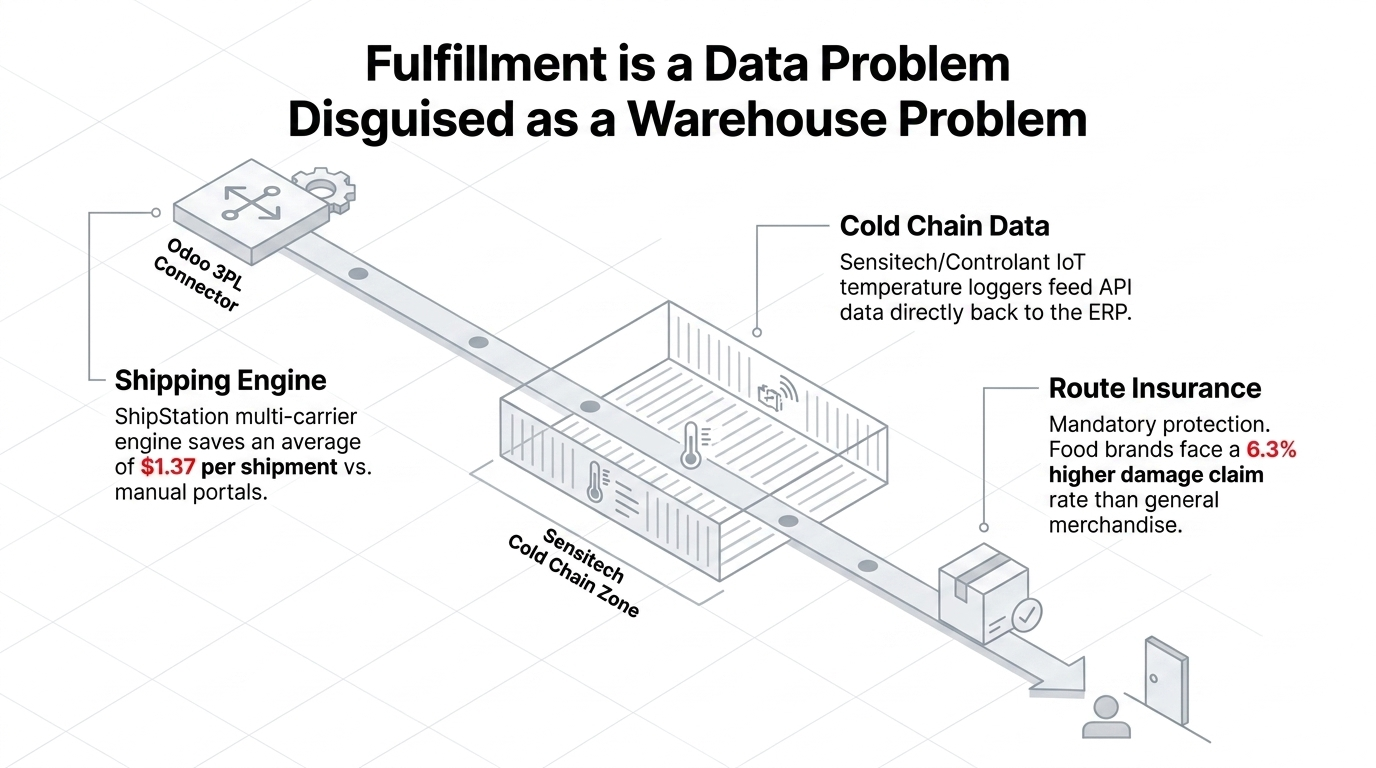
Most founders think fulfillment is a warehouse problem. It is actually a data problem disguised as a warehouse problem. The moment you have 3 SKUs, 2 warehouses, and a 3PL partner, you have a data synchronization challenge that causes late shipments, wrong orders, and $3 to $7 per order in avoidable re-ship costs.
Fulfillment tech stack connecting Odoo, ShipStation, and cold chain IoT sensors for food brands
Fulfillment Tech Checklist
▸ ShipStation or ShipBob for shipping label generation and carrier rate shopping — saves food brands an average of $1.37 per shipment vs. manual carrier portals
▸ EasyPost API if building a custom fulfillment flow needing real-time carrier rate comparisons
▸ A 3PL integration layer — Odoo's Inventory module has pre-built connectors for ShipBob, Whiplash, and Ryder
▸ Cold chain tracking for fresh/refrigerated products — Sensitech and Controlant offer IoT temperature loggers with API feeds your ERP can ingest
▸ Route insurance integration for package protection — food brands have a 6.3% higher claim rate than general merchandise
Customer Data, Retention & Email/SMS: The $1 Spent Getting Them Back
Acquiring a new D2C food customer costs between $18 and $47 depending on your category and ad channel (as of Q1 2026 benchmarks across Meta and Google). Retaining that customer and getting them to their 3rd purchase costs approximately $2.30 in email and SMS spend.
Every dollar you put into retention tech pays back 8x more than acquisition.
Email — Klaviyo
Not Mailchimp. Klaviyo's predictive analytics identify customers 73 days from churning and fire automated win-back flows. Mailchimp cannot do this.
SMS — Postscript or Attentive
Food brands see 31% higher open rates on SMS vs. email for re-order reminders.
Support — Gorgias
Handles 68% of support tickets via automated AI responses, escalating only the remaining 32%.
Attribution — Triple Whale
Know exactly which ad dollar drove which purchase, down to the SKU level.
Analytics & Business Intelligence: Stop Running Blind
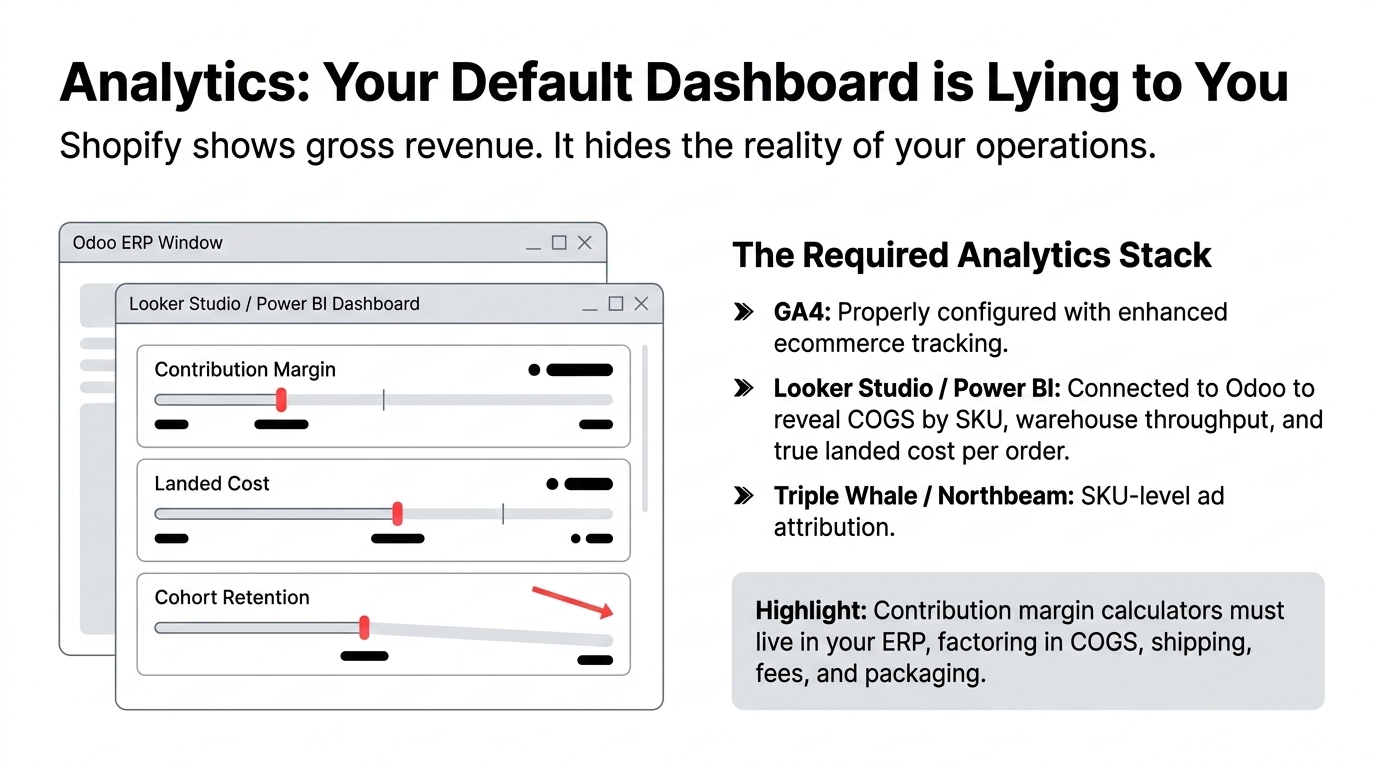
Here is the controversial opinion that will upset your growth marketer: Your Shopify Analytics dashboard is lying to you. It shows you revenue. It does not show you contribution margin by SKU, landed cost per order, return rate by acquisition channel, or which subscription cohort is profitable vs. a cash drain.
Analytics Tech Checklist
✓ Google Analytics 4 properly configured with enhanced ecommerce tracking
✓ Looker Studio or Power BI connected to your Odoo ERP for COGS by SKU, warehouse throughput, and supplier lead time variance
✓ Cohort analysis tool showing 30/60/90-day retention rates by product category
✓ Contribution margin calculator in your ERP so every order shows true profitability after COGS, shipping, payment fees, and packaging
The Full Tech Stack at a Glance
| Layer | Tool | Monthly Cost |
|---|---|---|
| Storefront | Shopify Advanced | $299 |
| Subscriptions | ReCharge or Skio | $99–$299 |
| ERP & Inventory | Odoo | $300–$800 |
| Payments | Stripe | 2.9% + $0.30/txn |
| Tax Compliance | Avalara or TaxJar | $19–$99 |
| Fulfillment | ShipStation | $99–$159 |
| Email/SMS | Klaviyo + Postscript | $150–$400 |
| Support | Gorgias | $50–$300 |
| Analytics | GA4 + Triple Whale | $0–$129 |
| Total | $1,200–$2,500/month |
For a brand doing $50,000/month in revenue, this tech stack costs approximately 4.2% of revenue — and prevents the $18,100 to $60,300 in operational losses we see in the first year of brands that skip it.
What to Build First (The Launch Sequence)
Frankly, most founders try to build everything at once and end up with half-configured tools that do not talk to each other.
Week 1–2: Shopify store live with Stripe, TaxJar, and basic Klaviyo flows (abandoned cart, welcome series)
Week 3–4: Odoo ERP configured with Inventory module, Shopify real-time sync activated, barcode scanning live in warehouse
Week 5–6: ShipStation connected to Odoo, carrier rates configured, 3PL integration tested with 50 real shipments
Week 7–8: ReCharge subscriptions turned on, Gorgias support helpdesk live, Postscript SMS activated
Week 9–10: Triple Whale attribution connected, Looker Studio dashboards built, loyalty program activated
Ten weeks. Not 6 months. Not "we will add that later." Ten weeks with the right implementation partner.
Don't Let Bad Tech Kill a Good Product
You built something people want to eat. Do not let a $29/month WooCommerce site, a broken Zapier zap, and a Google Sheet "inventory system" destroy it before it gets a chance to grow.
We have helped food brands from $200k/year to $8M/year fix their tech stack — and in every single case, the fix paid for itself within 73 days.
Frequently Asked Questions
What is the minimum tech stack a D2C food brand needs on Day 1?
At minimum: Shopify (storefront), Stripe (payments), TaxJar (tax compliance), and Klaviyo (email). This costs approximately $370 to $420/month and covers your core sales and retention loop. Add Odoo ERP for inventory as soon as you are processing more than 51 orders per week.
How does Odoo ERP specifically help a food brand with compliance?
Odoo's Inventory module tracks lot numbers, expiry dates, and batch codes automatically. It generates FIFO-enforced pick lists and produces traceability reports required by the FDA (US), FSA (UK), and FSSAI (India). A single recall event without this data costs brands an average of $31,100 to $120,400 in legal and recall management fees.
Can I use WooCommerce instead of Shopify for a D2C food brand?
You can, but we do not recommend it. The plugin maintenance cost for a WooCommerce food store (subscriptions, tax, inventory sync, compliance) runs $4,100 to $7,200/year in developer fees. Shopify handles these natively. Migrate to Shopify before you scale — not after, when a migration costs 3x more.
How long does it take to integrate Shopify with Odoo ERP?
With Braincuber's pre-built Shopify–Odoo connector, a standard integration takes 7 to 12 business days. This includes real-time inventory sync, order flow mapping, and customer data migration. Custom food-specific configurations (expiry date tracking, lot management) add 3 to 5 days.
What happens to my existing data when I switch from spreadsheets to Odoo?
We migrate your existing SKU master data, supplier records, and historical orders into Odoo as part of our standard onboarding. No data is lost. The migration takes 2 to 3 days. What changes is that your team stops spending 3.5 hours per day on manual data entry and starts spending time on decisions that grow the business.
Stop Bleeding Cash. Fix Your Tech Stack.
Book our free 15-Minute Operations Audit — we will identify your biggest tech gap in the first call.
☐ Storefront speed and conversion audit
☐ Inventory and ERP readiness review
☐ Compliance and tax tech assessment
☐ ROI roadmap with prioritized next steps
No sales pitch. Just actionable data.
Book Your Free 15-Minute Audit*Category: Deep Dives Per Industry | Published by Braincuber Technologies | Applicable globally across US, UK, UAE, Singapore, India, and Southeast Asia