
The Cash Problem Nobody Wants to Name
At ₹5Cr+ revenue, your D2C brand stops being a simple hustle. It becomes a complex operational machine with expensive failure points. Cash gets trapped in slow-moving stock, delayed payment gateways, pending marketplace payouts, and return shipping bills that arrive long before your customer's money does.
Most founders spend their days obsessing over ROAS, CAC, and topline Shopify revenue. Meanwhile, inventory replenishment decisions live in WhatsApp threads, return reconciliation lives in outdated Excel spreadsheets, and payment gateway matching lives in three disconnected tools. That is how you end up with a beautiful P&L and a terrifying bank balance.
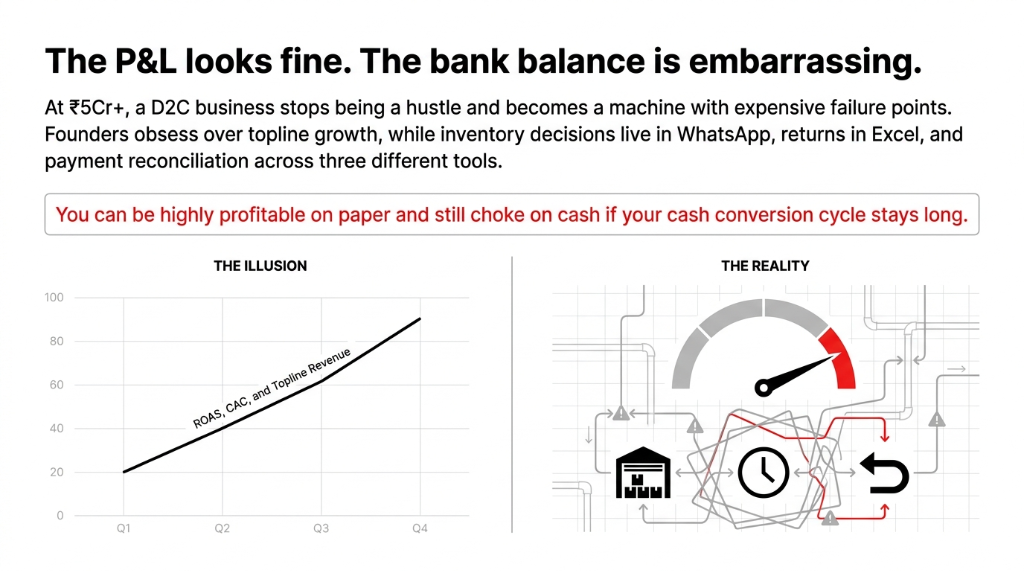
Working capital management technology exists to close this gap. It connects your SKU master, sales orders, payment gateways, and vendor liabilities into a single, automated operational control layer.
Why the Timing Game Breaks D2C Brands
D2C operations have a deceptive advantage: immediate customer payment at checkout. But they have a nasty operational weakness: it is a high-stakes timing game. You might collect cash on Day 0, but if you paid for the raw materials 60 days ago, paid your manufacturer 30 days ago, and paid your warehouse on Day 15, your cash was already spent long before the sale occurred.
The return logistics cycle is the most brutal part of this math. According to recent retail statistics, e-commerce return rates average 19.3%, with fashion and apparel climbing much higher. Post-holiday return activity in January regularly jumps by 25% to 35%.
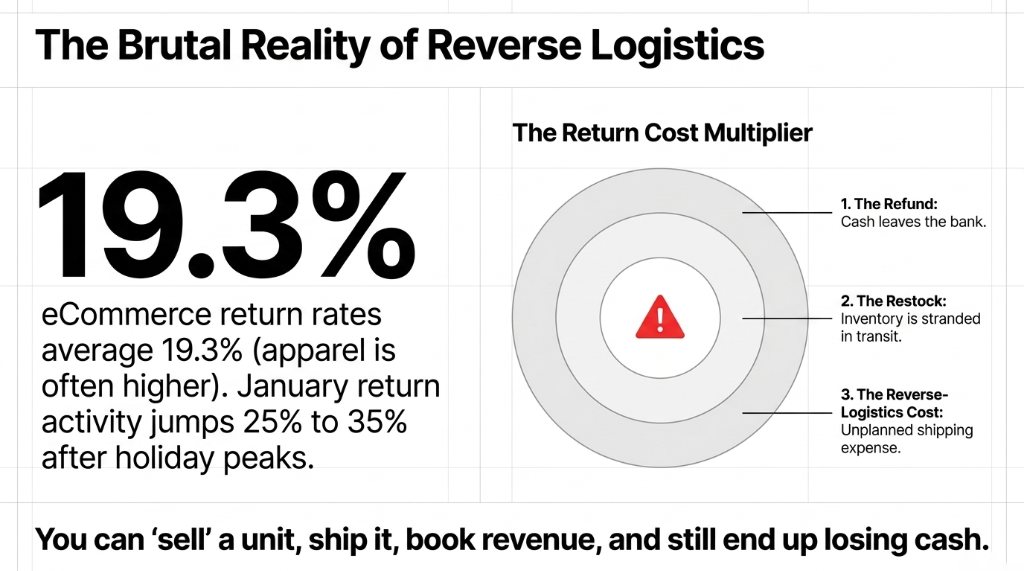
If your financial stack does not model return rates in real time, you are booking revenue that will vaporize into a refund, a stranded-in-transit SKU, and an unplanned reverse-logistics bill. Your working capital forecast is not a plan; it is fantasy.
Where Your Spreadsheets Fail the Business
Excel is fine when you are a small brand doing ₹1.5Cr and manually tracking a few dozen SKUs. It is a liability when you scale past ₹5Cr with multiple warehouses, flash sales, ad-driven demand spikes, and daily return batches that change your inventory position overnight.
The Hidden Cost of spreadsheet lag
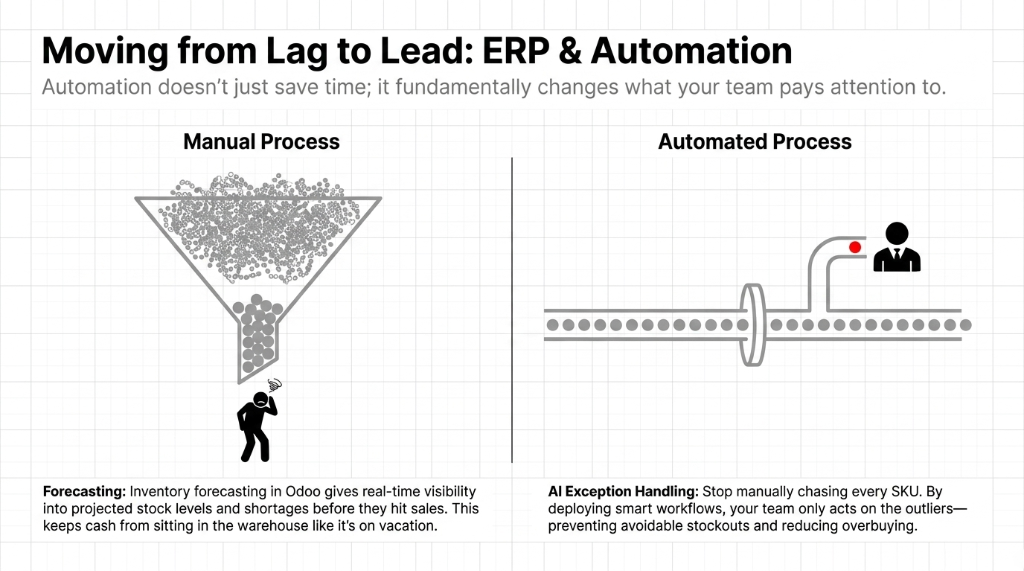
The real problem with Excel is not the manual entry mistakes. It is the lag between the physical event and the financial decision. By the time your finance team downloads the gateway report, matches it with Shopify orders, and updates the operations sheet, the cash opportunity is gone. You have already over-ordered the slow SKU and stocked out on the bestseller.
Connected ERP forecasting replaces this lag. It provides real-time visibility into SKU velocity, procurement costs, and payment cycles so your team works from live data, not historical artifacts.
The 4-Layer Working Capital Stack That Works
To stop cash leaks, you need a structured operational stack that links your sales front-end directly to your bank account:
Layer 1: The Commerce Front-End
Your storefronts on Shopify, Amazon, and Myntra capture customer demand and initiate the transaction. This layer collects the customer order data and passes it down instantly.
Layer 2: The Operational Backbone
This is where Odoo ERP manages your inventory, procurement, and warehouse workflows. When an order lands, Odoo allocates stock across your multi-warehouse setup, tracks real-time stock levels, and flags reorder thresholds based on actual sales velocity.
Layer 3: The Financial Integration Layer
This layer connects your sales channels and payment gateways (Razorpay, Cashfree, Shopify Payments) to your general ledger. It automates payment reconciliation, matching bank deposits to orders and isolating transaction fees, taxes, and return reserves automatically.
Layer 4: AI-Driven Intelligence
Our custom AI engine sits on top of Odoo to analyze historical sales, seasonal trends, and supplier lead times. It automatically adjusts safety stock levels, flags dead inventory, and builds purchase order recommendations that keep your cash from sitting idle in the warehouse.
The Synthesis: The Braincuber Approach
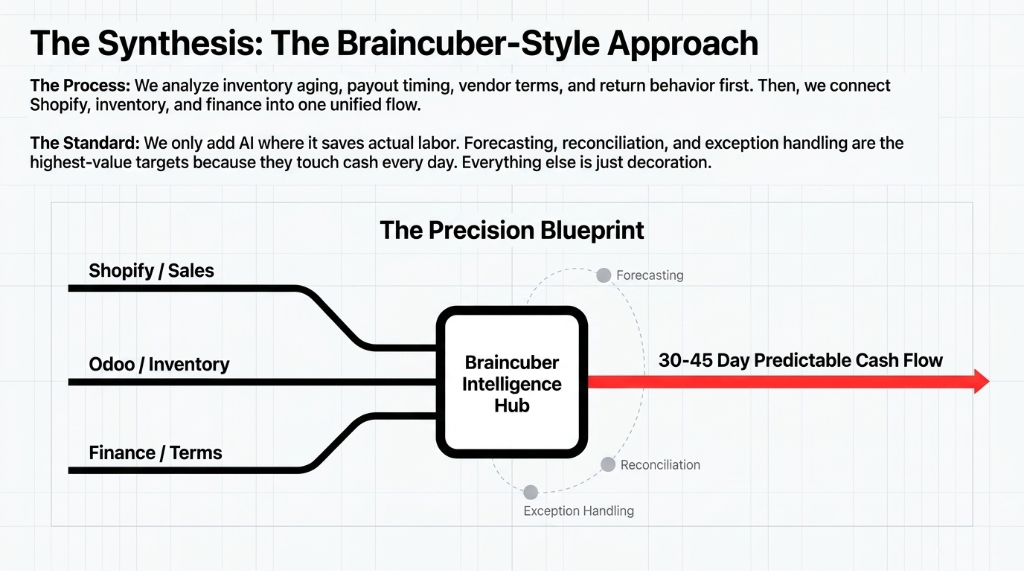
We do not believe in throwing software at a broken process. We start by identifying where your cash is leaking — analyzing inventory aging, gateway payouts, supplier terms, and return behavior first.
Then, we connect Shopify, Odoo, and your bank accounts into a unified cash-flow intelligence system.
Operational Impact: ₹5Cr+ D2C Brand Stack
Inventory Days (DIO)
94 Days to 41 Days
AI-driven safety stock levels and replenishment stopped over-purchasing
Payout Match Time
47 hrs/mo to 18 min/mo
Automated reconciliation matched gateway payouts to orders instantly
Cash Conversion Cycle
67 Days to 18 Days
Opened up trapped operational cash to fund growth without high-interest loans
Manual vs. Automated Working Capital
| Operational Task | Spreadsheet Process (₹5Cr Brand) | Odoo + AI Automated Process |
|---|---|---|
| Demand Forecasting | Gut feel + historical spreadsheet downloads (takes 14 hours) | Real-time analysis of channel speed, seasonality, and ad spend signals |
| Payout Reconciliation | Manual CSV matching of gateway deposits to Shopify orders | Automated reconciliation engine highlighting only transaction mismatches |
| Replenishment Trigger | Weekly warehouse counts checked via WhatsApp messages | Automated purchase order drafts routed for approval based on stock levels |
| Reverse Logistics Costing | Ignored until end-of-quarter tax audit when cash runs short | Real-time return reserve deduction from projected cash balances |
What to Measure: The 30-Day Cash Action List
- Calculate your true Cash Conversion Cycle (CCC). Do not guess. Track your Days Inventory Outstanding (DIO), Days Sales Outstanding (DSO), and Days Payable Outstanding (DPO) weekly
- Establish a dynamic return reserve percentage. Apparel brands need a 22% cash buffer for reverse logistics, not a flat 10% assumption
- Consolidate your multi-gateway payouts. Match deposits to orders daily to detect transaction chargebacks and gateway processing holds immediately
- Bifurcate your forecast models. Model offline store demand separately from online channel speed so you do not freeze cash in dead stock
If you can predict a cash shortfall 45 days ahead, you have a financial operation. If you only realize you are short on cash when warehouse payroll is due, you are still running a hustle.
Frequently Asked Questions
What is the main goal of working capital technology for D2C?
It shortens the gap between cash out and cash back in by improving inventory, payouts, payables, and forecasting. In plain language, it stops cash from getting stuck in stock and slow processes.
Why is CCC so important for D2C brands?
CCC shows how long money stays trapped before it returns as cash, using DIO, DSO, and DPO. For D2C, that metric is one of the cleanest ways to see whether growth is healthy or just expensive.
Can Odoo help with working capital management?
Yes, because Odoo's forecasting and inventory tools provide real-time stock visibility, replenishment logic, and shortage detection. That helps reduce overbuying and makes cash planning much cleaner.
What breaks most often in D2C cash flow?
Returns, delayed payouts, overstocking, and poor reconciliation are the usual culprits. These problems often stay hidden until the bank balance forces attention.
Do we need ERP before automation?
Usually, yes. If your data is scattered across Shopify, Excel, QuickBooks, and Slack, automation will just move the mess faster. Clean process design and connected systems come before smart automation.
Stop Guessing When Your Next Cash Shortfall Will Hit
The brands that win at ₹5Cr+ are not the ones selling the loudest. They are the ones that know exactly where every rupee is sitting, what it is doing, and when it comes back. If you are still running your financial operations on spreadsheets and panics, call us. We build connected working capital systems that open up trapped cash in 10-12 weeks.