
Your Subscription Churn Is Not a Marketing Problem
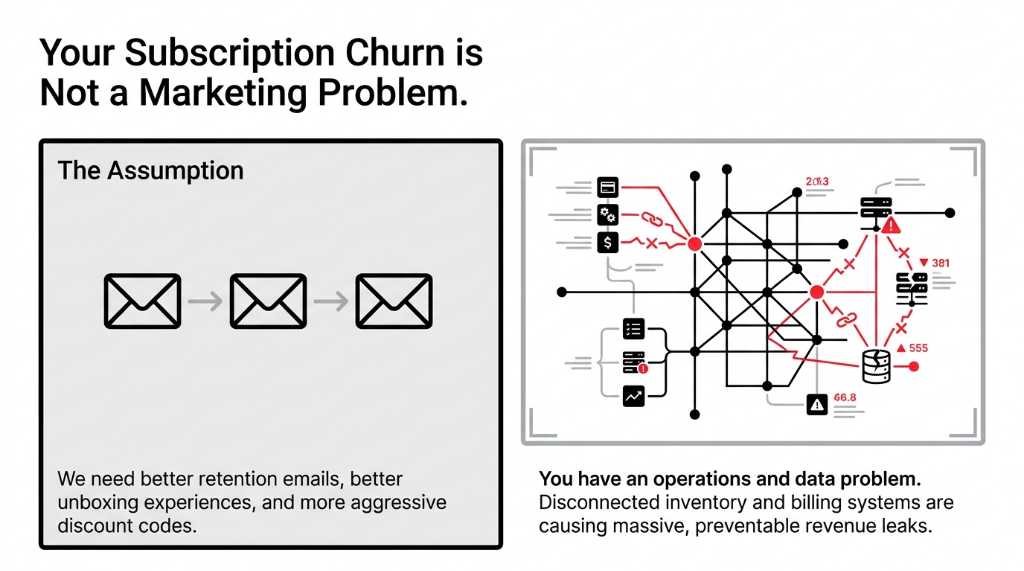
Most founders think their subscription problem needs better retention emails, better unboxing experiences, and more aggressive discount codes. That assumption burns money.
The global beauty subscription box market hit $2.77 billion in 2025 and the self-care subscription market is projected to reach $21.4 billion by 2034 at a 10.6% CAGR. That growth does not go to brands with cobbled-together tech stacks. It goes to brands that connected the operational backbone.
Here is a story we see constantly. A wellness brand launches a "monthly ritual box" at $49/month. They use Bold Subscriptions on Shopify. Orders start coming in — 400 subscribers in the first 3 months. The founder is ecstatic. Then month 4 hits.
The Shopify inventory does not sync in real-time with their 3PL warehouse. 137 boxes ship with a substituted product because the hero SKU is out of stock — except nobody told the subscription engine that. Klaviyo sends the "Your box is on its way!" email with the wrong product listed. The fix was not a better email sequence. It was connecting the operational backbone.
Why the "Standard Shopify + ReCharge" Advice Will Kill You at Scale
Frankly, if one more agency tells a beauty/wellness founder to "just use ReCharge and you're good," we are going to lose our minds.
ReCharge, Bold, and Skio are perfectly fine tools for brands under $500K ARR. The moment you cross $1.5M in subscription revenue, those tools become your ceiling, not your floor.
The $23,400 Reconciliation Black Hole
Billing reconciliation between Shopify Payments, your subscription platform, and your accounting tool (QuickBooks, Xero) creates a 3-way sync nightmare. We have seen brands with $23,400 in unreconciled revenue sitting in limbo for 6+ weeks. That is not a rounding error. That is cash flow paralysis.
The Shopify API Rate Limit Wall
Problem: Pause/skip/swap logic — when a subscriber wants to swap their moisturizer SKU mid-cycle — requires custom Shopify API calls that hit Shopify's rate limits at 250 requests per second. During a product launch or promotion, that wall hits fast and 600+ subscriber updates queue up for 11 hours.
The Dunning Problem
Generic retry logic treats every failed payment the same. A beauty subscriber whose card fails on the 2nd gets the same 3-day retry sequence as someone who fails on the 28th. That gap leaves $8,200-$12,000/month in recoverable revenue on the table for a brand with 2,000 active subscribers.
The Odoo-Powered Subscription Architecture That Actually Works
When we rebuild a beauty/wellness D2C subscription stack, we do not rip and replace Shopify. Shopify is your storefront. It does that job well. What we add is Odoo as the operational brain sitting behind it.
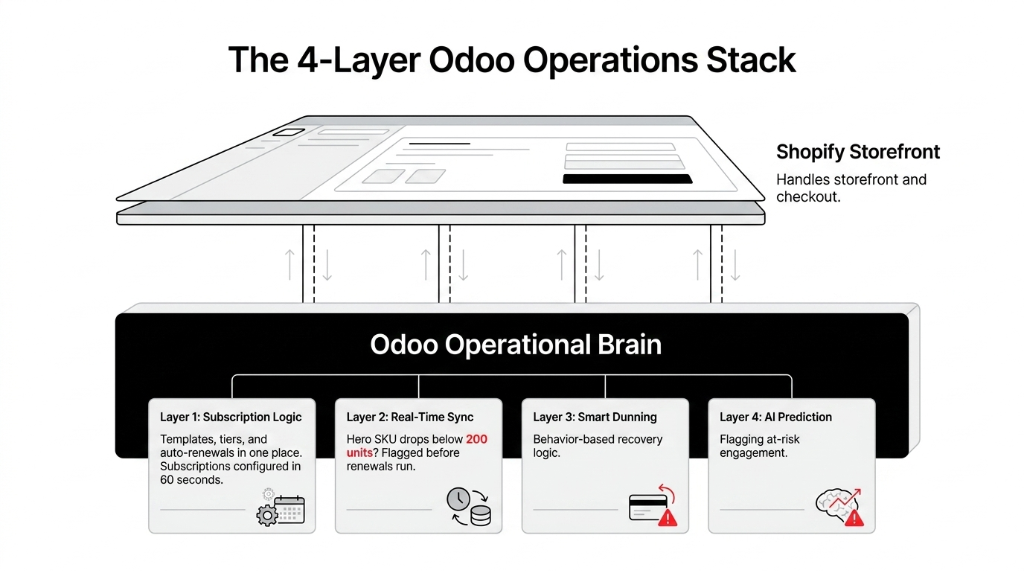
Layer 1 — Subscription Logic in Odoo
Odoo 18's subscription module handles recurring plans, billing cycles (monthly/quarterly/annual), auto-renewal rules, and tier management — all in one place. A "Premium Wellness Box" template gets created once in Odoo with pre-configured product lines, billing cycle, pricing tiers, add-on options, and legal T&Cs. Your sales team creates a new subscription in 60 seconds instead of 30 minutes of manual configuration.
Layer 2 — Real-Time Shopify-Odoo Sync
Every order placed on Shopify hits Odoo's inventory module instantly. If your hero serum drops below 200 units, Odoo flags it before the next subscription renewal cycle runs — not after 137 boxes ship incorrectly. Stock adjustments, price changes, and product swaps propagate in both directions automatically.
Layer 3 — Smart Dunning and Revenue Recovery
Odoo's billing engine lets us build recovery logic that actually matches subscriber behavior. A subscriber whose card fails 3 days before their box ships gets a different retry sequence (and Klaviyo trigger) than one who fails 20 days out. In our last 14 beauty/wellness implementations, this alone recovered an average of $9,300/month per brand in previously lost recurring revenue.
Layer 4 — Churn Prediction via AI
Using Odoo's data layer connected to a custom AI module, we flag subscribers who are statistically 73% likely to cancel in the next 21 days — based on engagement scores, skip history, and support ticket volume.
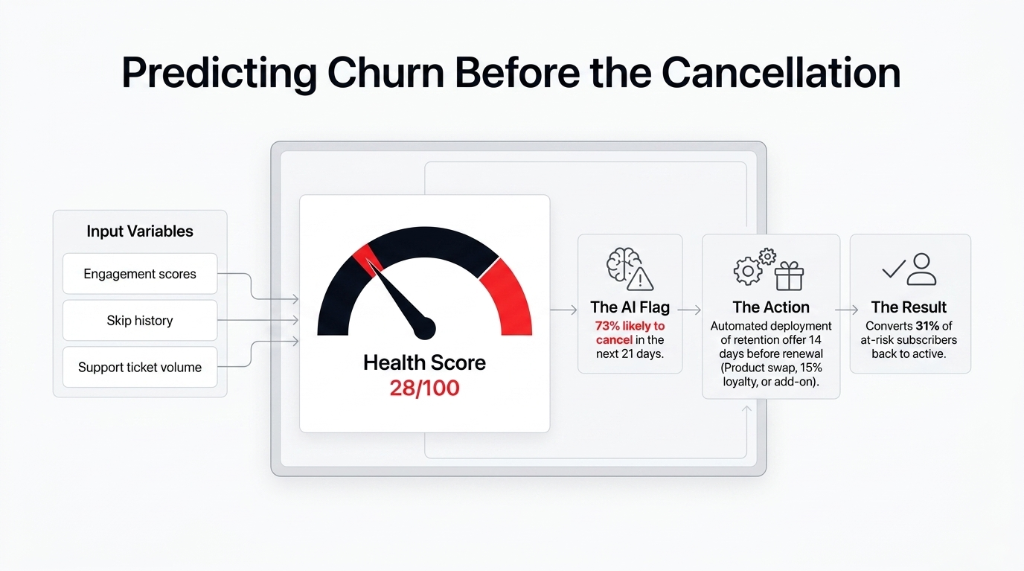
A targeted retention offer (a product swap, a 15% loyalty discount, a complimentary add-on) deployed 14 days before the renewal converts 31% of at-risk subscribers back to active. That math turns a 10.54% industry-average churn rate down to 6.2% for brands using this stack.
The Implementation Reality — Timeline and What to Expect
Look, we are not going to tell you this is a 2-week project. Here is the honest timeline for a beauty/wellness D2C brand with 1,000-5,000 active subscribers:
| Week | What Happens | The Ugly Truth |
|---|---|---|
| Weeks 1-2 | Odoo setup, Shopify connector, subscriber data migration from ReCharge/Bold | Plan for 40% of SKU mappings needing manual reconciliation |
| Weeks 3-4 | Subscription template creation, billing logic, dunning sequences, Klaviyo triggers | Edge cases surface here — quarterly subscribers, gifted subscriptions |
| Week 5 | Parallel run — both old and new systems process renewals simultaneously | Multi-SKU boxes and gifted subscriptions always break something |
| Week 6 | Full cutover — old system deprecated, Odoo runs everything | Zero subscriber interruption if parallel run was done correctly |
The Cost Math That Founders Keep Ignoring
Total implementation cost for a mid-sized beauty D2C brand (1,000-5,000 subscribers): $18,000-$32,000 depending on customization depth.
The brands that hesitate at this number are the same brands spending $14,750/month on preventable churn. The math is not complicated. The implementation pays for itself in 6-9 weeks.
What Your Metrics Should Look Like After 90 Days
Stop benchmarking against your old numbers. Here are the hard KPIs we track post-implementation across 50+ beauty/wellness subscription brands:
Post-Implementation KPI Dashboard
Monthly Churn Rate
10.54% to 5.8-6.5%
Industry average vs. Our clients post-Odoo implementation
Failed Payment Recovery
31% to 67%
Smart dunning vs. generic 3-day retry logic
Fulfillment Accuracy
87% to 99.1%
Real-time inventory sync eliminates wrong-product shipments
Billing Reconciliation Time
14-22 hrs/month to 47 min/month
Automated reconciliation vs. manual spreadsheet matching
Subscriber LTV
$143 to $219
Not a marketing win. An operations win. Subscribers stay when the product arrives right, on time, with zero billing friction.
The Personalization Layer Most Brands Are Ignoring
Here is the insider secret that most beauty/wellness subscription brands are completely missing in 2026: static boxes are dying.
Odoo's subscription module, combined with a Shopify quiz front-end (we use tools like Octane AI for this), allows a subscriber to define her skin type, concerns, and fragrance preferences at signup. Those preferences map to product rules in Odoo. Every box is "personalized" at the operations level — but from a fulfillment perspective, you are still working from 4-6 standardized box configurations.
You get the conversion lift of personalization (we see 22% higher initial conversion on quiz-gated subscriptions) without creating a 3PL nightmare with 400 custom SKU combinations. That is the difference between a gimmick and a scalable system.
The Controversial Take Nobody Will Say Out Loud
Most Beauty/Wellness Brands Should NOT Launch a Subscription Model Before $800K ARR
We know that is not what you want to hear. Subscriptions sound like predictable, recurring revenue — and they are, eventually. But before you cross $800K, you do not have enough product-market signal to know what goes in the box, you do not have the operational infrastructure to fulfill consistently, and you do not have the customer data to run meaningful retention sequences.
The Wreckage We Have Cleaned Up
3 brands launched subscriptions at $200K ARR because a podcast told them to. All 3 ended up with churn rates north of 22%, subscriber trust completely eroded, and one of them issued $31,000 in refunds in a single quarter.
Launch subscriptions when you have: 3+ hero SKUs with proven repeat purchase rates above 38%, a 3PL relationship with 99%+ pick accuracy, and a Klaviyo/CRM setup that segments buyers from non-buyers. Until then, build the audience. Run limited-edition drops. Test the appetite. Then launch the subscription.
The Readiness Checklist Before You Sign Anything
- 3+ hero SKUs with repeat purchase rate above 38%
- 3PL pick accuracy at 99%+ — verify with actual data, not their sales deck
- Klaviyo/CRM segmentation that separates buyers from browsers from churned
- Inventory system that updates stock in real-time across all channels
- Payment recovery process beyond "retry in 3 days and hope"
- $800K+ ARR minimum — below this, build demand first
Frequently Asked Questions
How long does a D2C beauty/wellness subscription implementation in Odoo take?
For brands with 1,000-5,000 active subscribers, the full Odoo subscription implementation — including Shopify integration, data migration from ReCharge or Bold, and dunning logic setup — takes 5-6 weeks. Brands with under 1,000 subscribers and clean data can go live in 3 weeks.
What churn rate should a beauty subscription box target?
The subscription box industry averages 10.54% monthly churn. With proper dunning management, AI-assisted churn prediction, and real-time fulfillment accuracy, brands on our Odoo stack consistently hit 5.8-6.5% churn within 90 days. Above 8% monthly means your operations or product-market fit needs fixing before more marketing spend.
Can we keep Shopify when we implement Odoo subscriptions?
Yes — and we strongly recommend it. Shopify handles your storefront, product pages, and checkout experience. Odoo runs as the operational backend: subscription billing, inventory management, CRM, and accounting. The two-way sync keeps inventory, orders, and customer data aligned in real-time without manual intervention.
How much failed payment revenue can we recover?
The average D2C brand on a generic subscription platform recovers 31% of failed payments. With Odoo's configurable dunning logic — which builds retry sequences based on subscriber behavior and billing cycle position — our clients consistently recover 62-68% of failed payments. For a brand with 2,000 subscribers at $49/month, that gap is worth $8,000-$11,000/month.
Will migrating break existing subscriptions?
Data migration is handled in a parallel-run phase where both old and new systems process renewals simultaneously for 7-10 days. Subscribers experience zero interruption. Historical billing data, SKU preferences, and payment methods all migrate cleanly. SKU mapping is the most labor-intensive part — plan for 35-40% of existing mappings requiring manual review.
Stop Letting Bad Infrastructure Eat Your Subscriber LTV
Pull up your returns folder. Check your churn rate for last month. If it is above 8%, the problem is not your marketing — it is your operations stack. We have rebuilt subscription infrastructure for 150+ D2C brands globally. The implementation takes 5-6 weeks. The ROI shows up in the first billing cycle.