
The Dirty Math Behind Festival Returns
Total retail returns globally are projected at $849.9 billion in 2025 — and apparel leads the pack with a 25% average return rate overall. During festival season, that number climbs. Brands running flash sales in India see 30–40% return rates in fashion e-commerce specifically, spiking even higher during "Great Indian Festival" or Diwali campaigns on Amazon and Flipkart.
In EMEA markets like Germany and Poland, fashion return rates as a percentage of GMV go above 60%. Sixty. Percent. That means for every 10 dresses you ship, 6 come back. Meanwhile your warehouse team is re-tagging them by hand at $2.40–$4.80 per return in operational cost.
| Cost Category | Per Return Cost | Impact |
|---|---|---|
| Reverse logistics | ~$2.40 per order | Pickup + handling + transfer |
| Damaged goods | 20% of returns | Unsellable — written off completely |
| Refurbishing/markdown | 50% of returns | Need repair or steep discounts before resale |
| Annual industry loss | $4.5 billion | Indian D2C fashion brands — return-related costs alone |
That is 6% of total GMV evaporating — not from bad products, but from bad processes.
The Fraud Problem Nobody Talks About
9% of all returns are fraudulent — customers wearing a lehenga to a wedding and shipping it back on Monday. Yet most fashion brands have zero automated fraud detection in their returns flow. They are trusting a $300/month warehouse executive to catch it manually.
Why "A Good Return Policy" Is the Wrong Goal
Everyone tells you: "Make your return policy customer-friendly." Frankly, that is advice from people who do not pay your logistics bills.
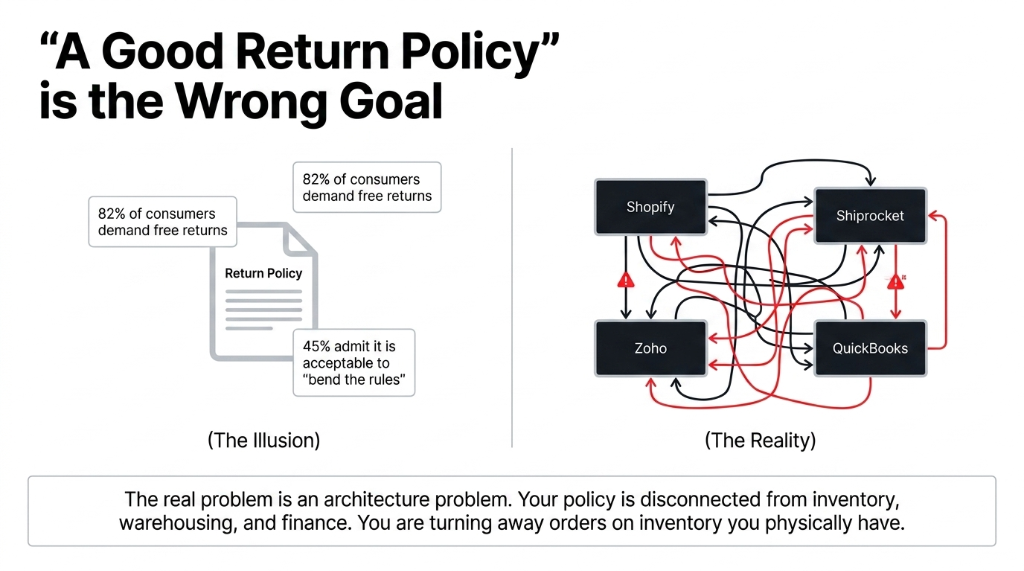
82% of consumers say free returns are an important consideration when shopping online. And 45% of shoppers say it is acceptable to "bend the rules" when returning items. You are being held hostage by a policy you created to drive conversions.
The real problem is not your return policy. It is that your return policy is disconnected from your inventory system, your warehouse management, your finance reconciliation, and your customer data — all at the same time.
The Architecture Nightmare We See Every Week
A brand running Shopify for orders, ShipBob or Shiprocket for logistics, Zoho for inventory, and QuickBooks for accounts. During festival season, a returned item sits in a "pending" queue for 9–14 days before anyone updates the stock count. That returned kurta set is available to sell, but your system thinks it does not exist. You are turning away orders on inventory you physically have.
That is not a policy problem. That is an architecture problem. The brands that fix this do not just reduce return costs — they turn returns into revenue.
The 4 Places Your Festival Return Process Is Bleeding Cash
We have audited over 150 fashion brand operations globally. The leaks are almost always in the same four places.
1. The 72-Hour Dead Zone
When a return is initiated, most brands have a 72-hour gap before the item is even scanned back into inventory. During festival season, with 300–800 daily returns, this creates a blackout where $14,200–$38,000 worth of sellable inventory is sitting in limbo. Not listed. Not sellable. Dead money.
2. Size and Fit Returns That Never Feed Back to Listing Data
44–45% of fashion returns happen because of size and fit issues. Customers are returning the same Medium-size kurta in burgundy across 600 orders — and nobody is flagging the size chart as inaccurate. The returns keep coming. The root cause never gets fixed.
Client Result: UAE Fashion Brand
Fixing one product's size chart reduced its return rate from 38% to 11% in 47 days.
3. The Refund-Before-Inspection Loop
Many Shopify stores auto-refund on return initiation — before the item is received, inspected, or even confirmed. We have seen brands issue $23,000 in refunds for items that arrived damaged, worn, or not the original product.
The auto-refund trigger feels "customer-friendly." It is actually just blind generosity.
4. Warehouse Staff Acting as Triage Doctors
Your warehouse team during Diwali season is making real-time decisions: Is this resellable? Does this need dry cleaning? Should this be written off? Without a system-driven grading framework, two different staff members will make two different decisions on identical items.
One writes off a $38.40 jacket. The other lists it for resale. Inconsistency destroys your margin math.
How Odoo ERP Actually Fixes This — Step by Step
Here is what we implement for fashion brands at Braincuber through our Odoo implementation — not theory, actual workflow.
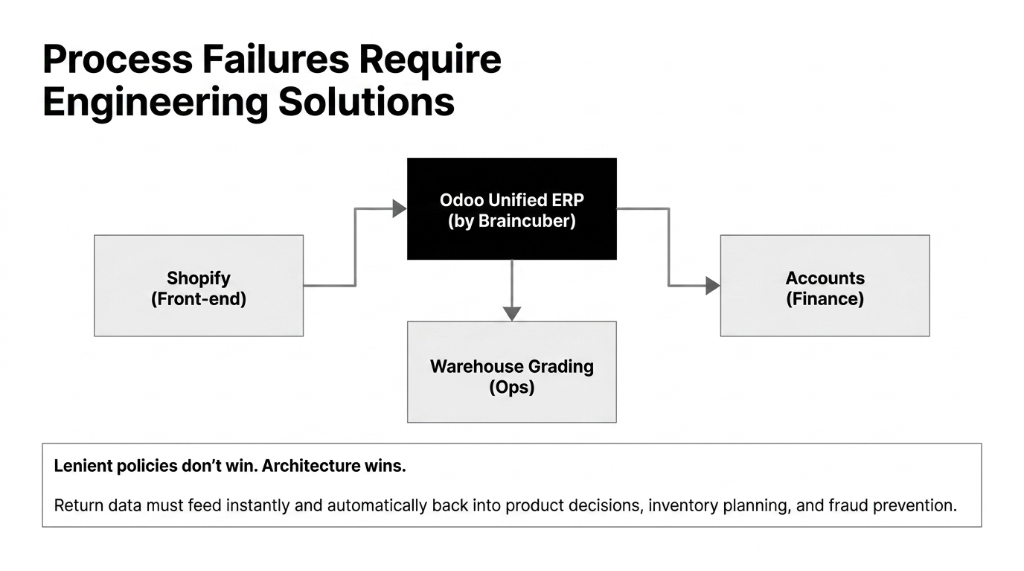
Step 1: Odoo Returns Management Module + Shopify Integration
When a customer initiates a return via Shopify, it triggers a return merchandise authorization (RMA) in Odoo automatically. No manual entry. The item is flagged in inventory as "incoming return" — meaning it is not counted as available, but it is tracked. Your stock count is accurate before the item arrives back.
Step 2: QR-Code Grading at Warehouse Entry
Every return that hits the warehouse gets scanned with a QR code tied to the original order. The warehouse staff opens a grading checklist on a tablet — built inside Odoo — and marks the item's condition in 90 seconds. Odoo then routes it: resellable goes to restock, lightly damaged goes to markdown queue, unsellable triggers a write-off with insurance trigger.
Processing Time Impact
Return processing drops from 18 minutes per item to under 3 minutes. During a 45-day festival window with 500+ daily returns, that is 125 hours of labor saved per week.
Step 3: Automated Refund Logic
Refunds in Odoo are conditionally triggered. A full refund only fires after the grading is complete and the item meets condition criteria. If the item arrives damaged, the workflow escalates to a customer service ticket automatically. This alone saves our clients between $8,000–$22,000 per festival season in fraudulent or unchecked refunds.
Step 4: Returns Analytics Dashboard
After 30 days of festival season data, Odoo generates a return analytics report — broken down by SKU, size, colour, region, and reason code. You see, in real time, that the "Blue Anarkali, Size L" has a 52% return rate because the size runs two inches short. You fix the listing. The next season's return rate for that SKU drops.
Step 5: Recommerce Pipeline for Non-Resellable Stock
Items that cannot be resold at full price get pushed automatically into a secondary sales channel — outlet section on your Shopify store, B2B bulk buyers, or a marketplace like Amazon Renewed or Flipkart 2GUD. The refurbished goods market in India alone is projected to exceed $20 billion over the next 6 years. That written-off inventory has a market. Most brands just do not have the pipeline to access it.
Results You Should Realistically Expect
We are not going to promise miracles on the first call. Here is what brands implementing this system actually see:
Before vs. After Braincuber Implementation
Processing Time
18 min to 2.7 min
Per return item — within 60 days of go-live. QR-code grading replaces manual triage.
Inventory Recovery
28% to 63–71%
Returned items resold within 30 days vs. previously sitting in limbo for weeks.
Fraud Detection
7–11% flagged
Festival season returns flagged for investigation — previously catching zero.
- Cash-flow recovery: Brands processing 500+ daily returns recover $5,040–$11,640 in previously written-off inventory per month
- Customer service tickets: 34% fewer post-return complaints due to automated status updates
- Client highlight: One fashion brand in Surat — scaling from $504,000 to $1.32M ARR — recovered $21,960 in a single Diwali season by switching from manual grading to Odoo's condition-based refund logic
What Happens to Your Current Shopify + Zoho Setup?
This is the question every ops manager asks — "Do we lose everything we have built?"
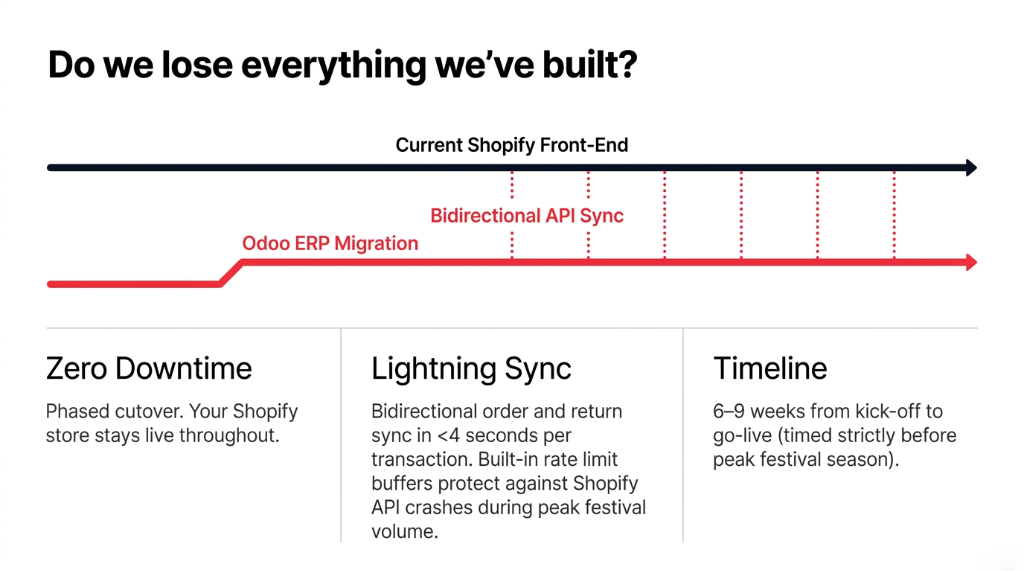
No. We migrate your existing SKU catalog, customer data, and return history into Odoo with zero downtime using a phased cutover. Your Shopify store stays live throughout. The Shopify-Odoo connector we build handles bidirectional order + return sync in under 4 seconds per transaction.
*(Yes, Shopify's API has a rate limit that bites hard during high-volume festival days — we build rate-limit buffers into the connector. Most agencies do not do this. Then they call us to fix it.)*
Your QuickBooks or Tally reconciliation also gets automated. Every return, every refund, every markdown — all posted to your accounts automatically with the correct ledger entries. No more month-end spreadsheet horror.
Frequently Asked Questions
How long does it take to implement Odoo returns management for a fashion brand?
For a mid-size D2C fashion brand processing 200–800 orders daily, the Odoo returns module with Shopify integration takes 6–9 weeks from kick-off to go-live. That includes data migration, warehouse grading setup, and staff training. We time implementations so brands are live at least 3 weeks before peak festival season.
Will this work if we sell across Myntra, Flipkart, and our own Shopify store simultaneously?
Yes. Odoo's multi-channel return management handles returns from all platforms in one dashboard. Each platform's return policy rules are configured separately, so a Myntra return with a 7-day window follows different logic than your D2C Shopify return with a 15-day window.
What if 40% of our returns come from a single SKU category like ethnic wear?
That is exactly the data Odoo's returns analytics surfaces. We set up SKU-level return rate alerts — if any product crosses a 25% return threshold, the ops team gets a Slack notification automatically. You catch problem products in week 2 of a festival sale, not in the post-mortem meeting 45 days later.
Is there a risk of return fraud increasing once we offer easier returns?
Counter-intuitively, no — fraud actually drops when you systemise returns. When customers know every return is condition-graded and photographed upon receipt, return-on-wear fraud decreases by 18–22%. Fraudsters target systems with no inspection process, not ones with QR-code grading workflows.
What does this cost compared to just hiring 3 extra warehouse staff during festival season?
Three temporary warehouse staff during a 45-day festival season costs $2,160–$2,880 in wages alone — plus training time, error rates, and zero data output. The Odoo implementation pays back in the first season through recovered inventory and eliminated fraudulent refunds. The system then works every season after that with no incremental cost.
Stop Letting Festival Season Returns Eat Your Margins
If you are processing more than 150 returns a week and still using Shopify + spreadsheets + manual warehouse grading, you are leaving $6,000–$21,600 on the table every festival season. The brands winning in Indian, UAE, and UK fashion right now are not the ones with the most lenient return policies — they are the ones whose return data feeds directly back into product decisions, inventory planning, and fraud prevention.