
This is the handbook nobody gave you at onboarding.
The Onboarding Mess Nobody Talks About
Most brands treat Flipkart registration as a checkbox. GSTIN, PAN, bank account, product images — done. That is exactly where the first $970/month leak starts.
The dirty detail: When your catalog manager uploads product listings without correctly mapping the item to the right Flipkart category tree, Flipkart's algorithm buries that SKU in irrelevant search results. We have seen a personal care brand with 47 SKUs get zero organic visibility for 23 of them — not because the product was bad, but because the backend category attribute "Sub-Category > Sub-Sub-Category" was mapped wrong.
What Correct Flipkart Onboarding Actually Involves
The Commission Model Has Changed — Did Your Pricing?
Most D2C brands we audit are still pricing their Flipkart SKUs based on the old 8–12% commission structure. That is operationally reckless.
The current reality: Flipkart introduced a Zero Commission Model for all products priced below $12.15 ASP (Average Selling Price) as part of the 'Flipkart Bachat Utsav' campaign. Shopsy sellers get 0% commission across all price points. Updated return and reverse pickup fees are expected to reduce the overall cost of doing business by up to 30%.
The Commission Math That Most Founders Miss
Old Model
8–12%
Legacy commission most brands still price against.
New Model (sub-$12.15)
0%
Zero commission under Flipkart Bachat Utsav.
Monthly Margin Leak
$1,720
Lost by not repricing eligible SKUs immediately.
The controversial opinion here: most D2C founders obsess over CAC and ROAS, but zero of them remodel their Flipkart margin stack when platform fees change. That is how you bleed $1,720/month without a single bad marketing decision.
The Catalog Is Your Silent Sales Team — Stop Neglecting It
A great product photo on Flipkart is not enough. The Flipkart algorithm ranks listings based on a combination of content score, keyword relevance, conversion rate, and fulfillment speed.
What We See in 8 out of 10 D2C Brand Audits
Product titles missing primary search terms — "Face Moisturizer 50ml" instead of "Face Moisturizer for Dry Skin SPF 30 – 50ml"
Missing bullet points in Product Features — Flipkart's algorithm penalizes incomplete listings and buries them in category pages
Image count below 5 — brands with 7+ images see 18.5% higher add-to-cart rates than those with 3 or fewer
Zero Enhanced Brand Content on top-selling SKUs
The insider secret most sellers do not know: Flipkart's search algorithm heavily weights relative conversion rate — meaning your listing is ranked against competing listings in real-time. If your conversion rate drops below 2.3% in a given 7-day window, your organic rank drops within 48 hours. That is why brands see a sudden "traffic cliff" after a promotional campaign ends.
One of our clients — a D2C home decor brand — recovered $21,870 in monthly GMV purely by fixing catalog content. No additional ad spend. No new SKUs. Just proper keyword integration, EBC setup, and 7 images per listing instead of 3.
Flipkart Ads: You Are Burning Cash, Not Running Campaigns
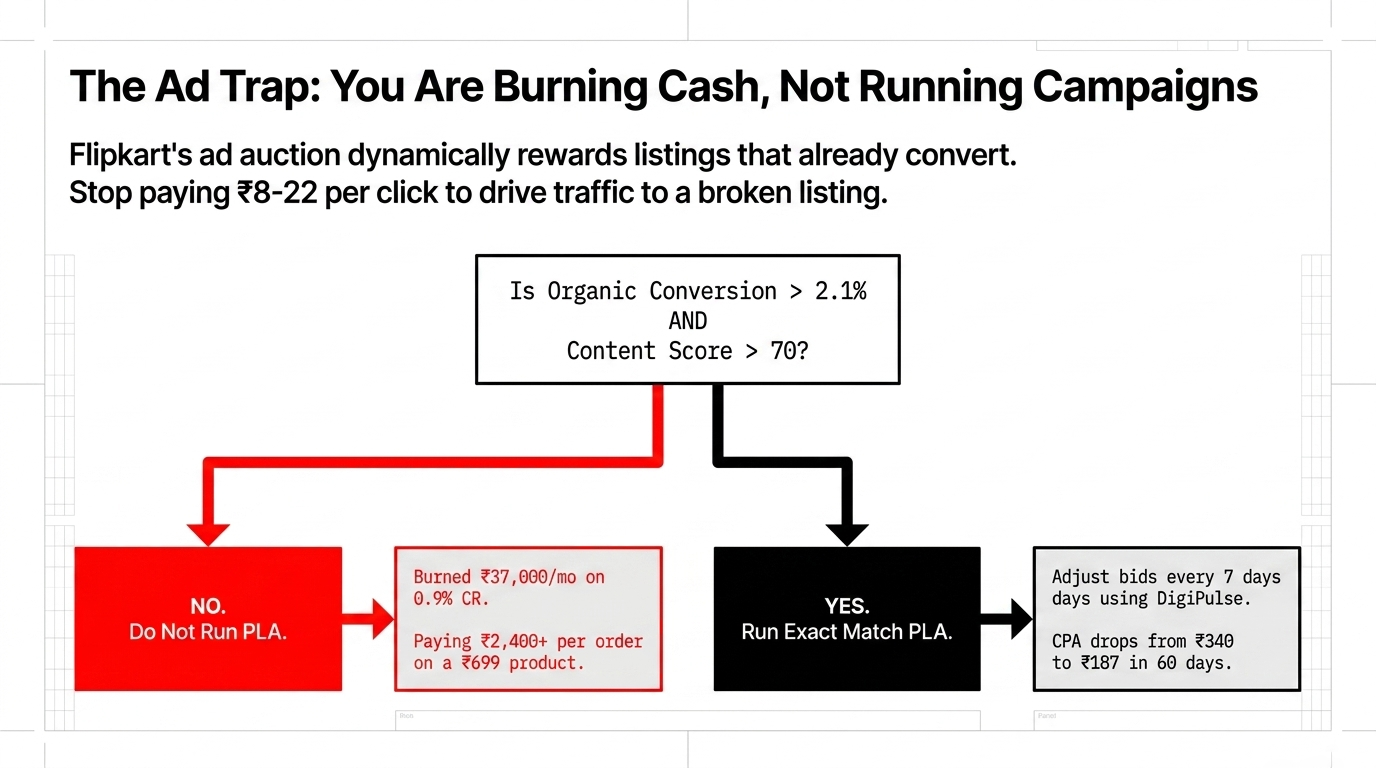
Everyone tells you to run Product Listing Ads (PLA) on Flipkart. Nobody tells you when not to.
Here is the ugly truth: if your organic conversion rate is below 2.1% and your listing content score is below 70%, running PLA is mathematically wasteful. You are paying $0.10 to $0.27 per click to drive traffic to a listing that will not convert. We calculated one brand's PLA burn at $4,490/month with a 0.9% conversion rate — meaning they were paying $291+ per order in ad costs on an $8.50 product.
The correct operating sequence:
- Fix catalog first — content score 80+, 7 images, complete attributes
- Run PLA only after organic conversion crosses 2.5%
- Start with Exact Match keywords — do not use Broad Match until you have 30 days of search term data
- Run DigiPulse reports weekly — Flipkart's dashboard shows your impression share, CTR trends, and competitor pricing in real-time
- Adjust bids every 7 days, not monthly — Flipkart's ad auction is dynamic; monthly bidding is a 2019 strategy
The Result When You Follow This Sequence
Brands that follow this sequence see cost-per-acquisition drop from an average $41.30 to $22.70 within 60 days. Not because of magic — because the platform rewards listings that already convert.
Returns, Reverse Logistics, and the Fee Leak You Are Ignoring
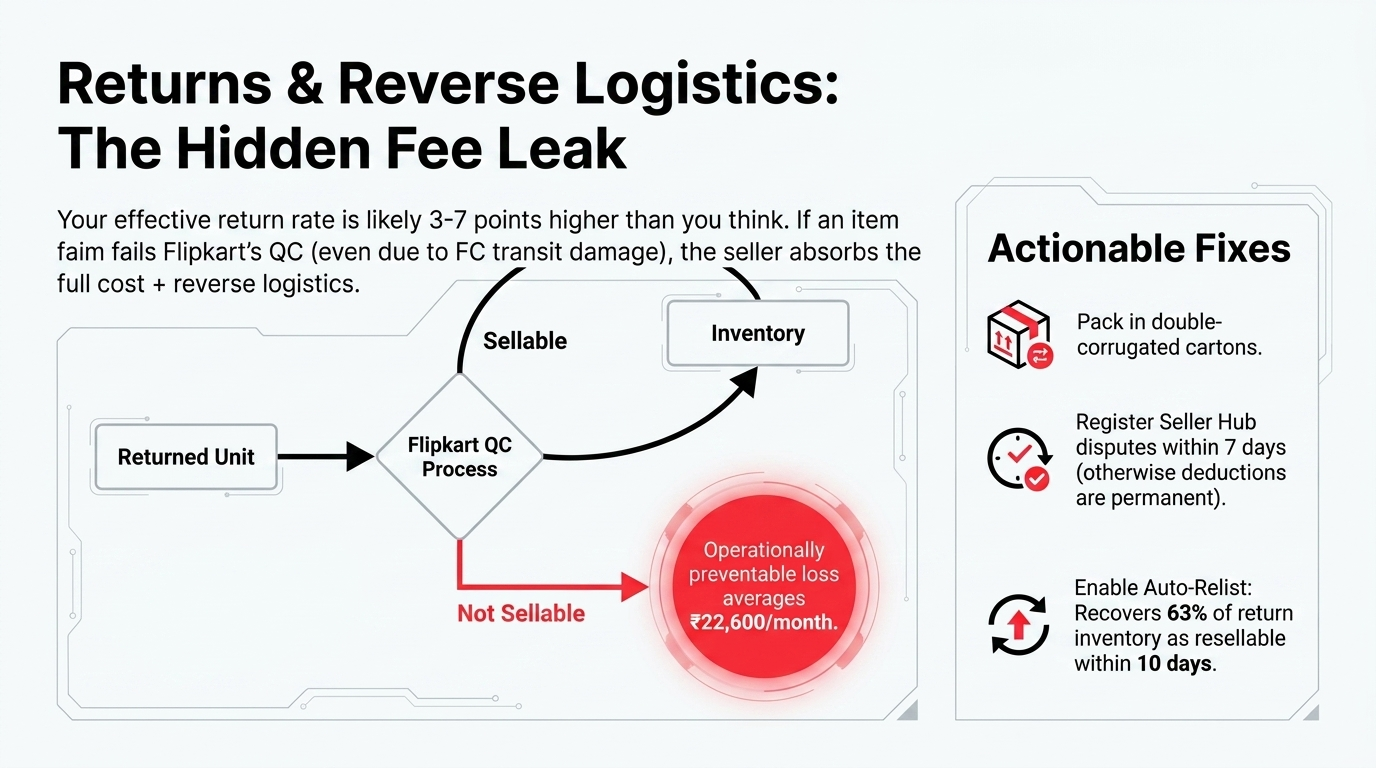
Here is the number that makes every D2C brand founder uncomfortable: your effective return rate on Flipkart is likely 3–7 points higher than you think because you are measuring gross returns, not net after Flipkart's quality check rejections.
When a customer returns a product, Flipkart processes it through a quality check. If the item is flagged as "not sellable" — even due to minor packaging damage that happened in Flipkart's own FC — the seller absorbs the full cost of the item plus the reverse logistics fee. We have seen brands absorb $2,740/month in return-related losses that were operationally preventable.
The Fulfillment Stack: Flipkart WFS vs. Self-Ship
This is a decision most brands make based on gut feel. That is a mistake.
Flipkart Warehousing & Fulfillment Services (WFS) — Flipkart's version of FBA — gives your listings a "Fulfilled by Flipkart" badge, which increases conversion by approximately 11–14% in competitive categories. It also makes your listings eligible for Flipkart Plus customer prioritization.
| Metric | WFS | Self-Ship |
|---|---|---|
| Average delivery time | 1.8 days | 3.9 days |
| Conversion rate uplift | +12–14% | Baseline |
| Storage fee (per unit/month) | $0.10–$0.22 | $0 |
| Best for | Top 30% SKUs by velocity | Slow movers, large items |
Our recommendation: Run WFS for your top-velocity SKUs and self-ship for anything that turns less than 45 units/month. Do not put slow-moving SKUs in WFS — you will pay $0.10 to $0.22/unit/month in storage fees for inventory that moves every 60 days. That math breaks on sub-$6.10 products.
The Seller Performance Score: Why It Kills Your Growth
Flipkart operates a tiered seller classification system — Gold, Silver, and Bronze — based on revenue, seller cancellations, policy breaches, and returns.
Here is what most D2C brands do not know: your seller tier directly controls your access to promotional events. Big Billion Days, End of Season Sale, and festive flash events have WFS slots and ad inventory preferentially allocated to Gold-tier sellers.
- Keep seller cancellations below 1.2% (Flipkart's threshold is 2%, but Gold sellers average 0.8%)
- Maintain return rate below 4.7% in your primary category
- Dispatch rate within SLA must stay above 97% — not 95%, not 96%
- Respond to customer queries within 24 hours via Seller Hub
We helped a kitchenware D2C brand move from Silver to Gold in 73 days by fixing their dispatch SLA (they were at 91% — a warehouse labeling error was causing 9% of orders to miss the pickup window). The result: $4,980 in incremental Big Billion Days revenue from better ad slot access.
The Odoo + Flipkart Integration Your Operations Team Needs
If you are managing Flipkart orders via the Seller Hub dashboard manually, you are capped at roughly 300–400 orders/day before operational errors start compounding.
The API reality: Flipkart's seller API has documented throughput limits that cause sync delays during flash sales. We have seen 500+ orders fail to sync to a warehouse WMS during a Big Billion Days event because the integration was built on a polling model instead of a webhook model.
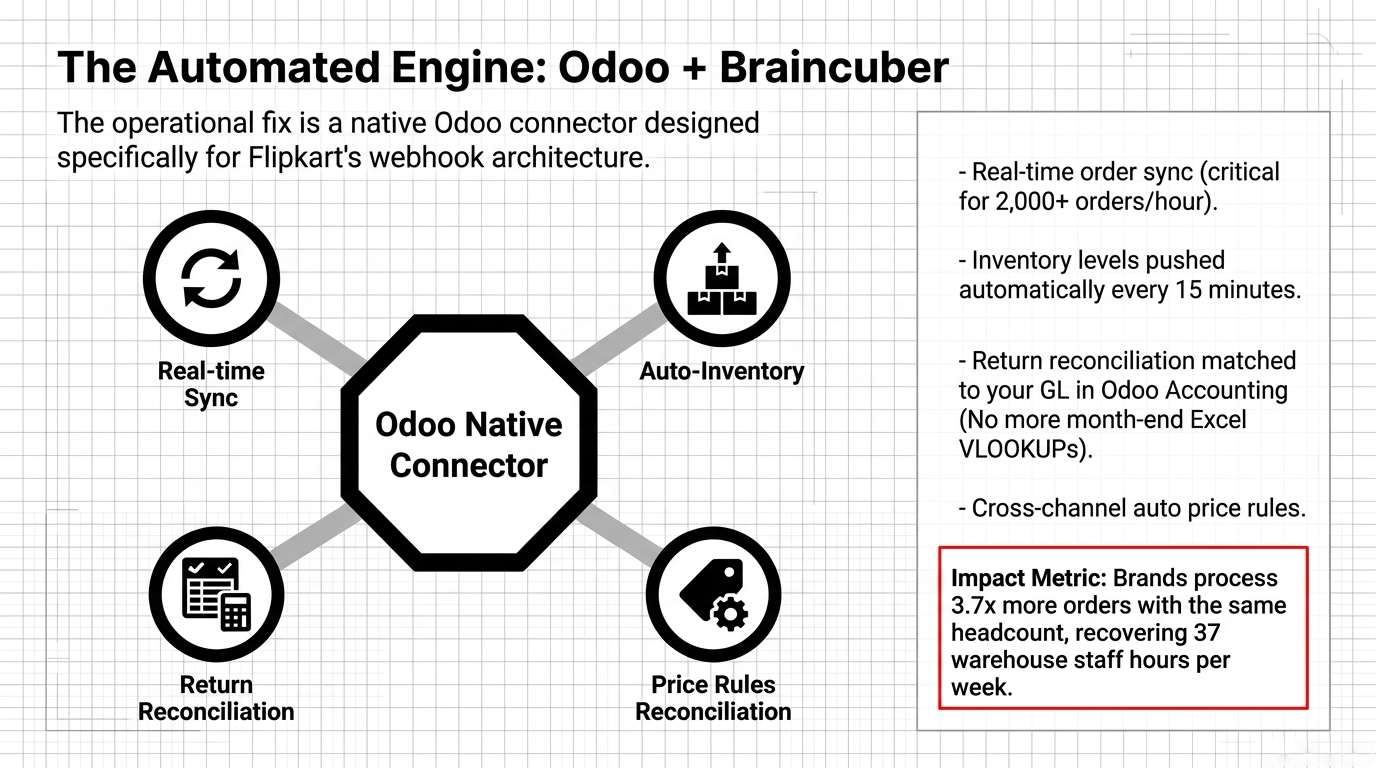
The fix is Odoo ERP with a native Flipkart connector that handles real-time order sync via webhook (not polling — this matters at 2,000 orders/hour), automated inventory level updates pushed to Flipkart every 15 minutes, return reconciliation that matches Flipkart payout statements to your GL in Odoo Accounting — no more Excel VLOOKUPs at month-end — and automatic price rule updates across Flipkart and your own website when a promotion runs.
Brands using Odoo + Flipkart integration process 3.7x more orders with the same warehouse headcount. That is not marketing language — that is 37 warehouse staff hours recovered per week on a 500-order/day operation.
Frequently Asked Questions
How do I qualify for Flipkart's Zero Commission Model?
Any product listed at an average selling price below $12.15 automatically qualifies under 'Flipkart Bachat Utsav.' Shopsy sellers get 0% commission across all price points. Brands that repriced within 30 days of the announcement improved net margin by 6–9 percentage points.
What documents do I need to register as a D2C brand seller on Flipkart?
You need a valid GSTIN, PAN card, active bank account, and product images. Registration is free and typically completes in 3–7 business days. Ensure your GSTIN is correctly mapped per product category — a single mismatch delays your first payout.
Should my D2C brand use Flipkart WFS or self-ship?
Use WFS for your top 30% of SKUs by monthly velocity — anything turning more than 45 units/month. Self-ship all slow-moving or large-format items. WFS listings convert 12–14% better due to the Fulfilled by Flipkart badge and faster delivery averaging 1.8 days vs. 3.9 days.
Why are my Flipkart PLA ads not converting despite high impressions?
High impressions with low conversions almost always trace back to a catalog content score below 70% or an organic conversion rate under 2.1%. Fix product title, images (minimum 7), and complete all attribute fields first. Only activate PLA after organic conversion crosses 2.5%.
How does Braincuber integrate Odoo ERP with Flipkart?
Braincuber builds a webhook-based Odoo-Flipkart connector that syncs orders in real-time, updates inventory every 15 minutes, automates return reconciliation against Flipkart payout statements, and manages promotional pricing rules across channels. Brands go live within 14–21 days.
Stop Leaving Flipkart Money on the Table
If you don't know your current catalog content score, your return dispute recovery rate, or your seller tier progression timeline — you are operating blind on India's second-largest e-commerce platform.