
The $2.12 Billion Problem No D2C Founder Talks About
The cross-border trade compliance automation market was valued at $2.12 billion in 2025 and is growing at 12.8% CAGR through 2030. That number does not exist because big enterprises are paranoid. It exists because the compliance burden on every shipment — including your $47 skincare kit to a customer in Riyadh — is exploding.
Here is what most D2C founders do not realize: You are the exporter of record. Not your 3PL. Not your freight forwarder. Not FedEx. You. Which means when your supplement brand ships protein powder to the UAE without checking SFDA import restrictions, the fine lands on your books, not your logistics partner's.
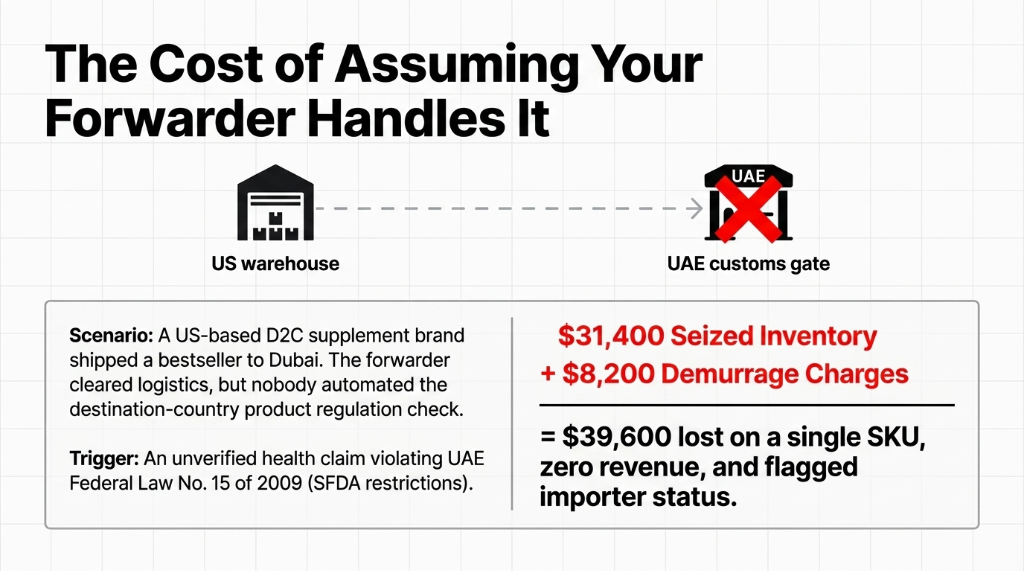
What Actually Breaks — The 5 Failure Modes Nobody Explains
Most founders do not know what they do not know. Let us get specific about the failure modes that cost real money.
Failure #1: HS Code Misclassification — The Silent Margin Killer
The problem: When your ops team manually assigns Harmonized System codes, they typically use a 6-digit global code. But in 2025, the US mandated full 10-digit HTS codes, GCC countries moved to 12-digit codes, and the EU's Combined Nomenclature added fresh TARIC extensions. If your SKU master in Odoo or Shopify carries a 6-digit HS code from 2022, you are either over-paying duties or under-declaring — both are compliance failures.
The Quiet Leakage
We found $18,300 in over-paid duty assessments at a single UAE beauty brand — from mis-classified HS codes that had not been updated in 19 months.
Failure #2: De Minimis Is Dead for the US Market
What changed: As of August 29, 2025, the Section 321 low-value import exemption below $800 no longer applies. Every shipment, regardless of value, now needs full HS classification, country of origin documentation, and consignee contact details submitted before the shipment departs.
Who Gets Hit Hardest
D2C brands doing high-volume, low-AOV dropship into the US who have not updated their pre-shipment data pipeline are paying duties they never budgeted for — or having shipments refused at the border.
Failure #3: Denied Party Screening Gaps — The One That Ends Companies
Real case: The US Bureau of Industry and Security imposed a $5.8 million penalty on a tech company in 2025 for unauthorized exports to restricted countries. Your customer in Country X might look legitimate at checkout. But if their shipping address, name, or company cross-references a sanctions list — OFAC's SDN list, the EU's consolidated list, or the UN Security Council list — and your system does not catch it, you just committed a federal export violation.
The Hard Truth
No Klaviyo automation catches that. No Gorgias ticket solves that. Manual screening is not scalable once you are above 150 international orders per day.
Failure #4: Country-Specific Regulatory Blind Spots
Selling CBD topicals? Legal in the UK, banned in Singapore, requires pre-approval in UAE. Selling lithium-ion battery-powered wearables? That is a UN 38.3 test certificate requirement in 47 countries — including IATA dangerous goods labelling, which FedEx and DHL will now reject at pickup if the documentation is missing.
Your freight forwarder does not track product-level regulatory changes across 47 jurisdictions. You need a rules engine that maps your product category to destination-country requirements automatically.
Failure #5: Surprise Duties Kill Customer LTV
The problem: In the UK, HMRC's post-Brexit rules mean any order above GBP 135 from a non-UK seller needs VAT collected at point of sale — not at customs. In Australia, GST applies to goods under AUD 1,000 imported by consumers. If your Shopify checkout is not calculating and collecting these at purchase, your customers are getting surprise charges at delivery.
The Double Hit
Surprise duties drive chargebacks AND parcel refusals. Both destroy your LTV and your unit economics. A $47 order that gets refused at delivery costs you $47 in product + $12-$19 in shipping + return logistics. You net negative on every refused shipment.
Why "Just Hire a Customs Broker" Is the Wrong Answer
Frankly, this is the advice that keeps 90% of D2C founders stuck in an expensive, reactive compliance loop.
Customs brokers are paid per shipment and per query. At $35-$180 per classification request, a brand moving 3,000 SKUs across 12 markets is paying $40,000-$60,000 a year just to manually classify product codes — and still getting it wrong 11-18% of the time because brokers are human and HS code updates roll out every quarter.
Brokers Operate After the Fact
They process the paperwork for what you have already decided to ship. They do not intercept a shipment to Iran at checkout. They do not flag that your new activewear line contains a material banned under California Prop 65. They do not know your product is on the EU's REACH restricted substance list until it has already been rejected at Rotterdam. Compliance has to live inside your ERP and order management system, not outside it.
The 5-Layer Tech Stack That Actually Works
Here is exactly how export compliance technology should be wired into a D2C operation, layer by layer.
Layer 1 — HS Code Classification Engine
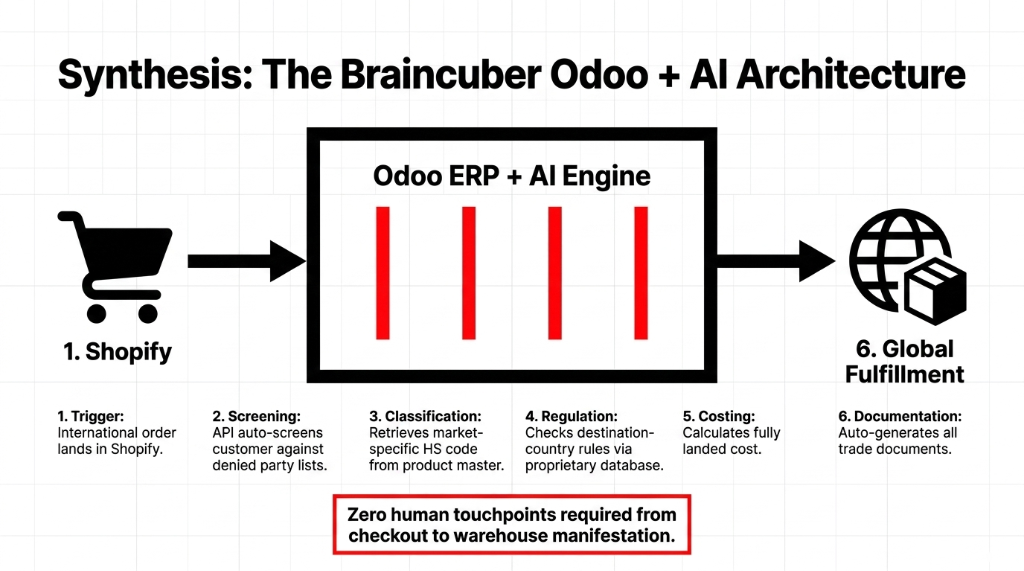
Tools like Zonos, Avalara AvaTax Cross-Border, and Descartes now run AI-powered classification engines that auto-assign HS codes from your product title, description, and material composition — cutting manual classification time from 12 minutes per SKU to under 90 seconds, with accuracy rates above 94%. Inside Odoo ERP, we integrate this at the product master level: every SKU carries a market-specific HS code that auto-populates shipping documents at order generation.
Layer 2 — Real-Time Denied Party Screening
This connects directly to your checkout or order queue. Every order above a defined risk threshold gets screened against OFAC, BIS Entity List, EU Consolidated List, and UN lists simultaneously. We configure Odoo's trade compliance module to flag — not just log — any match, holding the order for human review before it enters the fulfillment workflow. False-positive rate on well-tuned systems runs at roughly 3-7%, which is manageable. Unscreened orders are not.
Layer 3 — Country-Specific Regulatory Rules Engine
This is where most off-the-shelf tools fail D2C brands. A rules engine maps your product category to destination-country specific requirements: labelling standards, restricted ingredient lists, import licenses, and product certifications. We maintain a proprietary regulatory database across 47+ jurisdictions that updates in real time when regulations change — not when your broker reads about it in a newsletter 3 weeks later.
Layer 4 — Automated Document Generation
AI tools now auto-draft commercial invoices, packing lists, certificates of origin, and conformity certificates from your shipment data. We have seen this cut document preparation time by 73% — from an average of 22 minutes per international shipment to 6 minutes — and eliminate the transcription errors that trigger customs holds. In Odoo, this is handled through customized trade document templates that pull directly from the confirmed sales order: no retyping, no copy-paste, no "0" instead of "O" in the HS code field.
Layer 5 — Duty and Tax Calculation at Checkout
Integrations like Zonos Checkout or Avalara connected to Shopify resolve landed cost at the storefront level — with the full duty, tax, and compliance cost shown pre-purchase. No surprise charges at delivery. No chargebacks. No refused parcels.
The Braincuber Odoo + AI Compliance Architecture
We do not bolt export compliance onto your existing workflow as an afterthought. We architect it as a data flow that runs automatically — zero human touchpoints required from checkout to warehouse manifestation.
Results: UAE Beauty Brand — Q3 2025 Deployment
Customs Holds
7/month to 1/month
Pre-shipment compliance gates eliminated 86% of customs hold incidents
Duty Overpayments Recovered
$18,300
Mis-classified HS codes corrected across 1,247 SKU-market combinations
Compliance Labor
37 hrs/wk to 9 hrs/wk
Ops team freed from manual paperwork — now focused on growth operations
The Regulatory Tipping Points You Cannot Ignore in 2026
| Regulatory Change | What Changed | Who Gets Hit |
|---|---|---|
| US Tariffs on Indian Imports | Now 50% combined (25% reciprocal + 25% penalty tied to Russian crude) | Indian D2C brands selling into the US — your landed cost math is broken if it was built on 2024 duty rates |
| EU CBAM (Carbon Border) | Phased application began 2026 — embedded carbon emissions reporting required | D2C brands exporting textiles and electronics into the EU without carbon reporting |
| India E-Commerce Export Policy | Effective April 1, 2026 — exporters can ship goods of any value via courier under simplified procedure | An opportunity — but only for brands whose compliance systems handle updated documentation at scale |
| US Section 321 Death | De minimis exemption below $800 eliminated August 29, 2025 | Every D2C brand shipping into the US — full HS classification now required on all shipments |
Moody's 2025 study of 600 risk and compliance professionals found that companies investing in automated compliance infrastructure detected violations 4.3x faster and recovered from enforcement actions at 67% lower cost than those using manual processes.
What Implementation Actually Looks Like (No Over-Promising)
For a D2C brand doing $2M-$8M in international revenue with 200-2,000 active SKUs:
- Phase 1 (Weeks 1-3): SKU-level HS code audit and assignment across all target markets. This is the foundation. You cannot automate what has not been correctly classified
- Phase 2 (Weeks 4-7): Odoo trade compliance module configuration — denied party screening API, document templates, duty calculation rules per market
- Phase 3 (Weeks 8-10): Shopify integration for landed cost at checkout plus pre-shipment compliance checks feeding back from Odoo to the fulfillment queue
- Phase 4 (Weeks 11-12): Live monitoring dashboard setup, regulatory alert subscription, and team training
Total timeline: 10-12 weeks. The brands we have worked with recover implementation cost within 4-7 months through reduced penalties, reclaimed over-paid duties, and lower broker fees.
The Controversial Take on Compliance
Most D2C founders see export compliance as a tax on growth. They are wrong. Compliance infrastructure is a growth lever — because the brands that move into Germany, Australia, Japan, and the UAE without a seizure incident or a $374,000 penalty are the ones that compound market share while their competitors get stuck at customs. The AI-driven classification and screening tools that used to cost $200,000+ annually for enterprise clients are now accessible to brands doing $1M+ in international revenue. There is no excuse in 2026 for running a manual compliance process.
Frequently Asked Questions
How quickly can export compliance technology be integrated with an existing Shopify + Odoo setup?
For brands with a working Shopify-Odoo integration already in place, adding the trade compliance layer — HS code mapping, denied party screening, and landed cost at checkout — takes 6-8 weeks. The critical path is always SKU-level HS code classification, which depends on how clean your product data already is. Expect 2-3 weeks just on the data audit if your product catalog has more than 500 SKUs.
What is the real cost of not having automated denied party screening?
A single violation — shipping to an OFAC-sanctioned individual or entity — can trigger a civil penalty of up to $374,000 per transaction in the US, plus potential criminal liability. Beyond the fine, BIS can place your company on a denied export privileges list, effectively killing your ability to ship from the US. Manual screening of orders above a certain value is simply not scalable once you are above 150 international orders per day.
Do HS codes really change often enough to matter?
Yes — and the 2025 cycle was particularly disruptive. The US mandated full 10-digit HTS codes for USPS shipments from September 2025, GCC countries moved to 12-digit codes from January 2025, and the EU Combined Nomenclature was updated. Brands that do not have a system for catching these updates are paying wrong duty rates on every affected SKU, either over-paying or under-declaring — both are compliance failures.
Can smaller D2C brands (under $1M revenue) justify the investment?
Honestly, at under $500K ARR shipping to 1-2 markets, a good customs broker plus Zonos or Avalara entry-level plans cover most of the risk at $300-$600/month. Once you cross $1M ARR or go live in 4+ markets, manual processes become the bigger cost — and the exposure to a single compliance failure outweighs the technology investment. We do not recommend a full Odoo trade compliance build for pre-$1M brands.
What is the difference between compliance technology and logistics platforms like ShipBob or Easyship?
Logistics platforms handle the movement of goods. Compliance technology governs what can move, to where, under what conditions, with what documentation. ShipBob will not stop you from shipping a restricted supplement to Singapore. Easyship will not flag that your customer name appears on the EU sanctions list. Compliance technology sits upstream of logistics, inside your order management and ERP layer — making go/no-go decisions before a shipment is ever manifested.
Your Competitors in the UK and US Are Automating This. Are You Still Emailing PDFs?
If you are still emailing PDFs to a customs broker on a per-shipment basis, you are not just slow — you are exposed. Do not let a mis-classified shipment to the wrong country kill a market you spent 18 months building. We have deployed compliance architecture for 150+ brands shipping to 47+ jurisdictions. The implementation takes 10-12 weeks. The first customs hold you avoid pays for it.