
The Real Problem Is Not Your Product
Here is what is actually breaking inside a $357,000/year jewelry D2C brand:
You are running 4 to 6 disconnected tools simultaneously. Shopify (or WooCommerce) for orders. Tally or QuickBooks for accounting. A separate Excel for SKU-wise inventory. WhatsApp groups for your karigar production updates. ShipRocket or Delhivery for logistics. And maybe a Zoho CRM you opened once, configured 40%, and abandoned.
None of these talk to each other in real time.
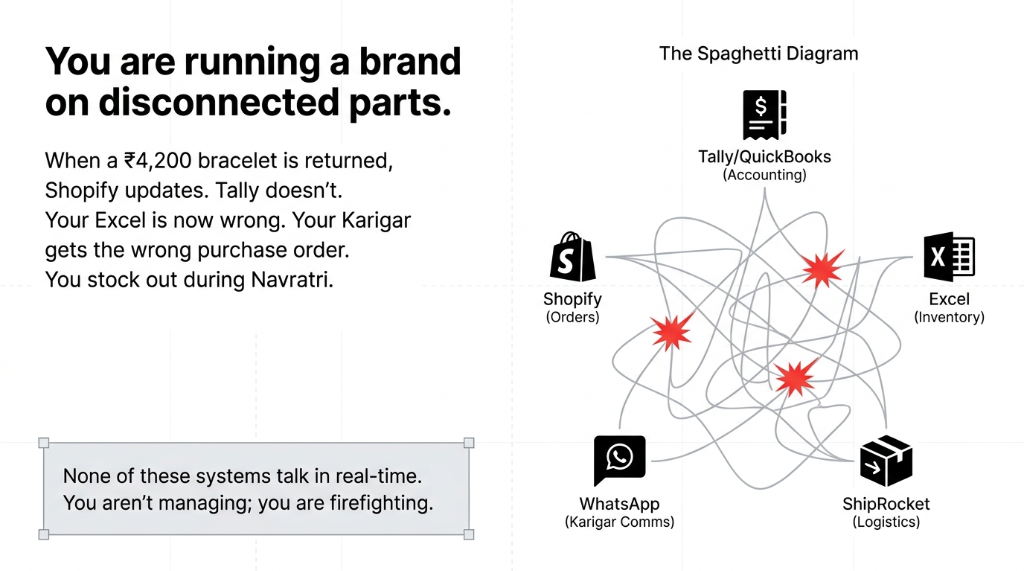
When a customer returns a $49.98 oxidised silver bracelet, your Shopify marks it as returned. But your warehouse team has not updated Tally yet. Your accountant does not know if it is restockable or damaged. Your inventory count is now wrong by one unit, which cascades into a wrong purchase order to your karigar, which cascades into a stockout during the next Navratri campaign.
Real Loss: $1,357/Month From One Process Failure
We tracked this exact loop in a D2C accessories brand. $1,357/month was leaking in un-reconciled returns and phantom inventory — units the system "believed" existed but physically did not. That is $16,284/year from one process failure. And that is before the multi-metal, multi-variant SKU explosion.
Why Your SKU Structure Is the Silent Killer
Jewelry and accessories have the most brutal SKU complexity of any D2C category.
A single neckpiece can exist in: Gold-plated, Silver-plated, Rose Gold, Oxidised Silver. Each in S, M, L. Each with Gift Box and Without Gift Box options. That is potentially 24 SKUs for one design. Now multiply that by 300 designs. You are managing 7,200 SKUs, and every one of them has a different material cost, a different karigar, a different lead time, and a different reorder point.
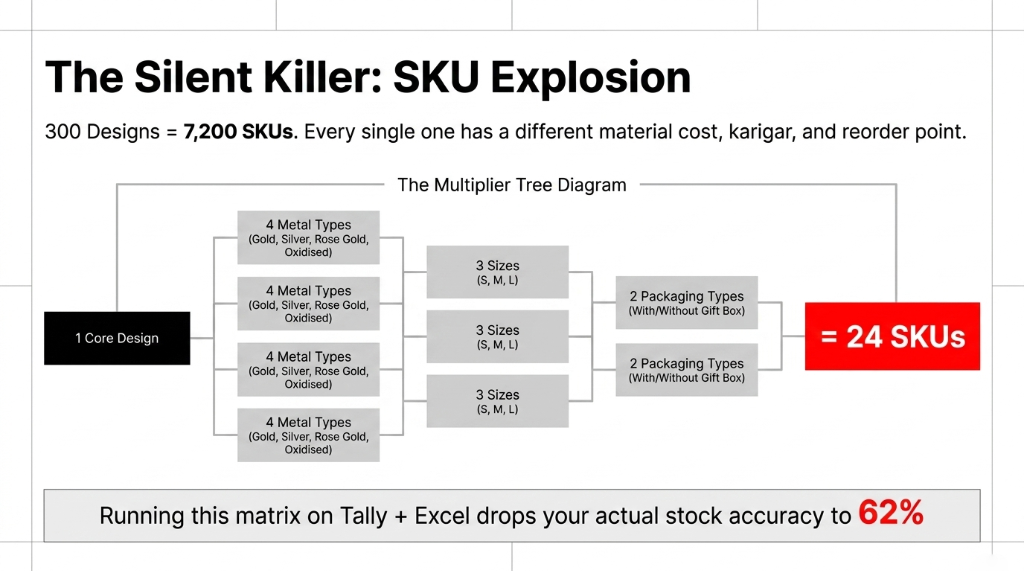
When you are running this on Tally + Excel, your stock accuracy is somewhere around 62% — meaning 38% of the time when you check a SKU count, it is wrong. You either oversell and cancel orders (killing your Meesho/Amazon seller rating), or you overstock and lock cash in dead inventory.
Frankly, this is where most brands tell us, "But we manage." No, you do not. You firefight. There is a difference.
What Odoo ERP Actually Does Differently Here
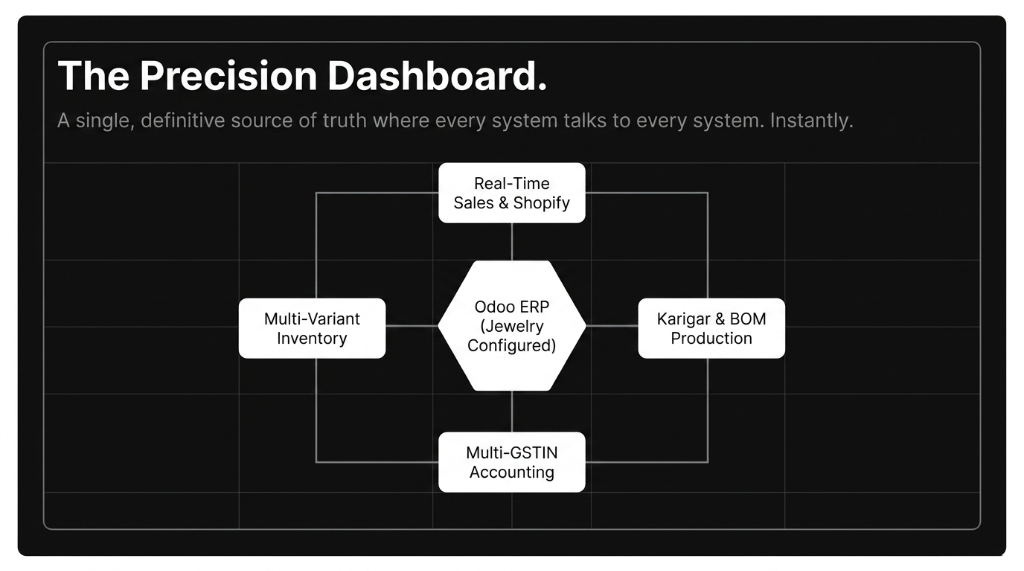
This is not a pitch for generic ERP. This is about what specifically changes when you run a jewelry D2C brand on Odoo — and why we at Braincuber have structured our implementations specifically for this vertical.
Lot and Serial Tracking That Matches Your Karigar Workflow
Each jewelry piece gets a unique lot number tied to: raw material batch, karigar name, production date, metal purity, and stone quality. When a customer calls with a quality complaint at month 3, you trace it back to the exact raw material lot in under 4 minutes instead of a 3-day WhatsApp detective chain.
Dynamic Pricing Linked to Live Metal Rates
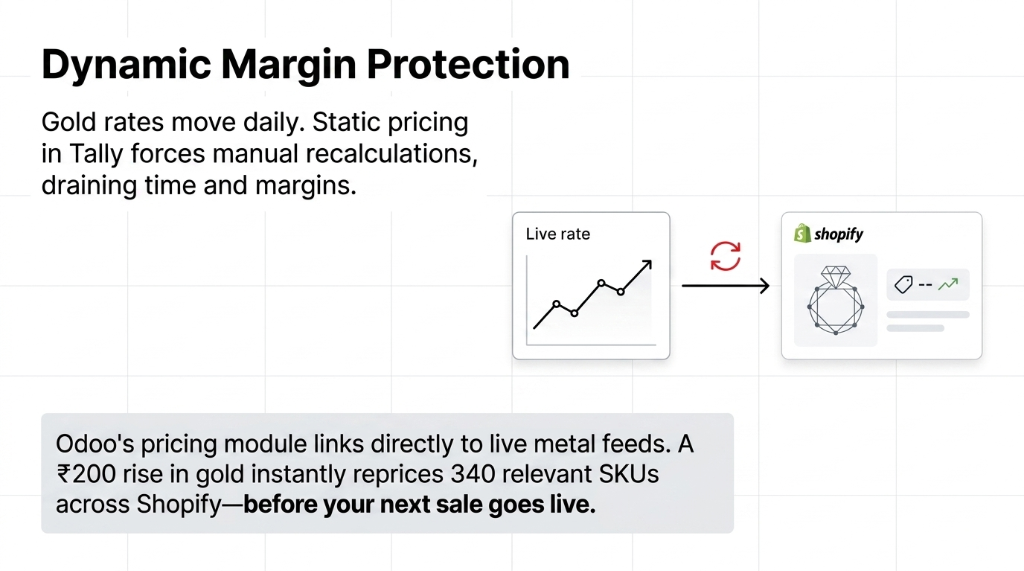
Gold rates move daily. If your pricing module in Tally is static, your margin on every gold-plated SKU is being recalculated manually — slowly and incorrectly. Odoo's pricing module links directly to live metal rate feeds. A $2.38 rise in gold price automatically reprices 340 relevant SKUs across your Shopify store before your next sale goes live.
Shopify–Odoo Integration That Actually Works at Scale
Insider detail most Odoo resellers will not tell you: Shopify's standard inventory sync has a 15-minute lag via webhook. During a flash sale where you sell 200 units in 8 minutes, you will oversell. We build real-time inventory reservation bridges so Shopify checks live Odoo stock before confirming the order.
GST-Ready, Multi-GSTIN Capable
Selling across India on your own website, Amazon, Nykaa Fashion, and Myntra means multiple GST rules, HSN codes for different jewelry categories, and GSTR-1 vs GSTR-3B reconciliation. In Tally: 14 hours of manual reconciliation monthly. In Odoo: under 2 hours.
Production Orders Tied to Sales Demand
When a customer places a custom ring order, Odoo auto-creates a Manufacturing Order with the BOM, assigns it to the right karigar, and tracks it through polishing, setting, quality check, and dispatch — each stage timestamped. Your production manager stops needing daily WhatsApp check-ins.
What It Costs to Not Act
| Leak Source | Monthly Loss |
|---|---|
| Un-reconciled returns and phantom inventory | $1,071–$1,666 |
| Overstock due to wrong reorder signals | $2,142–$2,975 |
| Stockouts during peak seasons (Diwali, Navratri) | $4,165–$7,140 |
| Manual GST reconciliation errors | $714–$1,428 |
| Excess staff hours in operations (3 extra FTEs) | $5,355–$8,925 |
| Total Monthly Operational Bleed | $13,447–$22,134/month |
That is $161,364–$265,608 per year walking out the door. An Odoo ERP implementation for a brand at this stage costs a fraction of that. The math is not close.
The Implementation Reality: What to Expect
Week 1–2: SKU Data Cleanup (The Painful Part)
Your 7,200 SKUs have inconsistent naming. We fix this first, or nothing downstream works. (Do not let any vendor promise you a 2-week implementation. They will cut corners on your data structure and you will pay for it in 6 months.)
Week 3–4: Inventory Migration and BOM Creation
Opening balances, BOM creation for production-based SKUs, karigar assignment rules.
Week 5–6: Integrations and GST Configuration
Shopify and payment gateway integration, GST configuration, carrier integrations (ShipRocket, Delhivery, Bluedart).
Week 7–9: Training, Parallel Running, Go-Live
Staff training, parallel running, go-live, and hypercare support.
Within 30 Days of Go-Live
Stock Accuracy
From ~62% to 96%+ across all variants
Order Processing
From 18 minutes per order to under 4 minutes
Return Reconciliation
From 3 days to same-day closure
The Two Groups in D2C Jewelry Right Now
Group 1: Brands that invested in operational infrastructure between $59,500 and $357,000 ARR. They hit $1.19M+ with the same or fewer people because their ops scale on automation.
Group 2: Brands that kept saying "we will fix ops later." At $595,000 ARR, they have 23 employees doing work that 8 should be doing. Their EBITDA margin is 4% when it should be 14–18%. Hiring more staff is not scaling; it is bloating.
FAQ: ERP for Jewelry/Accessories D2C Brands
How long does Odoo ERP implementation take for a jewelry D2C brand?
For a brand with 300-2,000 SKUs, one warehouse, and Shopify integration, go-live takes 6-9 weeks. Week 1-2 is always SKU data cleanup - the most underestimated step. Don't let any vendor promise a 2-week implementation.
Can Odoo handle multi-variant SKU complexity for jewelry?
Yes. Odoo's product variant engine handles unlimited attribute combinations - metal type, purity, stone, size, finish, packaging. Each variant carries its own BOM, cost, and reorder rule configured to mirror how your karigar and warehouse teams actually work.
What happens to our Shopify store during migration?
Your Shopify store stays live throughout. We run a parallel period - typically 2 weeks - where both systems are active. Opening inventory is migrated and validated before cutover. No downtime, no lost orders. Post-go-live, Odoo handles Shopify inventory automatically.
Is Odoo ERP worth it for a jewelry brand below $119,000 ARR?
Below $89,250 ARR with under 50 SKUs, a full Odoo implementation is premature. But at $89,250-$178,500 with 200+ SKUs selling on 3+ channels, the operational drag is already costing more than the ERP. We have implemented for brands at $107,100 ARR with full ROI in under 5 months.
Does Braincuber provide post-go-live support for jewelry customizations?
Yes. Our retainer model covers ongoing Odoo support, module customization as your catalog grows, and AI-powered add-ons like demand forecasting for seasonal spikes. 73% of our jewelry brand clients are on monthly support retainers for continuous ops improvements.
Stop Bleeding Cash on Disconnected Tools
You have already spent money building your brand. Do not let broken ops take it. Book our free 15-Minute Operations Audit — we will identify your biggest operational leak in the first call. Whether it is inventory sync, karigar tracking, or GST reconciliation chaos.