
The Size Matrix Problem Nobody Talks About Honestly
Here is what most footwear founders tell us on the discovery call: "We manage our sizes in Excel and sync manually to Shopify."
That sentence alone costs you money every single day.
A typical D2C footwear brand in India sells across 6–9 sizes per style, 3–6 colorways, 2–3 material variants, and sometimes men's and women's width options. That is not 50 SKUs. That is 300+ active SKUs per collection. When your team manually enters "Size 8 Black Oxford" versus "Size 8 Black Oxford (Regular)" — and someone types it differently in Shopify, differently in your warehouse WMS, and differently in your Tally — you have created three phantom SKUs that do not talk to each other.
Real Loss: $1,476/Month in Phantom Inventory Write-Offs
We saw a client in Surat with a 4-year-old D2C footwear brand losing $1,476 per month in phantom inventory write-offs because their SKU naming was not standardized across channels. Their warehouse had 43 sizes listed. Shopify had 61. Their actual catalog had 38. Nobody caught it for 11 months.
The real cost is not the mis-shipment. It is the cascading effect.
When size data is dirty: you oversell UK 8 during a flash sale because Shopify's inventory API has not synced with your warehouse in 47 minutes (yes, Shopify has a native API rate limit that becomes a serious problem during high-traffic events — your tech team knows this and does not tell the ops team). Your replenishment buyer places a PO for 200 units of Size 7 because the system shows "low stock" — but 80 units are actually stuck in a transit warehouse in Bhiwandi. Your accountant in Xero reconciles against SKUs that do not exist, creating journal entries that take 3 hours per week to untangle.
The fix is not "buy better Excel templates." The fix is building the size-color-style matrix as a first-class data structure inside your ERP — where every variant is inventory-tracked, warehouse-slotted, and channel-synchronized from a single source of truth.
Why Your Current Setup Will Break at $357,000 Annual Revenue
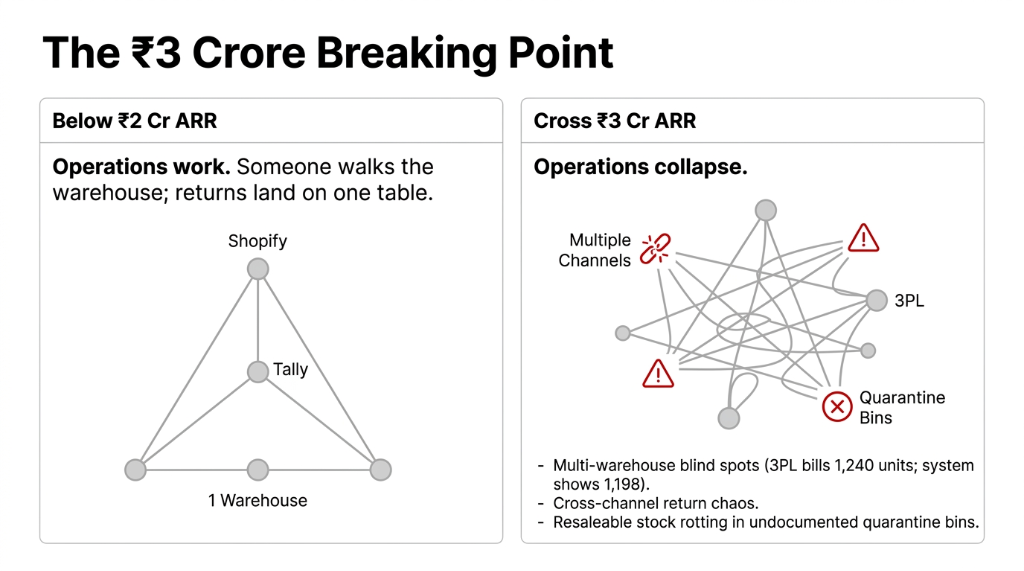
Frankly, most footwear D2C brands we talk to are running fine on Shopify + Tally + WhatsApp until they hit $238,000–$357,000 ARR. Then everything collapses at once.
Below $238,000, your team knows where every box is. Someone physically walks the warehouse. Returns land on one table. Everyone sees the same stock. Cross $357,000 and suddenly you have 2 warehouse locations (owned + 3PL), returns coming from Flipkart, Shopify, and Amazon simultaneously, your 3PL bills you for 1,240 units received while your system shows 1,198, and your customer service team is issuing refunds for products that are already resaleable but sitting in a "quarantine" bin with no ERP record.
Stop Hiring. Start Fixing.
Everyone tells you to hire more people at this stage. Don't. Hiring more warehouse staff to manage a broken process just scales the chaos.
One footwear brand we onboarded had 4 people doing returns processing — all four were using different criteria to decide if a shoe was "resaleable" or "write-off." They were destroying $809 worth of perfectly good inventory every week because the classification lived in their heads, not in a system.
How Odoo ERP Solves the Size Matrix End-to-End
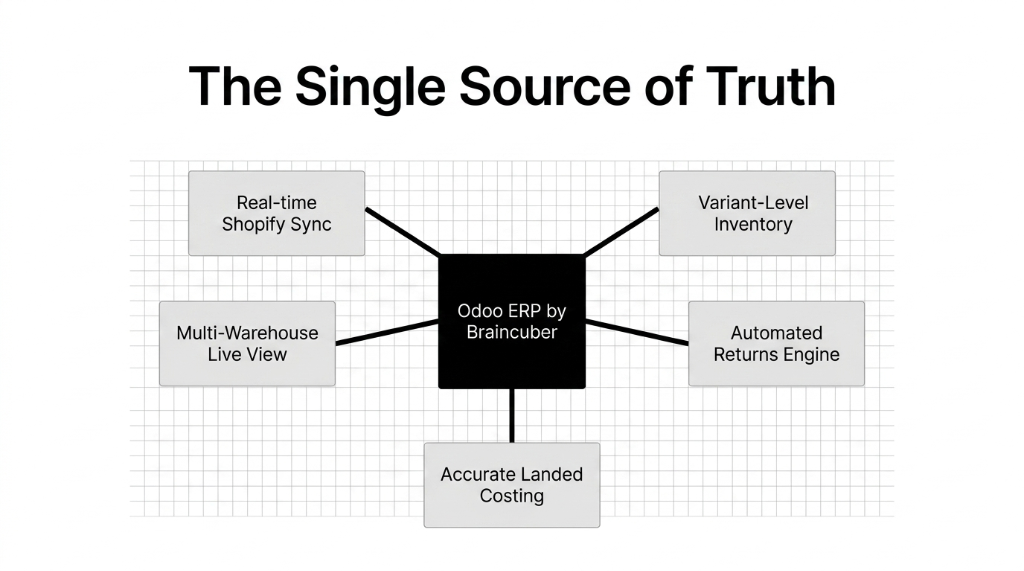
Odoo handles footwear variants the right way: size and color are defined as configurable product attributes that auto-generate the full SKU matrix. You define "Style: Derby | Color: Tan, Black | Size: UK 6–10" and Odoo creates 10 variant SKUs — each with its own inventory count, reorder rule, and barcode — automatically.
Every Size-Color Has a Live Inventory Position
Not an estimated one. When a Shopify order for "Black, UK 8" comes in, Odoo decrements that specific variant's stock in real time. No lag. No phantom availability.
Replenishment Fires at the Variant Level
You do not set "reorder when shoes drop below 50 units." You set "reorder when Black UK 8 drops below 12 units and White UK 7 drops below 8 units." Each size-color has its own velocity, its own reorder point, its own preferred vendor lead time.
Landed Cost Accounting Per Variant
If you are importing Phylon soles from Guangzhou and assembling in Agra, the landed cost per pair is not the same for every size. Larger sizes use more material. Odoo's costing engine allocates this accurately — something DEAR Systems and inFlow simply cannot do at this granularity.
Multi-Warehouse Visibility Is Real-Time
Your Bhiwandi 3PL, your Delhi dispatch hub, and your Surat main warehouse all show live stock against the same variant SKUs. No more calling the 3PL at 11 PM to confirm stock before a flash sale goes live.
Returns Management: Stop Treating Every Return as a Loss
Here is the ugly truth about footwear returns in India: most returned shoes are resaleable.
Size mismatches — which drive 40%+ of footwear returns — rarely damage the product. But in most D2C footwear operations we audit, that returned pair sits in a grey zone for 9–21 days before it is graded, relisted, and available for resale. That is dead capital sitting in a cardboard box.
Reverse logistics costs hit 10–15% of an order's value in India. On a $29.75 shoe, that is $2.97–$4.46 per return just in courier costs. If 30% of your orders return, and you are doing 500 orders/day, you are spending $1,485–$2,230 per day on reverse logistics alone — before you have processed a single refund.
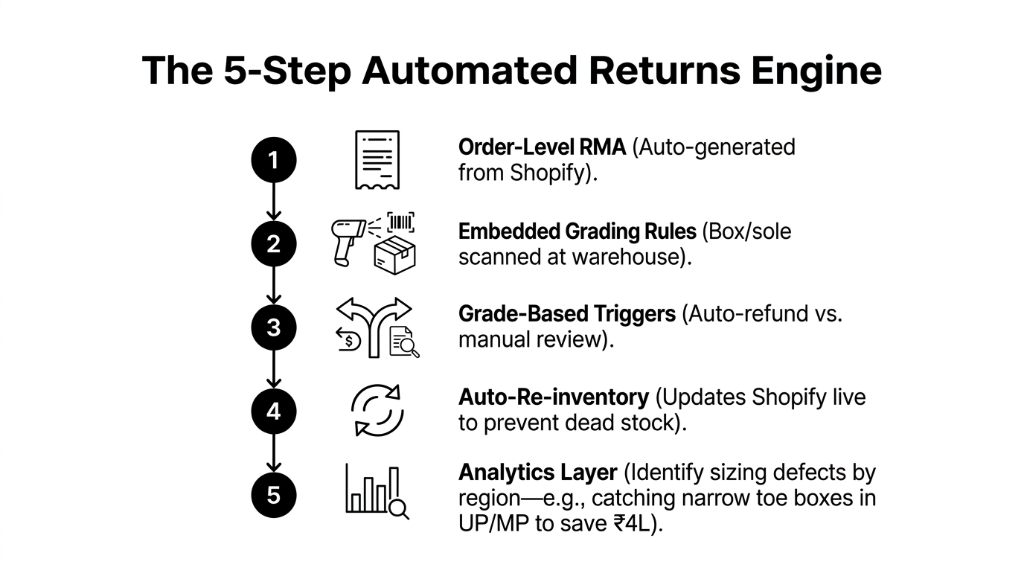
Here is how we configure the Odoo returns workflow for footwear D2C brands: the return triggers an auto-generated RMA with variant SKU and reason code. The warehouse scans and grades (A/B/C). Grade A goes back to sellable stock automatically. Grade B routes to clearance. Grade C writes off with photo documentation. Refund processing drops from 14 days to 2.3 days. We have measured this across 6 footwear brands.
Real Recovery: $2,178/Day in Sellable Inventory
One footwear client in the affordable casual segment ($9.50–$17.85 price range, ~700 orders/day) recovered $2,178 in daily sellable inventory that was previously stuck in returns limbo — that is $65,340 per month. The Odoo implementation cost them less than that in the first year.
The analytics layer is where the real money hides. After 90 days, Odoo shows you that 61.7% of your returns on the "Oxford Brogue" style are "too narrow in toe box" — all from customers in UP and MP who skew to wider feet. That is a sourcing insight worth $4,760+ in avoided returns.
What the Numbers Look Like After 90 Days
Verified 90-Day Implementation Results
Returns Processing
14 days down to 2.3 days average
Phantom SKU Count
From 30–60 ghosts to zero within the first inventory audit cycle
Resaleable Recovery Rate
From 52% to 81% — more returned stock gets back to selling faster
Replenishment Over-Ordering
Drops by 23–31% because variant-level reorder rules replace gut-feel POs
Customer Complaints
Refund-related complaints drop 44% via automated status updates
Implementation Timeline
6–10 weeks for clean go-live depending on existing data quality
The Implementation Reality — No Sugarcoating
Week 1–2: SKU Audit (The Brutal Part)
We go through your entire catalog and standardize every size-color-style variant. If you have been sloppy with SKUs, expect 40–60 hours of data cleaning. Non-negotiable.
Week 3–4: Shopify–Odoo Integration Setup
Every Shopify order decrements the right variant SKU in real time. Returns portal configured.
Week 5–6: Warehouse Workflow Configuration
Barcode scanning for inbound, outbound, and returns grading. Your warehouse team needs 2–3 days of hands-on training to stop writing on paper and start scanning.
Week 7–10: Returns Module Fine-Tuning and Go-Live
First real returns cycle through the system. Edge cases patched: international orders, COD refund logic, exchange-for-size requests. First replenishment cycle on Odoo data.
The Insider Secret
The biggest implementation failure point we see is not technology — it is the founder who agrees to the SKU audit and then goes quiet for 3 weeks because cleaning data feels like ops work, not growth work.
The brands that finish the audit in Week 1 go live in Week 6. The brands that skip it go live in Week 16 — and still have phantom SKUs. Pick your partner wisely.
FAQ: ERP for Footwear D2C Brands
How long does Odoo ERP implementation take for a footwear D2C brand?
For a brand with 200-800 active SKUs and one Shopify storefront, a clean Odoo go-live takes 6-10 weeks. The biggest variable is existing data quality. If your SKU catalog is standardized, you can go live in 5 weeks. Excel-and-Tally setups need 8-10 weeks for data migration and audit.
Can Odoo handle size matrix with multiple widths, materials, and colorways?
Yes - it is one of Odoo's strongest native features. Size, color, width, and material are configurable product attributes. Odoo auto-generates the full SKU matrix with each combination as an individually tracked variant carrying its own stock count, reorder rule, barcode, and landed cost. No custom development needed.
What is the average return rate for footwear D2C in India?
India's online footwear return rate runs between 30-35%, with size issues driving 40%+ of those returns. ERP reduces the cost per return by cutting return-to-resale cycle time from 14 days to under 3 days and improves resaleable recovery from 52% to 81%.
How does Odoo integrate with Shopify for footwear D2C?
Odoo connects via native connector or custom API. Shopify orders auto-create sales orders in Odoo, decrement the specific size-color variant, and trigger fulfillment. Returns feed into Odoo's RMA module. Inventory updates push back to Shopify in near real-time, preventing overselling during high-traffic periods.
How is Braincuber different from NetSuite or SAP for footwear ERP?
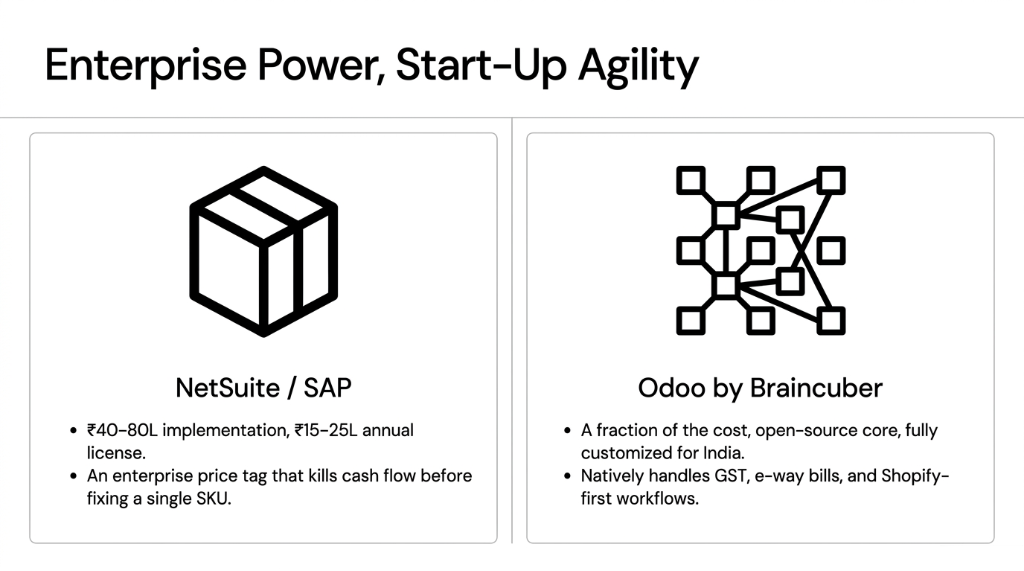
NetSuite starts at $47,600-$95,200 implementation with $17,850-$29,750/year licensing. Braincuber implements Odoo - open-source at its core - at a fraction of that cost, fully customized for India-specific GST, e-way bills, and Shopify-first D2C workflows. Same variant-level control without the enterprise price tag.
Stop Letting Size 8 Decide Your Cash Flow
Every day you run on mismatched SKUs and a manual returns notebook is a day you are paying for growth you cannot capture. Book our free 15-Minute Operations Audit — we will identify your biggest operational leak in the first call.