
The Actual Chaos That 500+ SKUs Create
Let us be precise about what "500+ SKU variants" means operationally for a fashion D2C brand.
You have one kurta. It comes in 6 colours. Each colour has 7 sizes (XS to 4XL). That is 42 SKUs for one product. Scale that to 15 hero styles in a single season, and you are at 630 SKUs — before you account for fabric batches, embroidery variants, and exclusive marketplace-specific bundles.
Here is what happens next. Your Shopify store shows "In Stock" on a Navy Blue XL because your warehouse team updated the tally in a shared Excel sheet — and the Shopify sync ran 4 hours ago. A customer orders. Your warehouse picks. The Navy Blue XL they pick is actually from a different dye lot, one that faded slightly. The customer returns it.
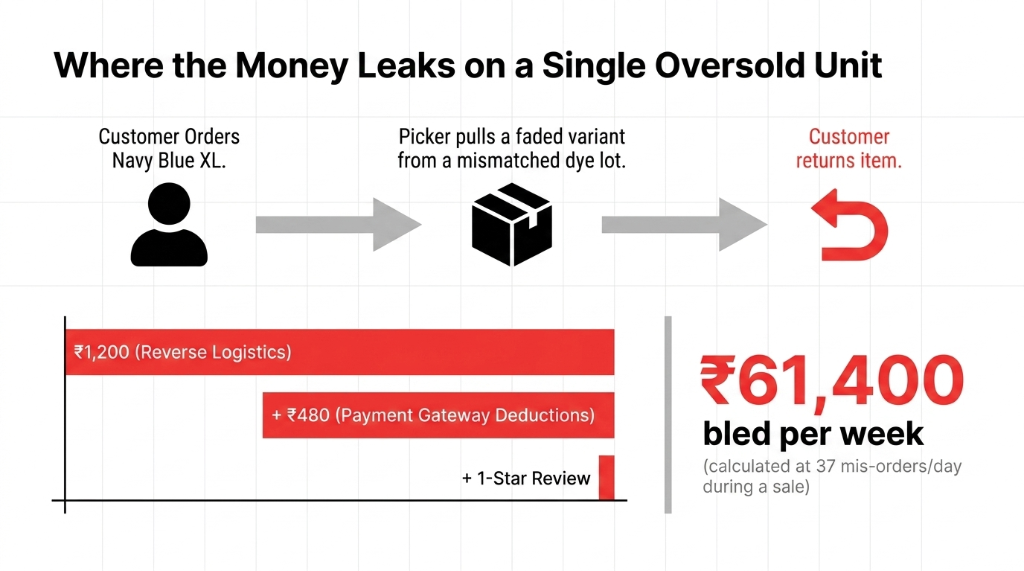
You just absorbed $14.30 in reverse logistics + $5.70 in payment gateway deductions + a 1-star review. Multiply that by 37 orders a day during a sale, and you are bleeding $731 in a single week.
Most founders we meet know something is wrong. They just keep hiring more warehouse staff to "manage the chaos." That is not managing. That is feeding the chaos with more headcount and a higher monthly burn.
Why Your Current Spreadsheet-Plus-Shopify Stack Will Break at Scale
We are not here to sell you on ERP in the abstract. We are here to tell you why the specific tools you rely on are actively working against you above 500 SKUs.
Shopify's Native Inventory Is Flat
It was built for a T-shirt brand with 20 SKUs, not a fashion-forward D2C with 600 variant combinations. The moment you try to manage colour + size + fabric + batch + channel (Myntra, Nykaa Fashion, your own D2C site, offline pop-ups) inside Shopify's native inventory, you are duct-taping a moped engine onto a truck chassis.
Excel VLOOKUPs break at row 50,000. And they always break at 11:45 PM the night before a big sale launch.
(Yes, we know. Your ops manager has a war story about this.)
The P&L Distortion Nobody Mentions
QuickBooks or Zoho Books without an integrated inventory layer means your finance team is reconciling SKU-level COGS manually — and getting it wrong by 3–7% every month. On a $59,500/month revenue brand, that is $1,785–$4,165 in P&L distortions per month. Your gross margin numbers are fiction.
Most fashion D2C brands are making product decisions based on incorrect margin data. They kill their best-performing SKU because the cost data includes a $0.17/unit allocation error compounding for 8 months.
What Odoo ERP Actually Does Differently for Fashion SKU Management
We have implemented Odoo ERP for 150+ brands globally, including fashion-focused D2C operators. Here is what the system does that your current stack physically cannot.
The Variant Matrix: Built for Fashion, Not T-Shirts
Odoo's Product Variants module is built for exactly this use case. You define attributes once — Colour, Size, Fabric, Fit, Embellishment — and Odoo auto-generates every combination with individual barcode, individual stock location, individual cost, and individual reorder rule. A 6-colour x 7-size x 3-fabric kurta becomes 126 trackable variants in under 8 minutes. (Compare that to the 6 hours your ops team spends building out a new product in your current setup.)
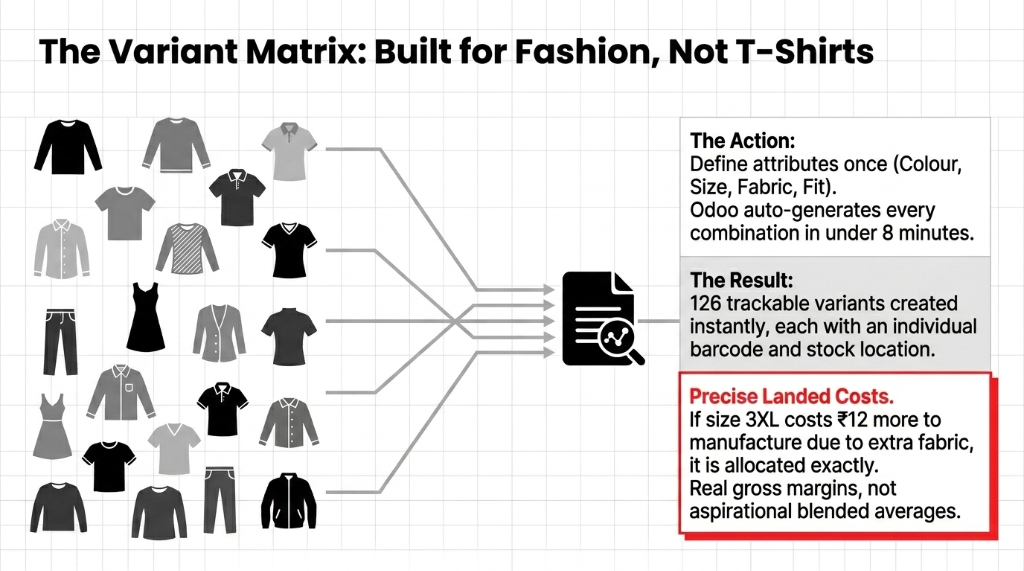
Every variant carries its own landed cost — not an average blended cost. If your manufacturer charges $0.14 more per unit for size 3XL and 4XL due to extra fabric, that gets allocated precisely. Your CFO gets real gross margins, not aspirational ones.
Real-Time Multi-Channel Inventory with Hard Locks
Odoo sits at the centre. Shopify, Myntra, Amazon, and your physical pop-up at a mall all pull from a single inventory pool. When a customer buys your Mustard Yellow L on Myntra, that unit is reserved immediately — not "synced in 15 minutes." The Shopify listing updates within 22 seconds via webhook.
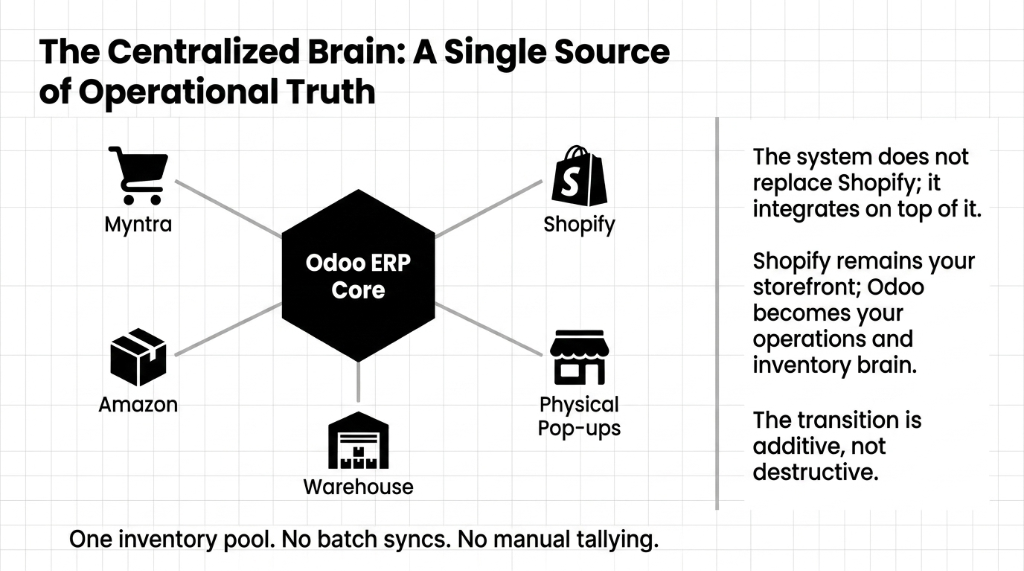
We clocked this in a live Odoo ERP integration for a kidswear brand doing $25,000/month. No oversells. No apology emails. No refund processing on Day 2.
Batch and Lot Tracking for Fabric Consistency
Fashion brands have a problem that electronics brands do not: dye lot variance. Two shipments of the same fabric in "Sage Green" from your manufacturer may not match — and if you fulfil an order mixing units from Batch 7 and Batch 9, you get returns and a brand perception hit.
Odoo's Lot/Serial Number tracking tags every GRN (Goods Receipt Note) to a specific production batch. Your pickers are forced to pick from the same lot for a single order. A brand we worked with reduced fabric-mismatch returns from 6.3% to 0.8% in their first 90 days post go-live.
Demand Forecasting That Uses Last Season's Data, Not Your Gut
Odoo's AI-assisted reorder rules analyse the sell-through rate of each SKU variant across the last 3 seasons and flag which colours and sizes to reorder, at what quantity, and by which date — based on your next campaign calendar.
Real Recovery: $22,300 Across Two Festive Seasons
Before Odoo, one of our clients (a festive wear brand doing $100,000 annually) was over-stocking "trendy" colours by $4,050 worth per season and under-stocking their core Navy and Off-White by a combined $14,300. Post-implementation, they recovered $22,300 in the first two festive seasons by reallocating OTB (Open-to-Buy) budget based on actual variant-level demand signals.
The Multi-Warehouse Reality: Fulfilling from 3 Locations Without a Stockout
Fashion D2C brands at $59,500+ ARR almost always run 2–3 fulfilment points: a primary warehouse, a 3PL partner, and sometimes a production unit that doubles as a backup stock location. Managing allocation across these without a centralised system leads to one very specific nightmare: split-shipment orders.
Customer orders 2 pieces. Piece 1 is in Mumbai. Piece 2 is in Bengaluru. Without ERP routing logic, your ops team ships them separately. You eat $4.05 in extra courier charges per order. If this happens to 23 orders a day, that is $93.15 per day, or $2,795 per month in entirely avoidable logistics cost.
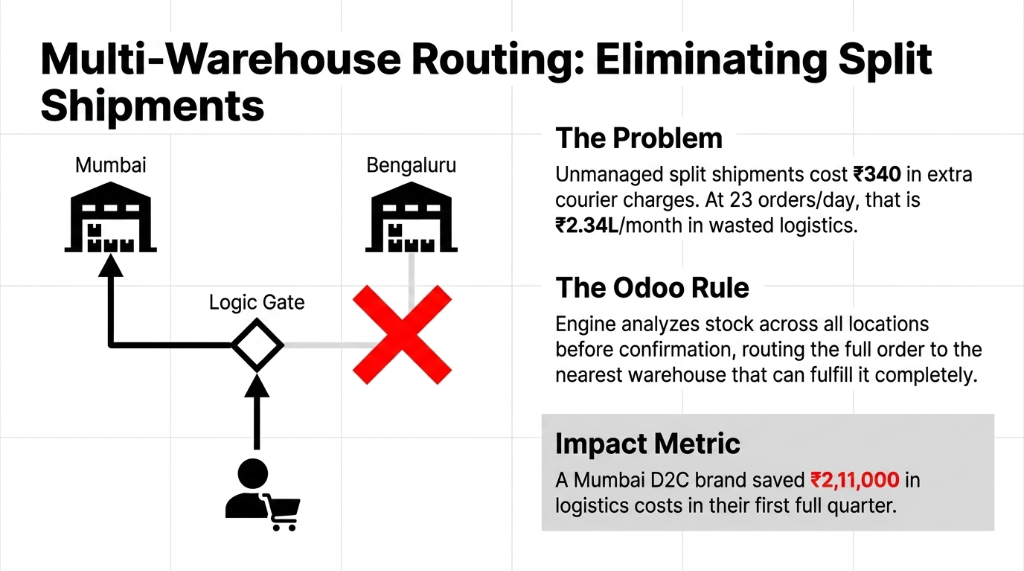
Odoo's multi-warehouse routing engine analyses stock availability at each location before order confirmation and routes the full order to the nearest warehouse that can fulfil it completely. If no single warehouse can, it flags the order for manual review rather than auto-splitting it. One D2C brand saved $2,515 in logistics costs in their first full quarter using this rule alone.
The Implementation Reality: What the First 90 Days Look Like
We are not going to promise you a magic button. Here is what an Odoo ERP implementation for a fashion D2C brand with 500+ SKUs actually looks like when done right.
Days 1–14: Data Migration (The Ugly Part)
Every SKU, every variant, every supplier price list, every Bill of Materials gets cleaned and imported. You will find 130 duplicate SKUs and 47 products where the cost price was never entered. (That is the average across our last 12 fashion implementations.)
Days 15–30: Shopify–Odoo Integration in Staging
We test 500 mock orders across every variant type. We find the edge cases — bundle products, gift-with-purchase SKUs, marketplace-exclusive sizes — before they go live.
Days 31–60: Go-Live on a Low-Traffic Week
Never during a sale. Your team runs parallel for 2 weeks, updating both systems, until confidence is at 100%.
Days 61–90: Sale Season Stress Test
Your first major campaign run entirely on Odoo. Average response from ops team: "Why didn't we do this 2 years ago?"
47–63 working days. Not 6 months. ROI crossover between Day 55 and Day 78.
Full implementation for a 500–800 SKU fashion D2C brand. The brands that delay "until next quarter" are the ones still bleeding $731/week to split shipments and dye-lot returns while their competitors just automated theirs.
What You Should Never Do (And Most Brands Do Anyway)
Frankly, the worst decision you can make is buying a big-box ERP like SAP Business One or Oracle NetSuite because your CA mentioned it. Unless you have $53,500–$71,400 to burn on implementation alone plus a 9-month timeline, those platforms will financially injure a sub-$297,000 D2C brand.
The second worst decision: buying a fashion-specific vertical SaaS that locks your data in a proprietary format, charges you $950–$1,430/month at scale, and has zero open API for when you want to connect your Klaviyo email flows to purchase behaviour data.
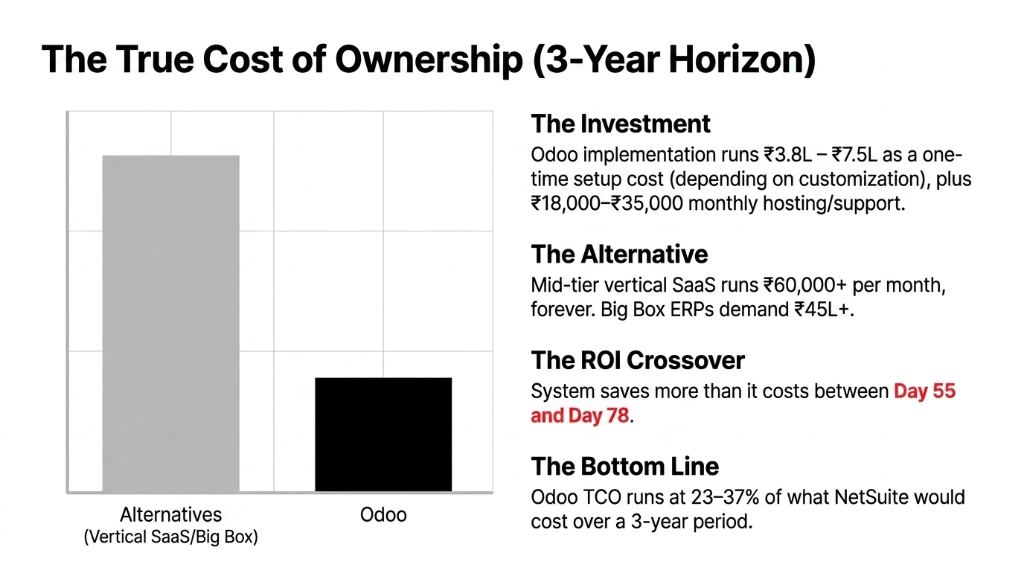
Odoo is open-source at its core. You own your data. You can extend it. And the total cost of ownership for a 500 SKU fashion D2C brand runs at 23–37% of what NetSuite would cost over a 3-year period.
The Insider Secret
Everyone says buy NetSuite. Don't. We have rescued three failed NetSuite implementations for fashion D2C brands where the total sunk cost exceeded $47,600 each time — before a single order was processed through the system. At that price point, you could run Odoo for seven years with full partner support.
The platform is not your problem. The implementation partner who does not understand fashion operations is your problem.
FAQ: ERP for Fashion D2C Brands
How long does Odoo ERP implementation take for a fashion D2C brand with 500+ SKUs?
For a brand with 500–800 active SKUs across 2–3 warehouses, our average implementation timeline is 47–63 working days. That includes data migration, Shopify integration, staff training, and a live stress-test. We do not go live during a sale window under any circumstance.
How much does ERP for fashion D2C cost?
A well-scoped Odoo implementation for a fashion D2C brand with 500+ SKUs and Shopify integration typically runs between $4,520 and $8,930 as a one-time cost, depending on customisation depth. Monthly hosting and support runs $214–$417. Compare that to $715+ per month for a mid-tier vertical SaaS alternative.
Can Odoo manage marketplace-specific SKUs for Myntra and Amazon separately?
Yes. Odoo supports channel-specific product listings, pricing rules, and inventory buffers. You can hold 15 units in a "Myntra safety buffer" that Shopify cannot touch — all from a single product record. This prevents overselling during simultaneous campaigns on multiple channels.
What happens to our existing Shopify data when we move to Odoo?
Nothing gets deleted from Shopify. Odoo integrates on top of Shopify, not in replacement of it. Your order history, customer data, and product listings stay intact. Odoo becomes the inventory and operations brain; Shopify stays your storefront. The transition is additive, not destructive.
Will our warehouse team actually use this, or will they go back to Excel in 2 weeks?
Only if the implementation is done wrong. We build the Odoo picking interface to match your warehouse's physical layout — aisle by aisle. Scanners replace manual typing. The average warehouse team is fully proficient within 9 working days. The brands that revert to Excel are the ones that went live without a proper 2-week parallel run. We enforce the parallel run. Non-negotiable.
Stop Bleeding Cash on Mis-Picks, Overstock, and Split Shipments
Book our free 15-Minute Operations Audit — in one call, we will pinpoint the single biggest operational leak in your current SKU management setup. Your next sale season is closer than you think. Your competitors are already fixing this.