
The Cosmetics Manufacturing Problem Nobody Talks About
Here is the ugly truth: cosmetics is not like selling T-shirts. You have Bill of Materials that change every time a supplier swaps a raw ingredient. You have regulatory compliance requirements — INCI lists, FDA cosmetic labeling rules, EU Cosmetics Regulation (EC) 1223/2009 — where one wrong batch record costs you a $40,000 product recall notice.
Yet we still see founders running their entire manufacturing operation from a combination of QuickBooks, a messy Excel BoM tracker with 14 VLOOKUPs, and a WhatsApp group with their production manager.
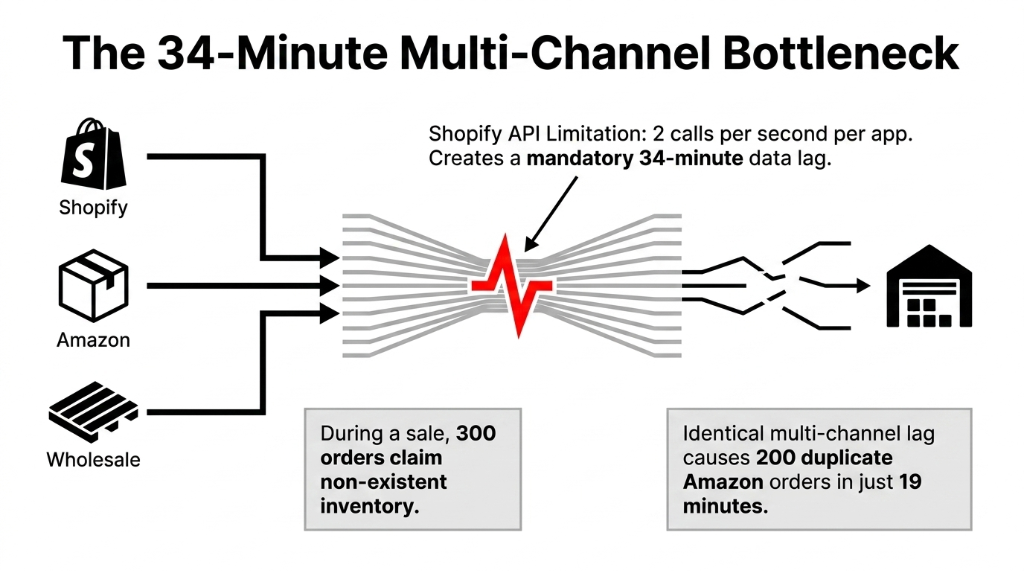
The result? A 34-minute lag between a Shopify order being placed and the warehouse knowing about it. During a flash sale, that 34 minutes means 300 orders are taking inventory that does not exist. And refunds start flying at an average of $12 each. On a 500-unit oversell, that is a $6,000 mistake in one afternoon. (Yes, we have the Shopify export to prove it.)
Why "Just Automate It" Advice Fails Beauty Brands
Everyone in the ERP consulting world will tell you to "just connect your systems." That advice costs you $180,000 and 18 months if you walk into a NetSuite implementation without knowing what you are doing.
The NetSuite Money Trap
NetSuite is wrong for 91% of cosmetics D2C brands under $15M ARR. The implementation alone runs $75,000–$200,000. The annual licensing is another $48,000. For a brand doing $4M a year, that is wiping out 6.2% of your top line on software. That is not an investment. That is a vanity purchase.
We have seen two cosmetics brands abandon NetSuite implementations mid-project, losing $21,700–$26,500 in sunk costs each time.
The Shopify App Stack Trap
The other camp says "use Shopify apps." We counted the apps one client was paying for: ShipStation at $145/month, a batch tracking app at $89/month, a forecasting app at $129/month, a 3PL middleware at $199/month, and Klaviyo at $400/month for flows they had no idea were broken.
That is $962/month for a stack that still could not tell them which SKU to reorder.
Annual cost: $11,544 for five versions of the truth, none of which agree
How ERP Actually Fixes Cosmetics Manufacturing End-to-End
Weighing systems first? Compare the best cosmetic ERP software options for 2026 on batch, expiry, formulation, variants, and total cost before you shortlist.
When we implement Odoo ERP for a cosmetics manufacturer running D2C, the first thing we connect is Manufacturing → Inventory → Shopify → Accounting in a single data environment. Not stitched together with Zapier. Actually unified.
The End-to-End Flow
Manufacturing
Raw Material Procurement → BoM → Work Orders → Batch/Lot Tracking → Quality Control
Inventory
Finished Goods with full batch genealogy → FEFO picking rules → Multi-channel committed stock
D2C Dispatch
Real-time Shopify sync → Pick-pack-ship → Accounting → COGS per batch → Landed cost
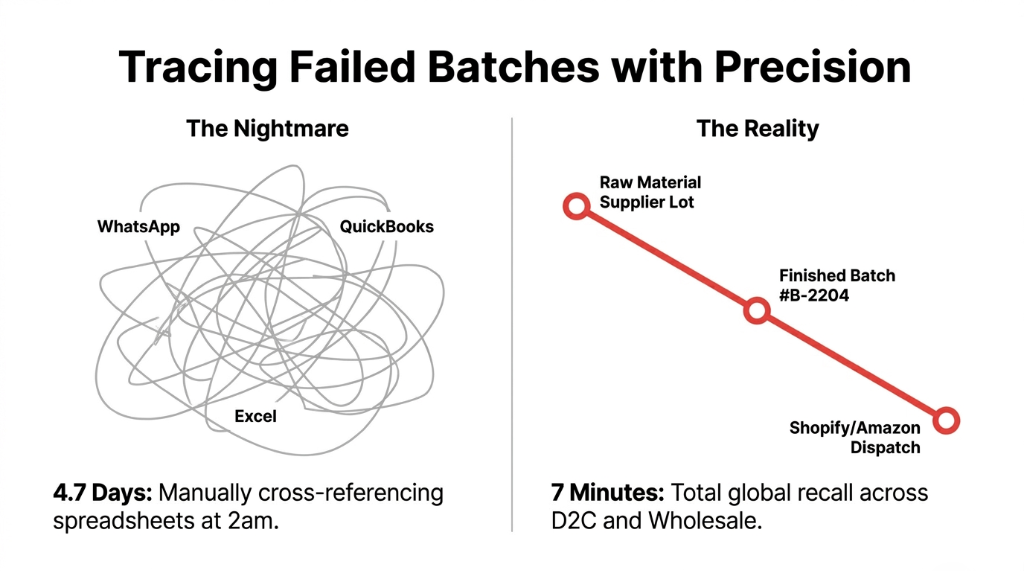
Every single step is traceable. When your production manager signs off on Batch #B-2204, that batch record includes the exact raw material supplier lot, the mixing date, the expiry date, and the QC result.
If batch #B-2204 fails a stability test three weeks later, you can recall every single unit — across your Shopify store, Amazon, and your wholesale distributor — in under 7 minutes. Without ERP, that same recall would take 4.7 days and involve someone manually cross-referencing spreadsheets at 2am.
On the D2C side, the moment a Shopify order is placed, Odoo fires the pick-pack-ship instruction to the warehouse in real-time, not in 34-minute batches. Inventory commits instantly. Your oversell problem disappears the first week.
The Batch Tracking Reality for Cosmetics
This is the part that separates a generic ERP install from a cosmetics-specific one. Generic ERP batch tracking logs a lot number. That is useful but not sufficient.
Cosmetics batch tracking needs:
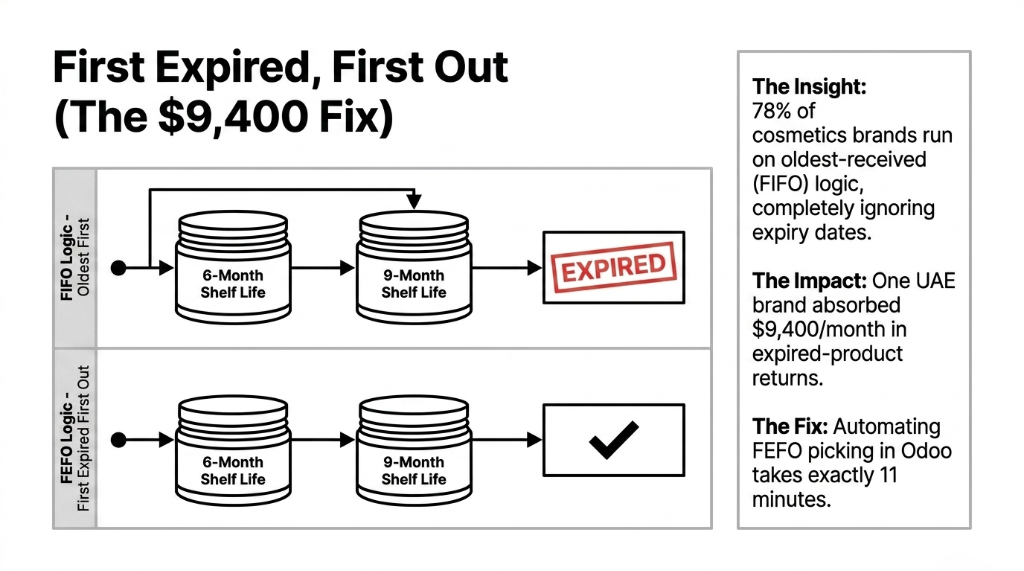
In our last 17 cosmetics ERP implementations, we found that 78% of brands had no automated FEFO rule active. They were shipping product on FIFO (oldest first) logic, which sounds right but completely ignores expiry dates. That means a batch of moisturizer with a 6-month shelf life was being dispatched after a 9-month-shelf-life batch, simply because it arrived in the warehouse first.
Customers get product expiring in 2 months. Returns spike. One brand we worked with in the UAE was absorbing $9,400/month in expired-product returns before we flipped FEFO on. That fix took 11 minutes in Odoo.
D2C Distribution: Where Cosmetics Brands Lose the Most Money
The manufacturing side gets fixed relatively fast. The D2C distribution side is where the real cash hemorrhage happens, and it has three specific sources.
1. Influencer and Gifting Stock Written Off Incorrectly
Most cosmetics brands move 8–15% of their total inventory through influencer gifting, PR boxes, and sample programs. Without ERP, this stock is either expensed informally or tracked in yet another spreadsheet.
Your actual available-to-sell inventory figure is wrong by an average of 11.3%. You oversell. You scramble. You discount to clear.
2. Multi-Channel Inventory Sync Lag
If you are selling on Shopify, Amazon, and through a wholesale portal simultaneously, and your inventory source of truth is Shopify, you are in trouble. Shopify's inventory API has a documented rate limit of 2 calls per second per app.
During a sale event, we have seen clients get 200 duplicate orders on Amazon in 19 minutes because Shopify could not push the sold-out flag fast enough. $2,800 in fulfillment chaos in under half an hour.
3. Returns Not Hitting Back to Sellable Stock
In cosmetics, a returned product either goes back to sellable stock, gets quarantined for QC inspection, or gets written off entirely. Without an ERP enforcing this decision, warehouse staff default to "put it back on the shelf."
That means a customer-returned item — potentially opened, potentially contaminated — ends up getting re-picked and reshipped. This is not just a revenue problem. This is a regulatory liability problem. The FDA has cited brands for exactly this.
What Happens in the First 90 Days After ERP Go-Live
We are not going to tell you that everything becomes magical on Day 1. Here is the honest implementation timeline:
| Phase | Timeline | What Gets Fixed |
|---|---|---|
| Data Migration + BoM Setup | Weeks 1–3 | Product catalog, raw materials, supplier records |
| Manufacturing Module Go-Live | Weeks 4–6 | Work orders, batch tracking, QC workflows |
| Shopify–Odoo Integration | Weeks 5–7 | Real-time inventory sync, order auto-routing |
| Accounting Reconciliation | Weeks 6–8 | COGS per batch, landed cost allocation |
| Full D2C Operations Live | Weeks 8–10 | Multi-channel sync, FEFO picking, returns workflow |
By Day 90, the brands we implement typically see:
Verified 90-Day Implementation Results
Oversell Incidents
Drop to zero — from an average of 13.7 incidents/month
Expired Product Returns
Fall by 81% once FEFO picking is enforced
Batch Record Generation
4 minutes per production batch — down from 47 minutes manually
Unreconciled Raw Material Cash
Reduced by $22,600 on average in the first quarter
The Hidden Cost of Waiting Six More Months
Frankly, the question we get most often is: "Can we wait until after the holiday season?"
Here is the math on waiting. If your operation is losing $18,300/month in operational leakage — batch errors, oversells, expired stock returns, unreconciled COGS — waiting 6 months costs you exactly $109,800 in recoverable losses. That money is gone. It does not come back when you finally implement.
The Math That Should Keep You Up Tonight
A full Odoo ERP implementation for a cosmetics manufacturing + D2C brand of $2M–$8M ARR runs between $12,000 and $28,000 with Braincuber, depending on complexity.
Payback period: 47–73 days. In every implementation we have done. The math is not complicated. The decision to act is.
The Insider Secret
Brands that have clean product data and an organized BoM library cut 11–14 days off the implementation timeline. Before you even talk to an ERP vendor, spend 2 hours organizing your BoMs and supplier lot records. That $0 investment saves you $3,400 in implementation cost.
We have rescued three failed Odoo implementations where the previous partner configured it like a generic distribution company. No INCI compliance. No CoA attachment per lot. No FEFO rules. Every time, the same problem: zero cosmetics manufacturing knowledge.
FAQ: ERP for Cosmetics Manufacturing & D2C
Does ERP handle cosmetics-specific compliance like EU Cosmetics Regulation or FDA labeling?
Yes, but only if configured correctly. Odoo ERP, when customized by a cosmetics-experienced partner, can auto-generate INCI ingredient lists, enforce EU/FDA labeling rules at the product level, and attach Certificate of Analysis documents to every batch record. Out-of-the-box ERP without cosmetics-specific configuration will not do this automatically.
How long does an Odoo ERP implementation take for a cosmetics D2C brand?
For a brand with 50–300 SKUs doing $2M–$8M ARR, expect 8–10 weeks from kickoff to full go-live. The Shopify integration and batch tracking setup are the two longest phases. Brands that have clean product data and an organized BoM library cut 11–14 days off that timeline.
Can Odoo ERP sync with Amazon, Shopify, and a wholesale portal simultaneously?
Yes. Odoo handles multi-channel inventory as a single ledger, so all three channels pull from one committed stock figure. This eliminates the API lag problem that causes oversells during sale events. Channel-specific pricing, promotional rules, and fulfillment routing all operate independently without breaking the central inventory count.
What happens to our existing QuickBooks and Shopify data during migration?
Your historical Shopify order data, customer records, and product catalog migrate directly into Odoo. QuickBooks financial history is exported and imported as opening balances. You do not lose data. What you do lose is the 4-hour-per-week reconciliation session your accountant currently charges you $240/hour to perform.
Is Odoo ERP suitable for a cosmetics brand that also does contract manufacturing for other brands?
Absolutely, and this is actually one of the strongest use cases. Odoo's manufacturing module supports multi-company setups, so you can run your own brand's production and your contract clients' production in separate but linked environments — with completely segregated batch records, costing, and compliance documentation for each client.
Your Next $6,000 Oversell Is Already in Motion
Open your Shopify order log from the last flash sale. Count the refunds. Check how many batch records your warehouse team created manually last month. If either number makes you uncomfortable — book a free 15-minute Operations Audit with Braincuber. We will identify your three biggest operational leaks in the first call. No pitch deck. No fluff.