
The Numbers Proving This Wave Is Not Optional
D2C brands leased 5.94 lakh sq ft of retail space in just the first half of 2025 in India alone — 18% of total retail leasing, up from 8% in H1 2024. Fashion led at 60%, followed by homeware and jewellery at 12% each.
Globally, the D2C market sat at $684.4 billion in 2025 and is projected to hit $2,839.5 billion by 2034 at a 16.61% CAGR. The brands capturing that growth will not be the ones with the prettiest storefronts. They will be the ones who solved the operational nightmare of running online and offline on the same inventory.
Here is the ugly truth: most D2C brands go offline with zero infrastructure for it. They are using a Shopify-native inventory system, a POS that does not talk to their warehouse, and a finance team reconciling SKUs in Excel every Tuesday. That is not a retail strategy. That is a $23,000-a-month disaster.
Where the Money Actually Leaks (3 Breaks in 90 Days)
When a D2C brand opens its first physical store without fixing its backend, three things break within the first 90 days. Every. Single. Time.
Break #1: Inventory Becomes a Lie
What happens: Your Shopify store says 47 units of SKU-BLK-XL are in stock. Your store manager just sold 12 of them. Your warehouse already committed 30 to an Amazon FBA shipment. Nobody updated anything in real time. A customer orders online at 11 PM, and your warehouse ships it the next morning — only to realize the store already sold the last units at 2 PM the previous day.
Real Cost We Found
$14,700/month in phantom inventory refunds at a single $3.1M Dubai apparel brand. Not a demand issue. Not a product issue. A data sync issue.
Break #2: Your POS and ERP Speak Different Languages
The bad advice: "Just use Shopify POS." Do not. Unless you are running a single store with under 50 SKUs and no wholesale channel, Shopify POS creates reconciliation headaches the moment you scale past two locations. It lacks the multi-location inventory allocation logic you need when you are simultaneously serving D2C, retail, and marketplace channels.
The Reconciliation Tax
We have seen brands running 3 locations on Shopify POS spend 37 hours per month just reconciling end-of-day sales data with their central inventory. That is one full-time employee's workweek. Every single month. Wasted.
Break #3: Demand Forecasting Collapses
Why: Online D2C demand follows predictable digital signals — ad spend, email open rates, social virality. Offline retail demand follows foot traffic, geography, seasonality, and local events. Brands that do not bifurcate their forecasting models end up either overstocking stores by 31% (tying up cash in slow-moving inventory) or going out-of-stock on bestsellers during peak footfall.
The Double Loss
Overstocking kills your cash flow. Stockouts kill your customer relationship. Both happen simultaneously when you run one forecasting model for two fundamentally different sales channels.
Why "Just Add a POS" Is the Most Expensive Advice You Will Get
Everyone tells D2C founders to bolt on a POS system and call it a day. We hear this constantly. It is wrong.
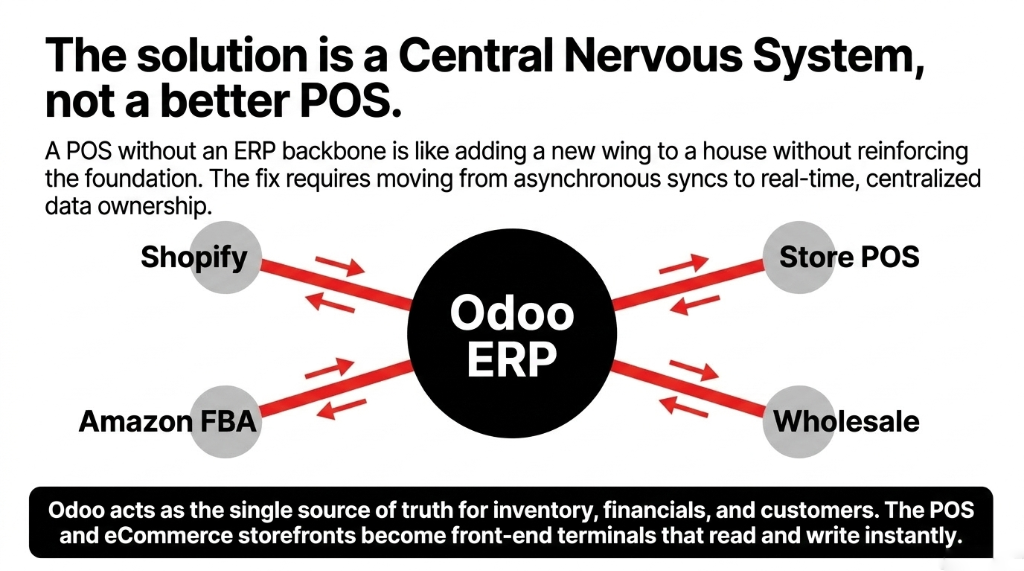
A POS system without an integrated ERP backbone is like adding a new wing to your house without reinforcing the foundation. It looks fine from the outside. Until it does not.
The Data Island Problem Nobody Warns You About
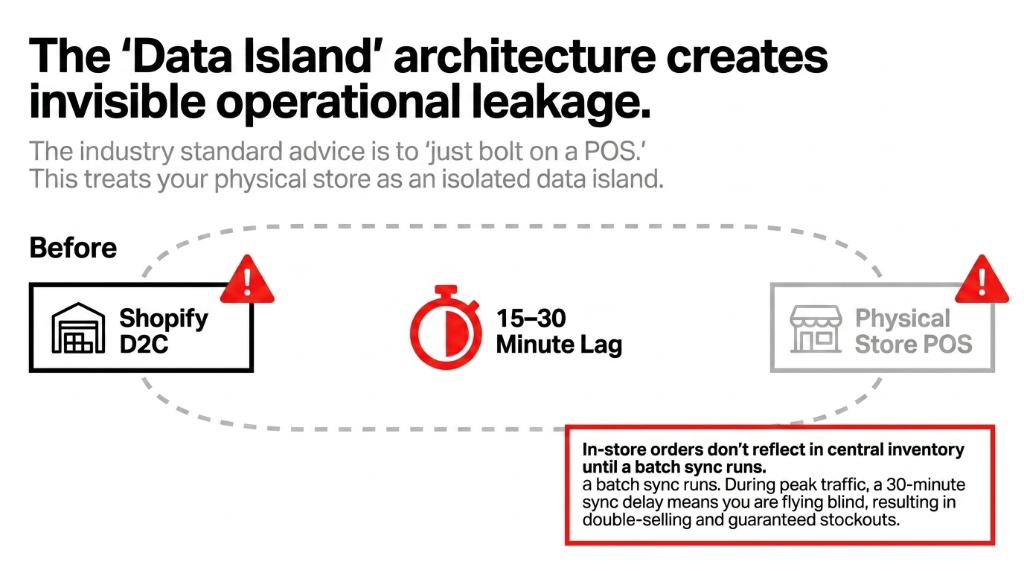
Most POS systems, including Square, Lightspeed, and standalone Shopify POS, treat your physical store as an isolated data island. Orders processed in-store do not reflect in your central inventory until a sync job runs — and most of those sync jobs run every 15 to 30 minutes. During a flash sale or a high-traffic weekend, 30 minutes of inventory lag means you are flying blind — resulting in double-selling and guaranteed stockouts.
The real fix is not a better POS. It is a central nervous system — an ERP that owns the single source of truth for inventory, orders, customers, and financials, with the POS sitting as a front-end terminal that reads and writes to it in real time.
The 5-Layer Tech Stack That Actually Works
The brands that have expanded successfully from D2C to retail — and done it without hemorrhaging money — are running a specific architecture. Here is the exact logic:
Layer 1 — Odoo ERP as the Central Brain
Odoo sits at the center. Every order, whether from Shopify, Amazon, your retail store POS, or a wholesale distributor, feeds into Odoo in real time. Inventory levels are updated the moment a transaction happens. Not every 15 minutes. The moment.
This single change — moving from async sync to real-time ERP-driven inventory — cut stockout-driven lost sales by 23.4% for a health and personal care brand we implemented in Singapore within the first 60 days of go-live.
Layer 2 — Shopify-Odoo Integration for the Online Channel
Your Shopify store does not own inventory data anymore. Odoo does. Shopify pulls available-to-sell quantities from Odoo via API, and when a sale happens, Odoo decrements inventory instantly. Your online store never oversells on a product that your retail store just cleared.
(Yes, Shopify's native inventory API has a rate limit that bites you during Black Friday. That is exactly why you should not let Shopify own your inventory master data.)
Layer 3 — Odoo POS for In-Store Operations
Odoo's built-in POS module runs directly connected to the same inventory database. Store staff see real-time stock. If a customer asks for a size that is out of stock in-store, the system shows availability at other store locations or in the warehouse — and the staff member can place an order for home delivery on the spot. No spreadsheet. No phone call to the warehouse. The transaction takes 4 minutes instead of the 22-minute circus most retail staff go through.
Layer 4 — AI-Powered Demand Forecasting
This is where Braincuber's Agentic AI layer sits on top of Odoo. We build custom forecasting models that separate online demand signals (ad spend, email campaign schedules, influencer drops) from offline demand signals (store location, footfall data, local events calendar). The result: purchase orders are generated with 18.7% better accuracy than manual forecasting, and you stop tying up $40,000 to $80,000 in dead stock at your retail locations.
Layer 5 — Unified Customer Data
This is the one layer almost every brand forgets. When a customer buys from your website and then walks into your store three weeks later, your store staff should know who they are, what they bought, and what they are likely to want next. With Odoo CRM integrated across channels, a single customer profile follows them everywhere. Your loyalty program works online and offline without a separate app.
Real Result: Unified Profiles Drive Repeat Revenue
A $4.3M lifestyle brand in the UK saw their repeat purchase rate climb from 29% to 41% within six months of implementing unified customer profiles across channels — just because their staff could have informed conversations instead of treating every walk-in as a stranger.
The Implementation Reality (No Sugarcoating)
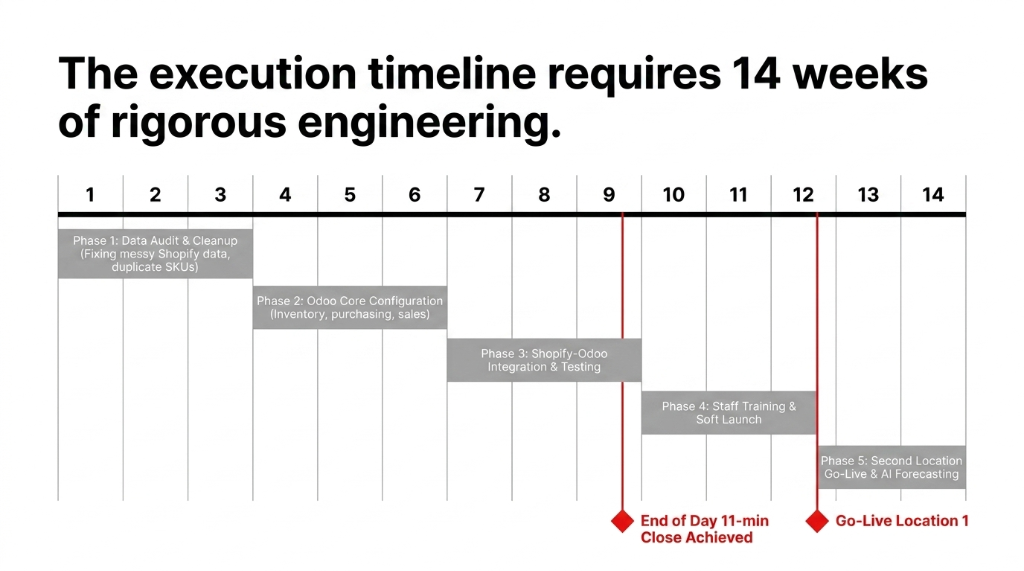
Most Odoo implementation partners will tell you this takes 3 months. The honest answer: for a D2C brand with an existing Shopify store, 2 active retail locations, and a 500+ SKU catalog, a proper implementation takes 9 to 14 weeks.
Here is why: your existing Shopify data is messy. Product variants have duplicate SKUs. Customer records have split profiles. Purchase orders are sitting half-completed in someone's Notion doc.
| Phase | Timeframe | What Actually Happens |
|---|---|---|
| Phase 1 | Weeks 1-3 | Data audit and cleanup — fixing messy Shopify data, duplicate SKUs, split customer profiles (always underestimated) |
| Phase 2 | Weeks 4-6 | Odoo core configuration — inventory, POS, purchasing, and sales modules |
| Phase 3 | Weeks 7-9 | Shopify-Odoo integration and testing with real transaction data — end-of-day 11-min close achieved by Week 9 |
| Phase 4 | Weeks 10-12 | Staff training, go-live at Location 1, soft launch with live monitoring |
| Phase 5 | Weeks 13-14 | Second location go-live and AI forecasting module activation |
The first thing that gets easier, immediately, is end-of-day reconciliation. What used to take your retail manager 2 hours now takes 11 minutes. By week 8, you will stop receiving the 11 PM "we are out of stock and I do not know why" texts from your store manager.
Implementation Cost vs. Operational Leakage
Implementation Cost
$12,000-$28,000
One-time investment based on integrations, locations, and custom AI modules
Monthly Leakage Stopped
$14,000+/month
Operational bleeding we regularly find in brands that have not fixed their stack
Payback Period
47-63 days
The math is not complicated. One-time cost vs. recurring leakage that compounds every month
Brands That Got This Right (And What They Did Differently)
SUGAR Cosmetics, one of India's fastest-growing D2C beauty brands, went from purely online to 45,000+ retail touchpoints — and the core of that expansion was a technology-first approach to inventory and distribution management. They did not open stores and then figure out the tech. They built the tech backbone first.
The Souled Store followed a similar playbook — D2C first, then offline retail — using integrated inventory systems to ensure their online catalog and in-store availability stayed synchronized as they scaled. Both brands understood that offline retail is not a distribution strategy. It is a data strategy.
The Pattern in the Brands That Fail
They open stores, run them on a different inventory system than their online channel, and spend 18 months watching their gross margins erode from 62% to 44%.
Not because retail is unprofitable. Because their operations are eating the profit alive.
Your 30-Day Action List (If You Are Serious)
- Audit your current inventory sync latency. How long does it take for an online sale to reflect in your retail store's available stock? If it is more than 5 minutes, you have a problem
- Map your current tech stack conflicts. Are you running Shopify, a separate POS, QuickBooks, and a 3PL that uses its own WMS? Every seam between those systems is a place money leaks
- Stop buying standalone software. Every new SaaS tool you add is another integration to maintain, another sync to break, another bill to pay
- Pilot unified ERP at one location first. Do not try to roll out to all stores simultaneously. Get one location working perfectly, then replicate
The D2C founders who scale offline without breaking their business are not smarter than you. They are just operating with better infrastructure.
The Controversial Take Nobody Will Say
Everyone says buy NetSuite when you are going multi-channel. Do not. It burns $500,000+ and takes 9-14 months for a brand doing $2M-$10M in revenue. Odoo achieves the same multi-channel infrastructure at 15-25% of the cost and goes live in half the time. We have cleaned up 11 NetSuite implementations in the last 18 months for D2C brands that got sold a system built for Fortune 500 companies, not a 4-person ops team trying to open their second store.
Frequently Asked Questions
How long does it take to integrate Odoo ERP with an existing Shopify D2C store for offline retail?
For a brand with 300-700 SKUs, one to three retail locations, and an active Shopify store, a proper Shopify-Odoo integration takes 7 to 9 weeks. This includes data migration, real-time inventory sync configuration, POS setup, and staff training. Brands that rush this under 4 weeks typically spend twice as long fixing broken sync issues afterward.
What is the biggest technology mistake D2C brands make when expanding offline?
Treating the POS as an independent system rather than a terminal connected to a central ERP. This creates inventory data silos where online and offline stock levels diverge within hours of a store opening. The result is overselling online and understocking in-store simultaneously — a double loss that costs brands between $8,000 and $22,000 a month depending on order volume.
Can Odoo handle both D2C e-commerce and retail POS from a single platform?
Yes. Odoo's native POS module connects directly to the same inventory and customer database used by your e-commerce channel. Every in-store transaction updates central stock in real time, and customer purchase history is unified across both channels. This eliminates the need for a separate retail management system and the expensive integrations that come with it.
How much does a D2C-to-retail technology implementation with Braincuber cost?
A full Braincuber Odoo implementation for D2C brands expanding to physical retail — including Shopify integration, POS configuration, AI demand forecasting, and unified CRM — typically ranges from $12,000 to $28,000. This is a one-time project cost, not a recurring subscription. Most brands recover this investment within 90 days through reduced inventory leakage and eliminated reconciliation labor.
Does offline retail expansion actually improve D2C profitability?
When done with the right tech backbone, offline retail improves total brand profitability by 19-31% because physical stores reduce customer acquisition cost, improve brand trust, and increase average order value through in-store upselling. D2C brands that go offline without fixing their operations see the opposite — margins erode by 15-20% as operational costs outpace revenue gains.
Check Your Inventory Sync Latency. If It Is Over 5 Minutes, Call Us.
We bet your retail store's POS and your Shopify inventory are running on different versions of reality right now. Pull up the numbers. If your end-of-day reconciliation takes more than 15 minutes, your tech stack is bleeding cash. We have rebuilt D2C-to-retail infrastructure for 150+ brands globally. The implementation takes 9-14 weeks. The leakage stops on Day 1 of go-live.