
The Core Components of a Modern Cold Chain Stack
A perishable D2C brand needs seven technology layers working together. Miss one and the chain breaks — literally.
| Component | What It Does | Failure Cost |
|---|---|---|
| Cold Storage / Dark Stores | Localised refrigerated micro-fulfilment near demand | $8,400/month in spoilage |
| Temperature-Controlled Transport | Reefers, insulated vans matched to SKU temp bands (-18C frozen, 0-4C chilled) | 23% order rejection rate |
| Active Cooling Consumables | Dry ice, eutectic plates, gel packs for transit gaps | $1.20–$3.60 per failed order |
| IoT Sensors + Gateways | Real-time temp, humidity, shock, GPS across journey | Zero visibility = zero corrective action |
| CCMS Platform | Ingests telemetry, enforces rules, triggers alarms, integrates OMS | Sensors without workflow = expensive data nobody reads |
| Traceability Layer | Blockchain or tamper-evident ledgers for audit trails | Recall response in hours vs. minutes |
| Analytics and AI | Predictive route risk, spoilage probability, dynamic re-routing | Reactive ops instead of preventive ops |
How These Components Map to a D2C Customer Journey
The cold chain is not a warehouse problem. It is a 6-stage relay race where every handoff is a potential temperature excursion.
Stage 1 — Sourcing and Pre-Cooling
Harvest-to-chill window. Fresh goods must be cooled rapidly after harvest or production to the target band. Failure here shortens shelf life irreparably. Pre-cooling equipment and SOPs are non-negotiable. A mango that is not pre-cooled within 2 hours of harvest loses 37% of its shelf life before it even enters your supply chain.
Stage 2 — Dark Store Staging
Inventory is held in temperature zones. Picking and packing happen in controlled environments to avoid temperature excursions during processing. Micro-fulfilment minimises time outside cooling. Zone SKUs by temperature band and velocity — co-locate fast-moving chilled SKUs near packing lines.
Stage 3 — Packaging and Conditioning
Insulated packaging combined with phase-change materials or dry ice, sized for transit time and ambient conditions. Overpacking with unnecessary dry ice wastes $1.80 per order and raises safety/regulatory overhead. Right-size packaging per route duration and local climate.
Stage 4 — In-Transit Monitoring
IoT sensors stream temperature and GPS. The CCMS evaluates these streams against SLA thresholds and sends real-time alerts to operations when excursions occur. Without this, you only discover temperature failures after the customer opens the box.
Stage 5 — Last-Mile Delivery
Cold vans or insulated thermal boxes on bikes. Delivery partners must be trained to prioritise cold parcels and have SOPs to avoid product exposure at doorstep. Most temperature failures occur in the last mile — invest here first.
Stage 6 — Post-Delivery Verification
Digital receipts with temperature logs, optionally shared with the customer for trust and transparency. This is not a nice-to-have — it is a competitive weapon for premium perishable brands.
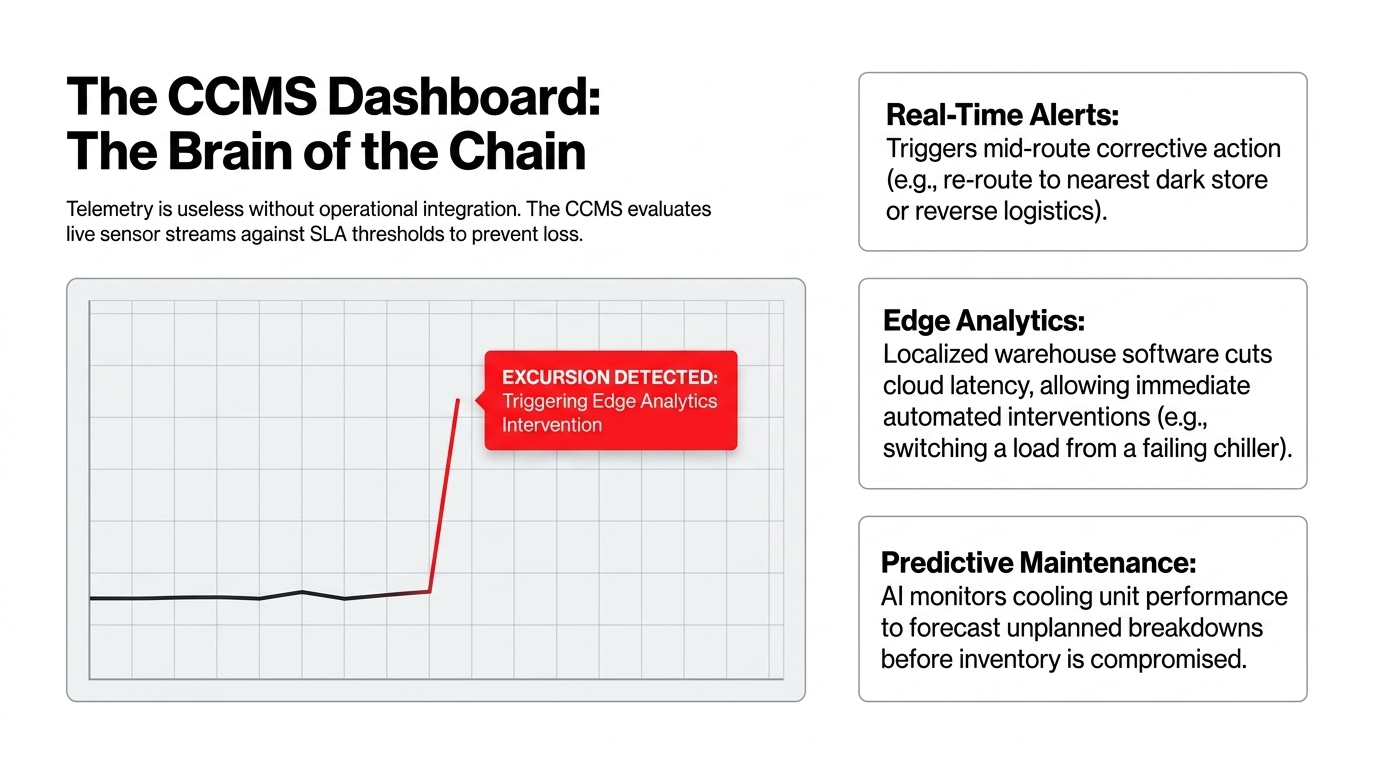
The CCMS Dashboard: The Brain of the Chain
Telemetry is useless without operational integration. Buying sensors without integration plans is the most expensive mistake we see — you end up with beautiful data nobody acts on. The CCMS evaluates live sensor streams against SLA thresholds and prevents loss.
Technology Use Cases That Materially Reduce Loss
Real-Time Alerts
30–50% Less Spoilage
Mid-route corrective action: re-route to nearest dark store, reverse logistics to vendor, or customer reschedule. Published case studies confirm this range.
Edge Analytics
Sub-Second Response
Localised warehouse software cuts cloud latency on critical alerts. Automated interventions like switching a load from a failing chiller to backup.
Predictive Maintenance
Zero Unplanned Downtime
AI monitors cooling unit performance to forecast breakdowns before inventory is compromised. One chiller failure can wipe out $14,200 in inventory overnight.
Operational Changes Required — Cold Chain Is Not Logistics-Only
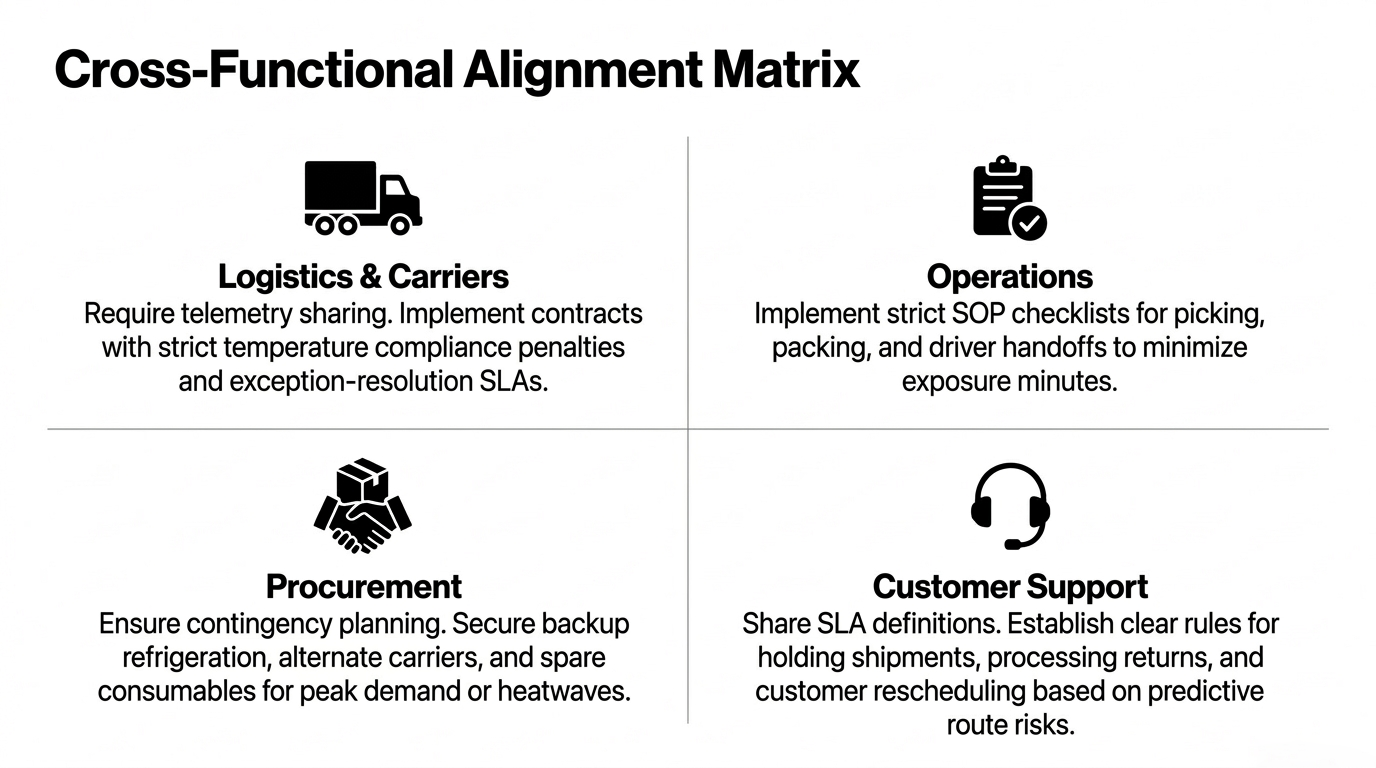
The biggest pitfall: treating cold chain as a logistics problem. Success requires operations, product, and customer experience alignment across four teams simultaneously.
The Carrier Contract Trap
Generic couriers without cold-chain skill sets are the most common failure vector we see. Require telemetry sharing, temperature compliance penalties, and exception-resolution SLAs in every carrier contract. If your carrier cannot share real-time temperature data, they are not a cold chain partner — they are a liability.
- Training and SOPs: Picking, packing, and driver onboarding require strict checklists for minimising exposure during handoffs
- Redundancy planning: Backup refrigeration, alternate carriers, and spare consumables for peak demand or heatwaves
- Regulatory compliance: Handle dry ice and hazardous materials per IATA/DOT rules for air shipments — noncompliance fines start at $2,400
- Sustainability: Plan for return or composting of single-use packaging if local regulations require
Cost vs. Benefit — Realistic Expectations
We are not going to pretend cold chain technology is cheap. Here is the honest math:
The Investment Side
Upfront capital: Cold rooms, chillers, sensor hardware, and specialised vehicles are significant. For a mid-size D2C perishable brand doing $360,000–$1.2M ARR, expect $48,000–$120,000 in infrastructure investment.
Operational cost: Consumables (dry ice, eutectic plates), extra packaging, and carrier premiums increase per-order cost by $0.60–$1.80. Offset with dynamic pricing, minimum order values, and subscription models.
The ROI Side
Measurable levers: Reduced spoilage rates (30–50% improvement), fewer returns, improved repeat purchase rates, and higher customer lifetime value from trust signalling. Paired with route optimisation and reduced waste, the investment often pays back in 7–14 months for high-margin perishable lines.
Marketing the Cold Chain: Trust as a Premium
Here is what most perishable D2C brands miss: your cold chain is not just an operational cost — it is a marketing weapon.
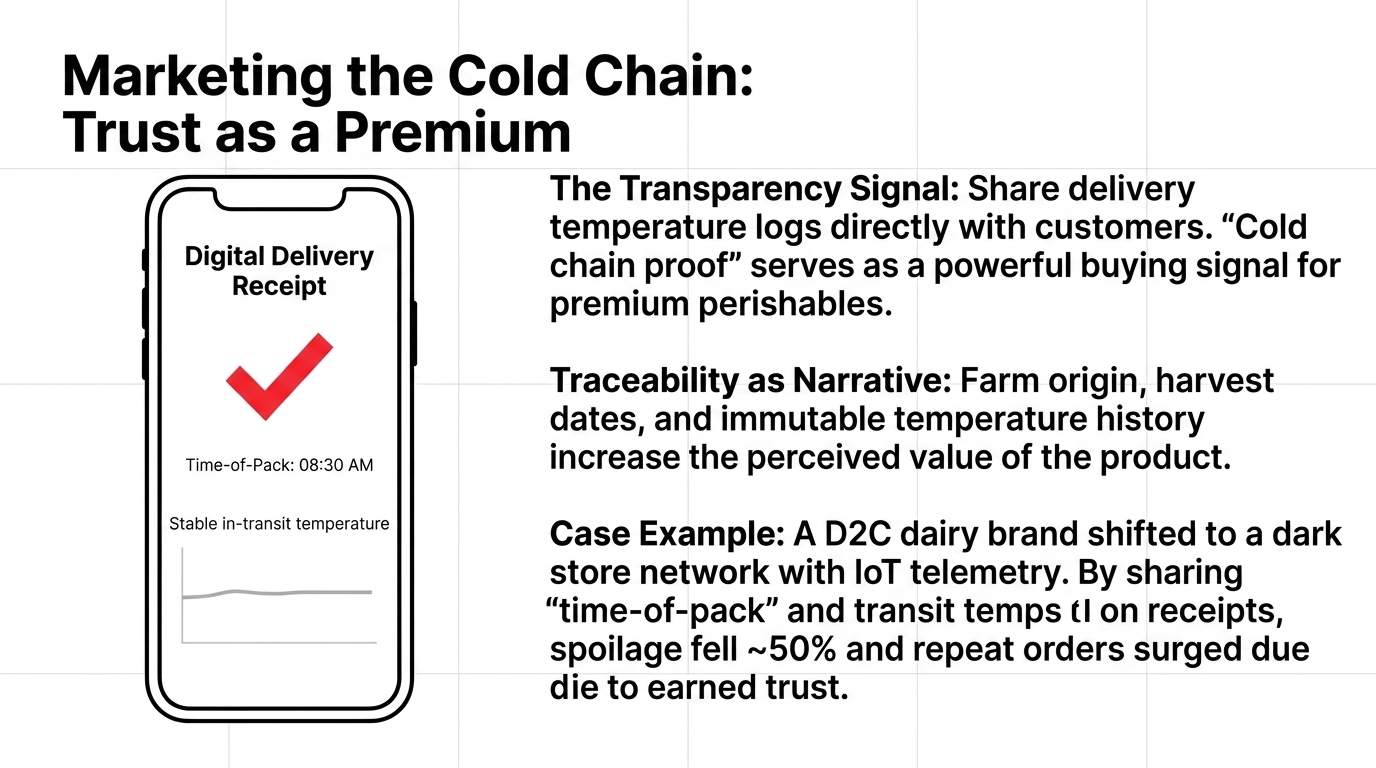
Share delivery temperature logs with customers to build trust. Use "cold chain proof" as a buying signal for premium perishable goods. Offer subscription models with scheduled deliveries to optimise packing and reduce per-order cold costs — predictable demand reduces wastage.
Use traceability as a brand story — farm origin, harvest date, and temperature history increase perceived value. One D2C dairy brand we worked with moved from generic couriers to a dark store network with IoT telemetry. Within six months, spoilage fell by ~50% and repeat orders surged as customers saw "time-of-pack" and in-transit temperature on their order receipts.
The 90-Day Implementation Playbook
Do not try to boil the ocean. Here is how we implement cold chain technology through our ERP integration services:
Days 1–30: Audit and Pilot
Classify SKUs by temp band, velocity, and margin. Pilot dark-store + one carrier in a single city. Instrument high-value SKUs and measure excursion events. Lower-value items can use batch-level audits and periodic spot checks.
Days 31–60: Sensors and CCMS
Choose sensors with open APIs — prioritise accuracy, battery life, and connectivity (cellular, NB-IoT, LoRaWAN). Evaluate tamper resistance. Set temperature thresholds and notification flows inside your Odoo implementation.
Days 61–90: Train and Scale
Train staff and drivers. Simulate excursions and rehearse resolution flows. Scale regionally — add micro-hubs in Tier-2/3 cities with extreme ambient temperatures and carrier partners while continuously optimising packaging per route.
5 Common Pitfalls and How to Avoid Them
1. Treating cold chain as logistics-only
Success requires operations, product, and customer experience alignment. A logistics team alone cannot fix temperature excursions caused by bad packaging decisions or untrained warehouse staff.
2. Underestimating last-mile complexity
Most temperature failures occur close to the consumer. Invest in last-mile cold transport or insulated handoffs before scaling to new cities.
3. Single point of refrigeration failure
One chiller failure can wipe out $14,200 in inventory. Build redundancy and real-time monitoring. No exceptions.
4. Skipping dry ice regulatory requirements
Dry ice and certain refrigerants require labelling, handling training, and sometimes carrier restrictions per IATA/DOT rules. Non-compliance fines are real and expensive.
5. Buying sensors without integration plans
Telemetry is only valuable when integrated into operational workflows that trigger action. A $12,000 sensor deployment that feeds into a dashboard nobody checks is a $12,000 waste.
Vendor Selection: What to Actually Evaluate
We have helped perishable D2C brands evaluate cold chain vendors through our AI solutions practice. Here is what actually matters:
Vendor Evaluation Criteria
Sensors
Accuracy, battery life, connectivity options (cellular, NB-IoT, LoRaWAN). Tamper resistance and data integrity features. Cost per unit at scale.
CCMS Platform
Must integrate with your OMS, WMS, and carrier APIs. Require real-time telemetry ingestion and role-based alerts. No offline-only dashboards.
Transport Partners
Proven cold-chain experience and telemetry-sharing contracts. SLA clauses around temperature excursions. Penalty structures that actually bite.
Traceability
Immutable ledgers only when you need strong provenance (regulated verticals, high-value seafood). Otherwise, strong cloud audit trails suffice.
Frequently Asked Questions
What is the minimum telemetry needed for perishable D2C?
At minimum, temperature telemetry plus timestamped GPS is required for meaningful in-transit assurance and post-shipment audits. Without both, you cannot prove chain-of-custody to regulators or customers.
Can I ship perishable goods without a refrigerated vehicle?
Short routes with insulated packaging and appropriate phase-change materials (dry ice or eutectic plates) can work, but risk rises sharply with ambient temperature and transit time. Above 35C ambient or 90+ minutes in transit, a refrigerated vehicle is non-negotiable.
Is blockchain necessary for cold chain traceability?
Not always. Blockchain adds immutable provenance useful in regulated or high-trust contexts like pharmaceuticals or high-value seafood. For most D2C food brands, reliable cloud audit logs and secure telemetry are sufficient and far cheaper to implement.
How much does adding IoT sensors reduce spoilage?
Published case studies show spoilage reductions commonly in the 30–50% range when telemetry is combined with operational response workflows. Sensors alone without response SOPs show minimal improvement.
What is the single biggest failure point in D2C cold chain?
Last-mile temperature exposure and poor carrier handling are the most frequent causes of product compromise. This is where the majority of customer complaints originate. Invest in last-mile cold transport before scaling to new cities.
Check Your Spoilage Rate Right Now. If It Is Above 8%, You Are Burning Cash.
Every perishable order that arrives warm is a refund, a lost customer, and a one-star review. We have built cold chain operating systems — CCMS integration, IoT sensor deployment, carrier SLA enforcement, and ERP-driven batch traceability — for D2C brands doing $360,000–$1.2M ARR. The investment pays back in the first summer.