
The Dark Store Is Not a Warehouse — Stop Calling It One
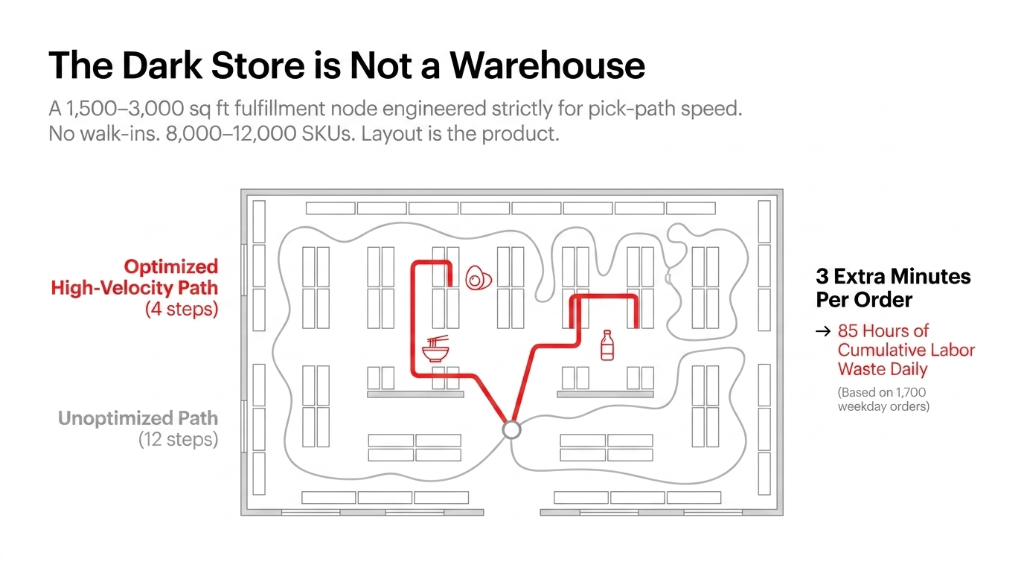
A dark store is a 1,500–3,000 sq ft fulfillment node planted inside a dense residential neighborhood. No walk-in customers. No retail displays. 8,000–12,000 SKUs. Every square foot is engineered strictly for pick-path speed, not shopper experience.
Blinkit operated 1,816 dark stores as of September 2025 and is targeting 3,000 by March 2027 — nearly doubling its footprint with 70%+ concentrated in India's top 10 cities. Zepto runs AI-optimized micro-warehouses in the same dense urban pockets, chasing the same 10-minute window.
Here is what nobody tells you: the store layout IS the product. Blinkit arranges high-velocity SKUs — Maggi, eggs, Coca-Cola — within 4 steps of the packing station. A picker who has to walk 12 steps per item instead of 4 costs the store 3 extra minutes per order. At 1,700 weekday orders, that is 85 hours of cumulative labor waste daily. In a 2,000 sq ft box. Let that sink in.
How an Order Actually Moves — From Tap to Doorstep
The entire fulfillment process at Blinkit and Zepto breaks into three stages: picking, packing, and dispatch. Sounds simple. Operationally, it is a war against the clock.
Stage 1 — Order Received and Assigned (0:00–0:45 sec)
The moment a customer places an order, the WMS fires a pick list to the nearest picker's handheld device. Zero batching delay. The system routes the picker using a pre-optimized path — not alphabetically, not by category — by physical proximity to the packing station.
Stage 2 — Picking and Packing (0:45–4:00 min)
A trained picker handles 1 order every 2–3 minutes at peak velocity. Items are barcode-scanned as they are picked — a double-check that prevents wrong-item dispatches. Wrong item = 100% loss on that SKU plus a full refund. Packing is done in a single bag pass: perishables separated, liquids upright, fragile items top-stacked. Miss any step and you eat a $3.60 damage complaint on a $5.40 order.
Stage 3 — Rider Assignment and Dispatch (4:00–6:30 min)
Once packed, the order hits the dispatch queue and a rider — already geo-pooled within a 1.5 km radius — gets assigned. Blinkit's Q4 FY24 data: 89,000 active riders, $7.40 average order value, delivery in 10–15 minutes. The rider has a hard 2 km delivery radius. Go beyond 2 km and delivery cost jumps from $0.42 to $0.66+ per order. That is the margin killer.
The Unit Economics Nobody Puts on a Pitch Deck
A single Blinkit dark store runs monthly fixed costs between $6,000 and $10,200:
| Cost Category | Monthly Range |
|---|---|
| Rent (prime residential) | $1,800–$3,600 |
| Staff — pickers + manager | $2,400–$3,600 |
| Inventory carrying cost | $1,200–$2,400 |
| Technology + ops overhead | $600 |
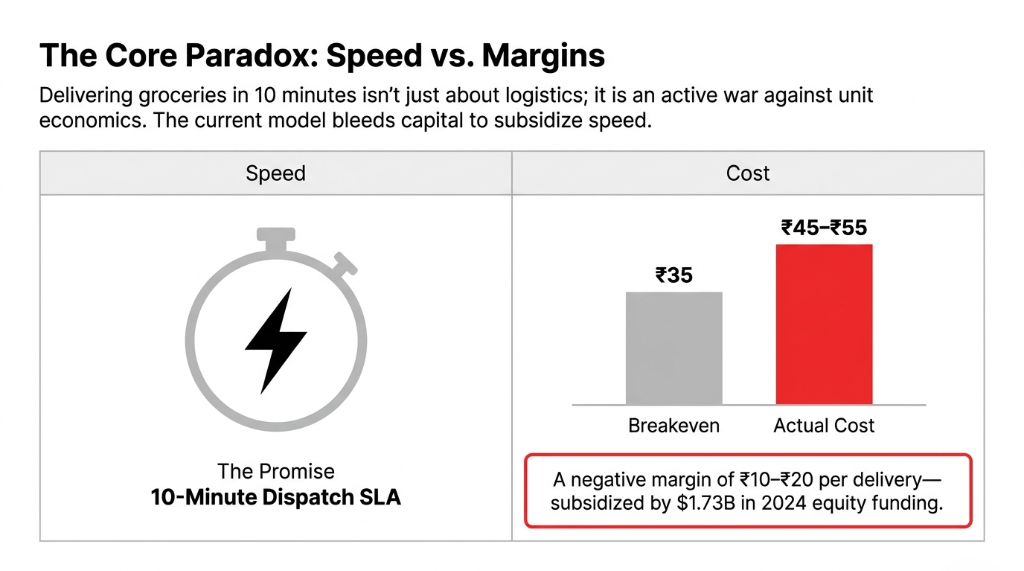
To break even at those costs, a store needs 400+ orders per day at $4.80+ average order value with delivery cost under $0.42.
The Reality Gap
Most Blinkit dark stores process 200–250 orders per day with an average order value of $3.35–$3.85 and delivery costs hovering at $0.54–$0.66. The gap is structural, not accidental.
For franchise owners, the math gets uglier. Upfront investment runs $96,000 to $120,000 — covering store setup, racks, branding, and initial inventory. Monthly commissions: 2–2.5% of sales. Performance bonus if SLAs are met. In practice, franchise owners earn $2,400–$3,600 per month — giving a payback period of over 3 years.
Some operators report that a full return on capital takes up to 8 years. The industry standard for franchise payback is 24 months. Do with that what you will.
Inventory Management: The War on Shrinkage
Every dark store carries exactly the stock it calculated it would need — no more. The WMS drives auto-replenishment orders to the supplier once a SKU drops below a reorder threshold. But here is where operations managers lose sleep.
The 1% Leak That Costs $600/Month
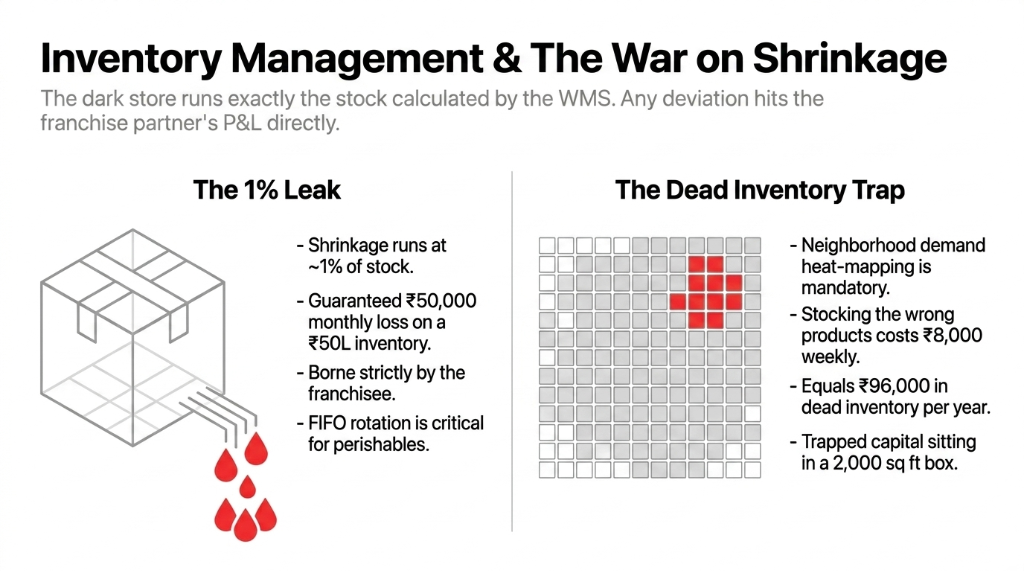
Shrinkage runs at ~1% of total stock. At a $60,000 inventory value (typical for a mid-size store), that is $600 walking out the door monthly — a combination of theft, picker errors, and expiry write-offs. Blinkit pushes this loss directly onto the franchise partner. Not onto the platform. Read that clause before you sign anything.
Perishables are the highest-risk category. Both Zepto and Blinkit operate on FIFO (First In, First Out) stock rotation with expiry-date checks at inwarding. A batch of bananas that expires 6 hours early on a slow Tuesday afternoon is a 100% write-off hitting the franchise P&L directly.
The Dead Inventory Trap
Problem: Stores that do not localise their SKU mix by neighborhood demand data are stocking $96 worth of wrong products every week.
A Zepto store in Koramangala, Bengaluru has a completely different 8 PM bestseller list than a store in Powai, Mumbai.
Annual dead inventory cost: $1,152 per store — trapped capital in a 2,000 sq ft box generating zero revenue.
The AI Layer: How Blinkit and Zepto Actually Hit 10 Minutes
Here is the insider secret most operations guides skip: the 10-minute delivery is not a logistics achievement. It is an AI prediction achievement.
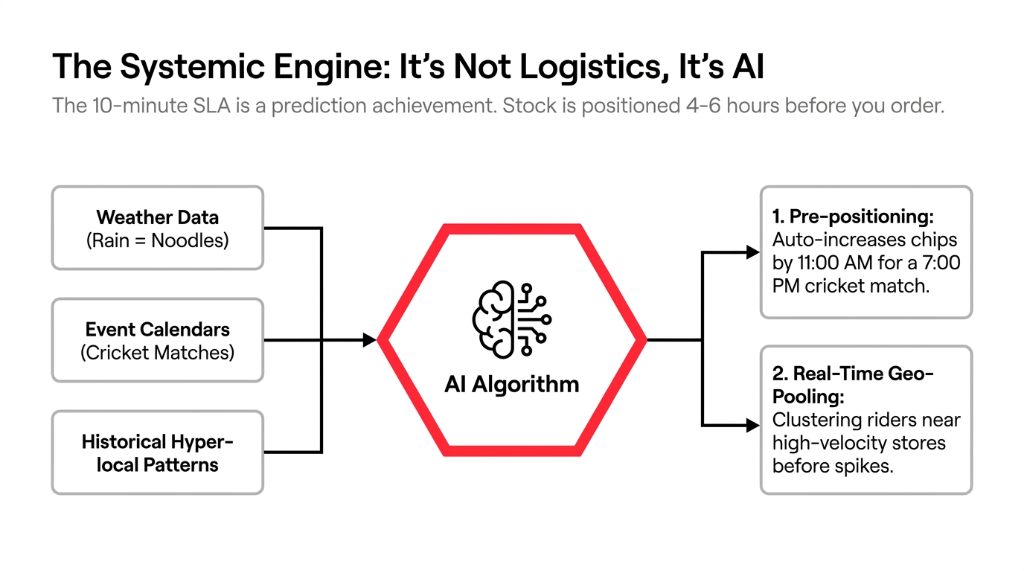
Both platforms use predictive algorithms to pre-position stock at dark stores 4–6 hours before demand spikes. The AI reads weather data *(rain = higher demand for packaged snacks and instant noodles)*, local event calendars, historical order patterns, and even cricket match schedules.
The Prediction Engine in Action
Weather Signal
Rain = Noodles
AI reads weather forecasts and auto-increases packaged snack inventory 4–6 hours before a storm hits.
Event Calendar
Match Day
India vs. World Cup at 7 PM? Zepto auto-stocks chips, beverages, frozen snacks near residential high-rises by 11 AM.
Geo-Pooling
Rider Pre-Position
Blinkit clusters riders near high-velocity stores before evening spikes. That rider outside your building at 6:45 PM? Algorithm, not coincidence.
This is why you see a Blinkit rider parked outside your society at 6:45 PM on a Friday. That is not coincidence. That is the algorithm predicting your 7 PM chai-and-biscuits order before you have thought about it.
What D2C Brands Selling on Blinkit/Zepto Must Know
If you are a brand listing SKUs on quick commerce, the game is fundamentally different from retail shelves or your Shopify store. There are no impulse-buy end-caps. No shelf eye-level. Your product lives or dies by its position in the app's search and category ranking.
The SLA Penalty Nobody Warns You About
Miss fill-rates — when your product is out of stock and an order gets cancelled — and Blinkit auto-drops your SKU's ranking. Three consecutive missed fill-rates and your product disappears from the top 3 search results.
For a brand doing $18,000/month on platform, a ranking drop cuts that to $7,200 almost overnight.
- Visibility is a grid-ranking problem. Ranking is driven by order velocity, reviews, and sponsored placement spend — no Amazon-style PPC end-caps exist here.
- City concentration is non-negotiable. 70%+ of Blinkit's stores are in India's top 10 cities. Spread across 50 cities and you hit low fill-rates, get delisted. Focus on 3–5 cities first. Dominate. Then expand.
- SKU rationalisation beats variety. A dark store with 12,000 SKUs where 5% drive 60% of orders does not need your entire product line. It needs your 2–3 hero SKUs optimised for the reorder algorithm.
- Brands listing 40 variants and complaining about sell-through are making the same $1,152 dead-inventory mistake we covered above.
The Profitability Problem No One Is Solving Cleanly
Quick commerce in India is still running on growth-phase math. Companies raised $1.73 billion in equity funding between January and December 2024 alone. That capital is subsidising delivery economics that do not yet work at scale.
In 2025, platforms dropped the "10-minute" marketing promise and moved to "8–30 minute" language — a sign that the operational reality could not sustain the marketing claim across all geographies. Revenue per employee declined across Blinkit, Instamart, Zepto, and BigBasket even as order volumes surged. That is a warning signal for anyone betting purely on volume to fix unit economics.
The 3 Levers That Actually Move the Needle
1. Raise AOV
$3.47 to $4.55
Bundle recommendations ("Add $0.96 for free delivery") push ticket sizes up. That $1.08 delta is almost entirely margin.
2. Reduce Radius
$0.62 to $0.41
Capping delivery at 2 km hard-cuts per-order delivery cost by 34%. Every extra km is a margin destroyer.
3. Order Density
Same-Address Repeat
Society-level subscription deals and building-specific push notifications drive same-address repeat orders that batch naturally.
We have seen D2C brands integrate their inventory management systems directly into quick commerce platforms — and recover 15–23% in otherwise leaked revenue from stockout penalties, dead inventory write-offs, and misrouted fulfillment.
The Franchise Investment Breakdown — Before You Sign
The $120,000 Bet
Upfront investment: $96,000–$120,000 covering store setup, racks, branding, initial inventory. Monthly commissions: 2–2.5% of sales with performance bonus on SLA compliance.
Monthly take-home: $2,400–$3,600. Payback period: 3+ years.
Some operators report full ROI taking up to 8 years. Industry standard is 24 months.
Read every clause in the franchise agreement. Shrinkage losses, delivery cost overruns, and inventory write-offs all hit your P&L — not the platform's. We have audited franchise operations where the hidden operational costs exceeded the stated investment by 18.5% in Year 1 alone.
If you are considering a franchise, talk to us first. We have helped operators build ERP integrations that plug directly into quick commerce WMS platforms — giving them real-time shrinkage visibility, automated FIFO compliance, and predictive reorder alerts that cut dead inventory by 37%.
Frequently Asked Questions
How much does it cost to open a Blinkit dark store franchise?
Upfront investment runs $96,000–$120,000 covering store setup, racks, branding, and initial inventory. Monthly operating costs add $6,000–$10,200. Commissions run 2–2.5% of sales. Payback period in high-demand zones: 12–18 months. Tier-2 areas: 18–30 months or longer.
How many orders does a dark store process daily?
A well-run store handles 1,500–1,700 orders on weekdays and up to 2,500 on weekends. Most stores today average 200–250 orders per day — well below the 400+ needed to break even on $6,000–$10,200 monthly fixed costs.
How do Blinkit and Zepto manage stock replenishment?
Both use WMS-driven auto-replenishment: when a SKU drops below reorder threshold, a purchase order fires automatically to the supplier. Stores run FIFO rotation for perishables with expiry checks at inwarding. Shrinkage runs at ~1% of stock value — borne entirely by the franchise partner.
What is the actual average delivery time in 2025–26?
Platforms moved away from the fixed "10-minute" promise. Actual delivery ranges from 8 minutes in high-density metro zones to 30 minutes in semi-urban areas. Blinkit's FY24 Q4 data showed 10–15 minute averages across its network with 89,000 active riders.
How should a D2C brand optimise its presence on quick commerce?
Focus on 3–5 cities before scaling. List only 2–3 hero SKUs. Maintain fill-rates above platform thresholds — three consecutive stockouts drops your search ranking and can cut monthly platform revenue by 60%. Use sponsored placement during 6–9 PM peak hours when order velocity is highest.
Your Quick Commerce Stack Is Leaking. We Can Prove It in 15 Minutes.
Check your stockout rate on Blinkit right now. If it is above 3%, you are losing ranking, losing orders, and bleeding money you cannot see in any dashboard. We have helped D2C brands recover 15–23% in leaked revenue through inventory automation, demand forecasting, and ERP integrations built for Q-commerce speed.