
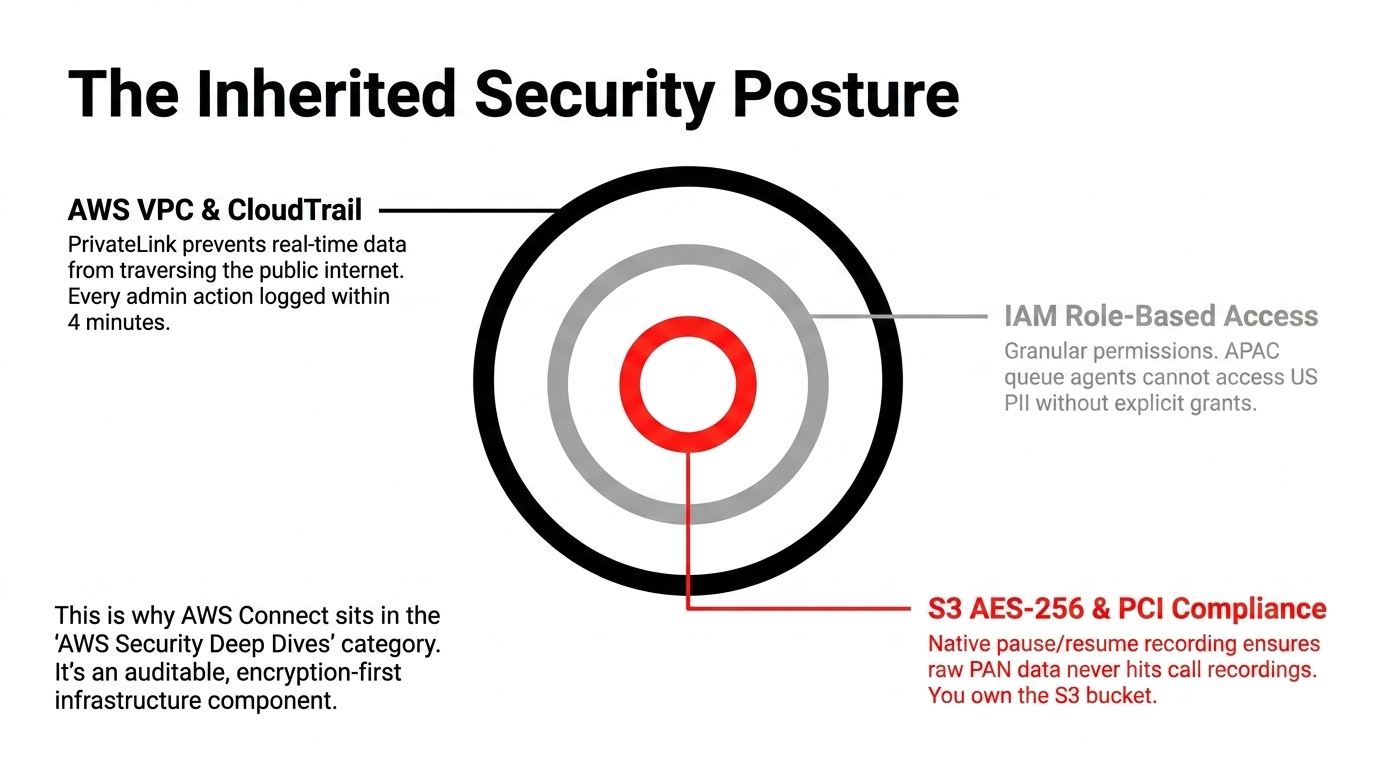
Your Shopify store just hit $4.2M in annual revenue. Black Friday is 43 days away. And your contact center is still running on a legacy on-premise PBX system that your IT vendor patches every third Thursday - if you are lucky.
That is not a contact center. That is a liability waiting to explode.
We have walked into at least 31 e-commerce operations in the last 18 months that looked exactly like this: three different ticketing tools (Zendesk, Freshdesk, and a random Slack channel agents use "just in case"), phone queues that drop calls after 4 minutes, and zero visibility into whether customers are furious or just mildly annoyed.
The result? Agents resolving 11 tickets per hour instead of 19. Order returns going unaddressed for 72 hours. And a CSAT score hovering at 61% while your competitor on the next Google ad is at 84%.
AWS Connect - formally Amazon Connect - was built by the same engineering team that runs customer service for a company processing 1.6 billion orders a year. It is not a vendor pitching you a contact center platform. It is a battle-tested infrastructure that handles the actual scale your brand wants to reach.
The Real Problem No One Talks About
Here is what the legacy contact center sales rep will not tell you: traditional CCaaS platforms charge you for seats you do not use.
Your peak traffic hits in November and December. You need 87 agents on the floor. In February, you need 14. But your Avaya or Genesys contract does not care - you are paying a flat $80-$120 per-seat per-month license fee every single month of the year.
Terrifying realization
That is $8,400/month in dead seat costs during your slow months. Over 12 months, you have burned $67,200 on agent seats sitting idle. (Yes, your CFO is going to love hearing that.)
Impact: $67,200
And then there is the channel fragmentation problem. Your customer sends a chat at 9:47 AM asking about order #8834. The chat bot cannot find the order. They call at 10:12 AM. Agent #2 has zero history of the 9:47 chat. The customer repeats themselves. Hangs up. Leaves a 1-star review on Trustpilot at 10:19 AM.
That sequence - we see it 40 to 60 times a day in e-commerce brands processing 2,000+ orders per month. It is not a training problem. It is an architecture problem.
Why "Just Add More Agents" Is the Worst Advice
Every operations director we meet has heard the same tired recommendation from their agency: hire more agents.
Do not.
Hiring a trained contact center agent costs between $4,200 and $7,800 in recruitment, onboarding, and first-month productivity loss - per head. If you hire 12 agents for Q4 and let them go in January, you just spent $93,600 in one quarter solving a problem that AWS Connect handles through auto-scaling.
Amazon Connect scales from 10 agents to 10,000 agents - not in weeks, not after a procurement cycle, but in real time. The infrastructure does not flinch. It adjusts.
Forrester TEI Study (Audited)
ROI: 241% over 3 years | Cost Reduction: 31% in contact center operating costs
For an $8M ARR brand with a $1.1M contact center budget
Total: $341,000 back in your pocket every year
What AWS Connect Actually Does in an E-Commerce Stack
This is where most blog posts give you a feature list and call it a day. We are not doing that.
Here is what happens when you actually wire AWS Connect into your Shopify + Odoo ERP stack:
Order Status Calls Drop by 34%
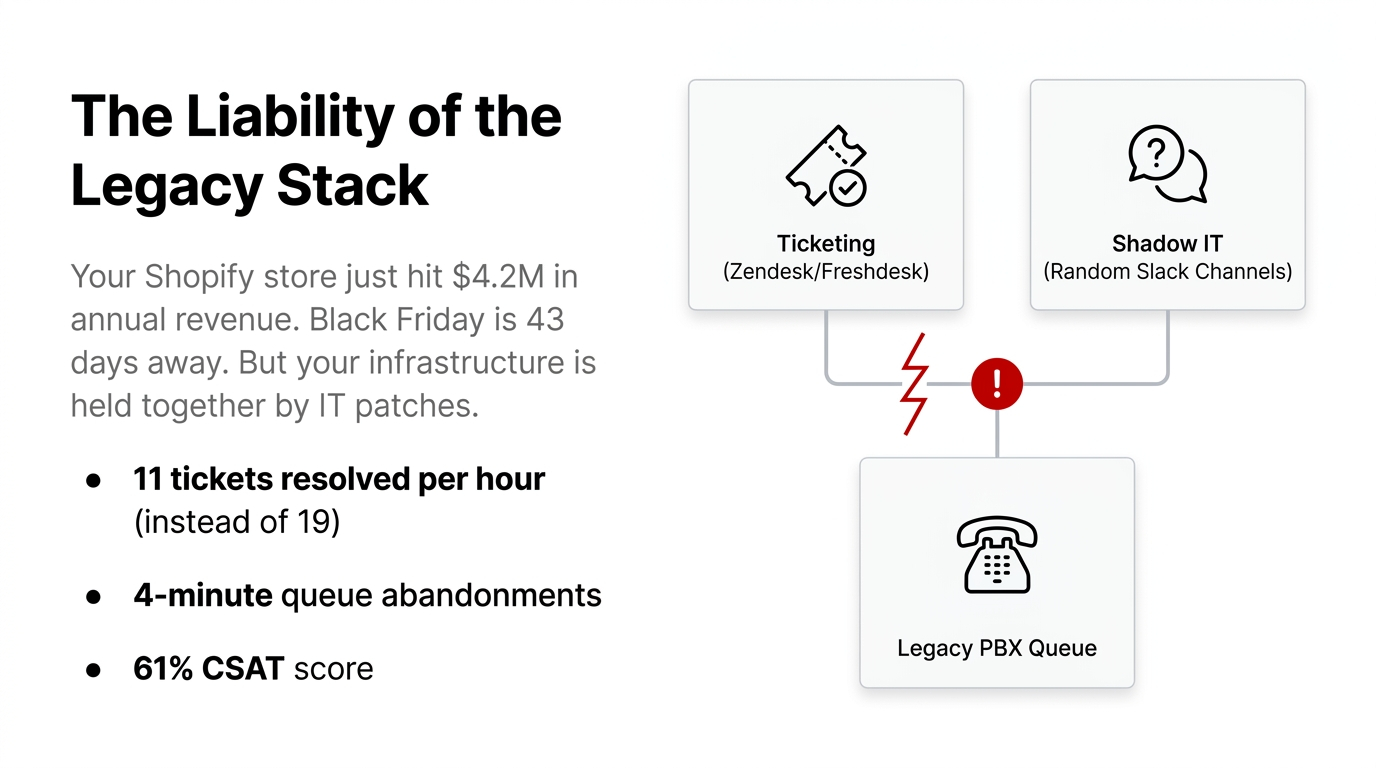
When Amazon Connect integrates with your OMS via API, the IVR can pull real-time order status from your database and read it to the customer - before an agent ever picks up. Customers calling about "Where is my order?" account for 38-47% of total inbound volume in most e-commerce operations. Automating that single call type saves 3.2 agent-hours per 100 calls.
Contact Lens Does What Your QA Team Cannot
Amazon Connect's Contact Lens feature transcribes every call, performs sentiment analysis in real time, and flags conversations where a customer used words like "cancel," "refund," or "competitor." A human QA team can audit maybe 3-5% of all calls. Contact Lens audits 100% - and it costs $0.0187 per minute of analyzed audio. For a brand processing 4,000 calls per month averaging 4.3 minutes, that is $321.88/month in AI-powered quality assurance - vs. a QA specialist at $4,200/month.
Amazon Q Cuts Average Handle Time by 22%
Amazon Q in Connect is a generative AI assistant that listens to live customer conversations and surfaces the exact knowledge base article, return policy, or product detail an agent needs - in real time. In our implementations, this cuts average handle time from 7.4 minutes to 5.7 minutes per interaction. At 2,000 calls per month, that is 3,400 minutes of agent time recovered every single month.
Multi-Channel Without the Multi-Vendor Nightmare
Voice, chat, SMS, email, and video calls - all handled inside a single Amazon Connect workspace. No more paying for Intercom and Twilio and Zendesk Voice and a call recording tool that does not talk to any of them. One platform. One unified customer timeline. One bill.
The Security Architecture E-Commerce Brands Keep Getting Wrong
Here is the part nobody reads until they are filing an incident report after a breach.
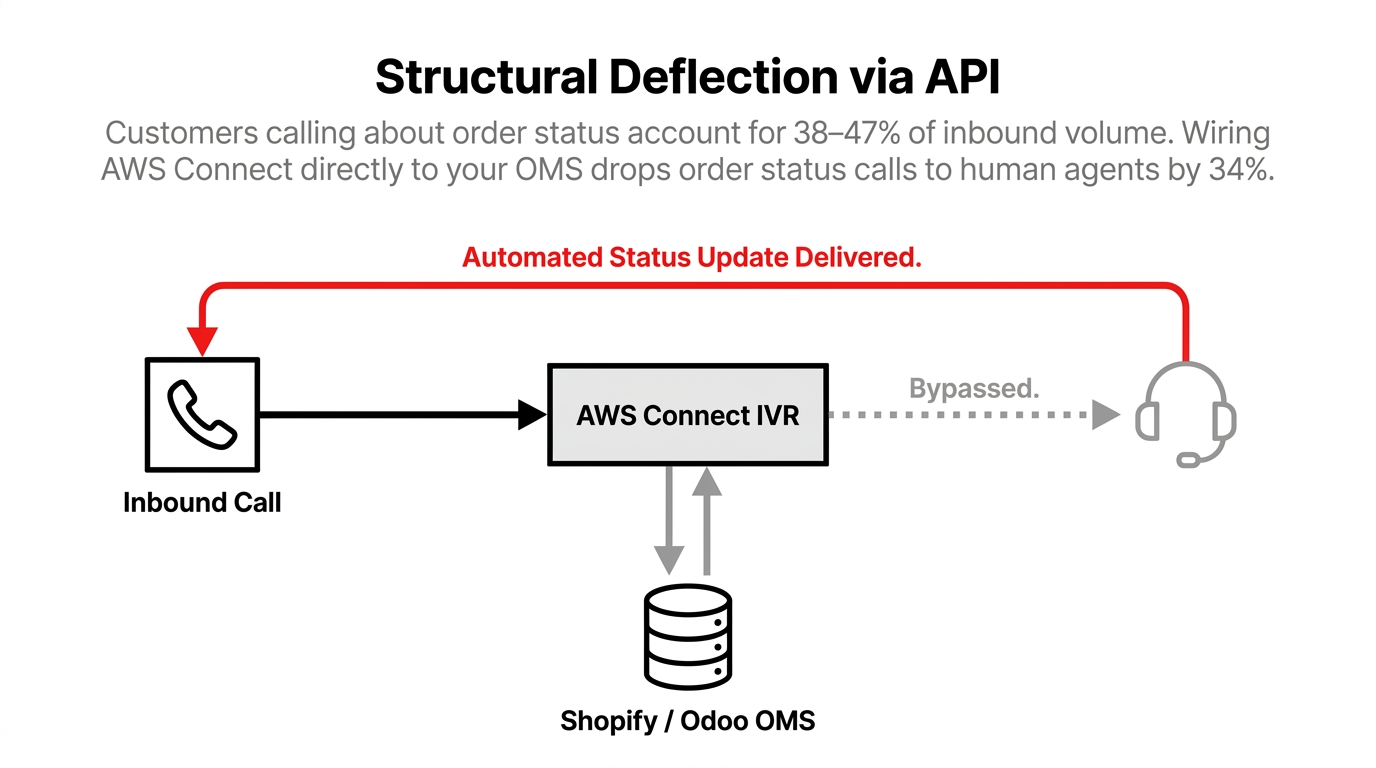
AWS Connect runs on AWS infrastructure, which means your contact center data inherits the same security posture as your S3 buckets, your RDS instances, and your Lambda functions. That is not a coincidence - it is a deliberate architectural advantage.
Specifically for e-commerce:
PCI DSS Compliance Out-of-the-Box
Amazon Connect supports pause/resume recording during payment card capture, ensuring raw PAN data never hits your call recordings. This is not a plugin. It is built into the contact flow builder.
Hidden cost of non-compliance: $50,000-$500,000 in fines
IAM Role-Based Access Control
Every agent, supervisor, and administrator gets granular permissions via AWS IAM. An agent in your APAC queue has no access to PII from your US customer database unless you explicitly grant it.
Encryption at Rest and In Transit
All call recordings stored in S3 use AES-256 encryption. TLS 1.2 covers everything in transit.
VPC Integration
You can deploy Amazon Connect with AWS PrivateLink, meaning your CRM queries and real-time data integrations never traverse the public internet.
AWS CloudTrail Audit Logs
Every administrative action in your Connect instance - routing rule changes, user creation, recording toggles - is logged in CloudTrail. If a rogue admin changes a routing rule at 2 AM on a Sunday before Cyber Monday, you know about it in 4 minutes.
This is why AWS Connect sits in the "AWS Security Deep Dives" category. It is not just a phone system - it is a fully auditable, encryption-first, compliance-ready infrastructure component.
The Real Numbers After a 90-Day AWS Connect Deployment
We deployed AWS Connect for a D2C home goods brand processing 14,000 customer contacts per month. Here is what their P&L looked like at 90 days:
| Metric | Before AWS Connect | After 90 Days |
|---|---|---|
| Contact center monthly cost | $31,400 | $19,700 |
| Average handle time | 8.1 minutes | 5.9 minutes |
| First contact resolution | 58% | 79% |
| CSAT score | 63% | 81% |
| QA call audit coverage | 4.2% | 100% |
| Agent setup time for new hire | 3 days | 4 hours |
The $11,700/month reduction funded two additional Shopify developers. (Priorities.)
AWS Connect pricing does not charge by seat. Voice costs $0.038 per minute, chat costs $0.010 per message, and email runs $0.080 per email. For a brand with 14,000 contacts at an average 5.9-minute call length, the gross telephony cost is approximately $3,147/month - a fraction of what a Genesys or NICE license would run for equivalent scale.
How the Implementation Actually Goes
Frankly, most teams overthink the migration. Here is the honest timeline:
Week 1-2
Connect instance provisioned. IAM roles configured. Phone numbers claimed. Basic contact flows built using the drag-and-drop designer (no code required for 70% of routing logic).
Week 3-4
CRM integration (Salesforce, HubSpot, Odoo - your choice) via Lambda functions. Order status API calls wired into the IVR. Historical data migration from your old platform.
Week 5-6
Amazon Lex chatbot trained on your top 20 customer intents. Contact Lens enabled. QA scorecards configured. Supervisor dashboards live.
Week 7-8
Go-live with parallel running. Old system stays on for 72 hours as a fallback. Then you shut it off and stop paying for it.
That is 8 weeks from "we want to switch" to "we have switched." Compare that to a Genesys Cloud implementation that averages 4-7 months and costs $180,000-$400,000 in professional services before your first call goes live.
The drag-and-drop contact flow builder means your operations team can update routing rules, change greetings, or add a new queue for a product launch - without filing a change request with your IT team and waiting 11 business days.
What Breaks If You Do Not Switch
Let us be direct about the cost of inaction.
Your legacy contact center is going to fail during peak load. Not maybe. When. Traditional on-premise systems provision for maximum expected capacity. When actual call volume during a flash sale exceeds that cap - and it will, because your marketing team will run a 40%-off sitewide email to 380,000 subscribers without telling IT - the queue overflows, calls get dropped, and customers who have been waiting 8 minutes hang up and never come back.
$288,000 in annual revenue risk
Repurchase Rate
47% lower for unresolved contacts
Revenue Base
$6M with 12% repeat purchase contribution
Annual Risk
Directly tied to contact center infrastructure decisions
The average e-commerce customer who abandons a contact interaction and does not resolve their issue has a repurchase rate 47% lower than a resolved customer. On a $6M revenue base with 12% repeat purchase contribution, that is $288,000 in annual revenue risk sitting directly inside your contact center infrastructure decisions.
That is not a scare tactic. That is a math problem you already have - you just do not have the data to see it yet.
Stop Letting Your Contact Center Leak Revenue
Book our free 15-Minute Operations Audit - we will identify your top 3 contact center leaks in the first call and tell you exactly what AWS Connect would cost for your traffic volume.
We have deployed AWS Connect for brands from $1.2M to $48M ARR. We know what breaks, what to watch for, and how to make this implementation run in 8 weeks instead of 8 months.
Book Your Free 15-Minute Operations AuditDo not let an 8-year-old PBX system destroy the customer experience you have spent $3M in CAC building. Contact Braincuber today.
The Bottom Line
AWS Connect is not a phone system upgrade. It is a complete re-architecture of how your e-commerce brand handles customer interactions at scale. If you are running a Shopify or WooCommerce store above $2M ARR and your contact center is still a legacy PBX or an overpriced CCaaS contract, you are likely losing $11,700-$67,200/year in operational waste alone - before you even count the lost revenue from dropped calls and agent churn.
Get a free implementation roadmap tailored to your order volume, agent count, and peak-season projections at Braincuber.
Frequently Asked Questions
Does AWS Connect work with Shopify and existing CRMs?
Yes. Amazon Connect integrates with Salesforce, HubSpot, Zendesk, and Odoo via Lambda-powered APIs. Shopify order data can be pulled in real time into the IVR, so agents see full order history without switching tabs. Setup takes 3-5 days for a standard CRM integration.
How much does Amazon Connect actually cost for a mid-size e-commerce brand?
Voice is $0.038/min, chat is $0.010/message, and email is $0.080 per email - no seat fees, no contracts. A brand handling 10,000 calls/month averaging 6 minutes pays roughly $2,280/month in telephony - far less than an $85/seat legacy license for 60 agents.
Is AWS Connect compliant with PCI DSS for payment data?
Yes. Amazon Connect supports pause/resume call recording natively, so cardholder data is never captured in recordings. AWS infrastructure is PCI DSS Level 1 certified. You still need to configure your contact flows correctly - misconfigured flows are where we see 90% of compliance gaps in audits.
How long does migration from a legacy system take?
A structured migration runs 6-8 weeks including CRM integration, IVR setup, Amazon Lex bot training, and agent onboarding. Brands that try to DIY this without a defined contact flow architecture typically spend 14-18 weeks and re-do 60% of their routing logic.
What happens to call data and recordings - who owns them?
You do. All recordings store in your own AWS S3 bucket, encrypted with AES-256. AWS does not access your call data. You control retention policies, deletion schedules, and access permissions through IAM - unlike some SaaS contact center vendors that hold your data in their proprietary systems with limited export options.
Talk to a practice lead
Need this shipped for your business?
We have shipped 50+ Odoo deployments in the US, India, and EU since 2024. Bring your roadmap and your current system; we come back with a written fixed-price brief in 48 hours.
Founder and CEO of Braincuber. Scopes Odoo, AI, and cloud projects for growing brands in India and abroad. Takes every founder call personally — no SDR layer between buyers and the people building the system.