
The Fee Structure Is Not What Your Accountant Told You
Here's the thing about Amazon.in's fee structure that nobody explains clearly on a single page: it has three completely separate cost layers, and founders typically calculate only one of them.
Amazon.in's Three Hidden Cost Layers
Referral Fee
0%
Now waived on products below $12.15 across 1,800+ categories. But your competitor gets the same benefit.
Weight Handling Fee
$0.35+
Starts at $0.35 per item. Climbs based on dimensional weight and FC-to-pincode distance. Recalculate today.
Closing Fee
$48–$117/mo
At 800 orders/month in the $6.10–$9.75 price band. Quietly written off as "platform costs."
Run the math on all three layers — not just the referral fee — before you price a single SKU.
FBA vs. Easy Ship: You Are Probably Using the Wrong One
73% of the D2C brands that come to us for an operations audit have made the same mistake: they chose their fulfillment method at launch and never revisited it.
Fulfillment by Amazon (FBA) means Amazon stores your inventory in their fulfillment centres, picks, packs, and ships for you, and handles returns. The upside is the Prime badge, which lifts conversion rates by 22–31% in high-competition categories. The downside nobody talks about: if your product has a 35-day average sell-through and it's sitting in a Bhiwandi FC, you're paying storage fees every month that your P&L doesn't flag separately.
Easy Ship means you store product at your own facility, Amazon picks it up and delivers it. For a D2C brand with consistent daily order volume above 120 units, Easy Ship is almost always the cheaper route per order. Amazon also reduced Easy Ship fees by more than 20% for products priced below $3.65 in March 2026.
| Metric | FBA | Easy Ship |
|---|---|---|
| Prime badge | Yes (+22–31% conversion) | No |
| Storage fees | Monthly per-unit charge | $0 (your facility) |
| Cost per shipment delta | Baseline | $0.09–$0.17 cheaper |
| Best for | Fast-moving SKUs | 120+ units/day volume |
The lazy answer is "use FBA for fast-moving SKUs, Easy Ship for slow-movers." The real answer: pull your last 90 days of fulfillment cost data from Seller Central, map it against your return rate by SKU, and then decide. You are probably overpaying $0.09 to $0.17 per shipment on your top-selling variants.
Your Listing Is the Reason You Are Invisible
Stop blaming the algorithm. We see brands spending $4,250/month on Sponsored Products while their main product listing has a 68-character title, two bullet points, and a hero image photographed on a kitchen counter.
Amazon's A9 (and now A10) algorithm weights these signals in sequence: keyword relevance in the title, bullet completeness, image count and quality, fulfilled delivery promise, review velocity. If your title doesn't include the exact search term a buyer types, your PPC spend is funding impressions, not conversions.
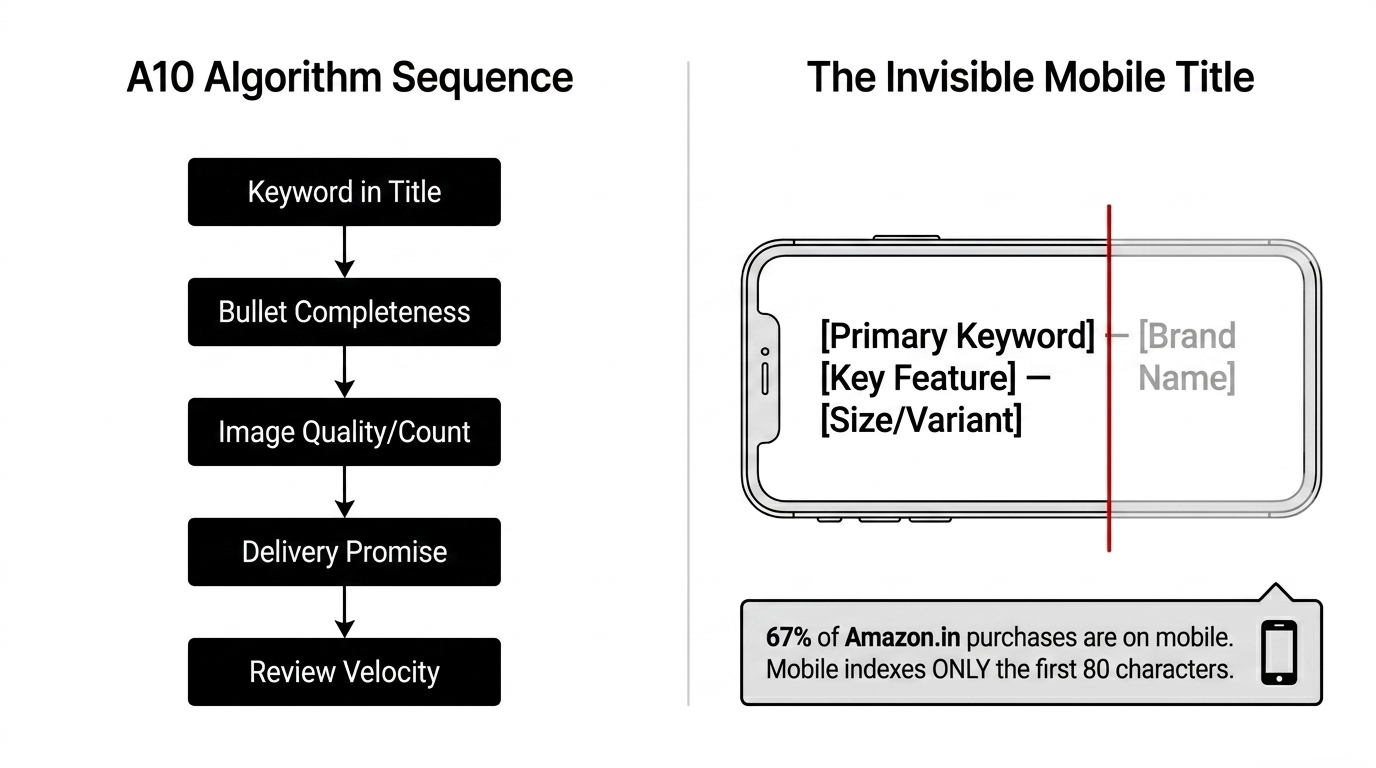
The 80-Character Mobile Title Trap
Amazon indexes only the first 80 characters of your product title for mobile search — and 67% of Amazon India purchases happen on mobile. If your brand name is 20 characters and comes first, you've wasted 25% of your ranking real estate. Restructure: [Primary Keyword] — [Key Feature] — [Size/Variant] — [Brand Name].
Account Health: The Silent Suspension Trap
In our last 31 client audits, 19 brands had at least one account health metric sitting in the yellow zone without realising it. Amazon India evaluates your account on three metrics that can result in suspension with 72 hours' notice:
The Three Suspension Triggers
The fix: Connect your inventory management system to Seller Central via API, and set alerts at 80% of your stock threshold. We helped a D2C personal care brand reduce their cancellation rate from 3.8% to 0.4% in 22 days just by fixing their inventory sync cadence. That brand was three weeks from suspension.
Returns Are a Revenue Recovery Opportunity, Not a Write-Off
This is the most expensive blind spot we see in Indian D2C operations.
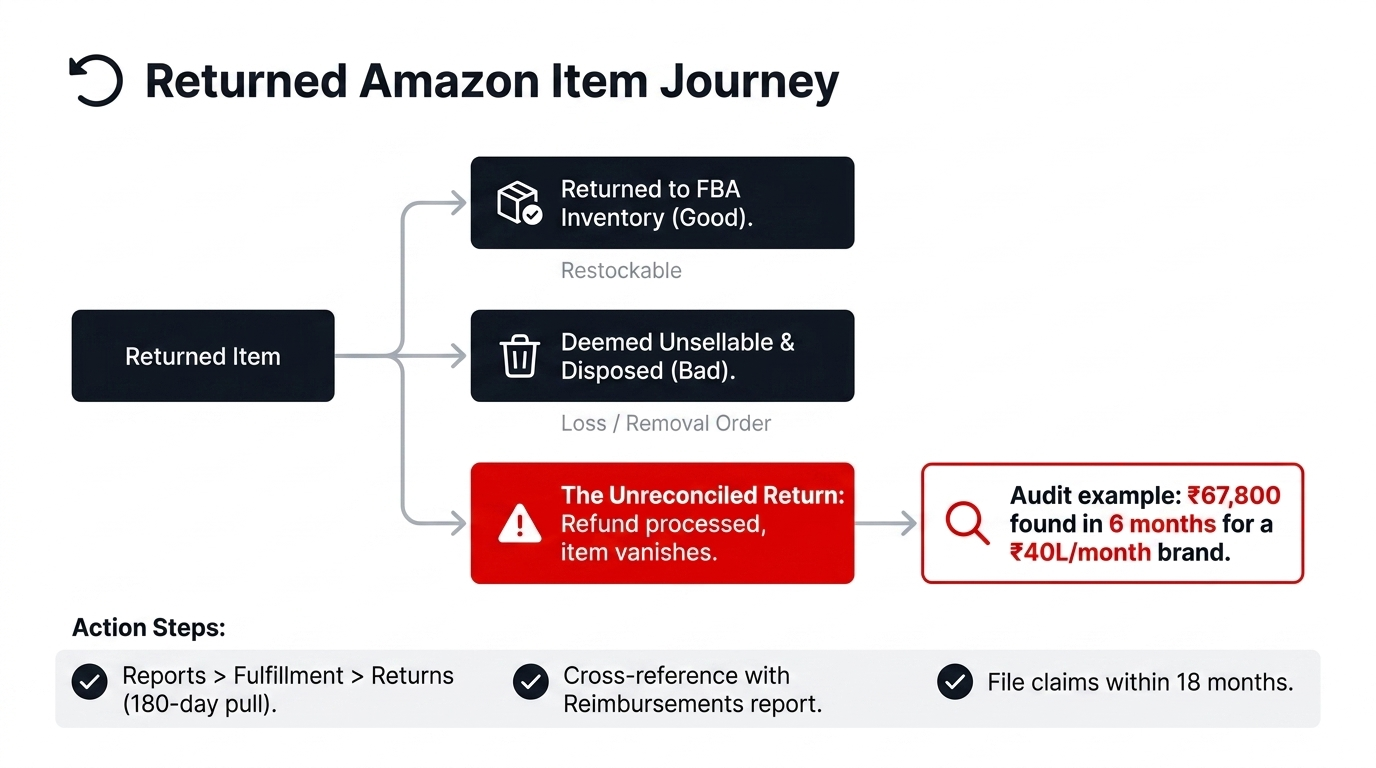
When a customer returns a product on Amazon.in, three things can happen: the item is returned to your FBA inventory (good), the item is deemed unsellable and disposed of (bad), or the refund is processed but the item never makes it back to your FC (invisible and terrible).
Amazon calls that third scenario an "unreconciled return." Most founders never file a reimbursement claim because they don't know the process exists. In our last audit of a $48,630/month supplements brand, we found $8,230 in unreconciled returns over 6 months — none of which had been claimed.
How to Audit Your Unreconciled Returns Right Now
Step 1: In Seller Central, go to Reports > Fulfillment > Returns. Pull a 180-day report.
Step 2: Cross-reference every return against your "Reimbursements" report under the same tab.
Step 3: Any return without a corresponding reimbursement or inventory restoration is a claim Amazon owes you.
Step 4: File these claims within 18 months of the original order date. After that, Amazon's policy does not require reimbursement.
Advertising Without Attribution Is Just Spending
If your ACOS (Advertising Cost of Sales) is above 28% and your brand is under $243,000 ARR on Amazon, you have a structural problem — not a bidding problem.
The structural problem is almost always this: you are running Sponsored Product campaigns without separating branded vs. non-branded keyword spend. Your branded keywords convert at 40–60% and cost $0.04–$0.10 per click. Your non-branded, high-intent keywords convert at 8–14% and cost $0.22–$0.55 per click. When you blend these into one campaign, your average ACOS looks acceptable. In reality, your non-branded spend is destroying margin while your branded campaigns prop up the average.
The ACOS vs TACOS Reality
ACOS (Misleading)
Looks OK at 24%
Blends branded (3% ACOS) with non-branded (45% ACOS). Hides the real problem.
TACOS (The Real Metric)
Target: 10–16%
Factors in organic revenue. Drop from 19% to 11% on a $182,000/mo storefront = $14,580/year recovered.
The 90-Day Ops Playbook for New Amazon.in D2C Sellers
- Days 1–14: Register, set up GST-compliant invoicing, configure Seller Central with correct tax settings, build listings using the 80-character mobile-first title structure, upload 7+ images per SKU.
- Days 15–30: Launch Easy Ship if daily volume is below 80 units. Run a Vine-equivalent review campaign on your first 10 units. Set up automated pricing rules with a floor price.
- Days 31–60: Activate Sponsored Products with a $61/day test budget. Separate branded and non-branded campaigns from day one. Begin tracking TACOS weekly.
- Days 61–90: Audit Account Health dashboard every Monday morning. Pull your returns reconciliation report. If organic rank hasn't improved on your top 3 keywords, audit listing keyword density — not ad spend.
A nutraceutical brand we onboarded in January 2026 followed this exact sequence and hit $10,570 in monthly revenue by day 73, with TACOS at 14.3% and ODR at 0.11%.
Don't Let Amazon Be Your Only Revenue Channel
Amazon.in is an acquisition engine — not a retention engine. Amazon owns your customer data. You do not. When someone buys your skincare serum on Amazon, you get an order notification. You don't get an email address, a phone number, a browsing history, or a lifetime value signal.
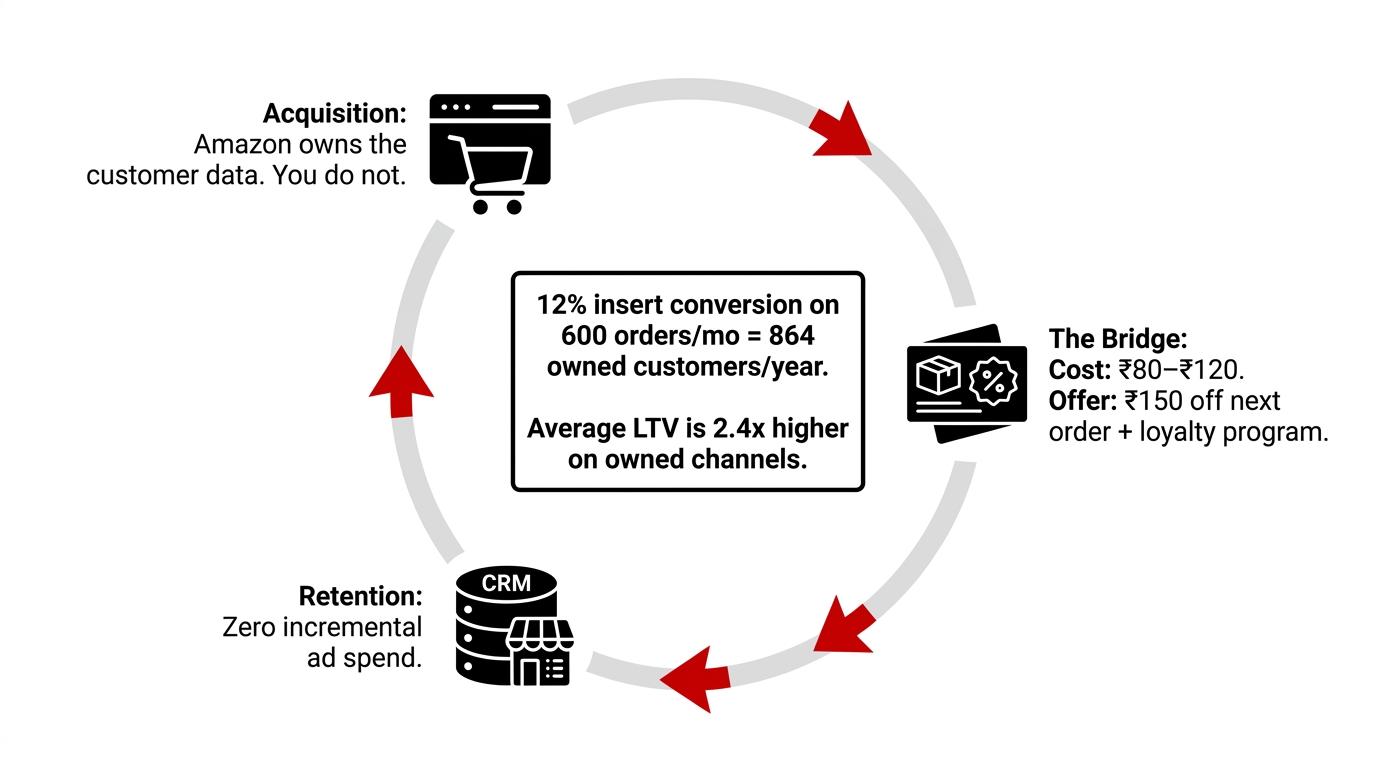
This is why the smartest D2C operators we work with use Amazon to acquire a customer once, then spend $0.97–$1.46 driving that same customer to their own Shopify or WooCommerce storefront via post-purchase packaging inserts. The insert says: "Register your product at [brand].in and get $1.82 off your next order + free access to our loyalty programme."
At a 12% insert conversion rate on 600 orders/month, that's 72 customers/month you now own — at zero incremental ad spend. Over 12 months, that's 864 customers on your own CRM, each with an average LTV that is 2.4x higher than a repeat Amazon buyer because you control the reorder prompt.
Frequently Asked Questions
How do Amazon.in's zero referral fees actually work for D2C sellers in 2026?
Amazon India removed referral fees on all products priced below $12.15 across 1,800+ categories. Sellers pay $0 commission per sale, but weight handling and closing fees still apply. Always verify your specific category eligibility in Seller Central before relisting at new price points.
What is the difference between FBA and Easy Ship on Amazon.in?
FBA stores your inventory in Amazon's fulfillment centres and earns the Prime badge, lifting conversion 22–31%. Easy Ship stores inventory at your facility with Amazon handling pickup and delivery. For brands with 120+ daily units and predictable sell-through, Easy Ship costs $0.09–$0.17 less per shipment.
How do I claim reimbursements for unreconciled Amazon returns?
Go to Seller Central, Reports, Fulfillment, Returns and pull a 180-day report. Cross-reference every return against your Reimbursements report. Any unmatched entry is a claim. File within 18 months. Most brands we audit have $3,040–$9,720 in unclaimed reimbursements in a 6-month window.
What is a healthy ACOS for a D2C brand on Amazon India?
ACOS above 28% at under $243,000 ARR signals a structural campaign problem. Track TACOS instead — it factors in organic revenue. Healthy TACOS for a growing D2C brand sits between 10% and 16%. Anything above 19% means ad spend is subsidizing sales that should come organically.
What documents do I need to register as a seller on Amazon.in?
You need a valid GST certificate, a PAN-linked bank account, an active mobile number matching your PAN registration, and a verifiable address. The most common failure is a mobile number mismatch between PAN records and Seller Central — this triggers a 7–14 day manual review freeze.
Stop Bleeding Margin on Amazon.in
If you've never pulled your unreconciled returns report, don't know your real TACOS, or haven't recalculated your fee structure since the zero-commission update — you are leaving money on the table every single day.