
The Two Peaks That Break Beauty Brands Every Year
Two windows every year will either make or destroy your margins: Diwali (October–November) and Summer (April–June). They are completely different animals.
The Two Demand Seasons That Break Beauty Operations
Diwali (Oct–Nov)
95% YoY Spike
Sharp 2–4 week burst. Fashion and beauty sales spike 95% year-over-year during the festive window. D2C beauty orders jump up to 700% YoY on Amazon Great Indian Festival. Kerala alone posts 118% more beauty orders than Karnataka.
Summer (Apr–Jun)
10–12 Week Runway
Sustained demand for sunscreens, SPF moisturisers, matte foundations, sweat-proof setting sprays. Brands that over-order in week 2 sit on $9,500–$16,800 in dead stock by mid-June.
Here is the ugly truth nobody tells you: most beauty brands treat Diwali prep as a marketing challenge. They pump $18,000–$30,000 into Meta and Google ads during September and October. Then they are shocked when the orders come in and fulfilment collapses within 72 hours of the sale going live.
Your inventory is not failing because of bad luck. It is failing because your demand signal is 6–8 weeks behind your supply chain lead time. That gap costs you the season.
Why Your "Plan Ahead" Strategy Is Still Failing You
We constantly see beauty founders making this exact mistake: they look at last year's sales peak, add 20–30% on top of it, and call that their purchase order for the season.
That is not forecasting. That is a guess with extra steps.
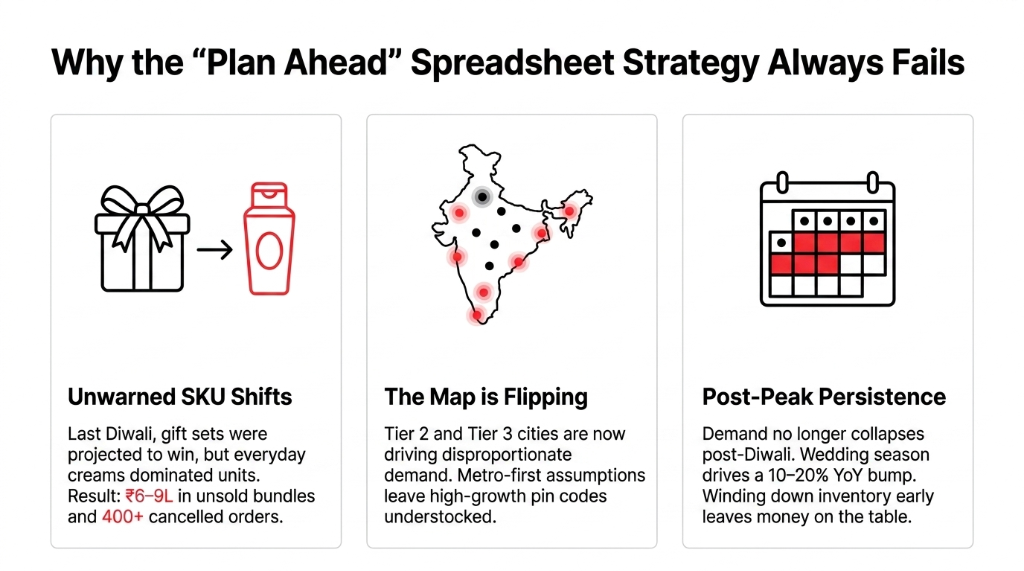
This approach ignores three realities that kill seasonal planning for beauty brands:
Reality 1: SKU-Level Demand Shifts Without Warning
Last Diwali, lipstick kits and skincare gift sets were projected to win. But "face and body creams" — L'Oreal, Nivea, Himalaya — dominated units. If you planned at the category level, you over-bought gift sets and under-bought everyday moisturisers.
Result: $7,200–$10,800 in unsold bundles and 400+ cancelled orders for the top-moving SKU.
Reality 2: The Demand Map Is Flipping
Problem: Tier 2 and Tier 3 cities are now driving a disproportionate share of online beauty purchases, fuelled by organic and local product demand. If your demand forecast is still built on metro-first assumptions from 2022, you are consistently understocking in pin codes that are now your fastest-growing segment.
Reality 3: Post-Peak Demand Does Not Collapse Anymore
Data point: Aggregate demand in the four weeks after Diwali 2025 climbed 10–20% year-over-year as wedding season kicked in immediately after the festive window. Brands that wound down inventory after the Diwali week left money on the table for 3–4 additional weeks.
Here is the problem everyone avoids talking about: your Excel-based forecast and your WhatsApp-to-supplier process cannot handle three simultaneous demand signals — festive, post-festive, and wedding season — at the same time. It physically cannot. You would need a full-time analyst doing nothing but updating pivot tables.
What Actually Breaks During Peak Season (The Dirty Details)
We have implemented ERP and inventory systems for beauty brands across India, UAE, and the UK. Here is what actually breaks — not the vague "supply chain disruptions" you read about in Forbes.
The Shopify-to-Warehouse Sync Problem
When your Shopify store gets 3,000 orders in 4 hours during a Diwali flash sale, Shopify's API rate limit throttles the sync to your warehouse management system. Orders queue up. Your warehouse team is packing based on a list that is 2–3 hours old.
The Damage
By the time the correct data arrives, 180–220 orders have already been assigned the wrong SKU. That is $2,640–$5,400 in wrong shipments. Then come the returns. Then the support tickets. Then the one-star reviews.
The Raw Material Lead Time Trap
Beauty products — especially skincare with actives like niacinamide or retinol — have a 45–60 day manufacturing lead time from ingredient procurement to finished goods. Start reordering in September for Diwali in October? Already too late.
Brands that do not have real-time inventory visibility in their ERP do not even know they are running low until the reorder alert triggers at 14 days of stock left. At that point, you are air-freighting ingredients at 4–6x the sea-freight rate. We saw one mid-size skincare brand in Mumbai spend $13,550 in premium freight costs in October 2024 alone — purely because their reorder point was set in a spreadsheet nobody had updated since 2023.
The Kitting Disaster
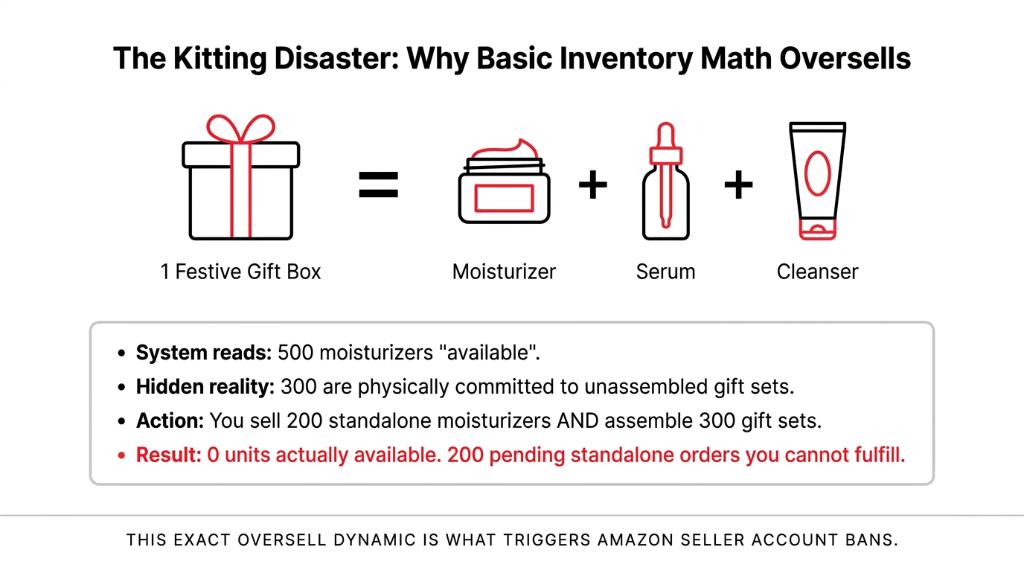
Festive gift sets require kitting — pulling 3–5 individual SKUs, bundling them in custom packaging, and treating that bundle as a new SKU. If your inventory system does not handle kitting logic natively, your stock count lies to you.
The Oversell Math
System reads: 500 moisturisers "available." Hidden reality: 300 are physically committed to unassembled gift sets.
You sell 200 standalone moisturisers. You assemble 300 gift sets. Now you have 0 units available with 200 pending standalone orders you cannot fulfil.
This exact oversell dynamic is what triggers Amazon Seller account bans.
How the Braincuber + Odoo Fix Actually Works
We do not sell magic. Here is the step-by-step logic of what we implement for beauty brands through our Odoo implementation.
Step 1 — Seasonal Demand Forecasting with AI Overlay (8–12 Weeks Pre-Peak)
Odoo's inventory module, combined with Braincuber's AI demand forecasting layer (built using time-series models trained on 3 years of your sales data), generates SKU-level forecasts broken down by region, channel (Shopify, Amazon, Flipkart, offline), and customer segment. 18–24 year old buyers behave very differently during Diwali than 35–44 year olds.
The system automatically adjusts reorder points 10–12 weeks before the predicted peak — not 2–3 weeks before, when every supplier is already backordered.
Result
This single change reduced emergency freight costs from $10,800–$16,800 per peak season to under $2,160 across our client base.
Step 2 — Kitting and Bundle Logic That Does Not Break
Odoo handles multi-level bills of materials natively. Every gift set SKU is tied to its component SKUs with real-time reservation logic. The moment a gift set order comes in, Odoo reserves the component inventory. Your standalone SKU availability is calculated net of committed components. No more overselling. No more $4,800 in returns.
Step 3 — Real-Time Shopify + Marketplace Sync
Braincuber's Shopify-Odoo connector is built with a queue-based architecture, not a real-time API call per order. During a 3,000-order-per-hour flash sale, orders batch-sync every 90 seconds, staying under Shopify's API rate cap. Inventory updates push back to Shopify every 2 minutes.
The window for an oversell error drops from 2–3 hours to under 4 minutes.
Step 4 — Automated Post-Peak Rebalancing
Instead of manually reviewing stock across 3 warehouses and 2 3PL partners after Diwali, Odoo generates an automatic rebalancing recommendation based on the next demand event (wedding season or Summer). Slow-moving post-Diwali SKUs get flagged for bundle promotions or return-to-vendor within 7 days — not 6 weeks later when you are sitting on $21,600 of dead stock.
What the Results Actually Look Like
From implementations we have run for beauty and personal care D2C brands: *(Yes, we make our clients give us the ugly before-and-after data. That is the only way we know if it is working.)*
Before vs. After Braincuber Implementation
Stockout Events
23 to 3
Per Diwali season. From an average of 23 stockout events down to 3 after the first implementation year.
Dead Stock Value
$14,400 to $2,520
Post-peak dead stock value dropped from $14,400–$21,600 per season to $2,520–$4,080.
Freight Spend
Down 83.7%
Emergency freight spend during peak season after the first implementation year.
- Order fulfilment accuracy during Diwali flash sales: up from 79.3% to 97.1%
- Manual inventory reconciliation time by ops team: down from 37 hours/week during peak to 6 hours/week
- Emergency freight costs: reduced from $10,800–$16,800 per peak to under $2,160
The Implementation Reality — What It Takes and When to Start
A full Odoo implementation with AI demand forecasting for a beauty brand doing $240,000–$1.8M ARR takes 11–16 weeks from kickoff to go-live. That means if Diwali hits in October, your cutoff to start is late June at the absolute latest.
For Summer demand, start in February. Not April. February.
First 30 Days Post Go-Live
Immediate wins: accurate kitting logic, live inventory visibility across all channels, and automated reorder triggers. The AI forecasting layer improves with each season — it learns your SKU-level demand patterns across Diwali, Summer, wedding season, and Holi. By year two, your seasonal accuracy is 31–38% better than year one.
What you do not need: a 6-month "consulting discovery phase." We have already built the templates. A beauty brand's operational blueprint is not unique. Your SKUs, your kitting, your 3PL sync — we have built this 40+ times. We move faster because of it.
Frequently Asked Questions
How early should a beauty brand start seasonal inventory planning for Diwali?
Start no later than late June for an October Diwali. Finished goods need to be in your warehouse by mid-September. Manufacturing lead times for beauty SKUs with active ingredients run 45–60 days. If your ERP does not trigger reorder alerts by July, you will be air-freighting at 4–6x standard cost.
Can Odoo handle kitting and gift set logic for Diwali bundles without overselling?
Yes — natively. Odoo's multi-level Bill of Materials reserves component SKUs the moment a bundle order is placed. Your standalone SKU availability is calculated net of committed components in real time, preventing the oversell errors that generate returns and Amazon Seller warnings.
What is the difference between managing Summer demand vs. Diwali demand for beauty brands?
Diwali is a sharp 2–4 week spike (up to 95% YoY growth) requiring burst inventory capacity and kitting readiness. Summer is a sustained 10–12 week build requiring gradual replenishment of SPF, matte, and sweat-proof SKUs. The forecasting model, reorder cadence, and marketing calendar alignment differ completely.
How does Braincuber's Shopify-Odoo integration prevent overselling during flash sales?
The connector uses a queue-based batch sync architecture — not a per-order API call — staying under Shopify's rate limits even at 3,000+ orders per hour. Inventory updates push to Shopify every 2 minutes, shrinking the oversell window from 2–3 hours to under 4 minutes.
How long does Odoo implementation take for a D2C beauty brand and when will ROI show?
Implementation runs 11–16 weeks for a beauty brand doing $240,000–$1.8M ARR. ROI is visible within the first peak season post go-live — primarily through reduced emergency freight costs, lower dead stock, and higher order fulfilment accuracy. Most clients recover the full implementation cost within one Diwali cycle.
Stop Losing $10,800–$21,600 Every Peak Season to Inventory Failures You Can See Coming
Pull up your last Diwali returns folder. If it is full of wrong-SKU shipments and cancelled orders, you have the exact problem we fix. Book our free 15-Minute Operations Audit — we will find your single biggest operational leak in the first call. No pitch deck. Just answers.