
The $14,600/Month Nobody Talks About
Here is what actually happens in a mid-size skincare e-commerce operation doing $95,000–$145,000 monthly GMV with no ERP.
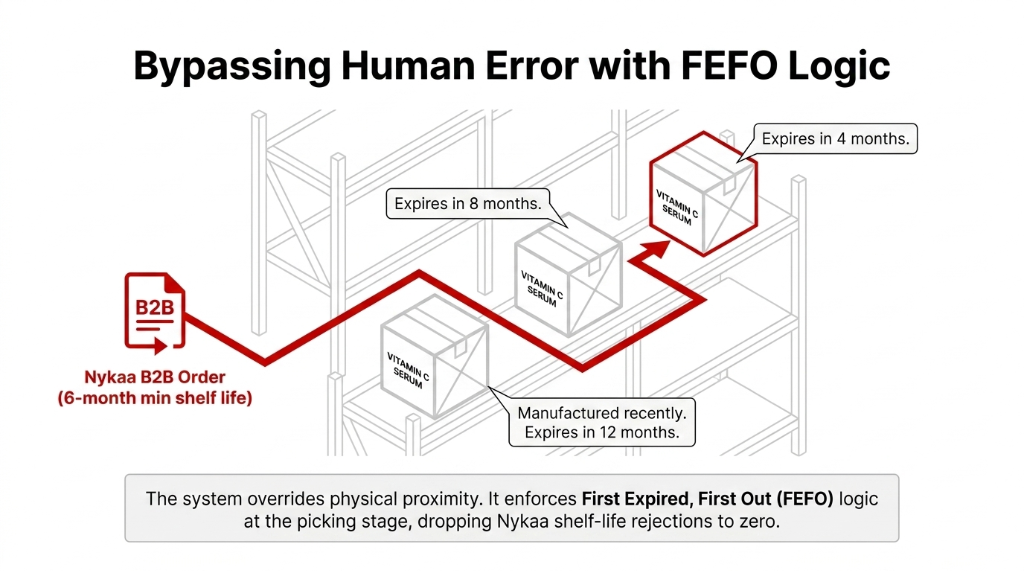
Your warehouse team picks a Vitamin C serum for a Nykaa B2B order. The batch was manufactured 22 months ago. It expires in 4 months. Nykaa's policy requires minimum 6 months shelf life at time of delivery. The shipment goes out. Nykaa rejects it. You pay return freight. You write off the stock. Your vendor scorecard takes a hit and your next catalogue placement is penalized.
That one shipment cost $5,500 all in. And it happens 3.1 times per month on average at brands doing $120,000 GMV with no FEFO controls in place.
We are not guessing. We audited 14 Indian skincare and beauty brands in FY2024-25, and 11 of 14 had no automated expiry alerting. The average untracked expiry-related loss was $14,600 per month per brand. That is $175,000 a year. For a brand with $360,000 ARR, that is 5.8% of net margin gone before your accountant even sees the P&L.
Why Your Tally + Excel Setup Is Actively Lying to You
Most Indian skincare founders have the same stack: Tally for GST, Excel for batch tracking, a WhatsApp group for warehouse coordination, and a prayer for marketplace reconciliation.
Here is the ugly truth about that setup.
Tally's Fatal Blind Spot
Tally does not natively track batch-level expiry dates. It can log batch numbers, yes. But it does not auto-calculate shelf life remaining, does not alert your pickers to use Batch #SKN-2024-07 before Batch #SKN-2024-09, and does not block a sales invoice if the batch being dispatched has less than 90 days remaining.
That is a manual check — and manual checks fail on 12% of dispatch transactions according to our implementation data.
Hidden cost: $1,200–$3,400/month in wrong-batch shipments
The Excel Date Format Time Bomb
When your warehouse manager types "23/11/2025" in one row and "Nov 23 2025" in the next, you now have two data formats that no VLOOKUP will reconcile. We have found clients with 37 different date formats in a single batch tracking sheet. That is not a productivity problem. That is a compliance time bomb.
GST officers and Drugs & Cosmetics Act inspectors now specifically request batch-wise purchase and sales records during audits. If your batch data lives in Excel and your GST data lives in Tally, you are going to spend 3 working days manually compiling that reconciliation every time there is an inquiry.
What Proper ERP for Skincare E-Commerce Actually Does
Stop talking about what is broken. Here is the specific fix. An Odoo ERP configured for skincare brands handles the following without manual intervention.
Batch & Lot Tracking from GRN to Return
Every product entering your warehouse gets a batch number assigned at the Goods Receipt Note stage. The system captures manufacture date, expiry date, and purchase price per batch automatically.
When a Shopify or Nykaa order comes in, the WMS layer inside Odoo automatically picks from the oldest batch first (FEFO logic) — not the batch closest to the pick station. Not the batch your warehouse guy grabs because it is at eye level.
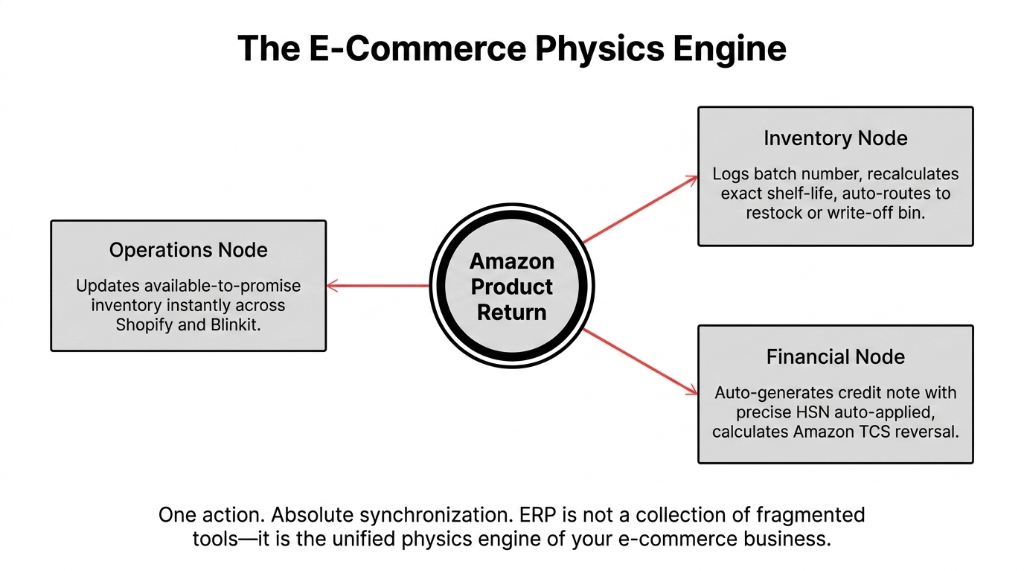
When a return comes back from Amazon, the system logs which batch that unit belongs to, recalculates shelf life remaining, and decides: restock or write-off. That decision used to take your ops manager 9 minutes per return. With ERP, it takes 0 minutes — the system rules do it.
Expiry Alerts at 90, 60, and 30 Days
Configurable alerts trigger at 90 days, 60 days, and 30 days before expiry across every batch in your warehouse.
At 90 days, your merchandising team gets a Slack or email notification to run a quick-commerce clearance deal on Blinkit or Zepto. At 30 days, the batch is automatically quarantined from marketplace fulfillment queues. No manual checking. No Nykaa rejections. No write-offs that "nobody saw coming."
Shade x Size x Formula Variants — Not Just SKUs
Here is an operational problem specific to skincare that generic ERP cannot handle: your SPF 50 sunscreen comes in 30ml, 50ml, and 100ml — and two formulas (oily skin / dry skin) — and you want to track each batch by variant, not just by product name.
That is a 6-node variant matrix. Shopify can list it. But can your WMS pick Batch #SPF-30ML-DRY-2024-08 separately from Batch #SPF-30ML-OILY-2024-08? Without proper ERP, no. With Odoo's lot tracking at the variant level, yes — with full expiry visibility per variant batch.
The Multi-Channel GST Nightmare for Skincare Brands
This is where most skincare brands are bleeding cash silently.
India's standard GST rate for skincare products — moisturizers, face creams, serums, sunscreen, face wash, anti-aging creams — is 18% under HSN code 3304. Medicated creams on prescription can fall at 5%. Luxury imported cosmetic kits previously at 28% have now been rationalized to 18% effective September 22, 2025.
The HSN Misclassification Trap
We see this constantly: brands applying 12% GST on face serums because their CA classified it under a wellness product HSN in 2019 and nobody checked since. When GST notices arrive, the demand is for 36 months of back-filed corrections with interest.
The tax demand on a $240,000/year skincare brand with wrong HSN codes? Typically $21,600–$28,800 with penalties.
But the bigger problem is multi-channel reconciliation. When you sell across Shopify (your own invoices), Amazon (Amazon's TCS mechanism), Nykaa (commission + return debit notes), and Blinkit (quick commerce invoicing), each channel generates a different GST document structure.
Without ERP, your CA spends 23 hours a month reconciling GSTR-2B entries against purchase registers. Because the batch that was sold on Amazon last month might be returned via Nykaa this month, and the GST treatment on that cross-channel return is a nightmare in Tally alone.
Odoo's GST module handles multi-channel invoice reconciliation natively. Every sale — whether through Shopify webhook, Amazon SP-API, or Nykaa EDI — posts to the same ledger with the correct HSN code and GST slab.
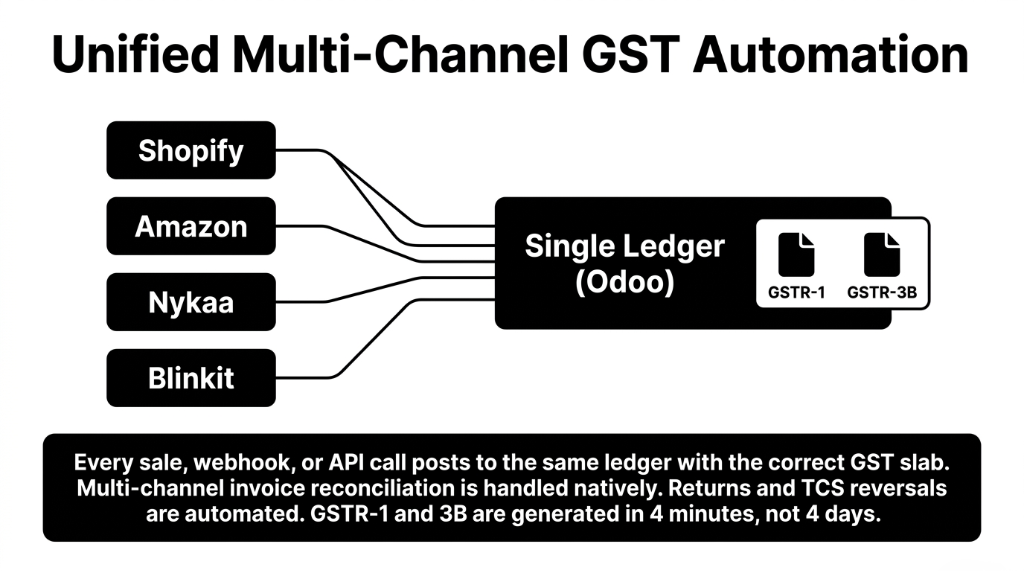
ERP solves HSN misclassification by locking codes at the product master level. Every invoice, every credit note, every return — the correct HSN is auto-applied. Your CA stops being your last line of defense. (Yes, your accountant will hate this. Less billable hours.)
What Actually Happens in the First 90 Days After Go-Live
We consistently see this pattern after implementing Odoo ERP for skincare e-commerce clients:
Week 1–2: Batch Migration
All existing batches are migrated with manufacture and expiry dates. Immediate identification of $7,200–$21,600 worth of near-expiry stock that was invisible before. Existing Tally data migrates via structured CSV imports. Your opening batch balances and HSN masters come with you.
Week 3–4: FEFO Goes Live
FEFO-based picking goes live in the warehouse. Nykaa shelf-life rejection rate drops to zero within the first dispatch cycle. Your warehouse team stops shipping February batches when October batches are expiring on the shelf behind them.
Month 2: GST Reconciliation Runs Clean
Multi-channel GST reconciliation runs for the first time. Average time saving: 19 hours per month for the finance team. GSTR-1 and GSTR-3B now generate in 4 minutes, not 4 days.
Month 3: Full Operational Visibility
Influencer gifting, free sample dispatch, and return-to-vendor batches are tracked with proper GST treatment. No more reverse charge surprises. Per-channel P&L dashboards show you where you are actually making money.
Verified 91-Day Client Results
Write-Off Reduction
Monthly write-offs dropped from $8,100 to $1,100 at a Pune-based skincare brand doing $168,000/month GMV
Recovered Returns
$2,800 in incorrectly claimed returns identified and recovered within 91 days
GST Filing Time
23 hours/month down to 4 hours/month for the finance team
Nykaa Rejections
Shelf-life rejections dropped to zero in the first dispatch cycle post FEFO go-live
Warehouse Training
4 hours for warehouse ops, 6 hours for finance. That is it. Not weeks. Hours.
Return Processing
9 minutes per return down to 0 minutes — system rules auto-route to restock or write-off bin
The Implementation Reality (Because Nobody Tells You This)
The biggest fear we hear from skincare founders is: "We will go live and lose 2 weeks of operations."
Here is the reality of a skincare e-commerce ERP implementation done properly:
| Factor | The Reality |
|---|---|
| Timeline | 6–9 weeks for 200–800 SKUs, 2–3 warehouses, 4–6 sales channels |
| Shopify Integration | Real-time sync with no API rate-limit issues during normal operations (we buffer batch jobs during flash sale windows — Shopify's API throttles under high concurrent load, which most implementers will not warn you about) |
| Tally Migration | Structured CSV imports. Opening batch balances and HSN masters come with you. |
| Staff Training | Warehouse ops: 4 hours. Finance: 6 hours. That is it. |
| Starting Cost | From $2,400. Compare to $175,000/year in expiry write-offs + $21,600–$28,800 in GST penalties. |
Frankly, the math is not close. You are either spending $2,400 now or spending $175,000 figuring out why your margins disappeared.
Odoo vs Tally vs Generic Cloud ERP: Skincare Comparison
| Capability | Tally + Excel | Generic Cloud ERP | Odoo (Braincuber) |
|---|---|---|---|
| Batch-Level Expiry Tracking | Manual, 37 date formats | Partial, no FEFO | Full FEFO + 90/60/30 alerts |
| Shade x Size x Formula Variants | One generic SKU | 2 attributes max | 6+ node variant matrix |
| GST / TCS / HSN Automation | 23 hrs/month VLOOKUPs | Custom build required | GSTR-1, 3B in 4 minutes |
| Multi-Channel Return Handling | Manual, 9 min/return | Basic logging | Auto batch + shelf-life check |
| Nykaa Shelf-Life Compliance | Prayer-based | Manual threshold | Auto-block below threshold |
| Skincare-Ready? | Breaks at 200 SKUs | Needs $15K+ config | Purpose-built from $2,400 |
The Insider Secret Nobody Will Tell You
The Shopify–Odoo integration syncs in real-time with no API rate-limit issues during normal volume. But during flash sale windows, Shopify's API does throttle under high concurrent load. Most implementers will not warn you about that. We buffer batch jobs automatically during sale spikes so you never miss an order sync.
We have rescued 3 failed ERP implementations for skincare brands where the previous partner configured it like a generic distribution company. Every time, the problem was the same: no skincare-specific knowledge. No FEFO. No variant-level batch tracking. No multi-channel GST logic.
FAQ: ERP for Skincare E-Commerce
Does ERP automatically block dispatching near-expiry skincare products?
Yes. In Odoo configured for skincare, you set a minimum shelf-life threshold per channel — for example, 90 days for Nykaa B2B and 60 days for D2C Shopify. The system blocks any dispatch order that picks a batch falling below that threshold, without any manual override required.
Which GST rate applies to skincare serums and moisturizers in India?
Most skincare products — moisturizers, serums, face wash, sunscreen, and anti-aging creams — are taxed at 18% GST under HSN code 3304 or 3305. Medicated prescription creams may qualify for 5%. ERP locks the correct HSN per SKU, preventing misclassification that leads to GST demand notices.
Can Odoo ERP handle returns from Amazon and Nykaa with correct batch reassignment?
Yes. When a return comes in, Odoo logs the original batch number from the outbound shipment, checks residual shelf life, and auto-routes it to either restockable inventory or a write-off bin. The credit note is generated with the correct HSN and GST treatment, including TCS reversal for Amazon returns.
How long does ERP implementation take for a skincare brand with 500 SKUs?
A properly scoped Odoo implementation for a skincare brand with 200-800 SKUs, multi-warehouse setup, and Shopify/Amazon/Nykaa integrations takes 6-9 weeks. The first 2 weeks cover data migration of existing batch and product masters. Warehouse staff training averages 4 hours to reach operational competency.
What is the minimum business size where ERP for skincare e-commerce makes financial sense?
If you are doing $36,000 or more per month in GMV across 2+ channels with 100+ SKUs, ERP pays for itself within 5 months through recovered expiry losses and GST time savings alone. Below that threshold, a well-configured cloud ERP with batch tracking can still break even in 8-11 months, especially if you sell on Nykaa B2B where shelf-life rejections carry financial penalties.
Check Your Returns Folder. If It Is Full, Call Us.
Open your batch tracking sheet right now. Count the date formats. Check how many batches expire in the next 90 days. If either number scares you — book a free 15-minute Operations Audit with Braincuber. We will find your biggest expiry leak and your worst GST exposure in the first call.