
The Hair Care Variant Problem Nobody Talks About
A mid-scale Indian hair care brand — doing $480,000–$960,000 annually — typically manages anywhere between 80 and 300 active SKUs once you factor in size variants, fragrance variants, hair type targeting (oily, dry, damaged, colored), and packaging formats (pump, flip cap, tube, sachet).
Each of those variants is a different formulation. Or at least it should be.
Here is what we see 9 out of 10 times during an onboarding audit at Braincuber: the brand is running 3 separate Excel files — one for formulations, one for raw material procurement, and one for production scheduling — and not one of them talks to the other in real time. The procurement manager reorders Castor Oil based on last month's numbers. The production floor uses a WhatsApp forward of a formulation sheet that was last updated 7 months ago.
(Yes, your competitor running a $3M hair care brand is probably doing the same thing. That does not make it okay.)
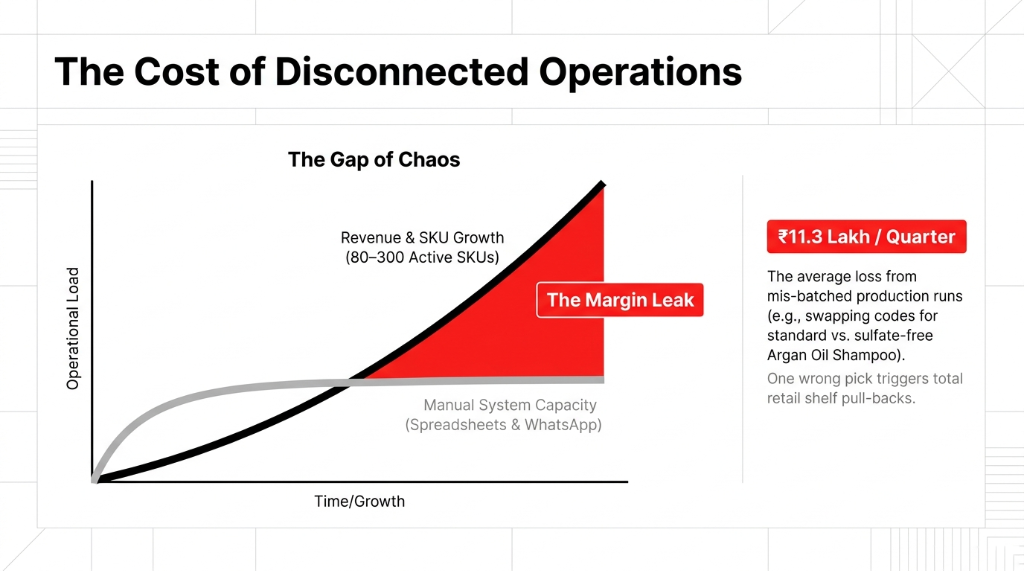
Formulation Drift: The Silent Margin Killer
Batch #1 of your "Onion Hair Oil – 100ml" has 12% Onion Seed Extract. Batch #17 has 9.3% because someone scaled down when stocks ran low and nobody flagged it. Your customer reviews start mentioning the product "isn't the same anymore." You spend $2,900 on a digital marketing campaign trying to fix reviews that were caused by a supply chain failure.
That is not a marketing problem. That is an ERP problem.
Why Your Current Setup Will Break at Scale
The instinct of most founders is: "We will hire an operations manager."
Frankly, that is the wrong fix. Hiring more staff is not scaling — it is bloating. An ops manager working off disconnected tools will hit the same wall in 6 months that you are hitting now, except you will now have their salary on top of the problem.
The SKU Proliferation Trap
Demand can spike 80%+ during festive seasons (Diwali, wedding season) or when an influencer posts about your scalp serum. Without a system that can generate variant-level demand forecasts, you will either overbuild inventory for slow variants or stockout on your hero SKU.
Soulflower's rosemary range drives 60–70% of their revenue precisely because they stopped spreading inventory thin across too many SKUs and focused on depth. Without data, you are guessing which SKU deserves the focus.
The Phantom Formulation Problem
When your R&D team tweaks a formulation — say, replacing Sodium Lauryl Sulfate with Sodium Lauryl Glucoside in your clarifying shampoo range — that change must cascade instantly to: procurement (new ingredient), production (new BOM), labeling (new INCI list), compliance (new safety assessment), and costing (new COGS).
Without ERP, this cascade happens across 4 emails and 2 Slack threads. Something always gets missed. Always.
Batch Traceability Nightmares
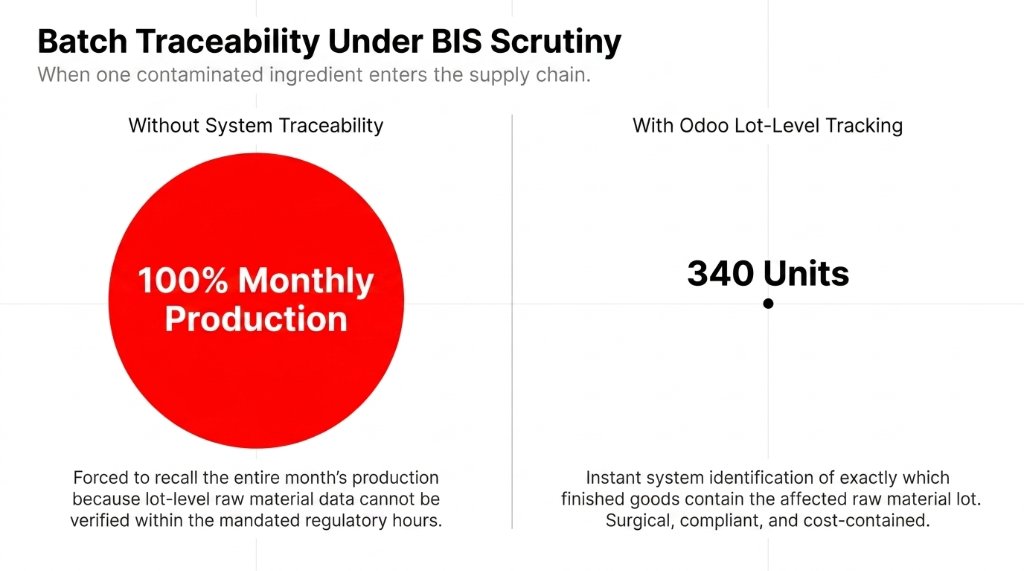
India's BIS regulations and increasingly strict e-commerce platform quality requirements mean you need to prove — within hours, not days — exactly which raw material lot went into which finished product batch.
Without lot-level traceability in a unified system, a single contaminated ingredient batch can force you to recall your entire month's production instead of just the affected 340 units.
What ERP Actually Does for Hair Care Formulation Management
When we implement Odoo ERP for hair care brands in India, we configure 7 operational layers that currently live across 4–6 disconnected tools:
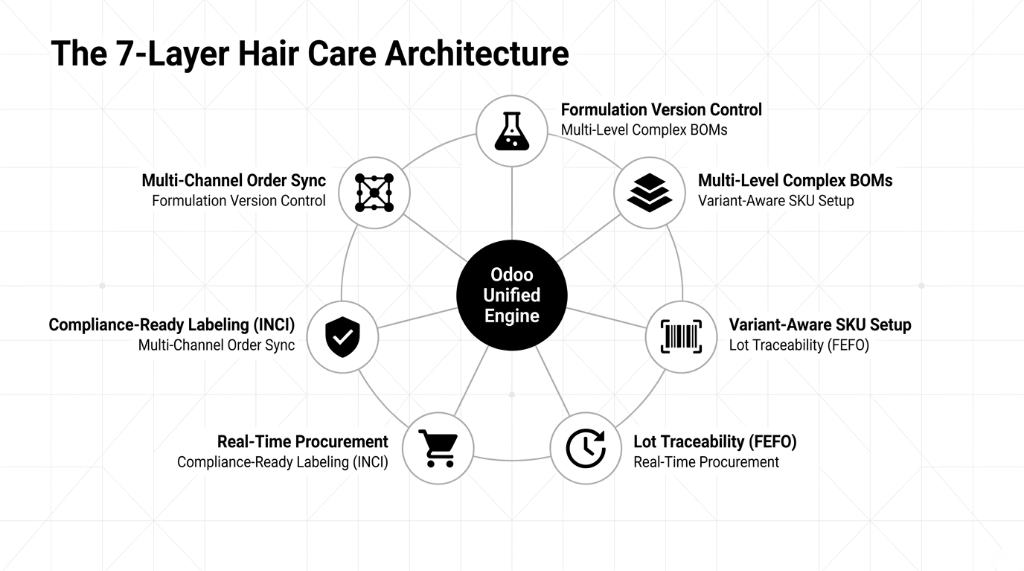
1. Formulation & Recipe Management with Version Control
Every formulation lives as a versioned Bill of Materials (BOM) in Odoo. When your R&D team updates the formula — adding 0.5% Biotin, reducing fragrance from 1.2% to 0.9% — they create Version 2.1, not overwrite Version 2.0. Production runs are locked to a specific version. You can audit exactly which formulation version was used in every batch, going back 3 years.
2. Multi-Level BOM for Complex Processes
Hair care manufacturing is not simple mixing. It is emulsification, active infusion, fragrance blending, pH adjustment, then filling. Odoo supports multi-level BOMs that map this exactly — powder blending feeds into the emulsification sub-assembly, which feeds into the final filling operation. Each step gets a quality checkpoint.
3. Variant-Aware SKU Architecture
Each size + formulation + packaging combination gets its own SKU with its own barcode. No shared codes between "Anti-Dandruff Shampoo 100ml" and "Anti-Dandruff Shampoo 200ml." No visual guessing in the warehouse. Scan-based picking eliminates the mix-up that costs you a $4,800 Amazon return penalty.
4. Batch & Lot Traceability (FEFO Logic)
Expiry-sensitive ingredients — your natural oils, botanical extracts, preservatives — get tracked at the lot level with FEFO (First Expiry, First Out) logic enforced automatically. If your Rosemary Extract lot expires in 60 days, the system schedules it into the next production run, not the one 90 days out. We have seen clients recover $2,050 in ingredient write-offs in the first 3 months purely from this feature.
5. Real-Time Raw Material Procurement Triggers
When a production order is confirmed for 10,000 units of your Protein Hair Mask, Odoo instantly checks current stock levels across all warehouses and auto-generates purchase requisitions for shortfalls. Your procurement team stops playing the "how much do we need?" guessing game that was eating 37 hours/month in manual stock-checking.
6. Compliance-Ready Labeling
Every finished product batch in Odoo carries the full ingredient list (INCI format), manufacturing date, batch number, and best-before date — linked directly to the formulation BOM. When your labeling team prints a batch sticker, it pulls live data. No more printing labels from a separate spreadsheet that may be 2 formulation versions behind.
7. Multi-Channel Order Management
Whether you sell on Nykaa, Amazon, your D2C Shopify store, or through salon wholesale — all channels feed into one inventory pool in Odoo. When Nykaa places a bulk order for 2,000 units of your Scalp Serum, inventory is reserved instantly. No more overselling the same stock across three channels and spending $9,600 in penalty fees to marketplaces.
The Numbers: What This Looks Like After 90 Days
We do not throw out round numbers. Here is what our last 3 hair care brand implementations in India looked like at the 90-day mark:
Verified 90-Day Implementation Results
Formulation Errors
Reduced by 91% — from 6.3 batch rework incidents/month to 0.6
Ingredient Write-Offs
Dropped from $2,300/month to $275/month via FEFO enforcement + real-time expiry alerts
Order Processing
18 minutes per order down to 3 minutes with automated warehouse task generation
SKU Rationalization
22% reduction — ghost variants with zero sales velocity removed, freeing warehouse space and management overhead
Compliance Audit Prep
From 4 days of manual document gathering to a 2-hour Odoo report export
Procurement Guessing
37 hours/month in manual stock-checking eliminated with auto-generated purchase requisitions
These are not features. These are recoveries from waste you are currently generating and not measuring.
The Implementation Reality (No Sugarcoating)
Here is what a Braincuber Odoo implementation for a hair care brand typically looks like:
| Phase | Timeline | What Happens |
|---|---|---|
| Discovery & Data Migration | Weeks 1–2 | Every formulation, SKU variant, supplier, and BOM mapped from your Excel files into Odoo. Your team spends 15–20 hours providing data. Do not skip this step. |
| Configuration & Testing | Weeks 3–5 | Variant product architecture built, multi-level BOMs configured for top 30 SKUs by revenue, batch traceability set up. Parallel testing alongside existing tools. |
| Inventory & Production Go-Live | Weeks 6–8 | Procurement, production orders, and batch tracking running live in Odoo. Your Excel files officially retire. |
| Sales Channel Integration | Weeks 9–12 | Shopify, Amazon Seller Central, Nykaa catalog sync into Odoo inventory in real time. Full multi-channel go-live. |
The Part Nobody Tells You
The first 2 weeks post-go-live are the hardest. Not because the system is broken, but because your team is unlearning habits they have had for years. Budget for this mentally.
We do 3 months of post-go-live support on every engagement precisely because of this. Not 30 days. Three months.
The Controversial Take You Need to Hear
Everyone in the Indian market tells mid-scale hair care brands to "wait until you are bigger" before investing in ERP.
That advice will kill your margins.
The window to implement properly is $360,000–$1.2M ARR — when your SKU count is exploding, your formulations are multiplying, and your team is still small enough to retrain fast. Wait until $2.4M and you are managing a legacy of 4 years of bad data, 12 Excel files no one fully understands, and a finance team that has reconciled their P&L with procurement data in ways that would require forensic accounting to untangle.
Do not let "we are too small for ERP" cost you $14,400–$21,600 per year.
That is inventory errors, formulation rework, and marketplace penalties combined. That is not a technology cost. That is the cost of not having the technology.
The hair care brands that will dominate the Indian market in the next 3 years are not the ones with the best formulations — they are the ones that can manufacture those formulations consistently, trace every batch, and scale across channels without operational collapse.
The Insider Secret
Brands with cleaner data in their existing Excel files get to full go-live 11–14 days faster. Before you even talk to an ERP vendor, spend one weekend organizing your formulation BOMs and supplier lot records. That $0 investment saves you $2,800 in implementation labor.
Total timeline: 10–12 weeks from contract sign to full multi-channel go-live. Not 6 months. Not a $60,000 SAP implementation that requires a dedicated IT team to maintain.
FAQ: ERP for Hair Care Brands India
How long does Odoo ERP implementation take for a hair care brand in India?
For a hair care brand with 50–200 active SKUs and 2–3 manufacturing facilities, implementation runs 10–12 weeks end-to-end. Weeks 1–2 cover data migration, Weeks 3–8 cover production and inventory go-live, and Weeks 9–12 cover sales channel integration. Brands with cleaner data get to full go-live faster.
Can Odoo ERP handle multiple formulation versions for the same product?
Yes. Odoo's BOM versioning lets you maintain V1.0, V2.0, and V2.1 of the same formulation simultaneously. Each production order is locked to a specific version — so even if R&D updates the formula mid-month, active production runs are not disrupted and you have a full audit trail of every change.
How does ERP help with BIS and regulatory compliance for hair care products in India?
Odoo links every batch to its exact formulation version, ingredient lots, supplier certificates, and safety data. When BIS or a marketplace quality team requests batch documentation, you export a single traceability report — no manual file gathering. This cuts compliance audit preparation from 4 days to under 3 hours.
What happens to our existing Shopify store and Amazon Seller Central during ERP migration?
Both platforms continue operating normally during implementation. In Weeks 9–12, we build the live integration — orders flow from Shopify and Amazon directly into Odoo, inventory levels sync back every 15 minutes, and dispatch is triggered from a single Odoo warehouse screen. There is zero downtime for your customers.
What is the realistic ROI in the first 90 days of Odoo ERP for an Indian hair care brand?
Across our hair care implementations, brands typically recover $1,700–$2,500/month in the first 90 days through ingredient write-off reduction (FEFO enforcement), marketplace penalty elimination (no overselling), and production rework reduction (formulation version control). Implementation cost is typically recovered within 4–6 months.
Stop Letting Formulation Drift and SKU Chaos Eat Your Margins
Open your formulation spreadsheet. Check how many versions exist for your top 5 SKUs. Check whether your warehouse can tell the difference between your 100ml pump and your 100ml flip cap by code alone. If either answer makes you uneasy — book a free 15-minute Operations Audit with Braincuber. We will identify your three biggest operational leaks in the first call. No pitch. No fluff. Just numbers.