
The Real Scale of the Problem
The Indian ethnic wear market generated $19.09 billion in revenue in 2023 and is on track to hit $30.45 billion by 2030, growing at a 6.9% CAGR. Online is the fastest-growing segment — yet offline remains the largest. That means you cannot afford to pick one channel over the other. You need both. And most ethnic wear brands are not operationally equipped to run both without bleeding money.
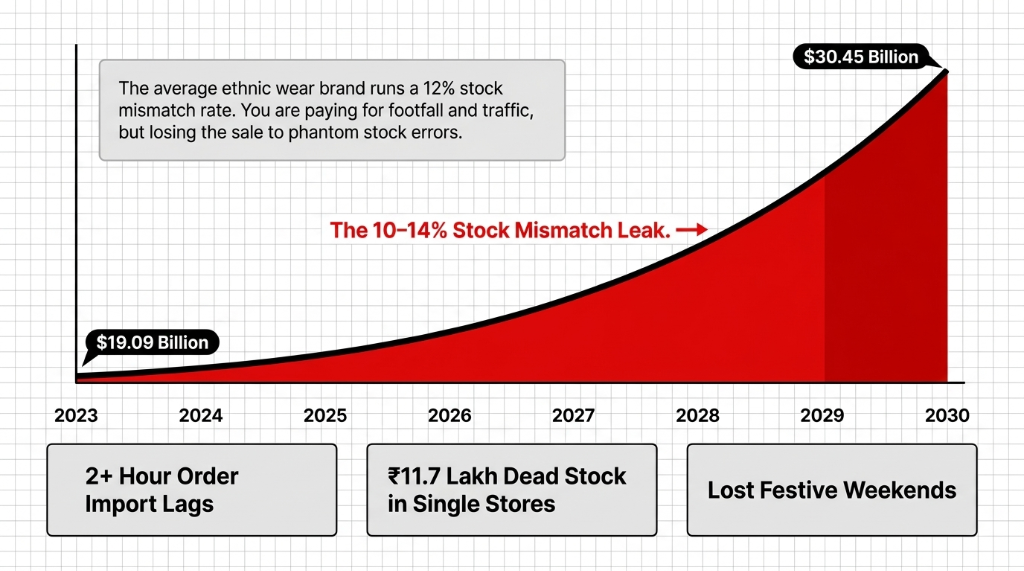
Here is what we consistently see across ethnic wear clients — the ones who come to us after they have tried everything else:
The Numbers Nobody Wants to Admit
One client — a bridal lehenga brand scaling from $297,500 to $714,000 ARR — was sitting on $13,930 worth of dead stock in their Surat store while their Delhi store was running out-of-stock for the same SKUs. No inter-store transfer system. No real-time visibility. Just two store managers DMing each other on Instagram.
Why "Just Hire a Stock Manager" Is the Wrong Answer
Every operations consultant you have spoken to has said some version of: "Add a dedicated inventory person."
Frankly, that is the most expensive band-aid in retail.
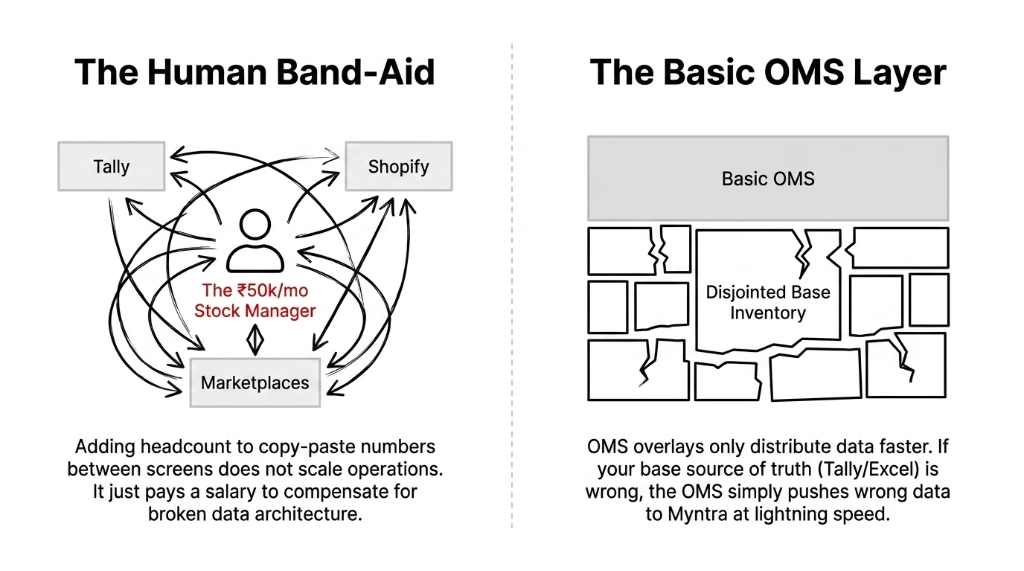
You do not have a people problem. You have a data architecture problem. Adding a person to reconcile data between Tally, your marketplace seller panel, and your D2C Shopify backend means you are paying a salary to compensate for broken systems. We have seen brands spend $417–$595/month on a "stock reconciliation executive" whose entire job is to copy numbers from one screen to another.
That person is not scaling your brand. That person is your ERP working at 2% efficiency.
The OMS Trap Nobody Warns You About
The other advice that kills ethnic wear brands: "Use Unicommerce or Increff." These are order management overlays. They help. But they sit on top of broken inventory data.
If your source of truth — the actual count of how many Bandhani kurta sets exist in what sizes across which locations — is wrong in the base system, an OMS layer on top just distributes that wrong data faster.
Wrong data at lightning speed is still wrong data.
What a Unified ERP Actually Does for an Ethnic Wear Brand
Here is the operational reality of running Odoo ERP for an ethnic wear brand — not the brochure version, the version we see after 90 days of go-live.
Single Inventory Record. No Exceptions.
One of the most measurable transformations we see is the elimination of the "which number do I trust?" conversation. With Odoo ERP configured for omnichannel ethnic wear, every sale — whether it happens at your Bandra store POS, on your Shopify D2C site, or via a Myntra fulfillment order — deducts from the same live inventory pool.
Verified Results: 50-Store Omnichannel Implementation
Stock Mismatch
From 12% down to below 1.5% across all channels
Order Import Lag
From 2+ hours down to under 15 minutes during peak events
Revenue Growth
+18% year-over-year — not from adding SKUs, but from stopping phantom stock losses
Variant-Level SKU Tracking (The Ethnic Wear Nightmare, Solved)
This is where every generic ERP fails ethnic wear brands. A single lehenga style in your catalog can have 6 colors x 4 sizes x 3 blouse options = 72 variants of a single design. Add dupattas, contrast blouse options, and regional fabric-weight variants, and you are managing 200+ child SKUs per style family.
Tally does not handle this. Excel cannot handle this. Your current OMS probably approximates this.
Odoo's product variant engine natively manages multi-attribute SKU structures — color, size, fabric, occasion tag — and ties each variant to its own barcode, reorder rule, and supplier lead time. So when your Navratri collection goes live and the "Firozi size M" sells out in 4 hours, the system flags it, blocks the online listing automatically, and queues the reorder to your Surat embroiderer — without your operations manager manually catching it at midnight.
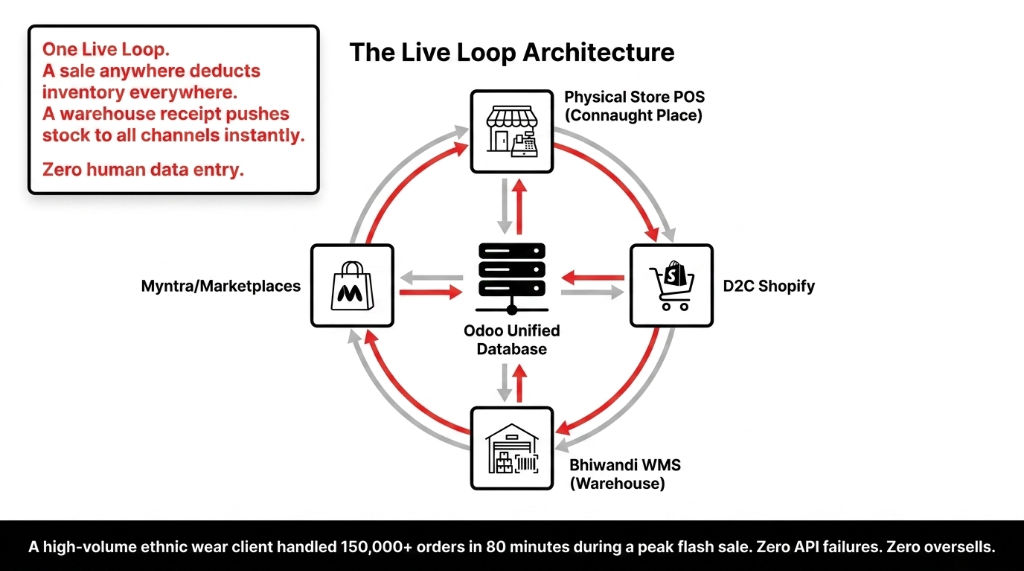
POS-to-Warehouse-to-Online: One Live Loop
Most ethnic wear brands run their offline POS on one system (usually a standalone POS or Tally extension), their warehouse on a separate WMS or manual log, and their online channels on yet another platform. Three systems means three reconciliation cycles, three places for errors to hide, and three monthly subscription fees.
Odoo's POS module, inventory module, and e-commerce/marketplace connectors run off the same database. When your store in Connaught Place sells a set, your Shopify listing adjusts within minutes. When your warehouse receives new stock from your Rajkot manufacturer, every sales channel — offline POS, website, Myntra — gets updated without a human touching a keyboard.
Real Result: 150,000+ Orders in 80 Minutes
A high-volume brand we work with was handling 150,000+ orders in 80 minutes during a peak flash sale event after Odoo ERP integration — zero API failures, zero oversells. Before Odoo, the same event caused system crashes and 500+ unsynced orders.
Festive Demand Forecasting That Uses Real Data
Here is something your current system cannot do: tell you in September how many Banarasi silk sets in size L you need to order for the Diwali–Bhai Dooj–Christmas window, broken down by store location and online demand signals.
Odoo's demand forecasting module uses historical sales data, seasonal pattern recognition, and configurable reorder rules to generate buying recommendations by style, size, and color. For ethnic wear brands where Navratri, Diwali, Eid, and wedding season account for 60–70% of annual revenue, getting festive procurement wrong by even 15% is the difference between a profitable quarter and a $21,420 dead-stock write-off.
We constantly see brands buy too much of the wrong sizes (size XL in conservative colors) and run out of the fast movers (size M, S in vibrant festive tones). Odoo turns three years of your own sales history into a procurement model — not a gut call.
Returns Without the Chaos
Ethnic wear has an above-average return rate on online channels. Fit issues, color-rendering differences, fabric feel expectations — a typical ethnic wear brand running on Myntra, Nykaa Fashion, or AJIO sees return rates between 18–28% for online orders.
Without ERP integration, every returned piece triggers a manual process: update the OMS, update the WMS, decide if it goes back to sellable inventory or to the QC pile, update the finance entry in Tally, reconcile the marketplace credit note. That is 6–9 manual touchpoints per return.
From 4.5 Hours to 35 Minutes
With Odoo, the return workflow auto-triggers: the item is scanned at the warehouse, a QC rule routes it to sellable or non-sellable stock, the inventory count updates across all channels, and the accounting entry is posted — all in one workflow.
A client processing 80–100 returns per day went from spending 4.5 hours on return reconciliation to under 35 minutes. (Yes, that freed up an entire person's workday.)
The Implementation Reality (No Sugarcoating)
We will not tell you Odoo goes live in a weekend. For an ethnic wear brand with 300+ active SKUs, 2–3 physical stores, and 2–4 online channels, a proper implementation runs 8–12 weeks. Here is the honest breakdown:
Weeks 1–2: SKU Master Data Cleanup
(This is always the ugliest part. Your product catalog is almost certainly a mess of duplicate entries, inconsistent naming, and missing variant attributes. Expect this to take longer than you planned.)
Weeks 3–5: Odoo Configuration
POS setup, inventory rules, reorder triggers, marketplace connector setup for Shopify/Myntra/Amazon. The boring stuff that prevents your next Navratri disaster.
Weeks 6–8: Data Migration and Parallel Running
Data migration from Tally / existing OMS, parallel running, staff training. Your Tally data — vendor ledgers, opening stock, GST filings — migrates into Odoo's accounting module.
Weeks 9–12: Go-Live and Issue Resolution
What gets easier immediately: your morning stock report goes from 45 minutes of WhatsApp messages to a single dashboard. Your store managers stop calling the warehouse. Your Shopify oversells drop to near-zero within the first week.
The ROI Math Is Not Complicated
If you are doing $595,000 annual revenue and your stock mismatch rate sits at 10%, you are mismanaging approximately $59,500 worth of inventory exposure every year — through dead stock, oversells, missed replenishment, and lost sales. A properly configured Odoo implementation at this scale costs a fraction of that. The first festive season post-implementation pays for it.
The Insider Secret
Odoo's community edition is open source, and the Enterprise edition is priced per user — making it far more accessible than NetSuite (which starts at $30,000+ annually for implementation) or SAP. For a brand at $238,000–$595,000 ARR, a full Odoo implementation with Braincuber, including customization for ethnic wear SKU variants and marketplace integrations, typically has an ROI break-even within the first festive season.
The brands that win are not the ones with the best designs. They are the ones who never oversell, never run out of a fast-moving SKU, and process a return in 7 minutes instead of 47.
FAQ: ERP for Ethnic Wear Brands
How long does Odoo ERP implementation take for an ethnic wear brand?
For a brand with 200-500 active SKUs, 2-4 stores, and 2-4 online channels, expect 8-12 weeks for a complete implementation including data migration from Tally, POS setup, and marketplace connector configuration. Brands that try to rush this to 4 weeks almost always skip the SKU master cleanup, which causes bigger problems post-launch.
Will Odoo connect directly to Myntra, Shopify, and Amazon together?
Yes. Odoo supports direct integration with Shopify natively and connects to Myntra, Amazon, and Nykaa Fashion via certified third-party connectors. All channels pull from a single inventory pool, meaning a sale on Myntra automatically reduces the count on your Shopify store with syncs running under 15 minutes.
What happens to our existing data in Tally during migration?
Your Tally data - vendor ledgers, opening stock, GST filings - migrates into Odoo's accounting module. The process involves data extraction, cleanup, mapping, and validation in a test environment before anything goes live. Nothing gets deleted from Tally until you are confident in the Odoo data. Most brands run parallel for 2-4 weeks.
Is Odoo ERP affordable for an ethnic wear brand doing $238,000-$595,000 annually?
Odoo's community edition is open source, and the Enterprise edition is priced per user - far more accessible than NetSuite ($30,000+ annually) or SAP. A full implementation with Braincuber including ethnic wear SKU variant customization and marketplace integrations typically hits ROI break-even within the first festive season.
Can our store staff actually learn to use this without weeks of training?
Odoo's POS interface is tablet-friendly and requires under 3 hours of training for daily operations - billing, stock lookup, returns. The complexity lives in the backend configuration, not in what your frontline team touches. Most store teams are running independently within their first week of go-live.
Stop Letting Spreadsheets Run a $595,000 Brand
$30.45 billion by 2030 means the competition for every Navratri sale, every bridal inquiry, every festive impulse purchase is only getting fiercer. Book our free 15-Minute Operations Audit — we will find your biggest inventory leak in the first call.