
The Real Problem Nobody Talks About
Here is the ugly truth about Ayurvedic manufacturing that generic ERP vendors never warn you about: this industry is not like selling t-shirts.
Every single batch of your Triphala churna, your Neem face wash, or your Ashwagandha capsule is a regulatory event. The Drugs and Cosmetics Act, AYUSH guidelines, and GMP certification requirements mean that every batch must carry a manufacturing record linking raw materials, process parameters, in-process checks, and final test results — all tied to a traceable batch number.
We constantly see clients walk into our office with the same disaster: their production team is maintaining batch records in a Word document. Their warehouse team is tracking raw herb inventory on a different Excel file. Their QC lab is logging test results in a paper register. And their accounts team is reconciling distributor returns using a completely separate Tally instance.
When an AYUSH inspector shows up asking for the batch manufacturing record for Lot #AY-2024-0037, they cannot find it in under 4 minutes.
That is not an audit failure. That is a license risk. One of our clients was spending 37 hours per month across three people just compiling batch documentation for compliance audits. Zero of those hours were generating revenue. All of them were plugging a hole that a properly configured ERP would seal in real time.
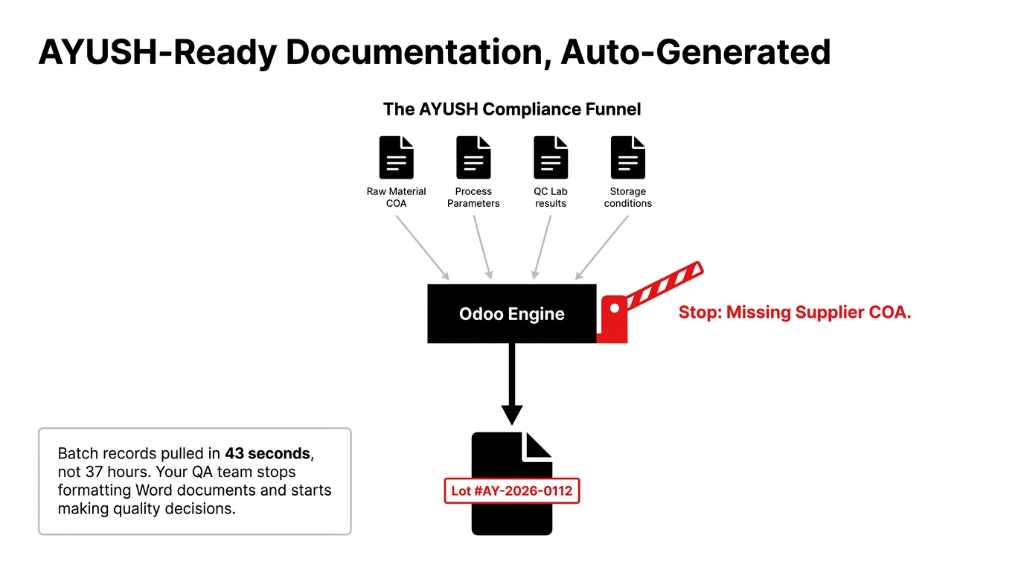
With Odoo: batch records pulled in 43 seconds. Not 37 hours.
Why "Pharma ERP" Is Not Your Answer Either
Everyone will tell you to buy a pharma ERP. Do not — not blindly.
Most pharma ERP systems are built for allopathic manufacturers. Their formulation logic is designed around fixed molecular compounds, not the reality of Ayurvedic manufacturing: seasonal herb availability, inter-batch potency variance, multi-ingredient classical formulations like Ashtavarga, and dual regulatory identity (some products sit between cosmetic and drug classification under CDSCO).
When You Force Allopathic ERP onto Ayurvedic Production
One of three things happens — usually all three:
Your production planner ignores the system because it cannot handle the fact that your Shatavari yield changes 18–22% between monsoon and winter harvests.
Your QC team bypasses the batch closure logic because it was not built for multi-stage quality checks under AYUSH Premium Mark standards.
Your MRP calculations go wrong because the system does not account for the 45–90 day lead time variance on wildcrafted herbs sourced from Uttarakhand or Himachal Pradesh.
The Fit Failure, Not the ERP Failure
We have seen brands spend $16,800–$21,600 on a pharma ERP that their own team refuses to use after go-live.
That is not an ERP failure. That is a fit failure. And you are paying for it twice — once for the software you do not use, and again for the problems it was supposed to fix.
What a Properly Configured Odoo ERP Actually Does for Ayurvedic Brands
Odoo, when implemented and customized by a team that understands Ayurvedic operations, handles the things that matter — not in theory, but in daily production reality.
Batch Traceability, End to End
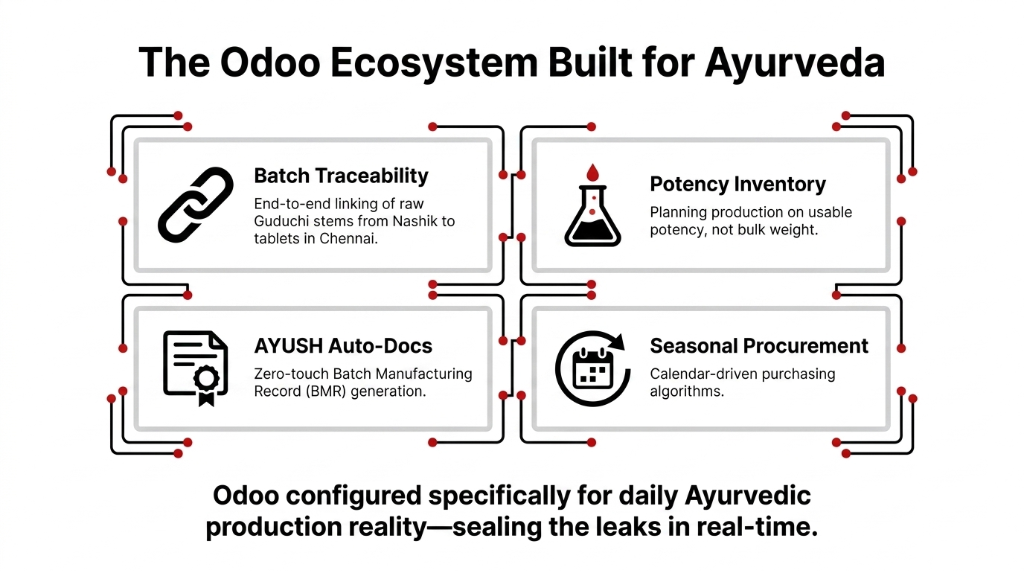
From the moment your raw Guduchi stems arrive from your supplier in Nashik to the moment a bottle of Guduchi tablets ships to a distributor in Chennai, every step is recorded. Lot numbers, storage conditions, moisture levels, QC test results, ingredient sourcing certificates — all linked to a single batch ID. When the AYUSH officer asks for Lot #AY-2026-0112, your compliance manager pulls it up in 43 seconds. Not 37 hours.
Herb Inventory That Understands Potency, Not Just Quantity
Standard inventory tells you "200 kg of Ashwagandha root." That is useless. Odoo configured for Ayurvedic manufacturing tracks: weight, grade (KSM-66 extract vs. raw root), expiry by potency decline curve, storage bin location, and supplier certification status. Your MRP engine plans production based on usable inventory, not total inventory. The difference? One $5,040 batch rejection we helped a client avoid in 2024.
AYUSH-Ready Documentation, Auto-Generated
Every batch closure in Odoo triggers automatic generation of the Batch Manufacturing Record in AYUSH-compliant format. Your QA team stops spending time formatting Word documents and starts spending time on actual quality decisions. The system also flags when a raw material's Certificate of Analysis is missing before production is allowed to begin — a rule that almost no Ayurvedic brand enforces manually with 100% consistency.
Seasonal Procurement Planning
This is the insider secret most ERP vendors will not tell you: Ayurvedic raw material procurement is not demand-driven, it is calendar-driven. You have to stock up on Shankhpushpi before the summer harvest window closes. You have to forward-book Safed Musli before October. Odoo's procurement module, configured with seasonal purchasing rules and supplier lead time buffers specific to herb categories, cuts annual raw material write-offs by 22–31% in the first growing season after go-live.
Multi-Channel D2C + B2B Order Management
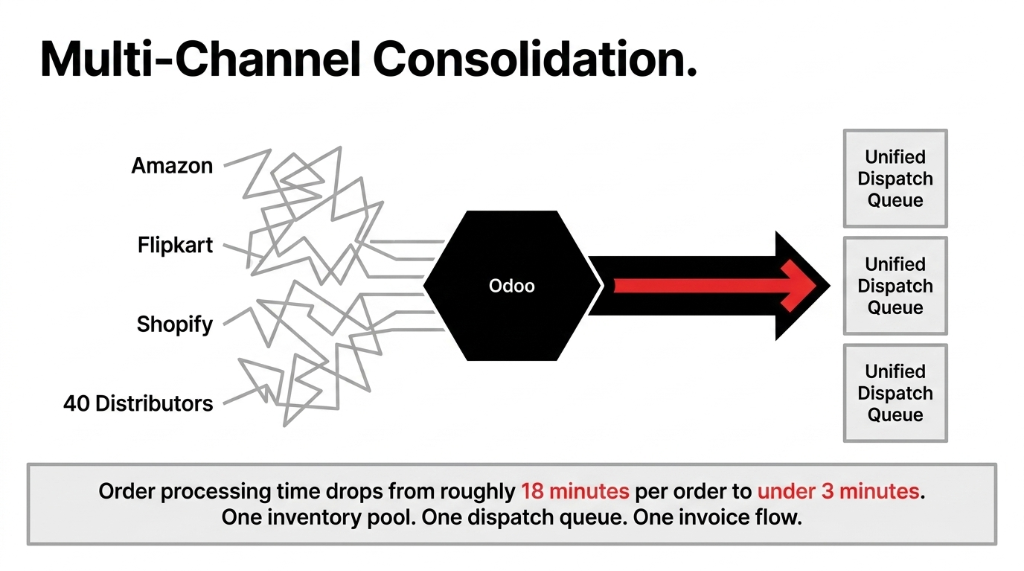
If you are selling on Amazon, Flipkart, your own Shopify store, and through 40 Ayurvedic distributors simultaneously, you are likely running on 4 different order tracking systems right now. (Yes, we know. You have a "dashboard" that your operations manager built in Google Data Studio that pulls from all of them. It breaks every third Monday.)
Odoo consolidates every order channel into one pipeline — one inventory pool, one dispatch queue, one invoice flow.
The Numbers You Should Be Tracking (But Probably Are Not)
Here is what we find in the first 15 minutes of an operations audit with most Ayurvedic brands:
| Operational Leak | Typical Monthly Loss |
|---|---|
| Herb inventory write-offs (expiry / potency drop) | $2,160–$3,840 |
| Distributor return reconciliation delays | $1,020–$1,680 |
| Compliance documentation labor cost | $504–$1,080 |
| Overproduction from inaccurate demand data | $2,520–$5,640 |
| Stockouts on hero SKUs during festive season | $4,200–$9,600 in lost revenue |
The organized segment already represents 70% of the India Ayurvedic market in 2025. The organized, systemized players are winning distribution shelf space, export certifications, and institutional procurement contracts. If your operations are still informal, you are competing with one hand tied behind your back.
The Implementation Reality (No Sugarcoating)
A full Odoo ERP implementation for an Ayurvedic manufacturing brand — covering inventory, production, QC, procurement, sales, and accounting — takes 14 to 22 weeks, depending on the number of SKUs, production lines, and integration complexity with existing systems like Tally or Busy.
Weeks 1–3: Data Migration
Your herb master list, supplier database, formulation BOMs, and customer master are cleaned and imported. This is where most implementations stall because brands discover their product data is a mess. Frankly, expect to spend 60% of your implementation effort here.
Weeks 4–10: Module Configuration & AYUSH Customization
Production order flows, QC checkpoints, batch record templates, and regulatory document generation are configured specifically for your product categories. This is where the difference between a generic Odoo partner and one that knows Ayurvedic manufacturing becomes visible.
Weeks 11–18: Parallel Run, Training & Go-Live
Your team runs both the old system and Odoo simultaneously — no operational gap. What gets easier immediately after go-live: batch documentation, inventory visibility, and order-to-dispatch time. What takes 60–90 days to optimize: demand forecasting accuracy and procurement cycle timing.
What Your Competition Is Already Doing
Brands like Patanjali, Himalaya, and Dabur are not your competition at the operations level — they have $60M+ IT budgets. Your real competition is the mid-sized Ayurvedic D2C brand from Pune or Jaipur that went live on Odoo 18 months ago.
That brand has already cleared ISO 22716 and AYUSH Premium Mark. They are now onboarding UAE and Singapore distributors because their documentation is clean, traceable, and audit-ready.
That brand is not smarter than you. They just fixed their operations 18 months before you did.
The Insider Secret
The Ayurvedic industry is at a $1.6 billion inflection point in India alone, growing at 12.68% annually. The brands that will capture the next wave are not the ones with the best formulations — those have existed for 5,000 years. They are the ones with the fastest, cleanest, most compliant operations infrastructure.
The organized segment owns 70% of the market already. If your batch records take 37 hours to compile, you are not in the organized segment. Full stop.
FAQ: ERP for Ayurvedic/Natural Product Brands
How long does Odoo ERP implementation take for an Ayurvedic brand?
For a mid-sized Ayurvedic manufacturer with 50–200 SKUs, a full Odoo implementation covering inventory, production, QC, and compliance documentation takes 14 to 22 weeks. Brands with cleaner master data and fewer custom formulations typically go live closer to the 14-week mark. Post-go-live optimization runs for another 60–90 days.
Can Odoo ERP handle AYUSH compliance documentation automatically?
Yes — but only when it is configured by a team that understands AYUSH's Batch Manufacturing Record requirements. Out-of-the-box Odoo is not AYUSH-ready. Braincuber customizes batch closure workflows to auto-generate BMR templates, flag missing Certificates of Analysis, and produce audit-ready records linked to every production lot and raw material source.
What happens to our existing Tally or Busy accounting data during migration?
Your historical accounting data, supplier ledgers, and customer masters are migrated into Odoo during the implementation. We run a parallel period — typically 4 to 6 weeks — where both Tally and Odoo operate simultaneously so your finance team can verify accuracy before switching fully. No data is deleted; everything is archived and accessible.
Does ERP help with herb procurement planning for seasonal raw materials?
This is one of the highest-ROI configurations we do for Ayurvedic brands. Odoo's procurement module is set up with seasonal purchasing calendars, supplier lead time buffers specific to herb categories, and potency-based expiry tracking. Brands typically see 22–31% reduction in herb write-offs in the first full procurement cycle after go-live.
What is the realistic ROI timeline for an Ayurvedic brand implementing Odoo ERP?
Most Ayurvedic brands recover their full ERP implementation cost within 9–14 months through reduced inventory write-offs, faster order processing, and eliminated compliance labor hours. Brands with complex multi-channel distribution (Amazon + Flipkart + distributor network + own D2C) typically see a positive ROI in month 6 or 7 as order-to-dispatch time drops and stockout incidents on hero SKUs decline sharply.
Do Not Let Another Festive Season Pass with Inventory Blindness
Check your batch documentation folder. Time how long it takes to pull one complete manufacturing record. Check your herb warehouse for unlabeled lots sitting past potency expiry. If any of those answers scare you — book a free 15-minute Operations Audit with Braincuber. We will find your single biggest operational leak on the first call. No sales pitch. Just a specific number tied to a specific fix.