
The SKU Explosion Nobody Warns You About
Walk into any growing activewear brand's backend and you will find the same horror story.
A single product — say, a compression legging — ships in 6 sizes (XS to XXL), 4 colors, 2 fabric variants (matte vs. sheen), and 3 waist styles. That is 144 active SKUs from one product. Now multiply that across 30 styles.
You are managing 4,320+ live SKUs. On a Google Sheet. With a part-time inventory executive who also handles customer support.
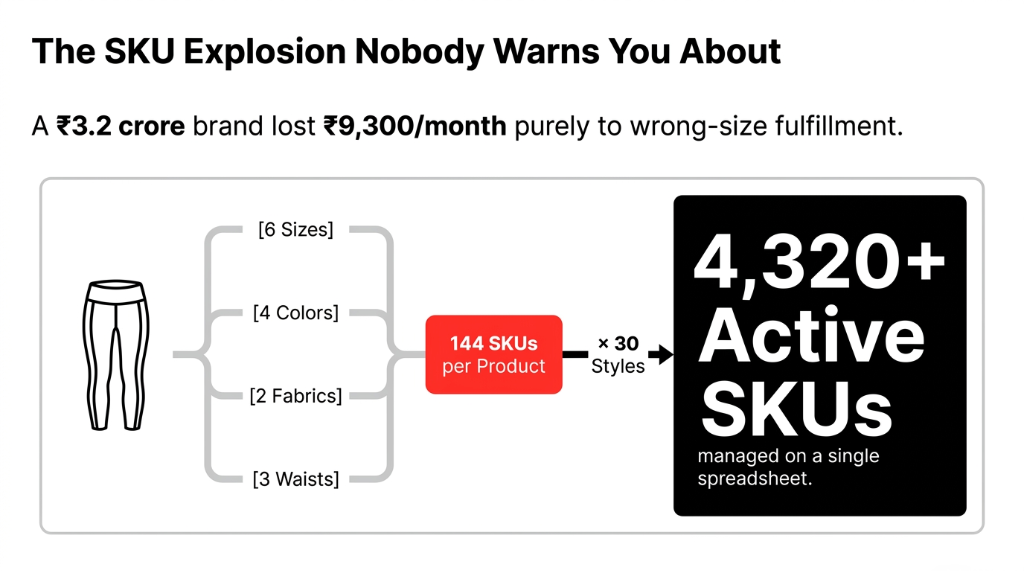
We constantly see this exact setup at brands scaling from $238,000 to $1.19 million ARR. Chronic overselling during flash sales. Stock mismatches between your Shopify storefront and your warehouse. Orders fulfilled with the wrong color or size — because your picker guessed when the system showed "available" but the actual shelf was empty.
Real Loss: $1,107/Month From Wrong-Size Fulfillment Alone
One of our clients, a Mumbai-based athleisure brand doing $380,000 annually, was losing $1,107 per month just in wrong-size fulfillments and their resulting exchange logistics. That is $13,284 a year — not from bad products, but from a broken SKU system.
Odoo's native product variant engine handles this at the attribute level. You define size, color, fabric, and fit as configurable dimensions. The system auto-generates the full SKU matrix, tracks each variant in real-time across every warehouse bin, and shows you exactly what is available — not what was available when someone last updated the sheet.
Why Your Shopify-to-Warehouse Flow Is Killing Your Margins
Here is an insider secret most ERP vendors will not say out loud: Shopify's inventory API has a rate limit problem.
During a peak sale event — say a Diwali flash drop or a brand collab launch — when you are processing 300+ orders per hour, Shopify's API calls start queuing. The result: your warehouse management tool sees orders 12–18 minutes late. By then, pickers are pulling stock that has already been sold twice.
The $5,595 Flash Sale Disaster
A Delhi NCR activewear startup ran a "72-hour drop" promotion. They sold 1,800 units in the first 4 hours. But 340 of those orders had to be cancelled because the inventory sync between Shopify and their warehouse tool (ShipStation with a basic Shopify connection) could not keep pace.
The refunds, the angry Instagram comments, the customer support load — it cost them $5,595 in direct losses and an immeasurable hit to brand trust.
The fix is not a better Zap or a smarter middleware. The fix is a single source of truth.
When Shopify, your warehouse, and your accounts all run on one Odoo instance, there is no API lag to reconcile. An order placed on Shopify triggers a warehouse picking task in real-time inside the same system. Stock is reserved the moment the order is confirmed — not after a webhook fires and a third-party app processes it.
Stop trying to stitch 7 tools together with Zapier and call it infrastructure.
The Returns Problem Is Eating Your EBITDA Alive
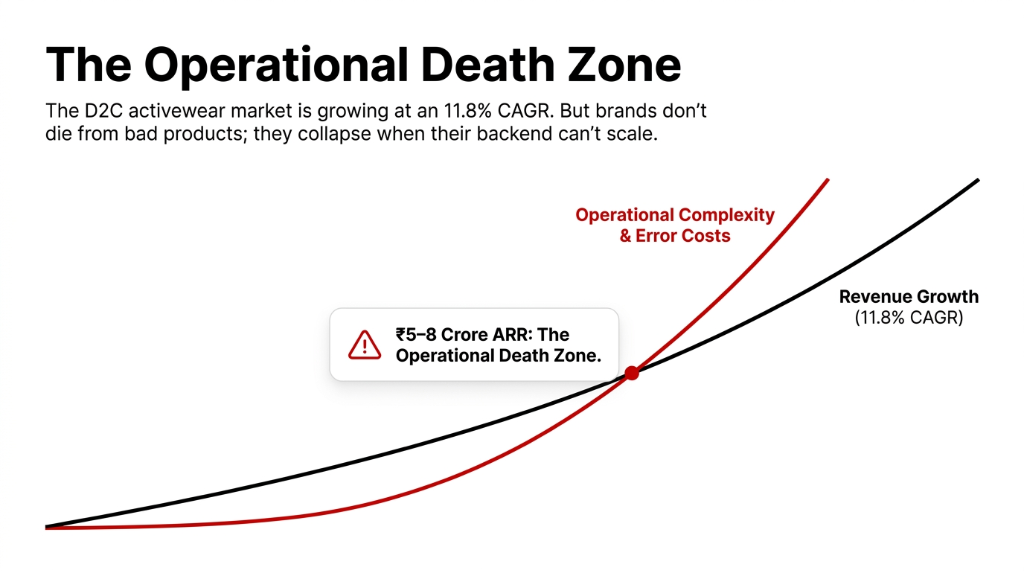
India's online fashion return rate sits above 33%. For activewear specifically, it is worse — sizing inconsistency between brands, fabric feel that does not match product photos, and impulse buys that get returned after the gym session never happened.
Reverse logistics alone costs 10–15% of order value depending on the destination pin code. For a brand doing $952,000 in revenue, that is $95,200 to $142,800 per year just in return logistics — before you count restocking labor, quality inspection, re-tagging, and the accounting nightmare of credit notes, GST reversal entries, and refund reconciliation.
Real Recovery: $1,167 in 11 Days
We worked with an athleisure brand in Bengaluru that had $1,482 worth of returned inventory sitting in a "quarantine zone" for 31 days because nobody knew which units were resellable. Their WooCommerce store, Delhivery's dashboard, and Tally accounting were three separate systems with zero communication.
In Odoo, every return triggers an automated RMA workflow. The system flags the return reason, routes it to the right warehouse bin for inspection, and creates the accounting entry — including GST credit note — automatically. That brand recovered $1,167 of that $1,482 quarantine inventory within 11 days of going live.
What "Omnichannel" Actually Costs You Without ERP
Everyone in the D2C space is talking about going omnichannel. Retail leasing by D2C brands more than doubled to 18% of total leasing in H1 2025. Campus Activewear went from 35 EBOs in 2017 to 250+ stores. Every founder wants that trajectory.
But here is what nobody tells you about opening your first 3–5 offline stores alongside your Shopify store: without a unified ERP, you will oversell from your offline store and undersell online — simultaneously.
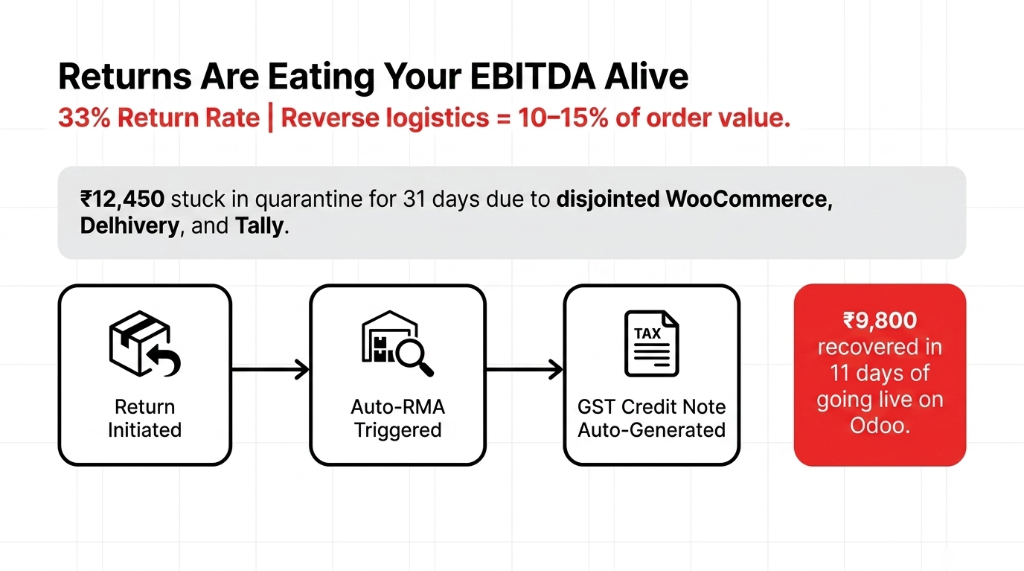
Your store manager in Pune transfers 50 units of a bestseller from warehouse stock to the showroom floor. That transfer happens in a WhatsApp message to the inventory team. The Shopify store never gets updated. You sell 30 units digitally. Now you have 30 unhappy customers and a very stressed Pune store manager.
We have seen this exact scenario play out at 11 of our activewear client implementations across India. The resolution cost — customer refunds, expedited re-procurement, warehouse overtime — averaged $3,690 per incident.
Odoo's multi-location inventory management treats your Shopify store, your Pune showroom, and your Delhi warehouse as nodes in one system. A stock move from warehouse to store automatically updates available inventory across every channel. No WhatsApp messages. No manual Shopify inventory adjustments. No $3,690 surprises.
The Dirty Truth About "D2C-Friendly" ERPs
Look, we are going to say something controversial: most ERP tools marketed specifically at D2C brands are toy software.
They handle basic order management and call themselves an ERP. They give you a pretty dashboard but fall apart the moment you try to do a landed cost calculation on a shipment from your Tirupur manufacturer, or run a style-level margin report, or generate GSTR-1 directly from your sales data.
The ERP Cost Trap
QuickBooks and Zoho Books are fine for a $59,500 business. At $595,000, you are doing manual reconciliations every month-end and your CA is billing you extra hours. At $1.78 million, the whole system collapses.
NetSuite? Unless you have $41,650–$59,500 for implementation plus $14,280–$21,420/year in licensing, it will break your cash flow before it fixes your operations.
Odoo sits at the exact intersection of power and affordability that growing Indian D2C activewear brands need. It handles your Shopify sync, your multi-warehouse inventory, your returns, your vendor bills from Tirupur or Surat manufacturers, your GST filings, and your financial reporting — all in one place, implemented by Braincuber for a fraction of what legacy ERPs charge.
The Insider Secret
We have taken brands from a $50/month Excel-and-Tally setup to a full Odoo implementation that gave them real-time margin visibility at the SKU level within 47 days of kickoff.
The brands that win the next 3 years will not be the ones with the best fabric. They will be the ones who can fulfill 10,000 orders during a sale weekend without a single WhatsApp-managed stock transfer.
What the First 90 Days Look Like After Go-Live
We know what you are thinking: implementation sounds painful. Frankly, it is only painful when done wrong.
Days 1–14: Data Migration
Your product catalog (with all variant attributes), existing inventory counts, vendor master, and customer history move into Odoo. Your Shopify store connects via our integration. We do not touch your live sales flow until the test environment is clean.
Days 15–30: Warehouse Workflows Go Live
Picking, packing, and shipping operations run through Odoo. Returns flow is configured. Your warehouse team gets 2 days of hands-on training — not a 40-page manual.
Days 31–60: Finance Module Activation
GST, purchase orders, vendor payments, and customer invoices run through Odoo. Your accountant stops sending you angry messages.
Days 61–90: First Full Month-End Close Inside Odoo
Style-level P&L. Channel-wise margin report. Returns rate by SKU. Data you have never had before, available in 3 clicks.
Verified 90-Day Recovery Results
Invisible Leakages Recovered
$7,140–$16,660 in the first 90 days from vendor over-receiving, unreconciled returns, and phantom inventory write-offs
Full ROI Timeline
Brands doing $595,000–$1.19M ARR typically see full implementation ROI within 4–6 months
Implementation Speed
45–60 days from kickoff to full go-live. Complex multi-node setups with 5+ offline stores: 75–90 days
FAQ: ERP for Activewear D2C Brands
How long does Odoo ERP implementation take for an activewear D2C brand?
For a typical brand with 1-3 warehouses and a Shopify storefront, Braincuber's Odoo implementation takes 45-60 days from kickoff to full go-live. This includes data migration, Shopify integration, warehouse workflow setup, and finance module activation. Complex multi-node setups with 5+ offline stores may extend to 75-90 days.
What ROI can we realistically expect in the first 90 days?
Based on our implementations, brands recover between $7,140-$16,660 in the first 90 days from previously invisible leakages - vendor over-receiving, unreconciled returns, phantom inventory write-offs, and manual data entry errors. Brands doing $595,000-$1.19M ARR typically see full ROI within 4-6 months.
Can Odoo handle GST filing and Indian compliance for a D2C brand?
Yes. Odoo's India-localized version generates GSTR-1, GSTR-3B, and e-invoices directly from your sales data. When a return is processed, the system automatically creates the GST credit note. Your CA gets a clean export and you stop paying extra hours for reconciliation.
What happens to our Shopify store during migration?
Your Shopify store stays live throughout the entire implementation. We build and test the Odoo environment in parallel, then switch over the inventory sync after full QA. Your product catalog including all size and color variants migrates with a structured data import. Zero downtime on your storefront.
Is Odoo the right ERP if we plan to add offline stores in the next 12 months?
Odoo is built for exactly this scenario. Each new store becomes a warehouse location in Odoo. Inventory moves between your online and offline channels are tracked in real-time. Scaling from 1 to 10 outlets does not require a new system or a new integration.
Your Operations Are Either a Competitive Moat or a Liability
Right now, for most activewear D2C brands in India, they are a liability. Book our free 15-Minute Operations Audit — we will find your single biggest operational leak on the first call. No pitch. Just a diagnosis.