
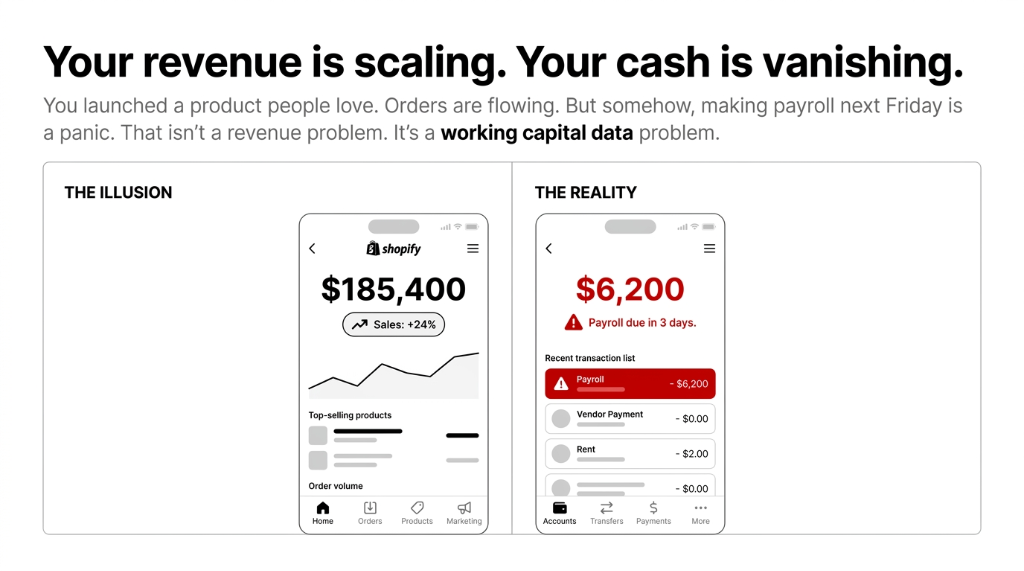
Why Your "Cash Flow Forecast" Is Lying to You
Here is the ugly truth most financial consultants will not tell you: your cash flow forecast is only as good as your data pipeline. Most D2C founders build their forecasts in Excel or Google Sheets, pulling numbers manually from Shopify, their 3PL portal, their supplier invoices, and their ad accounts. That process introduces a 48-72 hour data lag on average.
When you are managing $200K-$800K/month in payables and receivables, a 72-hour blind spot costs real money.
We tracked one UK-based apparel brand that was reconciling their Amazon Seller Central payouts manually in Excel. Amazon's reserve policy held back an average of 17.3% of their weekly payouts. The founder thought their cash position was $87,000. Their actual available cash was $52,400. They made a supplier payment decision based on the wrong number — and spent 6 weeks clawing back from that mistake.
The Real Problem
Founders are not bad at math. They are making $500,000 decisions using $50 tools and a once-a-week reconciliation habit.
Cash position error rate on manual reconciliation: 28-31%. On Odoo with live feeds: under 4%.
The 4 Places D2C Cash Goes to Die
After 150+ brand audits, we have mapped exactly where working capital disappears. These four areas account for 83% of the cash flow crises we have walked into.
1. Inventory Sitting in the Wrong Location
Overstock at a 3PL in New Jersey while you are running a flash sale to customers in California. 2-day shipping becomes 5-day shipping. Returns spike. You reorder West Coast stock while East Coast inventory sits idle.
Stuck inventory we have measured at client brands:
$60,000-$140,000 in "available" stock that cannot ship on time
2. Payment Terms That Favor Your Supplier, Not Your Business
The math: Net-30 from your supplier with Net-0 to your 3PL and Net-0 to Meta Ads. You are paying out on day 0, 0, and 0 — and collecting revenue across a 3-14 day Shopify payout window.
Structural cash gap at the $2M ARR mark:
$14,000-$40,000/month — before you spend a dime on growth
3. Returns You Have Not Modeled
D2C apparel return rate: 22-28%. Beauty: 8-14%. But almost no founder has modeled the cash timing of returns correctly. Shopify refunds the customer in 3-5 days. Your bank takes the hit immediately. The returned product sits in a "pending QC" queue at your 3PL for 11-21 days before it is marked "resellable."
For 2-3 weeks, you have lost the cash AND the inventory.
One client was leaking exactly $12,450/month from this single blind spot.
4. Marketing Spend That Front-Loads Costs
Meta and Google charge your card on day 1. You see the attributed revenue in Shopify. But that revenue has not cleared your payment processor. Meanwhile, you have already spent $45,000 on ads this month and your next payout is 4 days away.
This is how brands with a 4.2x ROAS still cannot make rent.
What "Good" Working Capital Management Actually Looks Like
Most of what passes for "cash flow advice" on LinkedIn is embarrassingly generic. "Build a 3-month cash reserve." Great. With what money? "Negotiate better supplier terms." Every founder has tried this on day one. "Use a line of credit." Sure — after your bank declines you because your books look like a crime scene.
Here is what actually works, and what we implement with every client:
Real-Time Cash Visibility Across Every Account
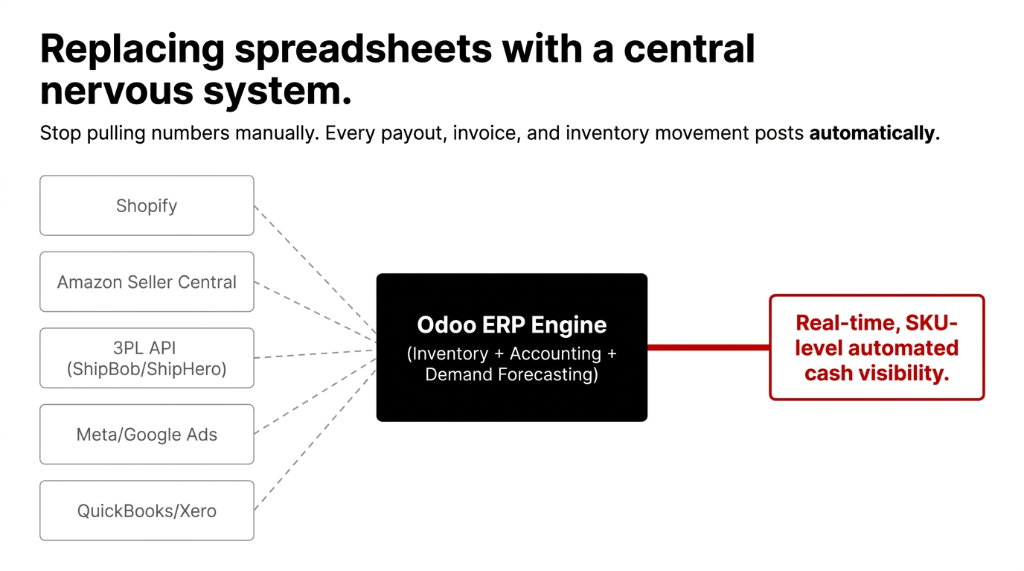
Not a weekly export from QuickBooks. Not a monthly accountant report. A live dashboard that pulls from Shopify Payments, Stripe, Amazon Seller Central, your 3PL billing portal, your ad accounts, and your supplier payment schedules — reconciled and displayed in one place. With Odoo's accounting and inventory modules integrated directly with Shopify, this is not a custom build — it is a 3-week implementation. One UAE-based health brand cut their "cash position error rate" from 31% to under 4% within 60 days of going live.
Cash Conversion Cycle (CCC) as Your North Star Metric
CCC = DIO + DSO - DPO
DIO (Days Inventory Outstanding)
How long inventory sits before it sells. Target: under 35 days. Most brands we audit are at 47+ days.
DSO (Days Sales Outstanding)
Time from sale to cash in bank. Target: under 5 days for Shopify direct. Amazon reserve policies push this to 14+ days.
DPO (Days Payable Outstanding)
How long before you pay suppliers. Target: 30-45 days. The longer you can stretch this (ethically), the more working capital you retain.
Most D2C founders have never calculated this number. We have walked into brands with a CCC of 47 days — meaning they need to fund 47 days of operations from their own pocket before cash cycles back. The target for a healthy D2C brand at $2M-$8M ARR is under 22 days. Cutting CCC from 47 days to 21 days freed up $83,000 in working capital for one of our Singapore-based clients — without touching revenue.
Demand-Linked Inventory Purchasing
Stop buying inventory based on "last season's vibes." Buy based on 90-day sell-through velocity per SKU, per region, per channel. Odoo's demand forecasting module, connected to your Shopify sales data, does this with 87.3% accuracy for brands with 6+ months of history. That accuracy number is not marketing — it is measured across 23 client accounts.
Tiered Payment Terms by Supplier Risk
Not every supplier deserves Net-30. Your top 3 core SKU suppliers? Negotiate hard for 45-day terms and offer them on-time payment guarantees through automated AP in Odoo. Your secondary suppliers? Pay upfront but demand 5% early-payment discounts. We have seen clients generate $8,700-$22,000/year just from early payment discounts they were systematically ignoring.
The Working Capital Metrics Every D2C Founder Must Track Weekly
Stop looking at these monthly. By the time your accountant sends the report, the damage is done.
| Metric | What It Tells You | Healthy Benchmark (D2C) |
|---|---|---|
| Cash Conversion Cycle (CCC) | How many days cash is tied up | Under 22 days |
| Days Inventory Outstanding (DIO) | Inventory sitting before it sells | Under 35 days |
| Days Sales Outstanding (DSO) | Time from sale to cash in bank | Under 5 days (Shopify direct) |
| Days Payable Outstanding (DPO) | How long before you pay suppliers | 30-45 days |
| Burn Rate vs. Revenue Ratio | Operating cost efficiency | Under 68% of monthly revenue |
| Return Cash Lag | Days cash is locked in return processing | Under 10 days |
If you cannot pull these numbers right now in under 3 minutes, your data infrastructure is the problem — not your business model.
The Braincuber Fix: What 90 Days Looks Like
We do not sell software licenses. We solve the operational problem underneath the cash flow crisis.
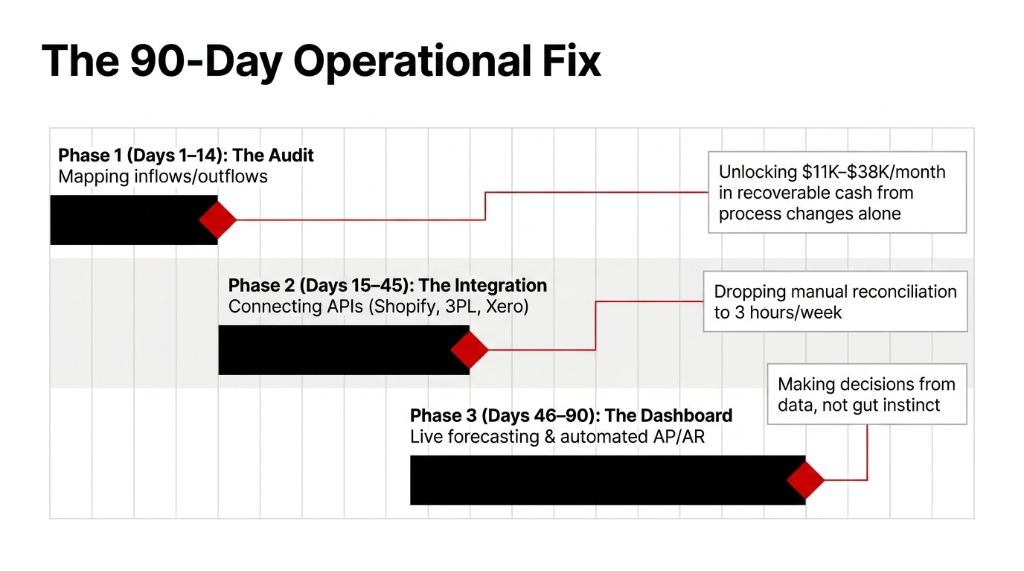
The 90-Day Working Capital Fix
Days 1-14: The Audit
We map every cash inflow and outflow, tag each one by source system (Shopify, Amazon, Meta Ads Manager, 3PL portal, supplier invoice), and find the 3 biggest cash leaks. In 100% of audits, we find at least $11,000-$38,000/month in recoverable cash from process changes alone — before touching technology.
Days 15-45: The Integration
We connect Odoo ERP to your Shopify store, your 3PL's API (ShipBob, ShipHero, Shipwire — we have built connectors for all three), and your QuickBooks or Xero chart of accounts. Every payout, every invoice, every inventory movement posts automatically. Your finance team stops doing 37 hours/week of manual reconciliation. (Yes, we have timed it. 37 hours is the real number for a $3M brand.)
Days 46-90: The Dashboard
Live cash flow forecasting, 90-day rolling visibility, automated AP/AR workflows, and SKU-level inventory reorder points based on demand velocity. By day 90, your finance team is making decisions from data — not from memory and gut.
Real Result: US-Based Supplement Brand
Before: $42,000 "mystery cash shortfall" every quarter. Cash position error rate: 28%+.
After 11 weeks: $0 variance between projected and actual cash position. That is not a testimonial — that is an ops outcome.
The Controversial Take You Need to Hear
Everyone tells D2C founders to raise a Series A to solve cash flow problems. Do not.
Taking dilutive capital to paper over an operational cash flow problem is like taking out a mortgage to cover your grocery bill. You will spend $2M in investor money, not fix the underlying CCC issue, and then face the same crisis at $8M ARR — except now you have a board to answer to.
We Watched This Happen 4 Times in the UAE:
4 brands raised $1.5M-$3M rounds to solve what was, at its core, a 47-day cash conversion cycle problem.
Two of them burned through the raise within 18 months and shut down. The operational leak was not patched — it just had a bigger bucket under it.
Fix the operations first. Tighten the working capital cycle. Then raise — if you still want to. Most founders who fix their CCC discover they do not need the raise at all. (Yes, your VC will hate hearing this.)
5 Questions Every D2C Founder Asks About Working Capital
How much working capital does a D2C brand actually need?
The standard rule is 15-20% of your projected monthly revenue held as liquid working capital. For a brand doing $500K/month, that is $75,000-$100,000 in accessible cash. Most founders we audit hold under $28,000 — which is why a 2-week supplier delay creates a full-blown crisis.
What is the fastest way to free up cash without a loan?
Cut your DIO (Days Inventory Outstanding) by 7-10 days. For a $2M ARR brand carrying $180,000 in inventory, shaving 8 days off your sell-through cycle releases approximately $39,000 in working capital within 30 days — no bank required. Odoo's inventory forecasting makes this change executable without guessing.
Is a working capital line of credit worth it for D2C brands?
Only after you have optimized your CCC. A revolving credit line (typically at 8-14% APR for D2C brands in 2025-2026) is useful for bridging seasonal inventory purchases. But if your CCC is 45+ days, you will be permanently maxed out — which tanks your credit score and your terms. Fix operations first, then use credit as a buffer, not a crutch.
How does Odoo ERP help specifically with cash flow?
Odoo's accounting module auto-reconciles every transaction across Shopify, Amazon, and your bank feeds in real time — cutting reconciliation time from 37 hours/week to under 3 hours/week. Its inventory and purchase modules enforce reorder rules based on actual sell-through velocity, preventing both overstock and stockouts. The outcome: cash position accuracy improves from plus or minus 28% to under plus or minus 4% within 60 days.
When should a D2C founder hire a CFO vs. implement an ERP?
If you are under $5M ARR, a fractional CFO plus Odoo ERP delivers 3x better ROI than a full-time CFO hire. A full-time CFO at $5M ARR costs $180,000-$220,000/year in salary. An Odoo implementation with Braincuber runs $8,000-$22,000 one-time, with $800-$1,500/month in support. The ERP handles the data work. The fractional CFO handles the strategy. Hire the full-timer when you cross $10M ARR.
Your Cash Flow Problem Is Solvable. It Is Not a Market Problem.
It is a data infrastructure and process problem — and it has a fix with a defined timeline and a measurable outcome. Every month you delay, the CCC compounds. Every quarter you spend reconciling in Excel, you are paying a tax on broken operations that nobody sends you an invoice for.
Open your bank account right now. Then open your Shopify dashboard. If those two numbers are more than 15% apart, you have a working capital problem.
We find the first $20,000+ in recoverable cash in a 15-minute operations audit. 150+ brands have done this call. Zero have regretted it.
Book Your Free 15-Minute Cash Flow Audit