
Why Channel-Level Economics Matters
A founder who only looks at blended CAC, blended AOV, and blended contribution margin is flying blind. A paid social order and a repeat email order may both show up in revenue, but they do not carry the same acquisition cost, return risk, or fulfillment burden.
That is where channel-level unit economics becomes the real operating system for growth. It tells you which channel deserves more budget, which one needs better creative or pricing, and which one should be cut before it drains cash.
The Unit Economics Stack
Start with one order and subtract every cost tied to winning, shipping, and keeping that order. At minimum, you should track revenue, discounts, COGS, payment fees, shipping, packaging, returns, pick-and-pack, and channel-specific acquisition cost.
Contribution Margin = Revenue - (COGS + Fulfillment + Payment Fees + Channel CAC + Returns)
First-Order Economics
A first-order loss can still be acceptable if repeat rate, subscription retention, or email capture creates strong lifetime value later. But you should never pretend the first order is profitable when it is not.
LTV Economics
Separate one-time customer economics from LTV economics. Revenue alone is a vanity metric. Contribution margin percent is the number founders actually need to make scaling decisions.
Paid Social Economics
Paid social usually means Meta, Instagram, TikTok, or a similar demand-generation channel. It is often the first place D2C founders scale because it can produce volume fast. It is also the easiest place to fake profitability with blended reporting.
The mistake is simple: founders look at ROAS and stop there. ROAS does not tell you whether the order is profitable after returns, shipping, discounts, and creative-testing waste. If your CAC on Meta is $24.80 and your gross margin per order is $19.60 after shipping and payment fees, you are not "close to breaking even" — you are losing money.
Paid social tends to work best for brands with strong visual products, impulse-friendly pricing, and enough margin to absorb learning-phase inefficiency. If your gross margin is thin, your AOV is low, and your return rate is ugly, paid social becomes a tax on your ambition.
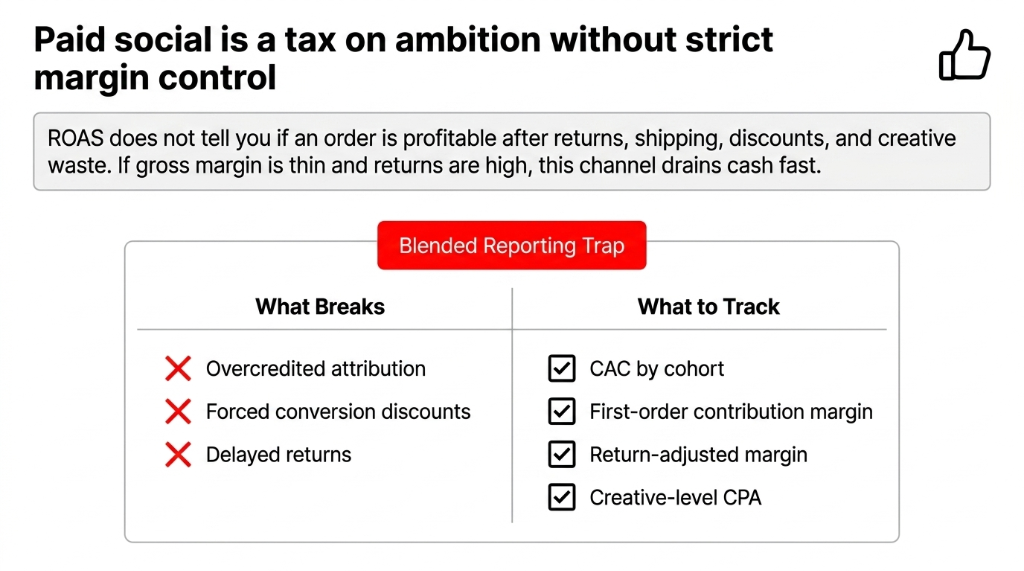
What Usually Breaks in Paid Social
Attribution is overcredited. Meta's dashboard tells you it "drove" the sale. Your customer was going to buy anyway from a Google search.
Discounts force conversion. That 15% off pop-up got the click. It also ate your margin.
Returns arrive weeks later. The ROAS you celebrated in January gets destroyed by February returns data.
Creatives burn too quickly. CAC rises as frequency climbs and you keep feeding the machine with new spend to fight fatigue.
Search Economics
Google Search and Shopping are different animals. They usually capture existing intent, which means the traffic is warmer, but the competitive CPC can get expensive fast in categories like beauty, supplements, home goods, and apparel.
Search economics are often cleaner than paid social because intent is clearer, but they still break when founders ignore margin by keyword cluster. A "buy now" search term may be expensive but profitable, while broad discovery terms can soak spend without producing enough conversion quality.
Search works best when your product has clear demand, a strong landing page, and enough margin to survive higher click costs. It becomes especially useful when your brand has high-intent hero products and repeat replenishment cycles.
Search Metrics That Actually Matter
CPC by keyword cluster. Not blended CPC. Cluster-level. A "buy organic face serum" click at $3.40 is a completely different investment than a "skincare tips" click at $0.80.
The metric most founders skip: branded vs. non-branded margin.
If 60%+ of your search revenue is branded, you are paying for traffic that was already yours.
Marketplace Economics
Amazon, Flipkart, and similar marketplaces change the math completely. You are not just paying for traffic — you are paying platform fees, referral fees, storage, fulfillment, ad spend, and sometimes penalties that only show up after the month closes.
This is where many founders lie to themselves. They see strong top-line sales on Amazon and assume the channel is healthy. But once you include marketplace fees, FBA or equivalent fulfillment costs, promo spend, and returns, the margin can collapse to single digits or go negative entirely.
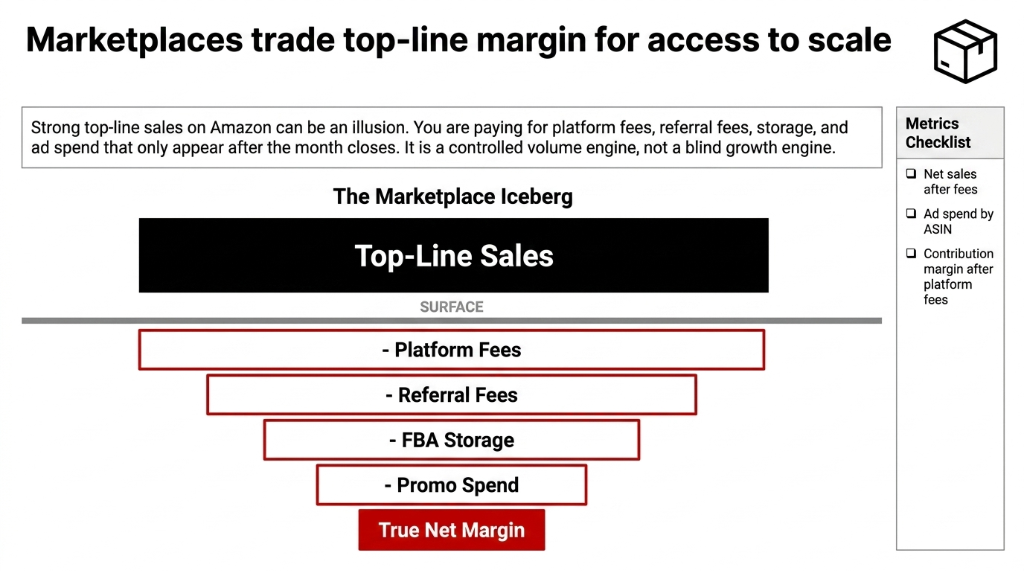
Marketplace economics are useful when the channel gives you access to scale, trust, and search demand you cannot create alone. But the channel usually performs best as a controlled volume engine, not as a blind growth engine.
Email and SMS Economics
Email and SMS are not "marketing channels" in the same way paid media is. They are margin recovery channels. If you are using them only for generic newsletters, you are wasting the highest-use assets in your customer base.
The economics here are usually excellent because the acquisition cost is already sunk. The real job is not to acquire attention but to convert existing attention into repeat orders, higher AOV, and lower churn.
This is where D2C brands can clean up the mess created by expensive first-order acquisition. A brand that loses money on first purchase can still become profitable if email and SMS drive enough repeat purchase behavior within 60 to 120 days.
Email/SMS: The Margin Recovery Engine
Revenue Per Send
Not total email revenue. Revenue per send isolates whether your list is engaged or fatigued. A declining revenue-per-send means you are burning your best asset.
Repeat Purchase Rate
If email is not driving repeat purchases within 60-120 days, the channel is window dressing. Measure incremental repeat rate, not just attributed revenue.
Abandoned Cart Recovery
This single flow can recover 8-14% of lost carts. If your recovery rate is below 5%, the flow is broken or your timing is off.
Affiliate Economics
Affiliate channels look attractive because they appear low-risk. On the surface, you only pay when a sale happens, which makes the channel feel safer than paid media.
The hidden cost is margin leakage through commissions, coupon abuse, and low-intent traffic. If your affiliate partners are mostly sending deal-seeking users who would have bought anyway, you are paying commissions for revenue you already owned.
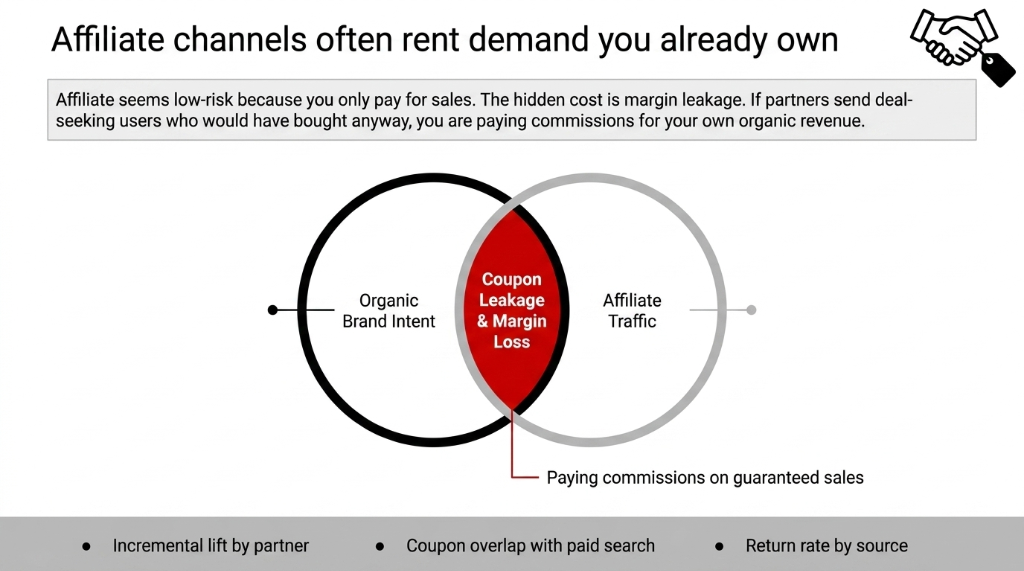
Affiliate economics make sense when you have tight tracking, clear partner rules, and products that benefit from trust-based recommendation. They break when the channel becomes a dumping ground for coupon sites and poorly controlled traffic.
Wholesale and B2B Economics
Wholesale looks boring to D2C founders who are addicted to direct revenue, but it can stabilize cash flow if the numbers work. The trade-off is obvious: lower margin per unit, less brand control, and slower feedback loops.
Wholesale becomes attractive when it reduces customer acquisition pressure, clears inventory, and creates predictable volume. It becomes dangerous when founders celebrate revenue without checking whether trade discounts, chargebacks, and working capital needs are destroying the business.
The right way to judge wholesale is not by gross revenue. Judge it by cash cycle, margin after trade terms, and inventory turns. A channel that pays slower but clears large batches can still be healthier than a flashy D2C channel that burns cash daily.
The Practical Channel Model
Here is the model we use when we want to know whether a channel deserves more budget. Start with one order, then build down to cash. Do not skip steps because that is exactly how bad decisions get made.
| Channel | Revenue Per Order | Main Costs | Real Question |
|---|---|---|---|
| Paid Social | High volume, variable AOV | CAC, returns, discounts, shipping | Can the first order break even or recover fast? |
| Search | Intent-led AOV | CPC, landing page drop-off | Does high-intent traffic stay profitable after fees? |
| Marketplace | Platform-led sales | Fees, fulfillment, ads, refunds | Is net margin still worth the scale? |
| Email/SMS | Repeat revenue | Low variable cost | How much incremental repeat margin did it create? |
| Affiliate | Commission-driven | Payouts, coupon leakage | Is the traffic incremental or just rented demand? |
| Wholesale | Bulk volume | Trade discount, working capital | Does cash and margin stay healthy after terms? |
If you cannot fill this table from your own numbers, your finance stack is too weak for serious scaling. That is not an opinion — it is the reason so many D2C brands look busy while their bank balance slides.
How Founders Should Make Decisions
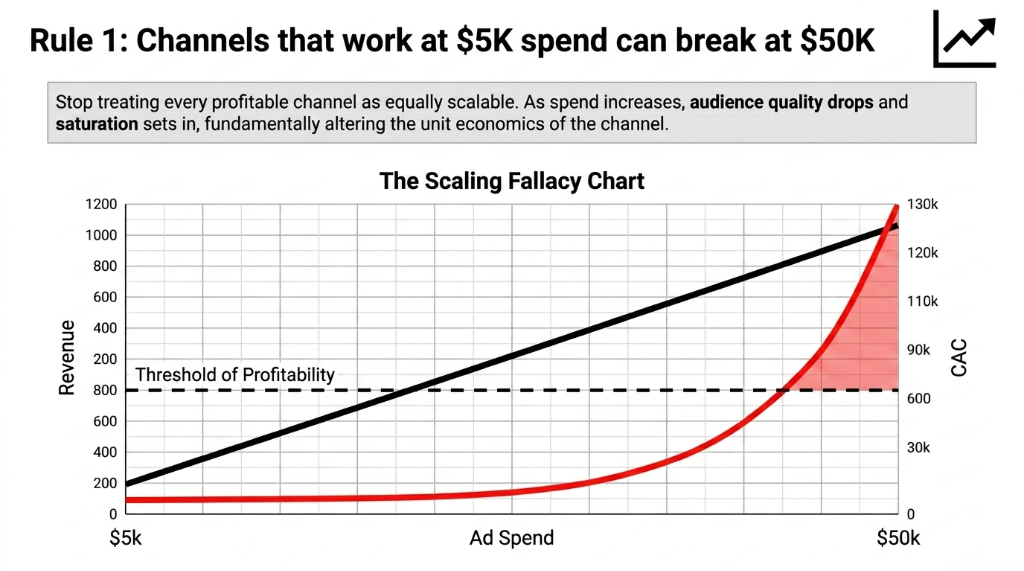
The 3 Rules That Prevent Bad Channel Decisions:
Rule 1: Stop treating every profitable channel as equally scalable. A channel can be profitable at $5,000 spend and terrible at $50,000 spend because CAC, saturation, and audience quality all change as you scale.
Rule 2: Measure by cohort, not just by month. If you launch in January and the returns hit in March, February revenue will lie to you unless the model follows the customer long enough to capture real margin.
Rule 3: Separate revenue growth from profit growth. A brand can double sales and still become weaker if the growth is concentrated in channels with bad economics.
The Founder Mistake That Costs the Most
The most expensive mistake in D2C is not poor creative or weak product-market fit. It is scaling a channel before understanding its true margin contribution.
We constantly see founders celebrate ROAS screenshots from agency dashboards while ignoring the actual P&L. That is how you end up with a busy ad account, a crowded warehouse, and not enough cash to reorder the next winning SKU.
The fix is boring but powerful: define each channel's real cost, calculate contribution margin per order, and review it weekly. When you do that, the good channels become obvious and the bad ones become impossible to defend. (Your agency will not love this conversation. Have it anyway.)
5 Questions Every D2C Founder Asks About Channel Economics
How do I know if a channel is profitable?
Check contribution margin after CAC, shipping, fees, discounts, and returns. If the order looks good before returns or fulfillment, that number is still incomplete. A channel is only profitable when the fully loaded cost per order is lower than the revenue it generates.
Should every channel be profitable on first order?
No. Some channels can lose money on the first order if repeat purchase behavior is strong enough. But you need proof, not hope. Track 60-day and 90-day LTV by channel before assuming a first-order loss will pay itself back.
Which channel usually has the best margin?
Email and SMS often produce the best incremental margin because acquisition cost is already sunk. Marketplace and paid social usually need tighter control. But best margin depends on your product, pricing, and return rates — there is no universal answer.
How often should I review channel economics?
Weekly for spend-heavy channels like paid social and search. Monthly for slower channels like wholesale. Fast-moving ad channels can go bad in days, not quarters. If you are reviewing channel economics quarterly, you are reviewing autopsy reports.
What is the biggest reporting mistake?
Using blended ROAS instead of channel-level contribution margin. Blended numbers hide the leak until cash gets tight. By the time you notice, you have already scaled the wrong channel for 2-3 months and the damage is baked into your P&L.
The Fix Is Boring But Powerful
Define each channel's real cost. Calculate contribution margin per order. Review it weekly. When you do that, the good channels become obvious and the bad ones become impossible to defend. The brands that build this discipline early scale profitably. The ones that skip it scale expensively — and eventually stop scaling at all.
Pull up your last month's P&L. Now split it by channel. If you cannot do that in under 10 minutes, your finance stack is the bottleneck — not your product.
We build channel-level margin visibility into every Odoo implementation. 15-minute audit. Zero fluff. Real numbers.
Book Your Free Channel Economics Audit