
Your Spreadsheet Empire Is Bleeding Cash
At $1M-$1.2M revenue, most D2C founders are still running the business like a busy spreadsheet, not a real system. Inventory lives in one export. Orders live in another. Customer data sits in a third tab. And finance is glued together with VLOOKUPs, CSV exports, and prayers.
That is not a tech stack. That is a margin leak with a logo on it.
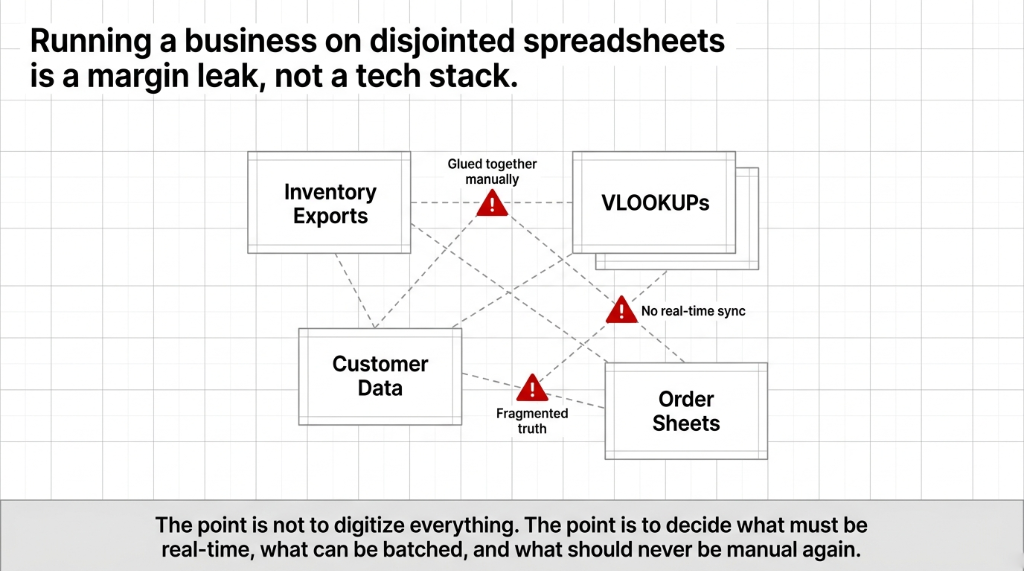
The point is not to digitize everything. The point is to decide what must be real-time, what can be batched, and what should never be manual again. Once you get that wrong, every sale creates more work than the last one.
We see this pattern in 73% of brands we audit
The founder built a brilliant product. Nailed the branding. Ran profitable ads. But the back office runs on 4-7 disconnected tools held together by one operations person who "just knows how things work."
Hidden cost: $3,800-$7,200/month in reconciliation labor, oversell refunds, and delayed shipments nobody tracks.
What Breaks First (And Costs the Most)
Failure #1: Inventory Sync
One SKU goes out of sync across Shopify, warehouse software, and marketplaces. Suddenly you oversell the hero product that paid for your ad spend. That is how a fast-moving brand turns a good launch into angry customers and refund tickets.
Real damage we measured at a skincare brand last quarter:
127 oversold units across 3 channels. Average order value: $47. Refund processing cost: $6.30 per order. Customer recovery emails sent: 127. Customers who repurchased: 11. That is an 8.7% save rate on a *preventable* error.
Failure #2: Order Routing
If your brand uses Shopify, shipping tools, WhatsApp support, and a third-party warehouse, each order needs to move cleanly through the chain. When that chain is fragmented, your team wastes 37 hours per week reconciling order status instead of fulfilling orders.
We timed it at one brand. Their ops manager spent 2 hours and 14 minutes every single morning just matching Shiprocket statuses to Shopify orders. By hand. In Excel.
Failure #3: Returns and Finance
Returns, replacements, COD reconciliation, and payout mismatches quietly erase margin. Especially when no one owns the full journey from order to cash. On paper the brand is growing. In reality, $4,100-$8,300 per month in working capital is getting trapped in broken ops.
The Finance Blind Spot
Pattern we see: Reported revenue says $110K/month. Bank deposits say $91K. The $19K gap lives in unreconciled COD, pending marketplace payouts, and return credits nobody tracked back to the original order.
Your accountant sees the gap. But cannot explain it.
Annual leakage from this pattern: $41,000-$97,000
The Stack That Actually Matters
For a D2C brand at $1M-$1.2M, the core stack should be simple: storefront, order/inventory backbone, CRM, support, and finance. Shopify often stays the storefront because it is fast to launch and flexible for growth.
But the *real* decision is what powers the middle layer where orders, inventory, and fulfillment are controlled.
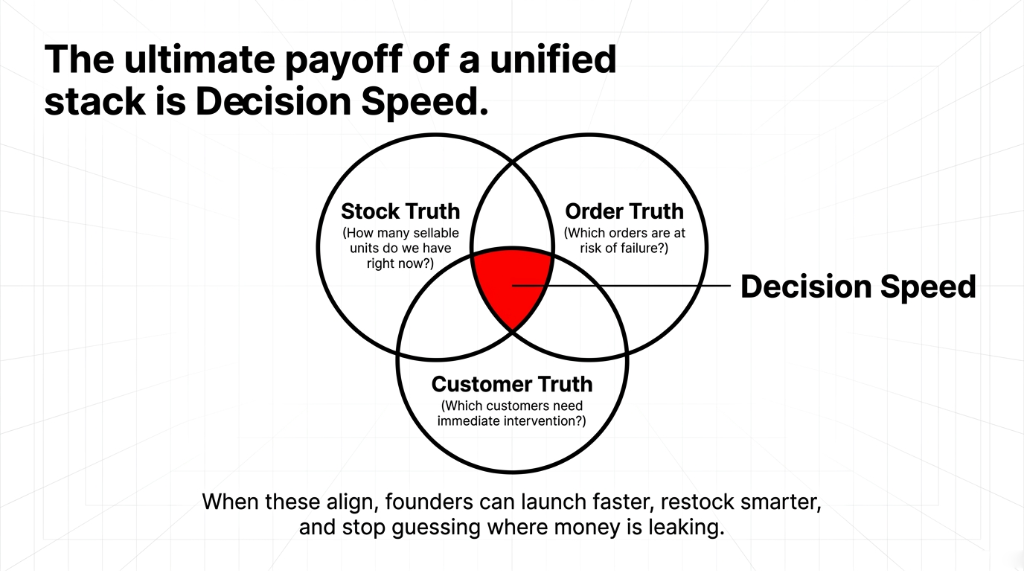
That middle layer must handle three things well: stock truth, order truth, and customer truth.
The 30-Second Test for Your Stack
Stock Truth
How many sellable units do we have right now? Not "in the system." Actually sellable. If you cannot answer in 30 seconds, your stack is too weak.
Order Truth
Which orders are at risk of failure? Delayed shipments, partial fulfillments, stuck COD pickups. If your team needs 3 tabs to answer this, you have a problem.
Customer Truth
Which customers need immediate intervention? Repeat buyers with open complaints. High-value customers with delayed orders. If support cannot see this, you are flying blind.
Here is the controversial part: do not buy more tools to compensate for missing process. Adding another app to fix warehouse errors usually just adds another source of error. A clean system with fewer integrations beats an impressive stack full of fragile automations.
Where to Spend First (And Where Not To)
Spend first on inventory and order control. Because that is where bad data becomes direct cash loss. A better OMS/ERP layer is worth more than a fancy email tool, a social commerce plugin, or another pop-up app that nudges conversions by 0.3%.
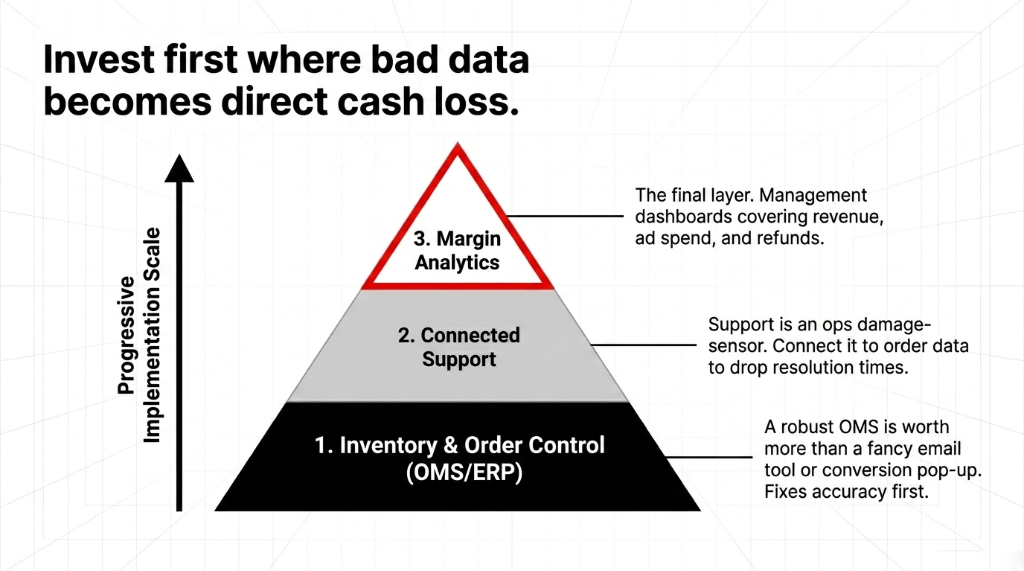
Next, connect support to order data. When support can see shipment status, payment status, and return history without switching between 4 browser tabs, resolution time drops and escalation volume falls. Support is not just a cost center. It is where operational damage gets exposed first.
After that, invest in analytics that tie together revenue, ad spend, inventory ageing, and refunds. A dashboard that only shows sales is vanity. A dashboard that shows contribution margin after returns and shipping is management.
The Priority Stack We Recommend
Layer 1 (Non-Negotiable): Inventory and order control via OMS/ERP. Fixes accuracy first.
Layer 2 (Next 90 Days): Connected support. An ops damage sensor. Connect it to order data to drop resolution times.
Layer 3 (Quarter 2): Margin analytics. Management dashboards covering revenue, ad spend, and refunds. The final layer.
What to Avoid (We Learned These the Hard Way)
Avoid building a custom stack too early unless you already have real ops complexity and an internal team that can maintain it. Custom code sounds elegant until one Shopify API change breaks order sync during a flash sale and your engineer is on vacation. Shopify itself can also hit rate-limit constraints during heavy automation, which is why poorly built integrations fail exactly when traffic spikes.
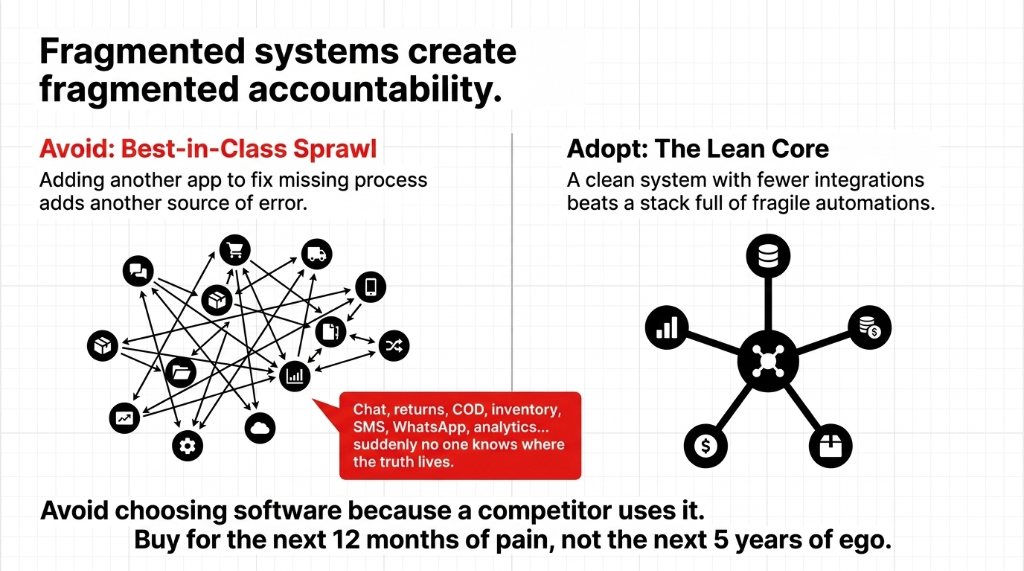
Avoid "best-in-class" sprawl. One tool for chat. Another for returns. Another for COD. Another for inventory. Another for SMS. Another for WhatsApp. Another for analytics. And suddenly no one knows where the truth lives. Fragmented systems create fragmented accountability. And fragmented accountability kills scale.
Avoid choosing software because a competitor uses it. A $1.2M brand does not need the same enterprise stack as a $12M brand. Everyone says buy NetSuite. Don't. It burns $500k before you see value at this stage. Buy for the next 12 months of pain, not the next 5 years of ego.
The Decision Framework (Before You Sign Any Contract)
Use this before signing any tool contract. We use it internally before recommending anything to clients:
| # | Question | If "No" |
|---|---|---|
| 1 | Does it remove a daily manual task? | You are buying a dashboard, not a solution |
| 2 | Does it improve stock accuracy or order accuracy? | It is a nice-to-have, not a need-to-have |
| 3 | Does it reduce refund, replacement, or support load? | It will not pay for itself in 6 months |
| 4 | Does it integrate cleanly with Shopify and finance? | You are adding another silo, not removing one |
| 5 | Can your team explain it without a vendor deck? | It will die after onboarding ends |
If the answer is "no" to three of those, walk away. A lot of software looks "strategic" until you ask who will maintain it after onboarding. Then the whole pitch collapses into training costs, hidden implementation fees, and a support queue nobody mentions on the sales call.
Our Rule of Thumb
If the tool does not protect margin, save time, or prevent errors, it is probably a distraction. Brands at $1M-$1.2M usually do not have a growth problem first. They have an operating discipline problem.
How This Usually Plays Out
Here is the story we hear 3-4 times a month. The founder starts with Shopify, Excel, and one shipping aggregator. Sales rise. SKUs multiply. Returns increase. Customer support starts asking warehouse questions all day. Then the finance team notices that reported sales and bank receipts do not match cleanly.
At that stage, the right move is not panic hiring. It is consolidating the order, inventory, and finance flow so every transaction moves through one logic. Once that is in place, the same team can handle 2.3x more volume without adding headcount at the same pace.
The real payoff is not just efficiency. It is decision speed. When inventory truth, order truth, and customer truth are connected, the founder can launch faster, restock smarter, and stop guessing where money is leaking.
The Practical Stack Map
| Layer | Good Choice at $1M-$1.2M | Why It Matters |
|---|---|---|
| Storefront | Shopify | Fast launch, strong ecosystem, easy growth setup |
| Order/Inventory | OMS or ERP backbone | Prevents oversell, sync errors, and fulfillment chaos |
| Support | Connected helpdesk | Cuts resolution time when it sees live order data |
| Finance | Accounting integration | Reduces reconciliation gaps and payout confusion |
| Analytics | Margin-focused dashboard | Shows refunds, shipping cost, and contribution margin |
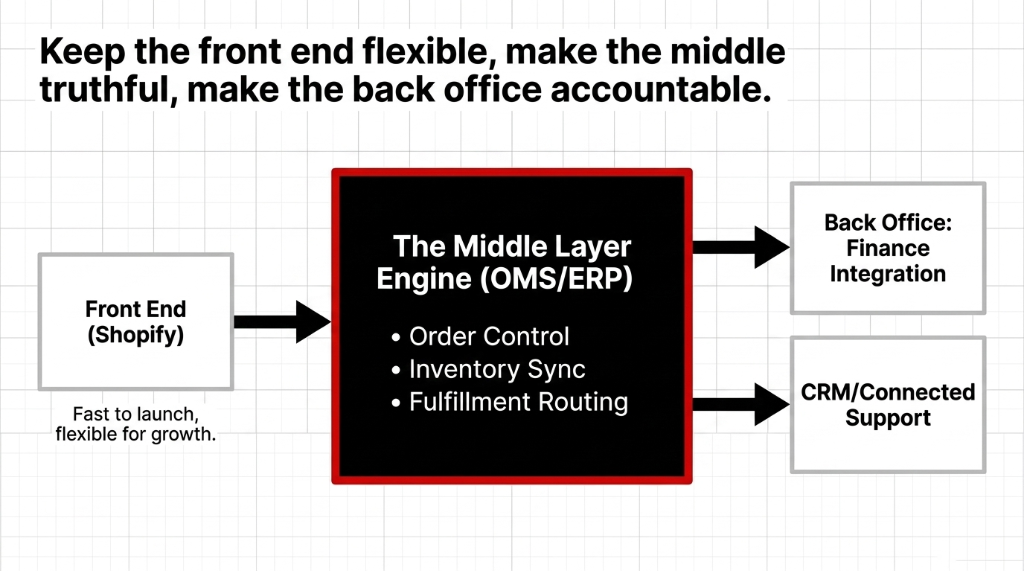
This is the stack logic that matters: keep the front end flexible, make the middle truthful, and make the back office accountable. Anything else is decoration.
The 5 Questions Every D2C Founder Asks Us
Do we need ERP at $1M-$1.2M revenue?
Usually yes, but not a heavy one if your operations are still simple. You need a system that controls stock, orders, and reconciliation in one place. Not a monster platform you cannot maintain. We have seen brands get away with lightweight Odoo implementations that cost 1/8th of what NetSuite quotes.
Is Shopify enough by itself?
No. Shopify is a strong storefront. But it is not a full operating system for a growing D2C brand. You still need inventory, returns, finance, and support connected around it. Think of Shopify as the front door. The house behind it still needs plumbing.
What breaks first when scaling?
Inventory sync and order handoff usually break first. Once those fail, support gets flooded, refunds rise, and the team spends more time fixing mistakes than growing revenue. We tracked one brand that spent 23 hours per week on error correction alone.
Should we build custom software?
Only when your process is stable and the business truly needs unique workflows. Building too early creates maintenance burden, integration risk, and hidden dependency on one developer or agency. We have rescued 14 brands from custom-code traps in the last 18 months.
What is the fastest win?
Fix inventory accuracy and order visibility first. That usually gives the quickest drop in errors, support tickets, and operational confusion. One brand saw support ticket volume fall 41% within 6 weeks of implementing multi-channel inventory sync.
The Bottom Line
A D2C brand at $1M-$1.2M wins by making the business more truthful, not more complicated. If the stack does not make cash, stock, and customer data easier to trust, it is the wrong stack. Period.
Open your Shopify admin right now. Export last month's orders. Compare to bank deposits.
If the gap is more than 3%, your stack is leaking. We find an average of $6,700/month in recoverable margin within the first audit.
Get Your Free Stack Audit