
The Real Fee Problem
If you sell on marketplaces, the commission is only the first bite. The real bill comes from referral fees, fulfillment fees, payment processing, listing charges, ad spend, storage, return handling, and account-level penalties that show up after you scale.
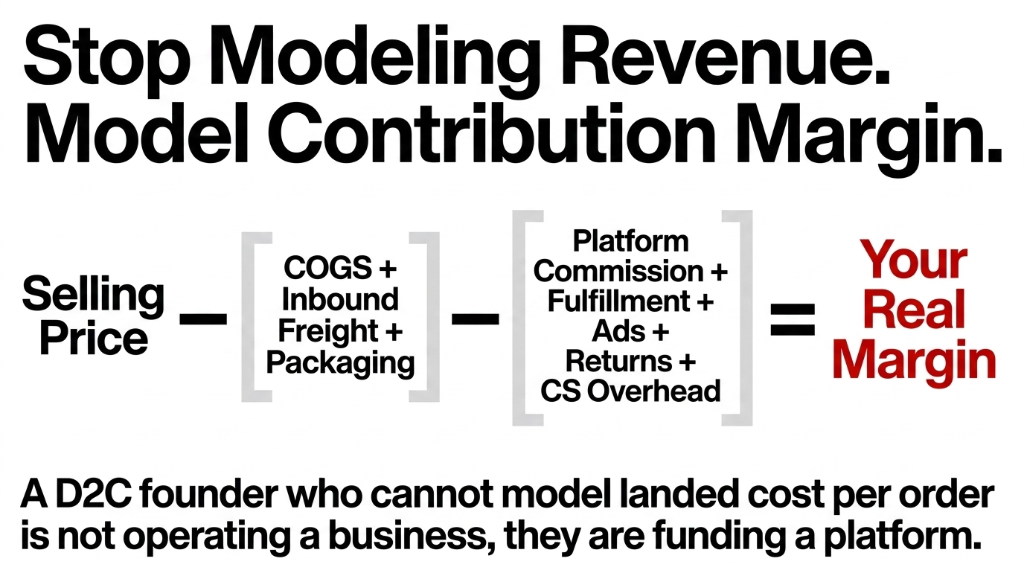
Marketplace economics have tightened across major platforms, with 2026 trends showing fee pressure rising and seller margins getting squeezed, especially for brands with low net margins and poor repeat-customer capture.
The founder mistake is simple: they compare commission rates and ignore everything else. That is how a "15% platform" becomes a 27% to 34% real cost structure once ads, returns, and shipping are included.
How the Fee Stack Works
Think of marketplace fees in layers. You have the commission or referral fee. The fulfillment or shipping fee. The payment processing fee. The listing or insertion fee. The advertising and promotion fees. The return, storage, and penalty fees.
Understanding the Fee Layers
Commission or Referral: The base charge for listing on the platform. Typically 8% to 15% on Amazon depending on the category, or final value fees on eBay.
Fulfillment or Shipping: FBA fees or 3PL pick-and-pack rates. These fluctuate with product size, weight, and dimensional weight logic.
Payment Processing: The transaction cost to clear the credit card or COD payment. Often bundled in the referral fee but billed separately on platforms like Shopify.
Ad Spend & Storage: The cost to rank on search pages plus long-term inventory storage charges if your stock sits longer than 180 days.
On Amazon, referral fees are commonly 15% for most categories, but FBA fulfillment fees add another meaningful layer. eBay uses final value fees, while Walmart and Etsy use their own mix of referral, payment, and listing costs.
Amazon Fees, Without the Sugarcoat
Amazon is the biggest reality check for founders because it gives you scale and takes margin with equal enthusiasm. If you are selling a $40 product, a 15% referral fee is $6 before fulfillment, storage, and ads. Add fulfillment, return risk, and pay-to-play ranking, and your contribution margin collapses fast.
Amazon works best when you have one of three things: high Average Order Value (AOV), strong repeat purchase, or a product that can absorb heavy acquisition cost. Without that, Amazon becomes a treadmill where you buy traffic one order at a time.
This is where clean backend data from an ERP system keeps you from making bad margin assumptions. You need to know what you are actually paying, not what the sales manager thinks you are paying.
eBay, Walmart, and Etsy
eBay is usually friendlier than Amazon on pure marketplace scale, but friendlier does not mean cheap. Its cost structure is still a stack of final value fees, payment-related fees, and occasional insertion or listing fees depending on your listing count and account type.
Walmart Marketplace has become a serious channel for D2C brands that can handle strict performance standards, but the fee structure still needs to be modeled alongside operational requirements, returns, and ad spend. Walmart is in the same broad category of commissions plus fulfillment and operational costs, rather than a simple flat-rate channel.
Etsy is often misunderstood as cheap because the listing fee looks tiny, but listing fee is not the full story. Etsy still charges transaction and processing fees, and the economics can become awkward for low-ticket or highly customized products where labor eats the remaining margin.
Shopify Is Different
Shopify is not a marketplace in the same sense, which is why the fee conversation changes. Instead of paying a marketplace commission, you pay platform subscription costs and payment processing fees, typically around 2.6% to 2.9% plus a fixed transaction amount depending on the setup.
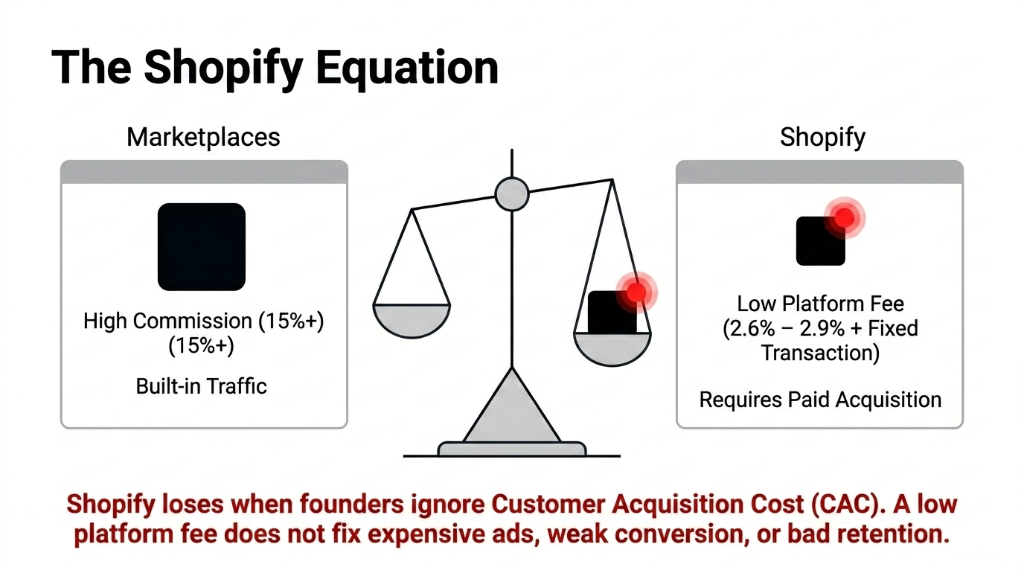
Shopify often wins on pure fee percentage, especially at scale. But Shopify loses when founders ignore customer acquisition cost, because a low platform fee does not fix expensive ads, weak conversion, or bad retention.
The smart D2C move is not "Amazon or Shopify." It is "Amazon for discovery, Shopify for profit and repeat purchase." That is how you turn marketplace traffic into a customer asset instead of a rented one.
Fee Structure Comparison
| Channel | Common Fee Pattern | What Founders Usually Miss |
|---|---|---|
| Amazon | Referral fee, fulfillment fee, storage, ads, returns. | Ads and returns can be larger than the headline referral fee. |
| eBay | Final value fees, payment costs, optional listing charges. | Margin varies heavily by category and listing volume. |
| Walmart | Marketplace commissions plus operational and ad costs. | Compliance and performance standards can add hidden cost. |
| Etsy | Listing fee plus transaction and processing costs. | Low listing fees do not protect low-margin handmade goods. |
| Shopify | Subscription plus payment processing, no marketplace commission. | Paid traffic and retention determine true profitability. |
The Founder Math
A clean way to think about marketplace fee structures is contribution margin, not revenue. Take your product price, subtract product cost, packaging, inbound freight, marketplace fees, ad spend, returns, and customer service overhead. What is left is your real margin.
Example of a compressed margin on a $60 product:
Base price: $60.00
Marketplace referral fee (15%): $9.00
Ad spend (12%): $7.20
Fulfillment equivalent (4%): $2.40
Returns reserve (3%): $1.80
Remaining Margin: $39.60 before COGS. You are already down 34% before accounting for the product cost itself. That is how brands with good top-line growth end up with useless bank balances.
The fee burden gets worse for brands running promotions. Discounts increase conversion but compress the base on which fees are calculated. Your promo creates more volume and less profit at the same time.
To track this without spreadsheet errors, brands use a centralized inventory system that matches actual selling price to actual landed cost per channel.
What Changes in 2026
The biggest shift in 2026 is not one single fee hike. It is the tightening of multiple fee layers across platforms at once, which leaves sellers less room to hide operational inefficiency.
Many D2C brands still price as if marketplace fees are stable and isolated. They are not. Platforms adjust commissions, campaign access, and service fees, while sellers absorb the risk of returns, logistics, and ad inflation.
This is why founders need a multi-channel sync system to dynamically route inventory to the channels that actually yield profit, rather than just chasing sales volume.
A Practical Operating Rule
Use marketplaces for acquisition, not dependency. If a channel brings you a first-time buyer, the real job is to move the repeat purchase to your own site, CRM, or subscription flow where you control margin and data.
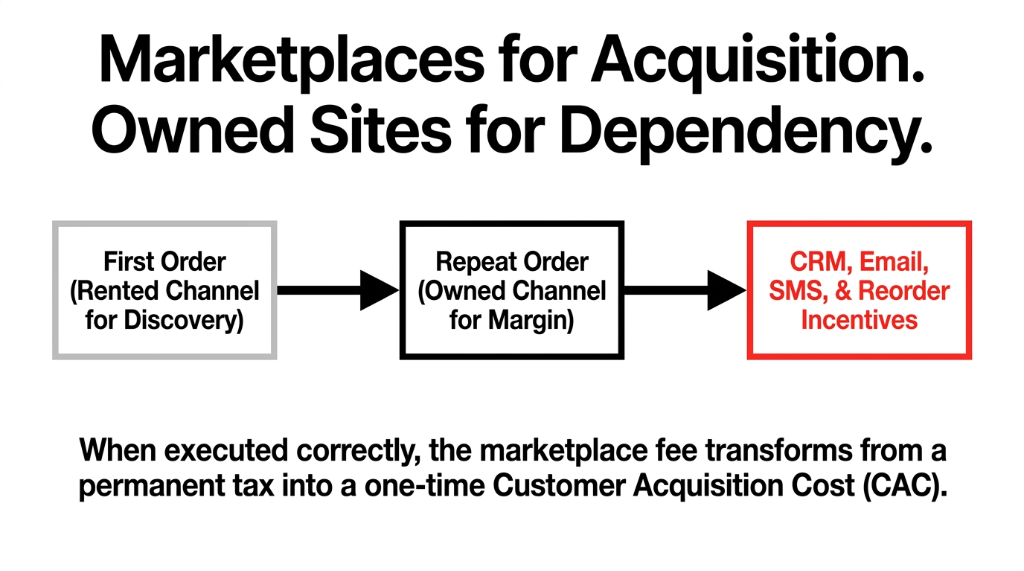
When brands do this well, the marketplace fee becomes a customer acquisition cost rather than a permanent tax. If you do not plan this migration path, you are just renting customers from Amazon and paying rent forever.
What Founders Should Do Now
Start with a fee audit for each channel. Build a spreadsheet with selling price, product cost, platform commission, fulfillment, ads, payment costs, returns, and packaging. Calculate net margin per SKU by channel.
Then sort SKUs into these four action buckets:
- Scale on marketplace: High margin, low return rate, stable ad cost.
- Move to Shopify: High repeat rate products where customer lifetime value justifies ad cost.
- Keep as marketplace-only: Low repeat rate but high AOV items that benefit from built-in traffic.
- Kill immediately: Negative margin SKUs after returns and ad spend are fully loaded.
Track fee changes monthly, because 2026 marketplace economics are not static. A channel that looked profitable in Q1 can turn marginal by Q3 if ad costs or fee structures change.
5 Questions Every Founder Asks About Marketplace Fees
Which marketplace has the lowest fees?
Shopify usually has lower platform fees than marketplaces because it charges subscription and payment processing rather than commission. But total profitability depends on your ad spend and conversion rate, so the cheapest platform fee is not always the most profitable channel.
Is Amazon still worth it in 2026?
Yes, if you have the margin to survive referral fees, fulfillment fees, and ad costs. It is strongest for brands that can use Amazon for discovery and then convert repeat buyers elsewhere. If your product has zero repeat purchase potential, Amazon's fee structure will eventually grind you down.
Why do marketplace fees feel higher than advertised?
Because the headline commission is only one layer. Fulfillment, payment processing, ads, storage, and returns raise the real cost far above the published rate. When you add FBA storage penalties and return processing fees, a 15% referral fee regularly becomes a 34% cash drain.
Should D2C brands sell on both Amazon and Shopify?
Usually yes, but with different jobs for each channel. Amazon is good for reach and discovery, while Shopify is better for margin, retention, and customer ownership. If you do not have a system to bridge the two, you are running two separate businesses and doubling your administrative cost.
What is the biggest mistake founders make?
They look at revenue instead of contribution margin. A channel can look busy and still lose money once fees, ads, and returns are fully loaded. We have seen brands grow 42% in top-line revenue while their cash balance dropped by $38,000 because they scaled the wrong products.
The Bottom Line on Marketplace Economics
Marketplace fee structures in 2026 reward disciplined operators and punish optimistic ones. If you do not know your true cost per order, you are not scaling — you are absorbing platform risk and calling it growth. Treat every marketplace like a rented storefront and every fee like a line item that must be justified.
Pull up your marketplace payout reports. Subtract ad spend, returns, and inventory storage.
If you cannot get this SKU-level contribution margin in under 10 minutes, you are flying blind. We build automated margin tracking that exposes fee leakage in 90 days.
Get Your Channel Margin Audit