
The Moment You Need One
Most founders wait too long. They keep saying, "I will hire operations after the next launch," or "We are too small for that role." That is backwards. The right time is when orders, inventory, vendors, and customer issues have become too many to hold in your head.
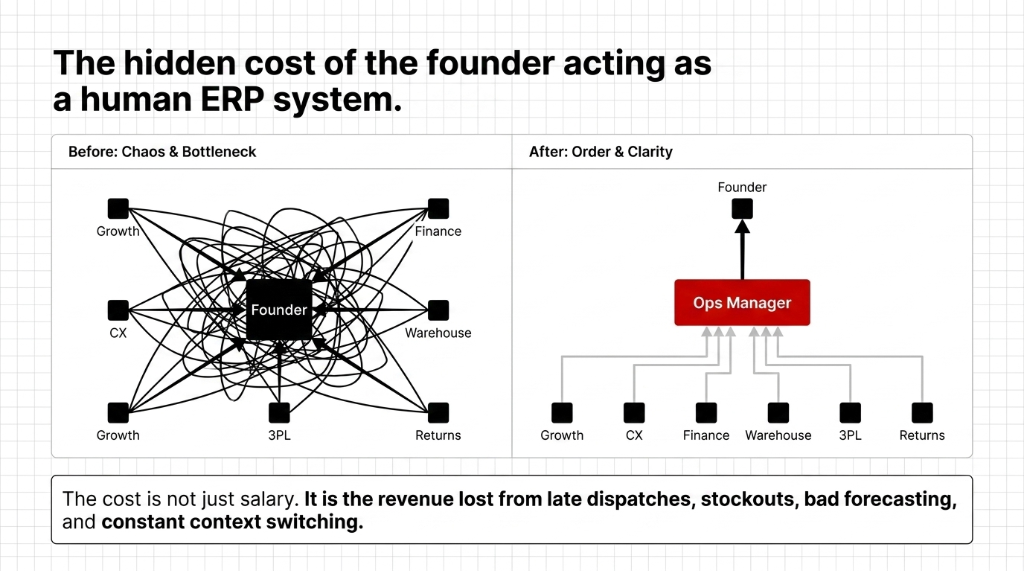
You need your first ops manager when:
Orders are delayed because someone forgot a handoff.
Inventory counts do not match what Shopify says.
Returns, refunds, and replacements are tracked manually.
Your team asks the founder the same process question every day.
Growth is limited by coordination, not demand.
At that point, the founder is acting as a human ERP system. That is not scalable, and it is definitely not cheap. The hidden cost is not just salary — it is the revenue lost from late dispatches, stockouts, bad forecasting, and constant context switching.
What This Role Actually Does
A first ops manager is not a "helpful generalist" or a glorified admin. The job is to own the daily operating engine of the brand so the founder can stop being the bottleneck. In a D2C business, that means making sure product, inventory, warehouse, 3PL, finance, customer support, and returns all move in sync.
The Daily Ownership Map
Order flow and fulfillment coordination. From checkout to doorstep, every handoff has an owner.
Inventory visibility and replenishment tracking. One number, one source, no arguments.
Vendor follow-ups and purchase order control. Deadlines enforced, not hoped for.
Returns, replacements, and damage claims. Tracked systematically, not on WhatsApp.
SOP creation and process enforcement. If it is not written down, it does not exist.
Cross-team coordination between growth, CX, finance, and warehouse.
Reporting on delays, errors, and exceptions. Weekly. Non-negotiable.
The biggest mistake founders make is hiring for "someone who can do everything." That phrase sounds useful and usually means the candidate is vague. You want someone who can take messy daily operations and make them measurable, visible, and boring. Boring operations are profitable operations.
The Founder Mistakes That Kill This Hire
Founders often hire too junior, too senior, or for the wrong personality. Too junior, and they cannot fix process gaps without constant supervision. Too senior, and you pay for strategic depth you do not yet need. Wrong personality, and they become a polite note-taker instead of an operator who pushes work to completion.
The Classic Mistakes We See Every Time
Hiring a "project manager" when you need process ownership. Hiring from corporate when you need someone who has handled daily firefighting. Hiring based on spreadsheets in the interview instead of real execution examples.
The blunt truth:
If the founder still approves every exception, the ops manager is decorative. The role only works when they own decisions inside a clear lane.
Skills That Matter for the First Hire
For the first hire, look for execution over polish. The best candidate is usually someone who has worked in D2C, e-commerce, retail operations, logistics, supply chain, or process-heavy fulfillment environments. They do not need to be perfect at strategy, but they need to be excellent at closing loops.
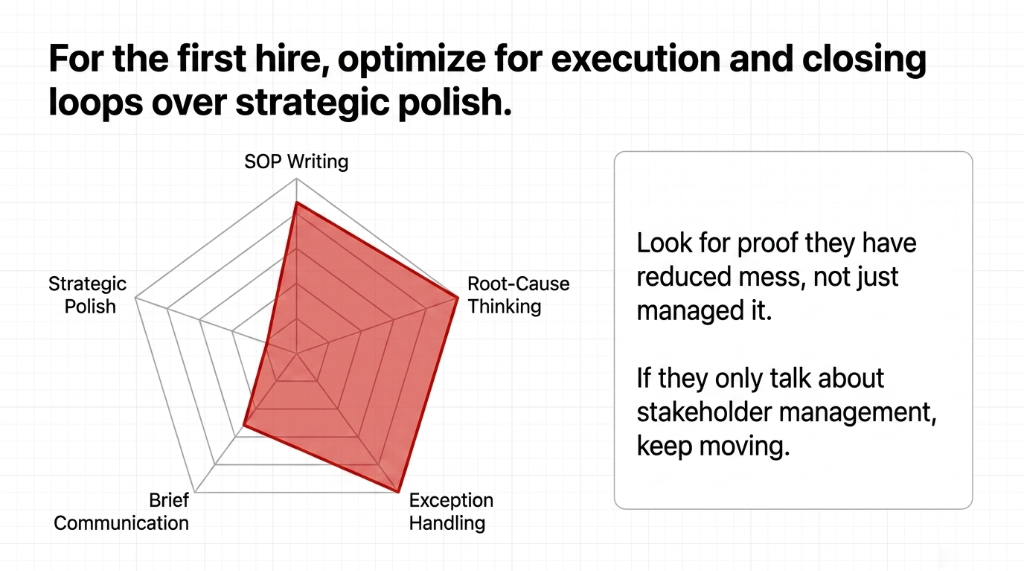
Look for proof that they have reduced mess, not just managed it. Ask about a time they cut order errors, reduced backorders, improved dispatch turnaround, or fixed a recurring fulfillment issue. If they can only talk about "collaboration" and "stakeholder management," keep moving.
The Hiring Scorecard
Use a simple scorecard before you start interviews. If you do not define the role, you will hire vibes instead of competence.
| Area | What Good Looks Like |
|---|---|
| Daily execution | Follows up until tasks are closed. Does not need reminding. |
| Process thinking | Spots recurring failure points. Builds SOPs without being asked. |
| Data comfort | Tracks numbers without panic. Can explain a variance in plain language. |
| Cross-team control | Pushes warehouse, vendors, and support teams. Not afraid to escalate. |
| Ownership | Solves issues without waiting for founder rescue. |
| Communication | Writes concise updates and escalations. No 800-word Slack novels. |
Interview Questions That Actually Reveal Competence
Do not ask generic interview questions like "What are your strengths?" Those answers are useless. Ask questions that reveal whether the person has actually run operations under pressure.
7 Questions That Separate Operators From Talkers
Execution Under Pressure
Tell me about a time fulfillment broke. What did you fix first? How do you handle a vendor who keeps missing deadlines? Give an example of a process you made simpler.
Systems Thinking
How do you track stock accuracy across multiple channels? What would you do if warehouse counts and Shopify counts never match? What reports would you build in your first 30 days? What would you automate first in a D2C back office?
Then go deeper. Ask them to explain the sequence of actions, not just the outcome. The best candidates will talk about exceptions, owner handoffs, escalation rules, and daily checkpoints. Weak candidates will jump straight to "I improved efficiency" without explaining how.
The First 90 Days
The first 90 days should not be about "doing everything." They should be about building control. The new ops manager needs to map the current state, identify the biggest leaks, and create a simple system the team can follow.
Days 1-30: Learn and Map
Learn every current process. Map order-to-delivery flow. Identify top 10 recurring failures. Build a daily reporting rhythm. Start documenting SOPs.
The goal is not fixing yet. The goal is seeing the full picture without the founder's narration.
Days 31-60: Fix the Biggest Leaks
Fix the highest-cost bottlenecks. Create owner mapping for each task. Standardize exception handling. Improve inventory visibility. Reduce manual follow-ups.
This is where the ops manager earns their salary. Tangible reduction in errors, delays, and founder escalations.
Days 61-90: Systems and Handoff
Put dashboards and routines in place. Tighten handoffs across teams. Start basic forecasting improvements. Reduce dependency on the founder. Create a monthly operations review.
The point is not perfection. The point is fewer surprises. If the ops manager cannot show clearer numbers, fewer escalations, and faster resolution inside 90 days, the hire is probably wrong or unsupported.
Pay, Authority, and Structure
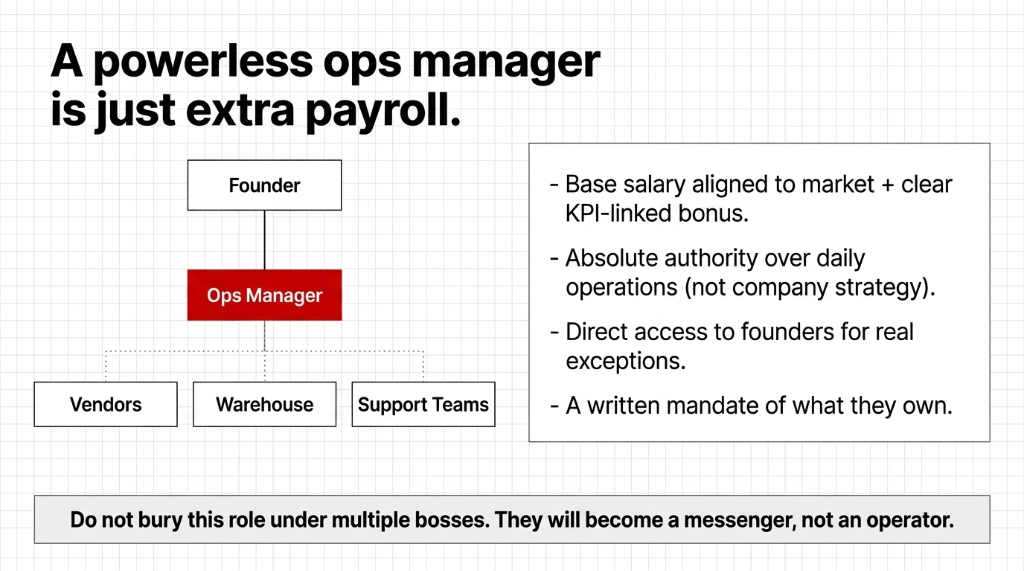
Founders often ask what to pay. The answer depends on geography, complexity, and experience, but the structure matters more than the exact number. A good ops manager should have enough authority to move people, chase deadlines, and enforce process.
Tools and Systems
The first ops manager is only as effective as the system around them. If your stack is scattered, their life becomes a cleanup project. The point is to reduce chaos, not merely track it better.
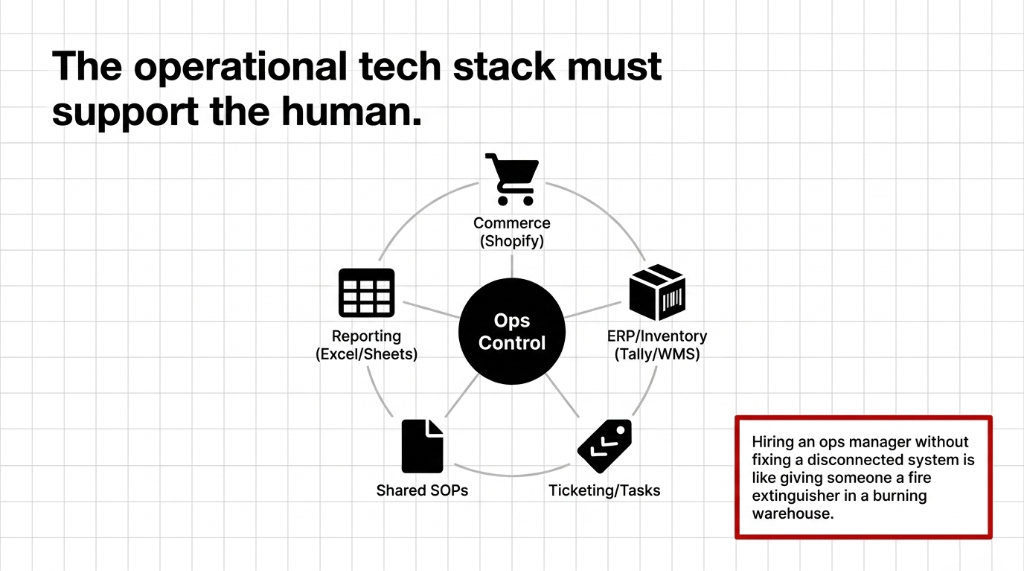
A strong ops manager will also tell you when the system itself is broken. That matters. Sometimes the issue is not the person — it is that the business is trying to run on disconnected tools and tribal knowledge. In that case, hiring an ops manager without fixing the system is like giving someone a fire extinguisher in a burning warehouse. That is when an ERP integration becomes the force multiplier.
The Founder Handoff
This is where many founders fail. They hire operations but refuse to let go of the daily control that made the hire necessary in the first place. The ops manager cannot succeed if every decision still needs founder approval.
The Clean Handoff Checklist
Define what they own. Completely. In writing.
Define what requires escalation. Everything else is theirs to decide.
Set a daily and weekly reporting rhythm. Not Slack check-ins every 2 hours.
Stop backchanneling process decisions. If you go around them, you undermine them.
Judge them on outcomes, not constant visibility. You hired an operator, not a live stream.
The founder's job changes here. Instead of solving every dispatch issue or vendor delay, you should be reviewing patterns and removing structural blockers. That is a much better use of founder time. It also makes growth possible without making the business fragile.
What Success Actually Looks Like
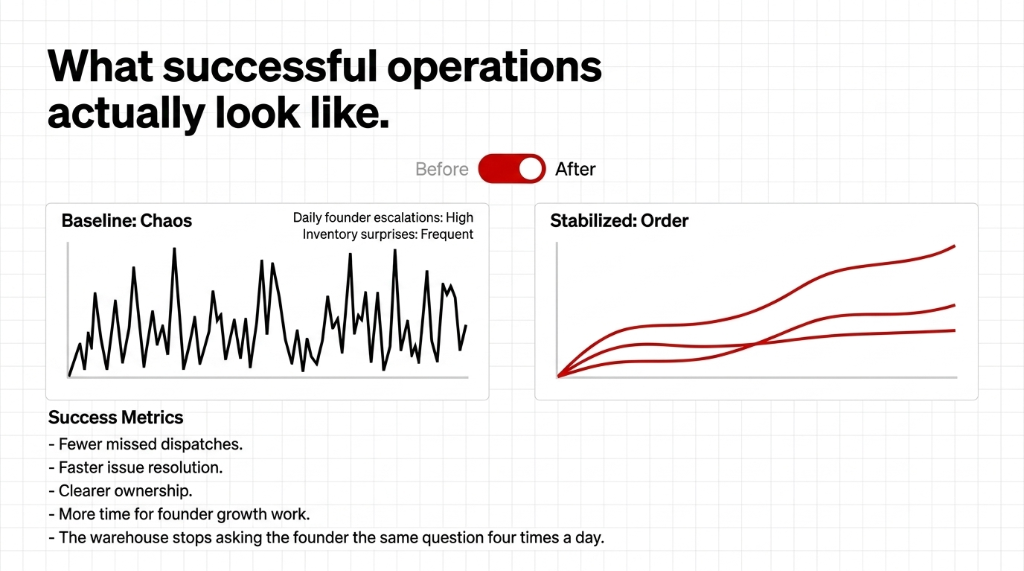
A good first ops manager makes the business feel less noisy. Orders move more predictably. Inventory surprises shrink. The warehouse stops asking the founder the same question four times a day. Customer complaints tied to process errors go down. Reporting becomes useful instead of decorative.
5 Questions Every D2C Founder Asks About Hiring Ops
When should a D2C founder hire the first ops manager?
Hire when operational complexity starts slowing growth, not after everything breaks. If order issues, stock mismatches, and daily follow-ups are becoming routine, the hire is overdue. Most brands we work with should have hired 3-6 months earlier than they did.
Should the first ops manager come from D2C?
Yes, ideally. D2C has specific pressure points like inventory turns, order spikes, returns, and fulfillment coordination. Someone from another industry can work, but they need proof of handling fast-moving operations with multiple moving parts and daily fire drills.
What is the difference between an ops manager and a project manager?
A project manager tracks tasks and timelines. An ops manager owns recurring business execution, process discipline, and daily operational stability. For a D2C brand, you need the second one. Projects end. Operations never stop.
How long before the hire starts helping?
A strong ops manager should start reducing noise within 30 days and show visible process control within 90 days. If nothing changes by day 90, the role is either not working, or you never gave them real authority to make decisions.
What should I avoid when hiring this role?
Avoid vague candidates, overqualified strategists, and people who cannot show real execution wins. Also avoid hiring without giving authority — a powerless ops manager is just extra payroll. If they report to three people, they become a messenger instead of an operator.
The Right First Ops Manager Does Not Just "Help the Founder"
They remove the daily operational drag that blocks scale. Hire for ownership, clarity, and execution — or you will keep paying the founder-tax in a thousand small ways. Late dispatches. Stockouts. Manual reconciliation. Vendor follow-ups. Every one of those costs more than a salary.
Count the hours you spent last week on operational firefighting. If it is more than 15, you do not have an operations problem. You are the operations problem.
We help D2C founders build the operational system that makes the first ops hire succeed — not just survive. 15-minute audit. No pitch deck. Just the truth about what is broken.
Book Your Free Ops Readiness Audit