
Why This Decision Destroys Margin (Quietly)
Most founders shop for a 3PL like they are buying storage space. That is the first mistake. A 3PL touches your pick accuracy, delivery speed, return processing, subscription retention, COD failure rates, and how many angry support tickets your team handles at 11:47 p.m. on a Saturday.
A bad partner does not fail loudly on day one. They fail in small ways: one mislabeled SKU, one delayed replenishment, one missed SLA, one "we will fix it tomorrow" during a sale weekend. By the time you notice the pattern, you are already paying for the damage in refunds, chargebacks, lost repeat orders, and wasted ad spend.
For D2C brands, logistics is not back office. It is part of the product experience. If your product arrives late, damaged, or wrong, that is a brand failure. Not a warehouse failure.
Start With Your Operating Model (Not a Google Search)
Before comparing 3PLs, get clear on how your brand actually operates. A skincare brand shipping 1,800 units a month with high return sensitivity needs a very different partner than a supplement brand doing 28,000 units a month with repeat replenishment and multiple subscription intervals.
Map Your Order Profile First
Volume Shape
Average order volume by month. Peak month multiplier. SKU count and complexity. Average order value. A founder who cannot describe the business model in logistics terms is not ready to negotiate with a 3PL.
Return Profile
Return rate by product category. COD success rate by region. Replacement vs refund ratio. If you sell fragile goods, packaging accuracy matters more than cheap storage. If you run flash sales, system speed matters more than a low per-order fee.
Channel Mix
Domestic versus international split. B2C, B2B, marketplace, and subscription breakdown. If you sell high-repeat consumables, replenishment accuracy and stock visibility matter more than fancy dashboards.
What a Competent 3PL Actually Does
A competent 3PL does much more than store boxes and ship parcels. It should help you receive inventory correctly, track stock in real time, process orders fast, manage returns cleanly, and handle exceptions without turning every mistake into a fire drill.
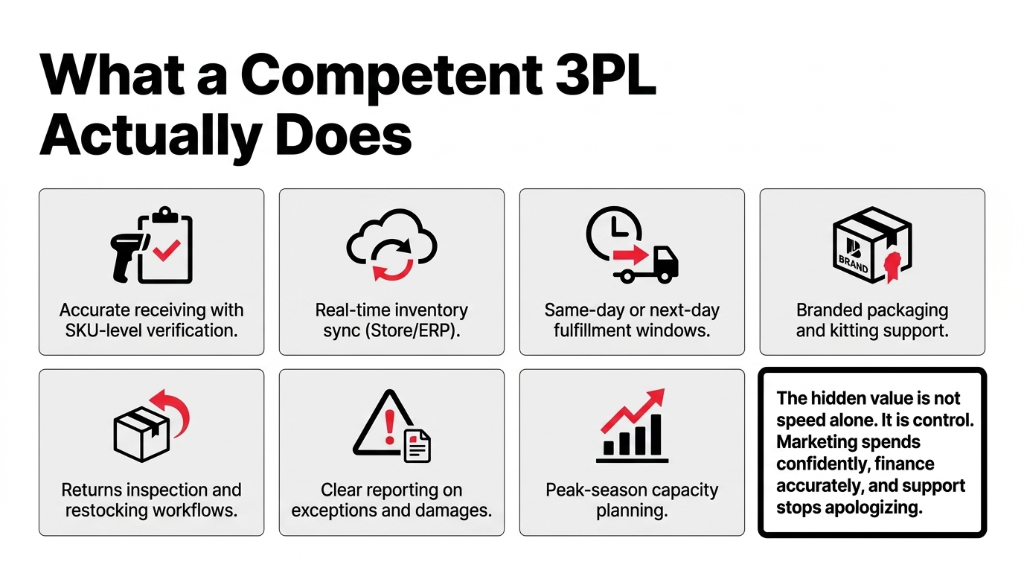
The hidden value is not speed alone. It is control. When your operations are controlled, marketing can spend confidently, finance can forecast accurately, and customer support stops apologizing for warehouse mistakes.
The Questions That Expose Weak Partners
Sales decks are cheap. Real operations show up in the questions you ask.
| Ask This | Good Answer Sounds Like | Walk Away If |
|---|---|---|
| Order accuracy rate last 90 days? | "99.2% across 47,000 orders. Here is the report." | They say "very high" with no data |
| Dock-to-stock time? | "24-48 hours standard. Same-day for priority inbounds." | They hesitate or say "depends" |
| How do you handle inventory discrepancies? | "Cycle counts every 14 days. Discrepancy report within 24 hours." | They blame it on "the system" |
| What happens during a stockout? | "Automated alert to your team. Backorder queue with priority rules." | They shrug |
| Same-day dispatch cutoff? | "2 PM local time. Extended to 5 PM during peak with advance notice." | No clear answer |
| Claims process for lost or damaged goods? | "Filed within 48 hours. Resolved within 14 days. Here is our SLA." | They say "we rarely have issues" |
A serious 3PL explains their process like an operator, not a salesperson. You are not looking for charm. You are looking for proof.
Pricing Traps Founders Miss
A low quote is often the most expensive quote in disguise. The base rate may look attractive, but the real cost hides in receiving fees, storage minimums, packaging charges, pick-and-pack tiers, returns processing, special handling, software fees, account management fees, and rate changes once volume grows.
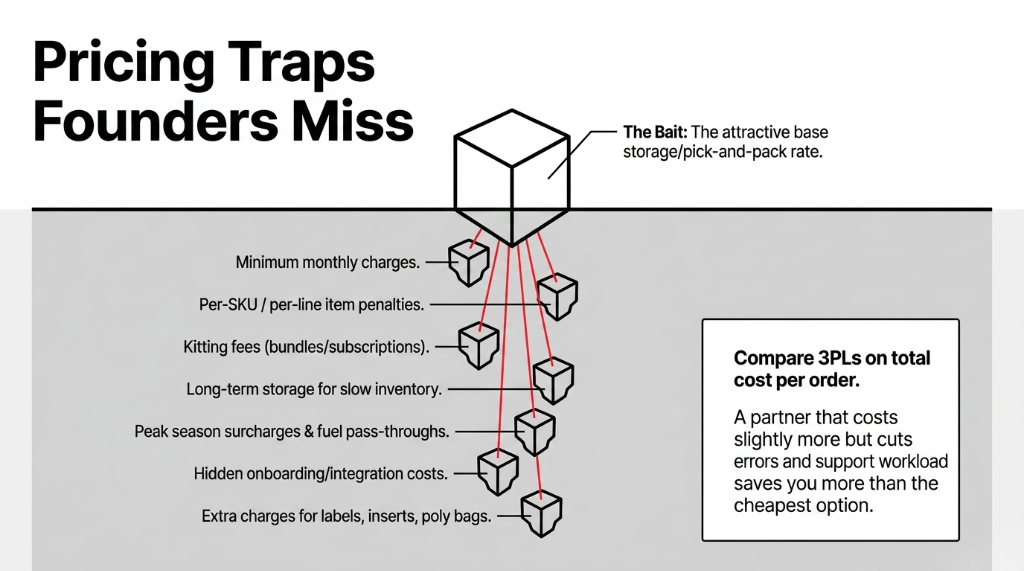
Real example from a $3.7M fashion brand:
Quoted rate: $2.85/order pick-and-pack. Looked great on paper.
Actual cost after 90 days: $4.73/order. The gap came from kitting fees ($0.45), poly bag charges ($0.18), label surcharges ($0.22), minimum monthly charges covering slow months ($0.41), and peak season fuel pass-throughs ($0.62).
Annual surprise: $47,200 more than budgeted. Nobody caught it until Q2 finance review.
Compare 3PLs on total cost per order, not storage rate alone. A partner that costs slightly more but cuts errors, returns, and support workload can easily save you more money than the cheapest option on the table.
Systems and Integrations (Where Brands Get Burned)
This is where many D2C brands get burned. The warehouse may look competent, but if it does not integrate properly with Shopify, Amazon, your ERP system, Klaviyo, or your subscription stack, you will spend months fixing manual work that should not exist.
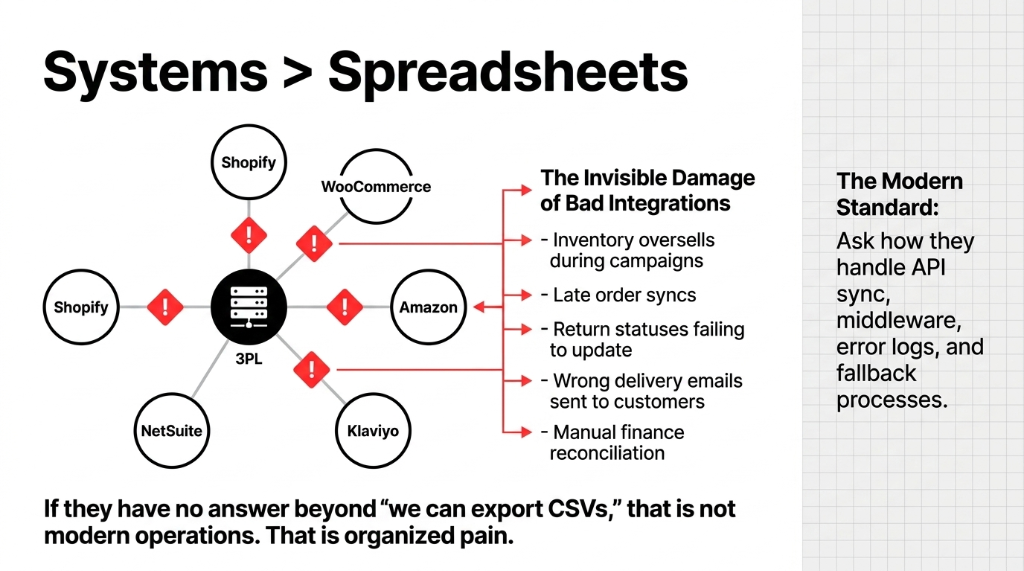
A good 3PL should fit into your stack without making your team become part-time spreadsheet operators. Ask how they handle API sync, middleware, error logs, and fallback processes when a connection fails.
If they have no answer beyond "we can export CSVs," that is not modern operations. That is organized pain.
The Integration Damage We See Most
Inventory oversells during campaigns because the 3PL WMS updates stock every 15 minutes, not in real time. A flash sale selling 340 units in 8 minutes creates 47 oversell cancellations.
Orders sync late — the 3PL gets orders 2-4 hours after placement. Same-day dispatch becomes next-day dispatch. Customer trust erodes.
Return statuses never update — support tells the customer "we are processing your return" for 11 days because the 3PL marks it complete in their system but the data never flows back to Shopify.
Location Is Strategy, Not Geography
Many founders pick a 3PL because the warehouse is cheap or close to the founder's office. That is lazy thinking. Warehouse location should be based on where your customers are, what your carrier network looks like, and whether you need regional split inventory to reduce delivery times.
A single warehouse may be fine early on. But if your order base is spread across regions, a two-node or multi-node strategy can reduce delivery costs by 14-23% and improve speed by 1.3 days on average. The tradeoff is complexity, so only do it when the volume supports it.
Location Factors That Actually Matter
Customer concentration by region. If 67% of your orders go to the East Coast but your warehouse is in Nevada, you are paying for geography every single shipment.
Carrier performance by region. Some carriers dominate specific zones. Your 3PL should know which ones and route accordingly.
COD success rates. If you do COD, regional performance varies wildly. A 3PL that ignores this is costing you 8-12% in failed deliveries.
How to Test a 3PL Before Signing
Never sign a long contract based only on a demo call. Run a controlled pilot first. Ship a batch of real SKUs, including slow movers, fragile items, bundle orders, and one or two exception cases that mimic actual customer behavior.
| Pilot Metric | What to Measure | Red Flag Threshold |
|---|---|---|
| Receiving Accuracy | SKU-level count match on inbound | Below 98.5% |
| Inventory Sync Speed | Time from receiving to stock visible in Shopify/ERP | Over 4 hours |
| Pick-and-Pack Accuracy | Correct items in correct packaging | Below 99% |
| Dispatch Turnaround | Order received to carrier handoff | Over 24 hours consistently |
| Return Handling | Return received to restocked or written off | Over 5 business days |
| Issue Response | Time to acknowledge and resolve a reported error | Over 12 hours to respond |
A clean pilot is worth more than a polished slide deck. The pilot tells you how they behave when something goes wrong, which is the part founders usually discover too late.
Contract Terms You Must Not Ignore
The contract is where founders lose use. Read it carefully and pressure-test every assumption before you commit. The exit clause matters, the SLA matters, the liability cap matters, and the process for price changes matters.
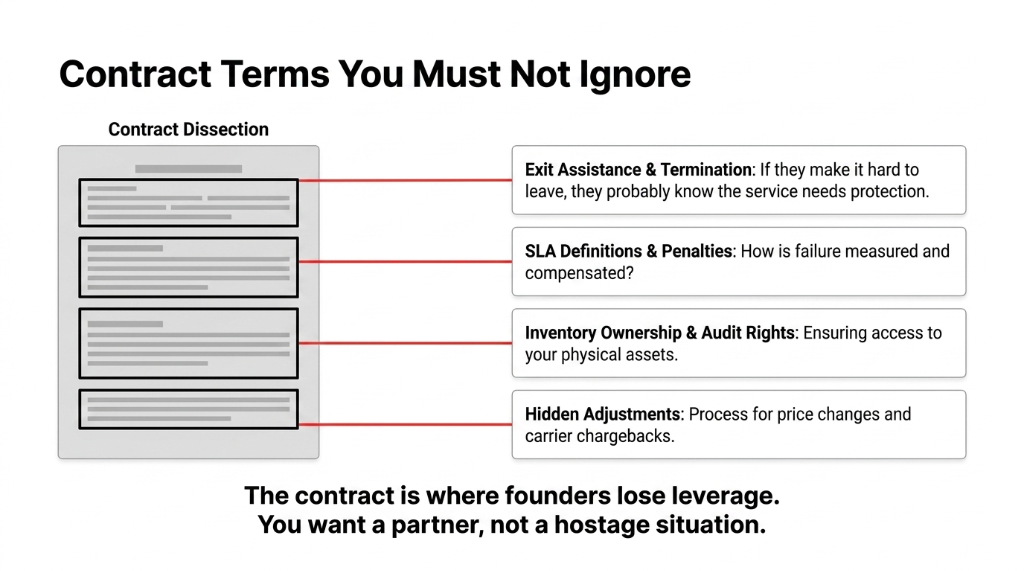
4 clauses we always flag during contract review:
Exit Assistance and Termination: If they make it hard to leave, they probably know the service needs protection. Look for 30-day exit with inventory transfer assistance.
SLA Definitions and Penalties: How is failure measured and compensated? Vague SLAs are worth nothing. You need specific metrics with credit triggers.
Inventory Ownership and Audit Rights: You must have the right to audit physical stock at any time. If they resist this, that is a massive red flag.
Hidden Adjustments: What is the process for price changes? Carrier chargebacks? Fuel surcharges? If the contract allows unilateral rate changes with 30-day notice, you have no pricing stability.
You want a partner, not a hostage situation.
Red Flags That Should End the Conversation
Walk Away Immediately If You See:
No clear SLAs. No live inventory visibility. Constant excuses about system issues.
Weak peak-season planning. Slow response during onboarding. No experience with your product category.
Hidden fees in the draft contract. Poor references from brands like yours.
Also be careful with partners who say yes to everything. Operationally mature 3PLs know their limits. The ones who promise the moon usually do not have the staffing or systems to deliver it.
5 Questions Every D2C Founder Asks About 3PLs
How do I know if my brand needs a 3PL?
If fulfillment is distracting your team from growth, you need one. The moment order volume, returns, or shipping exceptions start consuming founder time, a 3PL becomes a scaling tool rather than a convenience. We usually see the breakpoint around 1,500-3,000 orders per month.
What is the biggest mistake founders make with 3PLs?
They choose on price alone. Cheap storage means nothing if the partner misses dispatch windows, loses inventory, or creates customer complaints that damage repeat sales. We tracked one brand that saved $0.40/order on pick-and-pack but lost $14,700/month in repeat revenue from fulfillment errors.
Should I use one 3PL or multiple?
Start with one unless your geography, volume, or product mix clearly demands more. Multiple 3PLs can improve speed, but they also add complexity, reconciliation work, and control issues. Only split when volume justifies the overhead — usually above 15,000 orders per month with clear regional concentration.
How long should 3PL onboarding take?
A serious onboarding should take 2-4 weeks, not months. If setup drags past 6 weeks, the partner may not have the systems or team maturity to support growth. The best partners have a structured onboarding playbook with clear milestones and daily check-ins during the first 2 weeks.
When should I switch 3PLs?
Switch when errors, delays, hidden fees, or poor communication are hurting revenue and customer trust more than the migration pain. Staying too long with the wrong partner usually costs more than moving. We have helped 9 brands migrate 3PLs in the last 18 months. Average time to full transition: 23 days.
Choose a 3PL Like Your Margin Depends on It
Because it does. The right partner protects revenue, improves customer experience, and gives you room to scale without turning fulfillment into a daily emergency. The best sign is boring operations. Nothing dramatic happens. Orders go out. Stock matches. Support tickets fall. That is what good fulfillment looks like.
Check your last 30 days of fulfillment. Count the mispicks, late shipments, and "where is my order" tickets.
If those numbers make you uncomfortable, your 3PL is costing you more than the invoice says. We audit 3PL performance and find an average of $8,400/month in hidden fulfillment losses.
Get Your Free 3PL Performance Audit