
The Real Decision D2C Founders Make
Most D2C brands do not lose money because they chose Shopify. They lose money because they keep bolting on tools, spreadsheets, and manual workflows until the stack starts fighting the business. The build vs buy question is not about ego or control. It is about whether the system you choose will create speed, reduce errors, and support growth without turning into a maintenance trap.
If the function is standard, buy it. If it changes your economics, customer experience, or operating model, consider building it. If the answer lives across multiple tools, integrate and govern it properly instead of pretending one app will magically fix everything. That framing matters because D2C stacks break at the seams: checkout, inventory, returns, fulfillment, support, subscriptions, and reporting all need to talk to each other.
What to Buy First
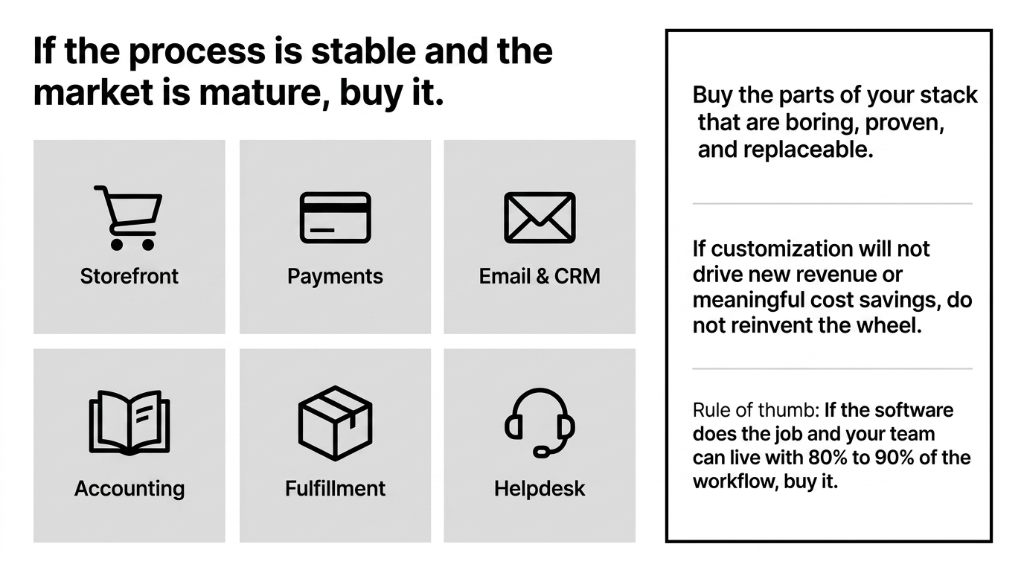
Buy the parts of your stack that are boring, proven, and replaceable. Storefronts, payments, email, CRM, accounting, shipping labels, and standard helpdesk workflows are commodity features. If hundreds of other brands already use a tool to solve the same problem, that is a hint. You do not need to fund a custom engineering project just to avoid a monthly software bill.
A common founder error is building because the current tool feels restrictive. But restriction is not always a bug; sometimes it is the cost of not needing to maintain a custom system. If customization will not drive new revenue or meaningful cost or time savings, do not waste time reinventing the wheel. In plain English, if the software does the job and your team can live with 80% to 90% of the workflow, buy it.
The Commodity Buy List
Checkout and storefront infrastructure (Shopify does this better than any custom dev team).
Accounting and finance basics (QuickBooks or Xero are industry standards).
Email and SMS sending (Klaviyo handles target segmentation without custom databases).
Returns, shipping, and fulfillment connectors (standard APIs exist for all major carriers).
Customer support ticketing (Gorgias or Zendesk organize issues out of the box).
What to Build
Build only where your business model truly differs. That means proprietary demand forecasting, custom bundling logic, special replenishment rules, margin-aware merchandising, or a customer experience that cannot be delivered by off-the-shelf software. If the capability changes conversion rate, stockout rate, repeat purchase rate, or average order value in a way your competitors cannot copy quickly, building may make sense.
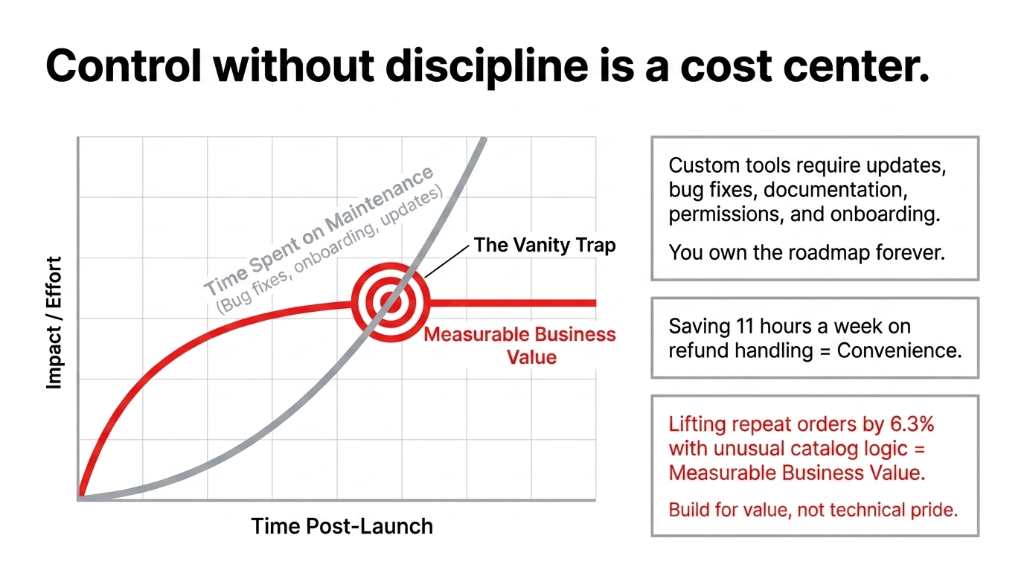
This is where founders get seduced by bad logic. They think "build" means control, but control without discipline becomes a cost center. A custom tool also needs updates, bug fixes, documentation, permissions, onboarding, and someone to own the thing when the original developer leaves. That is not software ownership; that is operational debt.
Ask One Hard Question
Is this a differentiator or just a convenience?
Convenience: A custom returns engine that saves 11 hours a week. *(Nice to have, but don't build it).*
Differentiator: A custom recommendation engine that lifts repeat orders by 6.3% because your catalog logic is unusual. *(Build it).*
The Hidden Middle
The middle is where most D2C brands actually live. You are not deciding between a completely custom platform and a single vendor. You are deciding how much of the stack should be bought, how much should be built, and how much should be connected through clean integration. That middle is where Shopify, ERP, 3PLs, subscription apps, support tools, and finance systems collide.
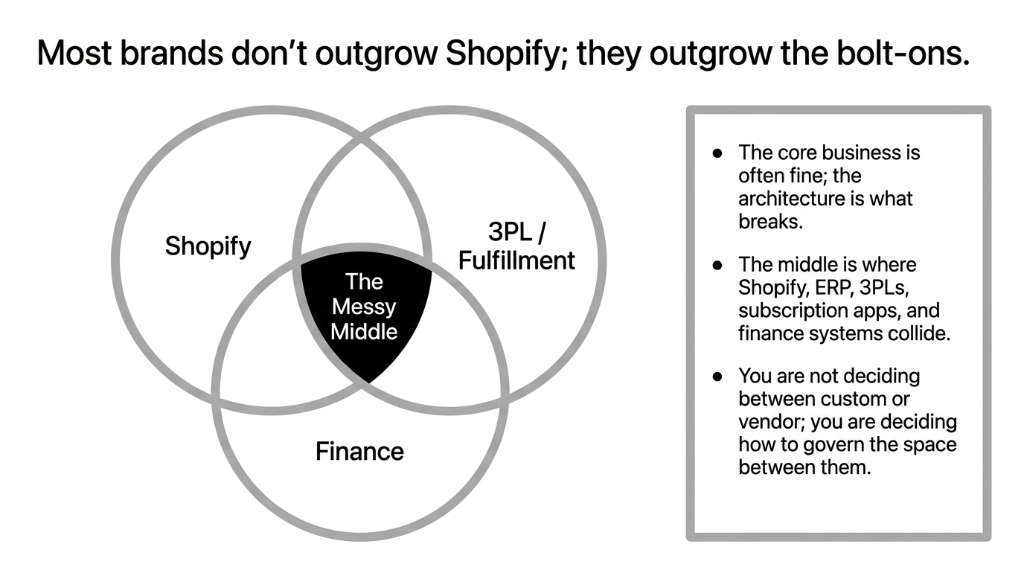
Most D2C brands do not outgrow Shopify itself; they outgrow the bolt-ons around it, like QuickBooks, a 3PL portal, a returns tool, and too many spreadsheets. That is the ugly truth. The business is often fine. The architecture is not. If your team is still moving CSV files across five systems, you do not have a tech strategy. You have a spreadsheet ritual.
The Build-vs-Buy Framework
Use this four-part test before you approve any custom software project:
The 4-Part Filter
1. Does this create meaningful differentiation? If yes, tilt toward build.
2. Is the process stable enough to justify software? If the workflow changes every month, do not write code yet.
3. Will the tool need constant maintenance? If yes, prepare to hire dedicated support.
4. Can a vendor solve 80% of this today? If yes, buy and adapt your process.
Timing also matters. Early-stage brands should bias hard toward buying because speed matters more than elegance. Mid-stage brands, especially the ones crossing messy operational thresholds, should start building around the margins only after the core systems are stable. Mature brands can justify more custom work because they have enough volume to spread the cost across real revenue.
Cost Is Not the Full Story
Founders love comparing license fees to engineering budgets. That is the wrong comparison. True cost includes implementation, training, downtime, integrations, vendor lock-in, support, and the opportunity cost of delayed launches. A cheap tool that causes 14 hours of manual reconciliation every week is not cheap.
Build also has a hidden tax: you own the roadmap forever. Every new warehouse, sales channel, market, or promo mechanic can require more development. Every unsupported edge case becomes your problem. Buying shifts some of that burden to the vendor, which is exactly why standard tools exist in the first place.
There is another financial trap: "temporary" workarounds that become permanent. A founder tells the team to patch the gap with Airtable, Zapier, and a few Google Sheets. Six months later, nobody knows which system is source of truth, and every month-end close turns into a fire drill. That is not a tech stack. That is debt with a dashboard.
Real D2C Examples
Here is how the decision plays out in real D2C scenarios. A balanced stack buys the commodities and builds only the custom logic that protects margins or boosts conversion.
| Function | Decision | Rationale |
|---|---|---|
| Storefront & Checkout | Buy (Shopify) | Security, scale, payment integrations are solved problems. |
| Lifecycle Marketing | Buy (Klaviyo) | Standard workflows and templates deliver speed in weeks. |
| Customer Helpdesk | Buy (Gorgias) | No need to write ticket sorting or channel routing logic. |
| Multi-Warehouse Routing | Build (Custom ERP logic) | Required if your inventory split or regional shipping rules are unique. |
| Margin-Aware Forecasting | Build (Custom prediction layer) | If bundles, promotions, and channel splits skew basic linear modeling. |
If you are scaling fast, the danger is not that you chose the wrong tool once. The danger is that you chose five tools that do not agree with each other. That is how a brand ends up with inventory discrepancies, wrong customer promises, delayed refunds, and reporting that nobody trusts.
The Implementation Reality
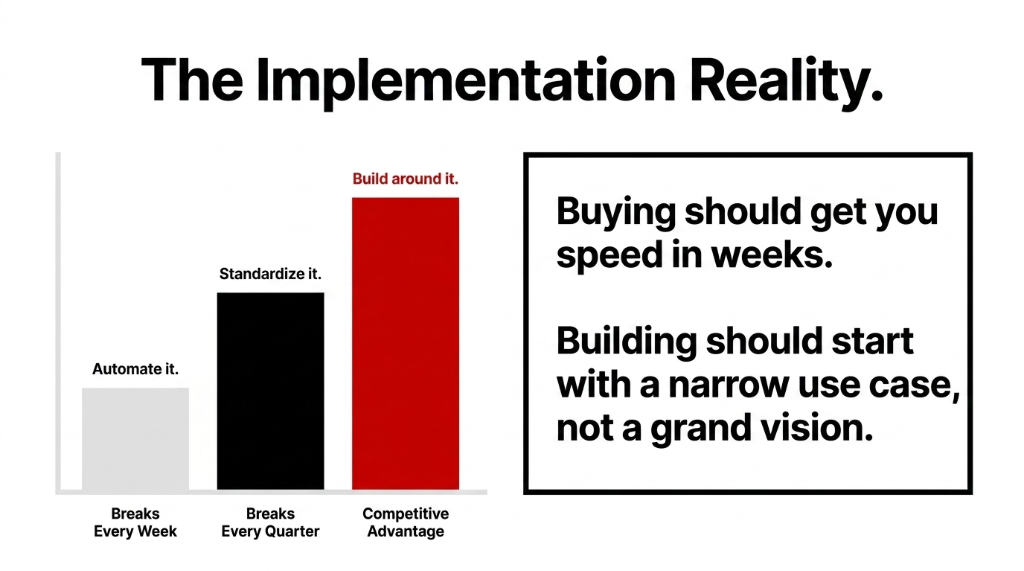
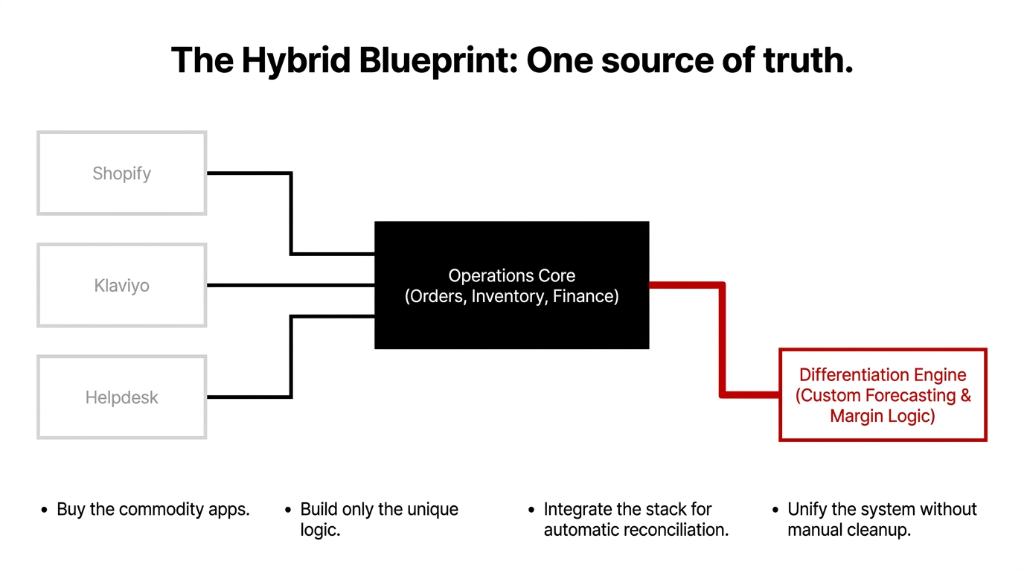
The best build-vs-buy decisions are boring in execution. Buying should get you speed in weeks, not quarters. Building should start with a narrow use case, not a grand platform vision. And hybrid systems should be designed around one source of truth for orders, inventory, and finance.
For D2C, that means the operating core should not live in a dozen disconnected apps. It should live in a system that can unify Shopify, fulfillment, accounting, and planning without constant manual cleanup. That is why many growing brands move toward ERP-style operational control once the bolt-ons start hurting more than they help. That is where an Odoo ERP integration keeps the team focused on execution instead of CSV updates.
The Operational Rule of Thumb:
If the process breaks every week: Automate it.
If it breaks every quarter: Standardize it.
If it is the source of competitive advantage: Build around it.
5 Questions Founders Ask About Build vs Buy
Should a D2C brand build or buy tech?
Buy the commodity parts and build only what creates true market differentiation. If a tool exists that solves 80% of your problem, buying it and adjusting your workflow is faster and cheaper than funding a custom software build.
When should a founder stop using spreadsheets?
The moment spreadsheets become the primary operating system for orders, inventory reconciliation, or payouts. When your team spends more time moving CSV files than planning growth, the stack has broken down.
Is custom software always more expensive?
upfront licenses may look higher, but custom software costs include ongoing maintenance, bug fixes, upgrades, and developer salaries. Over time, custom builds are almost always more expensive unless they directly open up revenue or massive cost savings.
What tech should D2C brands usually buy?
Buy storefront, checkout, payments, email marketing, helpdesk, basic shipping, and accounting systems. These are standard transactional problems with mature vendor markets and off-the-shelf integrations.
What is the biggest build-vs-buy mistake?
Building software out of developer pride or custom vanity rather than measurable business value. If your custom tool does not lift margins, cut stockouts, or boost customer retention, it is a cost center, not an asset.
Value Over Technical Pride
D2C founders should stop asking, "Can we build this?" Ask: "Does building this make us faster, more profitable, or harder to copy?" If the answer is no, buy it. If the answer is yes, build it carefully. If the answer is "sort of," integrate your existing stack and fix the operating model before you write a single line of custom code.
If your team is currently managing operations across 4 different sheets and a dozen custom Zapier scripts, you are paying a custom-maintenance tax every single day.
We design and deploy hybrid architectures that connect standard storefronts to unified operations cores. 15-minute call. No slide decks. Just technical clarity.
Book Your Free Tech Stack Audit