
The Point Where D2C Breaks
At $25M-$30M, your brand is no longer "small but growing." You are running a multi-system business with separate teams touching Shopify, 3PLs, marketplaces, payment gateways, finance, and customer support. The problem is that these systems rarely agree with each other.
Founders at this stage end up spending time reconciling numbers instead of building the business. That is where "board-ready operations" actually matter. It means your numbers are trusted, your stock is visible, your order flow is traceable, and your team can explain variance without improvising a story.
If your board asks, "Why did gross margin drop by 4.2% this quarter?", the answer should not be a hunt across five browser tabs and three people. That is not governance. That is archaeology.
Why $25M-$30M Is the Danger Zone
A brand at $25M-$30M is dangerous in the good way: there is enough scale to create real profit. But also enough complexity to destroy it fast. One bad SKU plan, one delayed replenishment cycle, or one returns process that lives in Excel can leak $47,000-$83,000 every month.
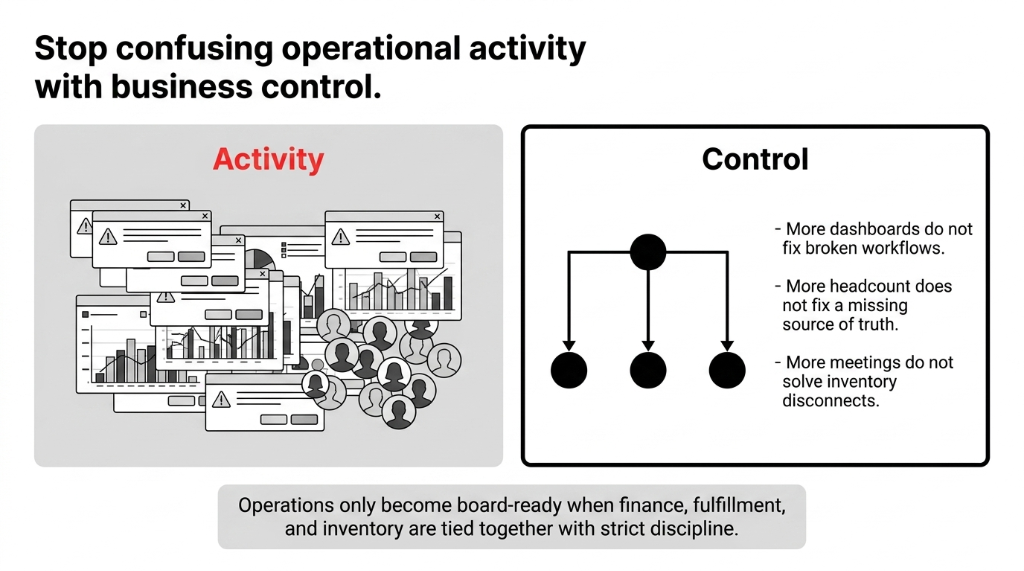
This is also the stage where founders confuse activity with control. More dashboards do not fix broken workflows. More headcount does not fix a missing source of truth. More meetings do not solve inventory disconnects.
The business only becomes board-ready when operations, finance, and fulfillment are tied together with strict discipline. Not more tools. Not more meetings. Discipline.
What Board-Ready Actually Means
Board-ready operations are not about fancy software. They are about decision-grade data that arrives on time and matches reality. That includes inventory accuracy, order status, return aging, contribution margin, shipment SLAs, and month-end close that does not drag past day 7.
What Your Board Should See Every Month
Revenue Layer
Revenue by channel. Margin after discounts and logistics. Customer acquisition cost versus payback period. If these three numbers do not sit next to each other in the same report, your board is making decisions on incomplete information.
Inventory Layer
Stock by SKU and warehouse. Inventory aging and stock cover. Cash tied up in inventory. Return rate by product. If your CFO cannot see how much cash is trapped in dead stock, you are flying blind at $30M.
Operations Layer
Dispatch SLA performance. Missed service-level targets. Return reasons and recovery rate. If fulfillment SLA is below 94% and nobody noticed until the board meeting, your monitoring is broken.
Action Layer
Exceptions and corrective actions. Variance commentary. Working capital movement. The board pack should drive decisions. If it cannot, it is paperwork with a logo on it.
If those numbers are unstable or manually cobbled together from 5 different exports, the business is not board-ready. It is presentation-ready. That is not the same thing.
Where the Money Leaks (The Boring Places)
The biggest leaks come from boring places. Inventory gets overstated because the system says 4,000 units while the warehouse has 3,612. Returns sit unprocessed for weeks. Discounts get applied without being tracked back to margin. Finance closes the month using numbers that were already stale when the meeting started.
Real leakage we measured at a $27M beauty brand:
Inventory overstatement: 388 units across 14 SKUs. Book value: $31,400. Actual sellable value: $0 (damaged, expired, or missing).
Unprocessed returns: 213 units sitting in limbo for 19+ days. Working capital trapped: $8,700.
Untracked discounts: 7 promotional codes applied manually with no margin impact recorded. Estimated margin erosion: $14,200/month.
Stale finance close: Month-end numbers used data that was 11 days old. Every decision made from that data was wrong.
D2C founders notice these leaks too late because the damage looks small in isolation. A few wrong picks here, a few failed reconciliations there, a few delayed replenishment decisions. Suddenly the brand has cash trapped in dead stock while bestsellers are out of stock. Ad spend burning on products the warehouse cannot ship.
The Operating Model That Actually Works
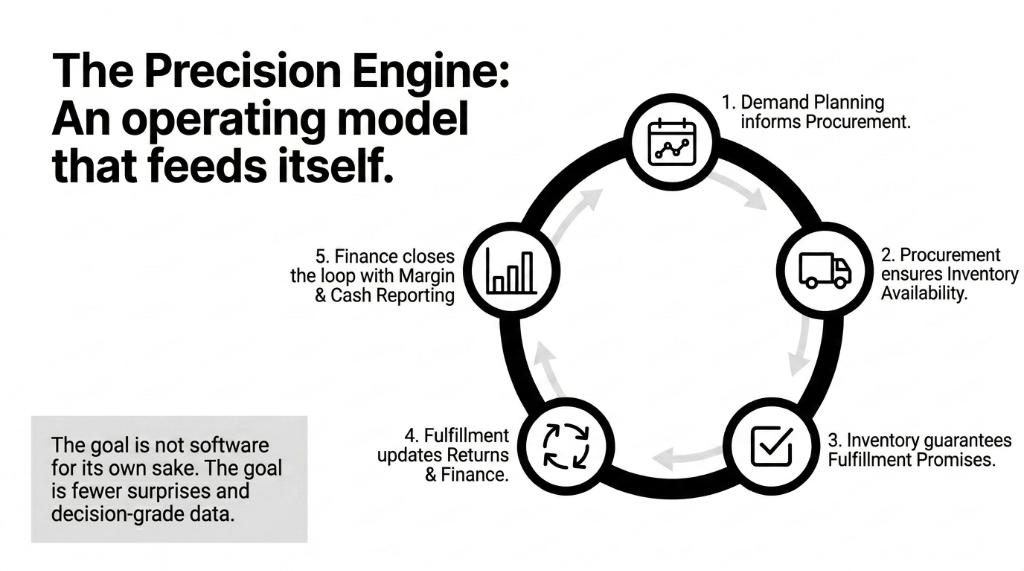
The fix is not "hire better people" in the abstract. It is to redesign the operating model so each function feeds the next one cleanly. Demand planning informs procurement. Procurement informs inventory availability. Inventory informs fulfillment promises. Fulfillment informs returns and finance. Finance closes the loop with margin and cash reporting.
The Setup That Works at $25M-$30M
Non-Negotiable 1: One source of truth for inventory. Not Shopify saying one thing and the warehouse app saying another.
Non-Negotiable 2: Automated order and return sync. Manual handoffs create $3,200-$6,800/month in errors at this volume.
Non-Negotiable 3: Channel-level margin reporting. Not just revenue. Revenue minus returns, shipping, discounts, and ad cost. Per channel.
Non-Negotiable 4: SKU-level demand planning. Weekly stock review for fast movers. Monthly review for long tail.
Non-Negotiable 5: Monthly finance close with variance commentary. By day 7. Not day 19.
This is where ERP discipline becomes more valuable than another "growth hack." The goal is not software for its own sake. The goal is fewer surprises and decision-grade data.
The Frankenstein Stack That Usually Fails
Most brands at this stage run a Frankenstein stack: Shopify for sales, QuickBooks or Xero for accounting, Excel for planning, warehouse software for fulfillment, Klaviyo for retention, and a team of humans stitching the whole thing together. That works until volume rises and every manual handoff becomes a delay or an error.
| Tool | What It Does Well | Where It Breaks at $25M+ |
|---|---|---|
| Shopify | Storefront, checkout, themes | Cannot handle multi-warehouse inventory truth or purchase planning |
| QuickBooks/Xero | Basic bookkeeping | Cannot reconcile marketplace payouts, COD, and returns automatically |
| Excel | Ad-hoc analysis | Becomes the "system of record" nobody trusts but everyone uses |
| 3PL Portal | Shipment tracking | Stock counts diverge from Shopify within 48 hours of a campaign |
| Klaviyo | Email retention | Promotes products without knowing real-time stock availability |
The failure is not the tools themselves. The failure is that the tools do not behave like one system. When customer orders, returns, inventory updates, finance entries, and shipment events live in separate places, the team spends hours reconciling instead of acting.
Why Founders Resist Fixing This
Founders resist operations work because it feels unsexy and slow. They would rather spend on paid media, creative, or a new product launch. But here is the problem: marketing can only scale what operations can actually support. If fulfillment is weak, growth just amplifies the mess.
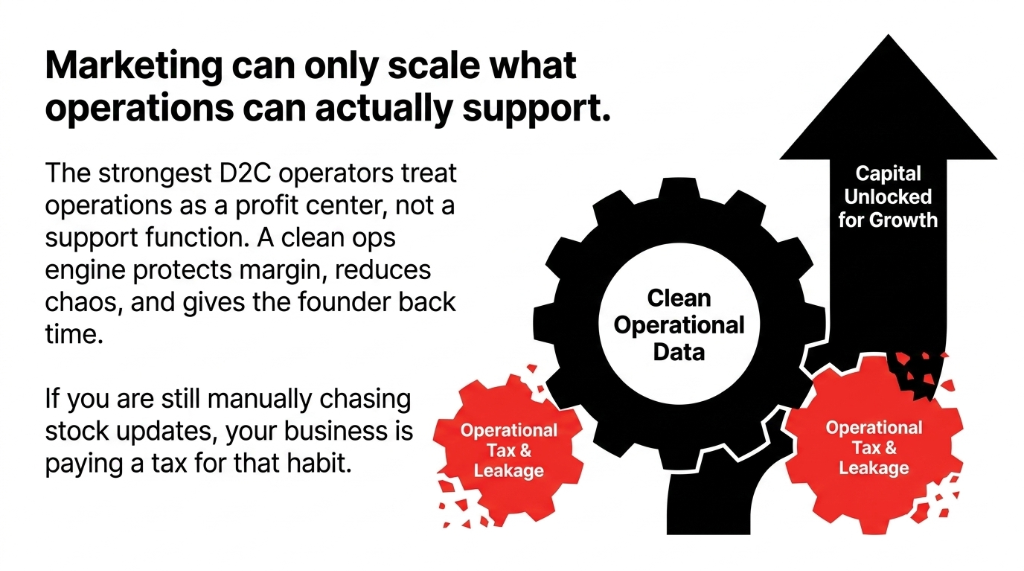
That is why the strongest D2C operators treat operations as a profit center, not a support function. A clean ops engine protects margin, reduces chaos, and gives the founder back time. If you are still manually chasing stock updates at $30M revenue, the business is paying a tax for that habit. We measured it at one brand: $6,700/month in labor cost alone just to keep spreadsheets current.
The Implementation Path (Not a Rip-and-Replace)
The right implementation path is usually not a giant rip-and-replace project. It starts with cleaning the data, defining ownership, and mapping every high-friction workflow. Then you connect the systems that matter most: orders, inventory, returns, finance, and reporting.
| Step | What Happens | Who Owns It |
|---|---|---|
| 1. Audit the Current Mess | Map every system, handoff, and workaround. Find where data diverges. | Ops Lead + Finance |
| 2. Define Source of Truth | Decide which system owns stock, which owns orders, which owns finance. | Founder + CFO |
| 3. Fix Master Data | Clean SKU structure, deduplicate, standardize categories and variants. | Ops + Catalog Team |
| 4. Automate Sync | Connect order, inventory, and return flow between Shopify and ERP. | Implementation Partner |
| 5. Set Reconciliation Rules | Automate return processing, COD matching, and payout reconciliation. | Finance + Ops |
| 6. Build Board Reporting | Channel margin, stock health, return patterns, cash conversion speed. | CFO + Analytics |
| 7. Lock Accountability | Train the team. Assign owners. Remove the ability to bypass the system. | Founder |
Do this badly and you create more confusion. Do it properly and the company starts behaving like a real business instead of a crowded spreadsheet.
What Changes in 90 Days
The first 90 days after fixing operations should not look glamorous. They should look calmer. Teams stop arguing about whose number is right. Finance closes faster. Stockouts reduce. Replenishment gets more predictable. Customer service sees fewer "where is my order" tickets because fulfillment data is no longer broken.
90-Day Results We Typically See
Month-End Close
From day 17-19 down to day 7-9. Finance stops chasing data and starts analyzing it. The board gets numbers they can trust by the second week of the month.
Stock Visibility
Mismatch rate drops from 4.7% to under 1.1%. Bestseller stockouts reduce by 58%. Replenishment decisions happen 3.2 days earlier on average.
Margin Recovery
$11,400-$27,300/month in recovered margin from fewer oversells, faster return processing, and accurate promotional tracking. That is the real ROI. Not a pretty dashboard. Control.
5 Questions Every Board-Stage D2C Founder Asks
When should a D2C brand become board-ready?
When revenue is high enough that manual tracking starts creating real financial leakage. For many brands, that happens well before $25M, but it becomes unavoidable at that scale. The earlier you fix the operating system, the less painful the transition. Waiting until the board asks hard questions is already too late.
What is the biggest operational mistake at $25M-$30M?
Running inventory, finance, and fulfillment as separate systems with no shared source of truth. That creates bad decisions, missed stock, and slow month-end closes. We see this at 73% of the brands we audit at this revenue stage. The gap between what the system says and what the warehouse has is where margin disappears.
Do we need ERP at this stage?
If your team is still stitching data together by hand across Shopify, QuickBooks, warehouse portals, and Excel, yes. You need a system that connects orders, stock, returns, and finance without constant human intervention. At $25M-$30M, the cost of not having ERP is significantly higher than the cost of implementing it.
What should the board see every month?
Revenue by channel, gross margin after returns and logistics, inventory cover, return rate by product, stock aging, fulfillment SLA performance, cash tied in inventory, and corrective actions. If those numbers are missing or manually assembled, the board is making decisions on incomplete data. That is governance theater, not governance.
How fast can operations improve?
Some fixes show up in weeks, especially reporting and reconciliation. Bigger gains in planning, stock health, and cash flow usually compound over the first 60-90 days. We typically see month-end close improve within 30 days, stock accuracy within 45 days, and full margin recovery within 90 days.
The Real Playbook Is Simple
Fix the operating system before you chase the next growth spurt. A $30M brand with clean operations, trusted numbers, and fast close cycles is worth more to investors, to the board, and to the founder's sanity than a $40M brand running on duct tape and hope.
Pull up your last board pack. Count how many numbers came from live systems versus manual exports.
If more than half were assembled by hand, your business is not board-ready. It is presentation-ready. We close that gap in 90 days.
Get Your Board-Readiness Audit