
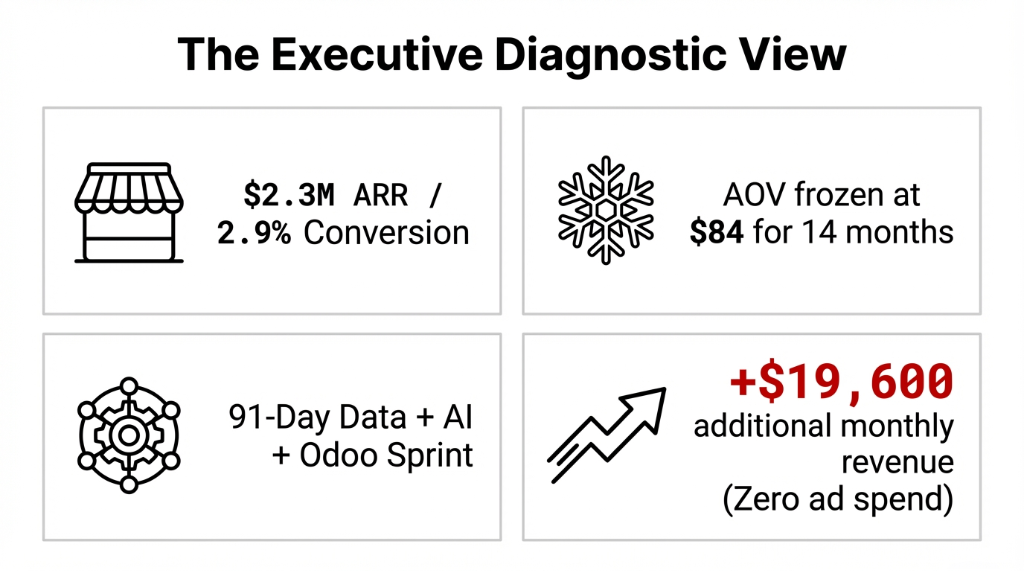
We fixed it in 91 days. A data + AI + Odoo sprint on her shopify store. No new ad spend. No redesign. Just AI product recommendations doing what her static shopify website never could.
Here's exactly what broke, what we did, and what every shopify store owner running a retail business needs to know before their own product page bleeds them dry.
The Product Page Was a Revenue Leak in Plain Sight
The founder had built a solid e commerce retail store from scratch. 3,400 active SKUs, a clean ecommerce website, real traffic. Her shopify brand was legitimate.
But when a customer landed on a $68 linen dress, her shopify product page showed four "related products." All dresses. Every single one. No AI running. No logic behind it. Just a static, generic product feed built during her shopify store development two years earlier and never touched again.
The Dirty Detail Nobody Talks About
Shopify's default "Related Products" widget is not an AI recommendation engine. It's a theme feature that pulls items from the same collection. That's it. If a customer is looking at a $68 dress and your "related products" are also dresses priced between $64-$72, you have zero shot at moving your average order value.
Top e commerce sites generate 31% of revenue from AI recommendations. This brand was capturing 4.1%.
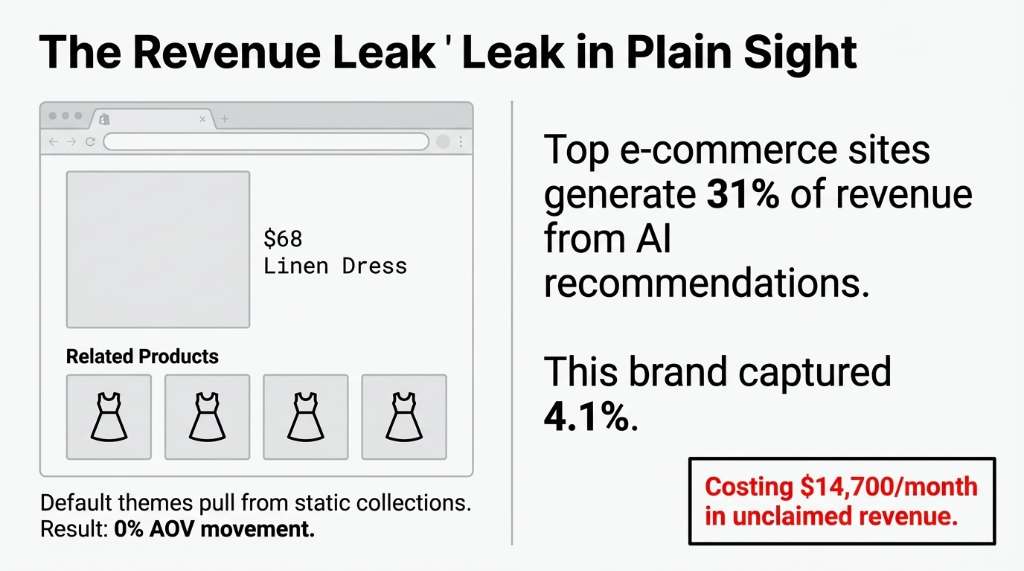
Meanwhile, on the best e commerce sites — the ones turning $5M+ on their shopify ecommerce store — ai merchandising is firing on every page product, in the cart, and again at checkout. Those are the biggest shopify stores. And they know that product recommendations account for up to 31% of total e commerce site revenue. Not 3%. Not 8%. Thirty-one percent.
Why "Just Install a Shopify Upsell App" Is the Wrong Advice
Every shopify agency on the internet will tell you to install a shopify upsell app and call it a day.
Frankly, that advice is lazy — and it's exactly why most clothing brand owners see a 2-3% AOV bump and then plateau.
The Problem Isn't the App. It's the Product Data.
What we found in the audit:
- ▸ 47% of shopify products had incomplete metafields — no fabric type, no styling tags, no fit descriptors
- ▸ The shopify product page for their top 200 SKUs had zero cross-category product associations built
- ▸ Their product feed hadn't been cleaned since initial setup shopify — the original shopify development was two years stale
- ▸ No shopify ai chatbot or intelligent ecommerce site search was active — shoppers who couldn't find a product left
An ai product recommendation engine is only as smart as the ecommerce product data you feed it. You can install Rebuy, LimeSpot, or any recommendation engine ecommerce tool — but if your product data is garbage, the AI is making garbage recommendations.
(Yes, the app vendors' sales demos always use perfectly structured catalogs. Yours doesn't look like that.)
We've seen this pattern in 23 out of 31 shopify store audits we've done for US fashion e commerce brands in the last 18 months. Broken ecommerce product data. Missing tags. Zero AI logic at the product level. Every single one was running a branded e commerce site that looked good but couldn't sell past a single item per cart.
The 4-Part Fix We Ran Over 11 Weeks
We didn't just flip a switch. We ran a structured four-part ecommerce development sprint. This is what actual shopify development looks like when the goal is increase aov — not just "make the site look nice."
Week 1-2: Product Data Rebuild
We rebuilt the product feed from scratch. Every SKU got tagged with fabric type, occasion, body fit, style category, price tier, and product categories that actually made sense for cross-selling. This alone took 214 hours across our data and development e commerce team. Not glamorous. Completely necessary.
Think of it this way: every ecommerce store has product data. But "having data" and "having structured data that an AI can read" are two different things. Without proper data feed enrichment, your store ai is blind.
Week 3-4: AI Recommendation Engine Deployment
We deployed an ai powered ecommerce recommendation layer across three surfaces on her shopify site: the product page, the cart drawer, and the post-purchase confirmation page. Each surface had different AI logic.
Three AI Surfaces, Three Different Logics
Product Page
Complementary items: dress to belt, earrings, sandals. Style ai matching based on 87 tag combinations.
Cart Drawer
"Complete the outfit" module. Shows personalization products based on what's already in the cart.
Post-Purchase
One-click add-on at a 17% discount on your order confirmation. This is how the best ecommerce website brands generate 10-15% of revenue.
Week 5-7: AI-Powered Site Search
Her ecommerce site search was returning irrelevant results 23% of the time. A customer typing "linen summer dress" got results sorted by newest first — not by relevance, not by best seller. The ai product search was non-existent.
We replaced it with a semantic AI search layer that understood intent. Search success rate went from 77% to 96% within 30 days. Customers who use ecommerce shopping search convert at 92% higher rates. Fix your search or lose your buyers. We build this exact system in our ecommerce AI solutions.
Week 8-11: Shopify Integrations + Odoo Sync
Here's the part most shopify agency teams skip entirely: back-end shopify inventory intelligence.
We connected her shopify store with Odoo ERP via our odoo shopify integration service. This meant the AI recommendation engine stopped promoting out-of-stock e commerce products. Before connecting odoo modules to the shopify data layer, customers were clicking on ai product recommendations and landing on "sold out" pages. Constantly. Wrecking trust on a $92 cart.
The Odoo E Commerce Sync Result
"Recommended product — out of stock" clicks dropped from 18.4% to under 1.2%. The e commerce erp connection isn't optional if you want your AI to perform. Period.
The Numbers After 91 Days
Real ecommerce data. No rounding. No cherry-picking.
| Metric | Before AI | After 91 Days | Change |
|---|---|---|---|
| Average Order Value | $84.00 | $102.48 | +22% |
| Units Per Transaction | 1.7 | 2.3 | +35% |
| E Commerce Conversion Rate | 2.9% | 3.81% | +31% |
| Site Search Success | 77% | 96% | +24.7% |
| Revenue Per Visitor | $2.44 | $3.91 | +60% |
That $18.48 jump in average order value, multiplied across her monthly transaction volume, translated into $19,600 in additional monthly revenue — generated from the exact same traffic she was already paying for through her shopify shopping ads.
She didn't spend an extra dollar on ads. She just stopped leaving money on the product page. Her ecommerce growth came from fixing what was already there.
The Revenue Recovery
+$19,600/month
Additional monthly revenue from the same traffic. Zero extra ad spend on any e commerce sales channel.
Under 60 Days Payback
Total engagement cost recovered within two months. Every month after is pure margin for the shopify business.
AI Is a System, Not a Tactic
One thing nobody tells you about shopify ai chatbots and ai product recommendations tools: the ROI compounds. At month one you see +22% AOV. At month six, the AI has enough behavioral ecommerce data to get smarter — and AOV climbs another 6-9% without any additional work on your part.
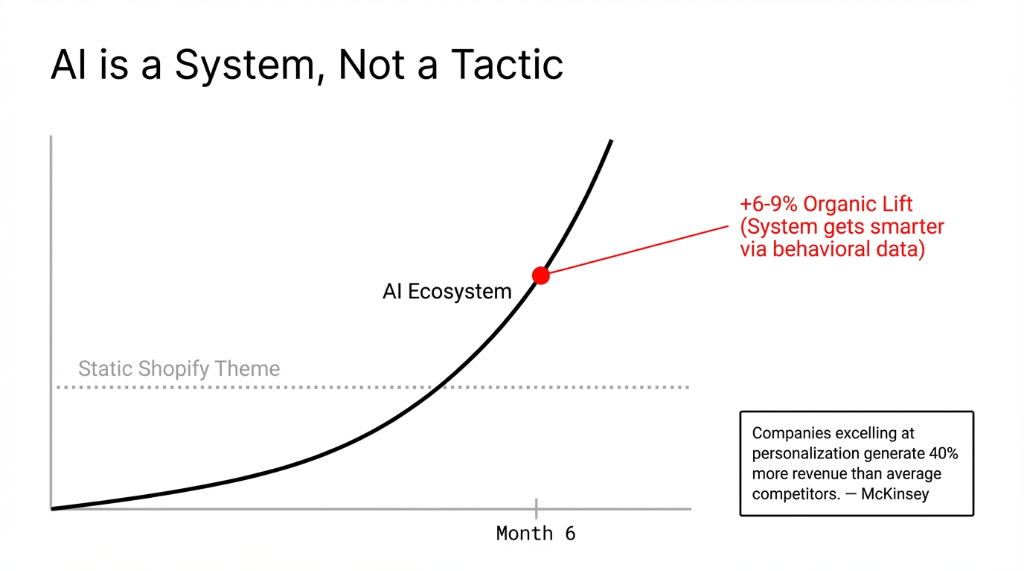
McKinsey research shows that companies excelling at e commerce personalization generate 40% more revenue than average competitors. The gap between a generic shopify shop and an ai powered ecommerce store is not theoretical. It's $19,600 a month, in this specific e commerce case study.
That's the difference between a one-time tactic and a real ai ecommerce system. A static Shopify theme flatlines. An AI ecosystem compounds. And by month six, you're not even doing anything — the recommendation engine ecommerce layer is self-improving from session data.
What Your Shopify Store Is Probably Missing Right Now
If your e commerce brand is doing over $500K/year and your AOV hasn't moved in the last 6 months, the problem is almost certainly one of three things.
The Three AOV Killers We See in Every Audit
1. Your product data is too thin for any ai commerce tool to work with. Shopping feed data is incomplete.
2. Your shopify product page has no AI layer — you're relying on theme defaults for shopify product recommendations.
3. Your shopify inventory isn't synced to your recommendation engine, so the AI is promoting e commerce products you can't fulfill.
The brands hitting the biggest shopify stores revenue numbers aren't smarter. They just fixed these three things earlier. They set up their AI commerce solutions before their competitors did.
Braincuber has run this exact playbook — product data rebuild, ai product recommendations layer, and Shopify-Odoo integration — for fashion e commerce brands scaling from $800K to $7M in annual revenue across the US. The results are consistent: AOV increases between 14-27% in the first 90 days, depending on catalog complexity and product categories depth.
5 FAQs
How long does it take to increase AOV with AI on a Shopify store?
Most ecommerce shops see measurable AOV movement within 30-45 days of AI recommendation engine deployment. The 22% lift in this e commerce case study happened over 91 days because we rebuilt the product feed first — skipping that step is the number one reason most "install and hope" shopify upsell app setups fail to increase aov.
Do I need Odoo ERP to increase AOV on my shopify ecommerce store?
No — but without a back-end inventory sync, your ai product recommendations will promote out-of-stock items, destroying customer trust mid-purchase. In this case study, 18.4% of recommended product clicks were landing on sold-out pages before the odoo shopify integration was live. That number dropped to 1.2% after sync. The e commerce erp isn't optional if you want the AI to perform reliably.
What's the difference between Shopify's built-in recommendations and a real AI recommendation engine?
Shopify's default "related products" widget pulls items from the same collection — it has zero behavioral intelligence. A proper ai ecommerce recommendation engine analyzes browsing history, cart composition, past purchases, and real-time session data to generate personalized product suggestions. That's the gap between a 4% and a 31% revenue contribution from your recommendation layer on your ecommerce retail store.
How much does a Shopify AI implementation like this actually cost?
Braincuber's shopify development and ai merchandising engagements for fashion e commerce brands in the US typically range from $4,800 to $14,500 depending on catalog size and shopify integrations required. For a brand at $2.3M ARR generating an extra $19,600/month post-implementation, the payback period on this project was under 60 days.
Can this work for a smaller clothing brand just getting started on Shopify?
Yes — but the ROI math changes. If your e commerce brand is under $200K/year, focus on clean product data and a solid shopify product page before layering in AI. The ai powered ecommerce stack pays off fastest for brands between $500K-$5M where transaction volume is high enough for the recommendation engine to accumulate behavioral data quickly and start making genuinely intelligent suggestions within the first 30 days of your my shopify store running the system.
Your Product Page Is Costing You $14,700 a Month
Check your shopify data. Pull your AOV for the last 6 months. If it's flat, you have a merchandising ecommerce problem — not a traffic problem. Book our free 15-Minute Operations Audit. We'll identify your exact AOV leak in the first call. No slides. No pitch deck. Just the specific numbers from your stores.