
Most project delays do not begin with poor effort. They begin when the wrong task reaches the wrong person at the wrong time, and nobody notices until deadlines slip.
That is why smart task assignment matters so much inside Odoo. The odoo software Project module already supports task stages, subtasks, recurring tasks, dependencies, planning, timesheets, profitability, and customer ratings—which means the platform already holds the operational signals an AI layer can use to recommend the next best owner for a task. Odoo’s Field Service side also supports service tracking, real-time updates, time logging, inventory usage, document signing, and invoicing from one interface, so assignment logic can continue beyond office work into on-site execution.
Several Odoo ecosystem previews for version 19 describe AI assistants, prompt-based server actions, predictive models, and automated task assignment based on task content and employee profiles—showing how ai integration is moving closer to everyday work inside odoo erp software.
The $8,700/Month Problem Nobody Calls a “Project Management” Problem
A lot of companies buy task management software expecting better visibility, but visibility alone does not create momentum. A board can show every overdue item in red and still fail if nobody knows which assignee has the right skills, the right workload, the right customer context, and the right timing.
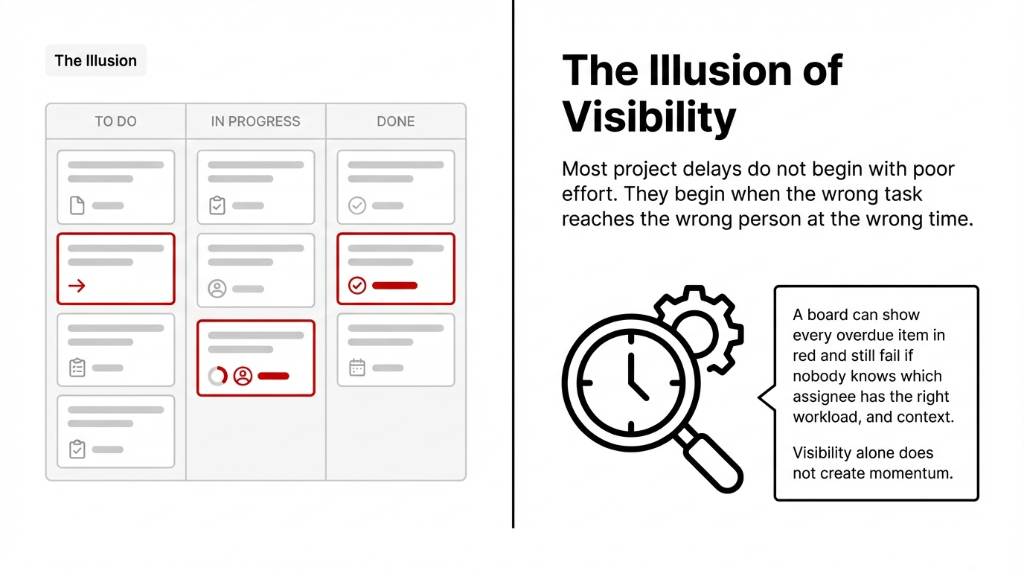
This is where ai for project management changes the conversation. Instead of using Odoo only as a project management system, businesses can use project management ai to study workload, past delivery patterns, skill fit, customer urgency, project planning needs, and task prioritization rules. Ai help turns task management into guided execution.
For US companies, this matters because work no longer happens in one room. Sales, operations, delivery, support, HR, and field service often run across time zones and job types. One team may live in the office, another in the warehouse, and another in a service van. When the work force is distributed like that, work management breaks down fast if managers rely only on instinct.
Why “Just Add More Dashboards” Doesn’t Work
Companies are not asking for flashy demos anymore. They are asking whether ai for business can improve employee productivity, reduce reassignment, shorten response time, and support better ai decision making without turning leaders into full-time spreadsheet detectives.
That is where ai and business becomes practical: less guessing, more data driven action.
How Smart Assignment in Odoo Actually Works
Smart assignment in Odoo should never mean random automation ai. It should mean intelligent ai that studies the signals your company already creates and then recommends or triggers the best next owner based on rules you control.
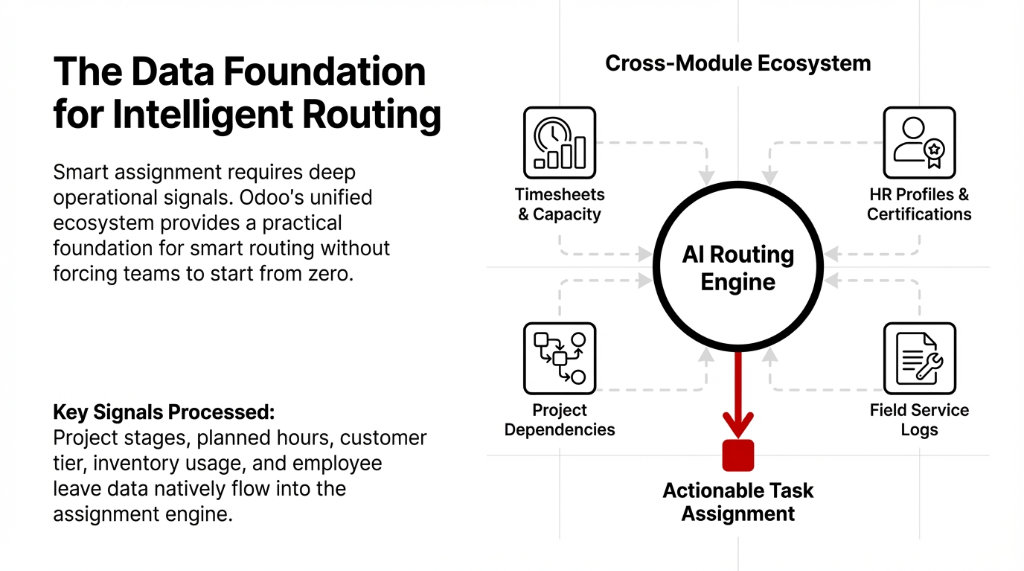
A strong setup usually starts with five layers of logic:
The 5 Layers of Smart Task Assignment
▸ Layer 1: Skill Fit
Match task type, tags, department, certifications, and prior task success rate. Stop sending integration work to generalists.
▸ Layer 2: Capacity Fit
Check allocated hours, open workload, due dates, and current backlog. No more overloading your best people while others sit idle.
▸ Layer 3: Context Fit
Read project stage, dependencies, priority, customer tier, and SLA urgency. A premium client’s ticket gets treated differently.
▸ Layer 4: Business Fit
Look at profitability, geography, field service needs, or account ownership. Route by what matters to the business, not just the backlog.
▸ Layer 5: Learning Fit
Improve recommendations over time from outcomes, reassignment patterns, and completion speed. The system gets smarter every sprint, not just at configuration.
Because odoo erp already supports project stages, subtasks, dependencies, planning, and timesheet tracking, it gives a practical foundation for smart routing rather than forcing teams to start from zero. If your operation includes field service management, Odoo can also connect assignments to mobile execution, time logs, inventory use, signatures, and invoicing—which is especially valuable for workforce management and field service management systems in the USA.
Now imagine how this feels in real work. A new implementation ticket enters odoo erp. The system reads the client type, delivery date, product mix, service location, and project development phase. Then an ai project management tool scores likely owners using ai data from skills, calendars, employee data, and historical delivery outcomes. The project manager does not lose control; the manager gains a recommendation with a reason.
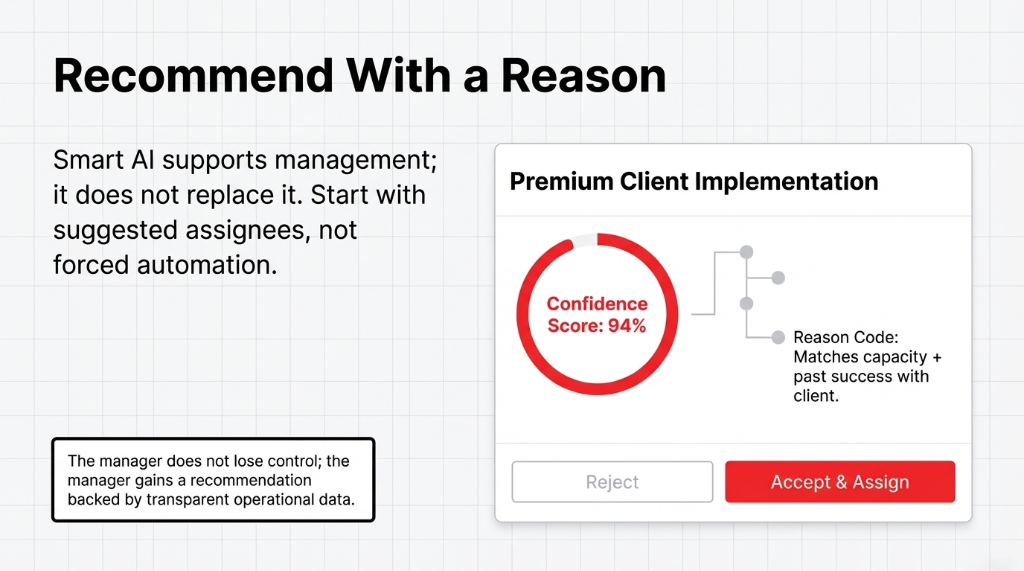
That is the best form of smart ai. It supports ai in management instead of replacing management. It gives ai for management a clear job: help humans decide faster and better.
For many companies, the smartest design is not full ai automation on day one. Start with suggested assignees, not forced assignees. Let managers accept, edit, or reject the recommendation. That approach builds trust, improves AI models with feedback, and makes ai and management feel like collaboration rather than surveillance.
Should You Wait for Perfect Native AI?
This also answers a common question in any odoo review: should companies wait for perfect native AI, or can they start now? The practical answer is to start with the data and workflows you already control. Odoo 19 previews describe assistants, predictive models, and AI-driven server actions—but the real advantage comes from combining those ideas with your own operating rules, service structure, and odoo support strategy.
Start now. Clean your data. Let the models learn. Don’t wait for perfection.
A USA Story: 120 Employees, One Broken Assignment Loop
Picture a mid-sized US service company with 120 employees. It sells equipment, runs installations, handles maintenance, and manages customer support. On paper, it already has odoo erp, solid process management, and a capable leadership team. In practice, it has chaos between departments.
Sales closes a deal and creates a project. Operations builds the timeline. A project manager reviews skills manually. HR checks availability in another system. Field teams wait for dispatch. Support teams work from email. Finance wants accurate timesheets. Everyone is busy, but teams work in fragments.
The company first tried traditional task management systems. It added more dashboards, more color codes, more project tracking views, and a heavier meeting routine. Nothing changed much. Why? Because task management for teams was still reactive. People were managing work after confusion appeared, not before.
So the company rebuilt assignment logic inside Odoo around one idea: every new task should have a recommended owner, a backup owner, a due-date confidence score, and a reason code. The system began to evaluate work type, region, certifications, open capacity, customer importance, past resolution speed, and whether the task touched field service or back-office delivery.
What Changed After Smart Assignment
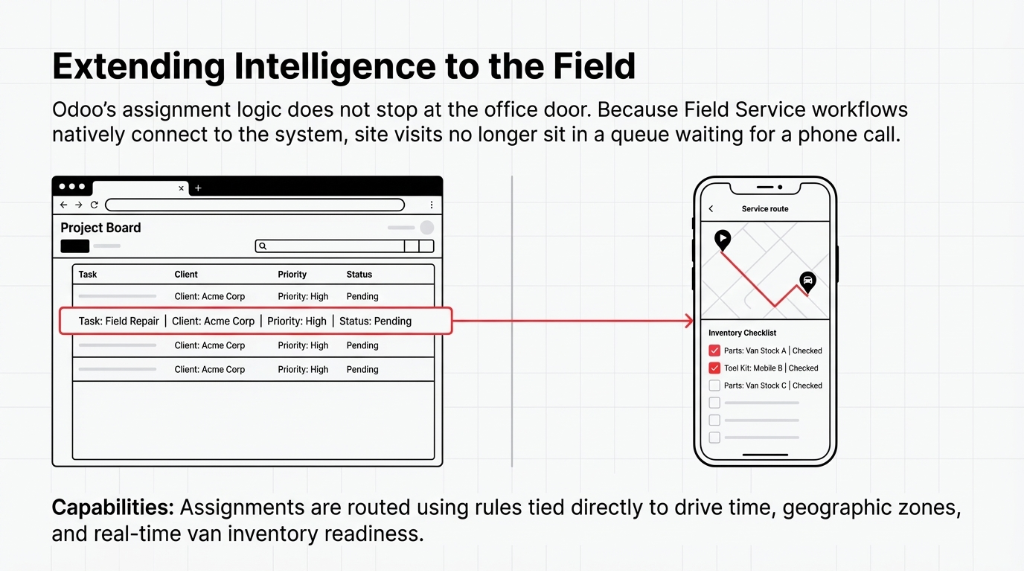
A support issue from a premium client in Texas no longer went to whoever was online. It went to the person with the strongest resolution history for that product and enough capacity that week. An implementation task with heavy integration work no longer landed with a generalist—it went to a specialist in project management in IT. A site visit no longer sat in a queue waiting for a phone call.
Extended Connections
▸ Connected hr ai signals for leave, availability, and staffing plans
▸ Linked learning management systems so certification status affected task routing
▸ Learning management stopped being separate from execution—became part of workforce management systems
This is where ai in organizations becomes powerful. Good ai for companies does not just move tickets around. It connects the whole operating model: project management teams, teams management, workforce management, ai workforce planning, and even hr and ai policies around fairness. It supports ai in businesses without making them feel mechanical.
| Benefit | Before Smart Assignment | After Smart Assignment |
|---|---|---|
| First assignment speed | Manager starts from blank slate | AI-scored recommendation in seconds |
| Task prioritization | Gut feeling + color codes | Scored in context: SLA, tier, dependency |
| Employee productivity | Skilled people on mismatch work | Right skill, right workload, right task |
| Staff management | Overload invisible until burnout | Overload flagged before it compounds |
| Customer response | Field + office in separate worlds | Unified routing across all work types |
But the deeper win is cultural. Instead of spending every morning asking who should own what, leaders start asking whether the rules are still right. That is a healthier use of management attention. It moves the company from manual dispatch to ai decision making, from reactive coordination to data and ai enabled execution.
Make It Stick: The Rollout That Works for US Firms
The biggest mistake in ai software development for operations is trying to make the model smarter than the business. If your stages are messy, timesheets are inconsistent, employee records are outdated, and project planning is optional, then even the best ai company or ai service companies will struggle. Clean operating data comes first.
▸ Define Assignment Rules by Type
Implementation, support, it project management, field service, internal work, and escalation work. Each type gets different routing logic.
▸ Standardize Odoo Data
Task types, tags, priority levels, planned hours, regions, skills, and dependencies. Your AI is only as good as the data you feed it.
▸ Connect People Data Carefully
Availability, role, certifications, employee data, and approved capacity. Use only business-relevant signals.
▸ Add Explainability + Governance
Every recommendation shows why the match was chosen. Access controls, privacy alignment, ai compliance checks, and audit history. Do not let an AI profile become a black box.
The Governance Piece That Matters
When companies deploy ai in the workforce, they need clear limits on what data is used and why. Use only business-relevant signals. Do not create hidden rankings. Do not let an ai employee profile become a black box that affects careers without review. Good ai and hr practice is about fairness, visibility, and human override.
This is also where buyers should evaluate vendors carefully. Some ai software development companies sell generic copilots. Others offer deeper ai services, ai solutions for business, or ai software development services tied to ERP workflows. The right partner should understand odoo erp, ai erp, odoo support, management systems, and the reality of running project management teams in live operations.
The Real Goal
The goal is not to prove that ai work exists. The goal is to make ai work valuable. That means fewer handoffs, better utilization, stronger project planning, better project and management control, and a calmer day for every project manager.
Whether you call it ai management, erp ai, or ai tools for project management—the winning design is the same: let the machine do the sorting so the people can do the work that matters.
Smart task assignment is bigger than one feature. It is the bridge between AI solutions and real execution. It is where ai for business, ai and data, and ai for companies stop sounding theoretical and start helping real teams business leaders run better delivery through your Odoo implementation and ERP integration.
Frequently Asked Questions
What is smart task assignment?
It is the use of rules plus AI to recommend or assign work based on skills, workload, urgency, and context—replacing the guesswork that causes most project delays in US businesses running distributed teams.
Is Odoo a good fit for smart task assignment?
Yes. Odoo already includes project features like stages, subtasks, planning, dependencies, and timesheets, which creates a strong base for smarter assignment workflows. The unified data architecture means AI has the signals it needs without third-party integrations.
Does smart task assignment help field teams too?
Yes. Odoo Field Service supports scheduling, time logging, inventory use, signatures, and invoicing, so smart assignment extends to field service and workforce management—routing by drive time, geographic zones, and van inventory readiness.
Do companies need full automation first?
No. Most teams start with recommendations, approvals, and feedback loops before moving into deeper automation ai. Start with suggested assignees, not forced assignees—let managers accept, edit, or reject. That builds trust and improves AI models with real feedback.
What is the real payoff of AI task assignment?
Better task management, faster project tracking, stronger employee productivity, and more reliable project delivery for growing US businesses. Teams typically see faster first-assignment times and fewer reassignments within 60 days of activation.
Your Team Isn’t Underperforming. Your Assignment Logic Is.
Book our free 15-Minute Operations Audit—we will map your current task routing gaps and show you exactly where smart assignment would recover capacity in week one.
Book Your Free 15-Minute Operations AuditOpen your project board right now. If you can’t explain why each task is with the person it’s with—call us.