
Your production line failed a quality check at 2:47 PM on a Tuesday. You found out at 9:00 AM on Wednesday — after 1,400 defective units had already shipped to your top 3 retail clients in Texas, Ohio, and Georgia. That’s not a one-off. That’s how reactive quality control works inside 73% of mid-size US manufacturers still running disconnected ERP and inspection systems.
The cost? A $38,700 recall, a $9,200 expedited rework order, and one client who never came back.
We’ve implemented AI for Odoo Manufacturing across 150+ brands globally, and the story above is almost word-for-word what we hear in the first 10 minutes of every discovery call. The good news: predictive quality control inside Odoo — powered by AI and machine learning — eliminates exactly this failure mode. The bad news: most manufacturers don’t know it exists, and their Odoo partner never told them.
The $47,000 Defect Problem Nobody Is Measuring
According to McKinsey, unplanned manufacturing downtime costs US manufacturers an estimated $50 billion annually across all sectors. That’s your scrap bin, your rework floor, your warranty claims, and your field service truck. AI in manufacturing research shows scrap rate reductions of 20–50% once predictive systems are deployed — with the average US manufacturer hitting 35% scrap reduction within the first 9 months.
Your current QC system is a lagging indicator.
Your inspectors find problems after the damage is done. They check 5% of units at end-of-line. They rely on manual measurements and handwritten logs. Your Odoo instance has the data to predict these failures 48–72 hours before they happen — but without an embedded AI system, that data just sits in a database doing nothing.
We worked with a $6.4M/year automotive parts supplier in Michigan. Their Odoo 17 setup had complete production data — machine sensor readings, work order timestamps, BOM deviations — all logged. But no AI analytics layer to interpret it. They were catching defect clusters 2–3 batches too late, losing $14,200 in rework costs every single month. That’s $170,400 a year. For a problem that was 100% visible in their own system.
Why "More Inspectors" Is the Wrong Answer
Here’s a controversial opinion most operations consultants won’t say out loud: hiring additional QC staff to solve a detection problem is how you turn a $14,000/month issue into a $22,000/month issue.
Manual inspection accuracy plateaus at around 72–80% even with well-trained operators. AI-driven systems achieve up to 90% defect detection accuracy — and they don’t get fatigued on the night shift or misread a micrometer at 11 PM. More importantly, intelligent automation catches the type of defects human eyes physically cannot: micro-fractures under surface coatings, sub-millimeter dimensional variances, and early-stage tooling wear patterns that show up as statistical noise before they show up as actual defects.
Gartner predicts that by 2025, over 50% of manufacturing companies will have integrated AI into their quality control processes, resulting in a 30% improvement in defect detection rates. The companies in the bottom 50%? They’re still running Excel-based inspection logs and wondering why their margins are eroding at 3.7% annually.
How AI Inside Odoo Manufacturing Actually Works
Odoo 18’s Manufacturing module ships with native Quality Control Points (QCPs) that allow you to set inspection triggers at any production stage. That foundation is solid. But QCPs alone are reactive — they tell you when to check, not what you’re about to find.
The AI and ML layer we build on top of Odoo does three specific things:
The 3-Layer AI Architecture
Sensor Data Correlation via Odoo IoT + AI Models
We connect Odoo’s IoT module to your PLCs, temperature sensors, vibration detectors, and pressure gauges. The AI model (TensorFlow or AWS SageMaker) continuously reads values against historical baselines. When the vibration signature on CNC machine #4 trends 12% above normal — before it produces a single bad part — the system auto-schedules maintenance.
Production Variable Pattern Recognition
AI watches 40+ variables simultaneously across your Bills of Materials and Work Center logs inside Odoo — humidity, material batch variance, operator shift patterns, die wear cycles. When a combination that has historically preceded quality failure starts forming, you get a proactive alert.
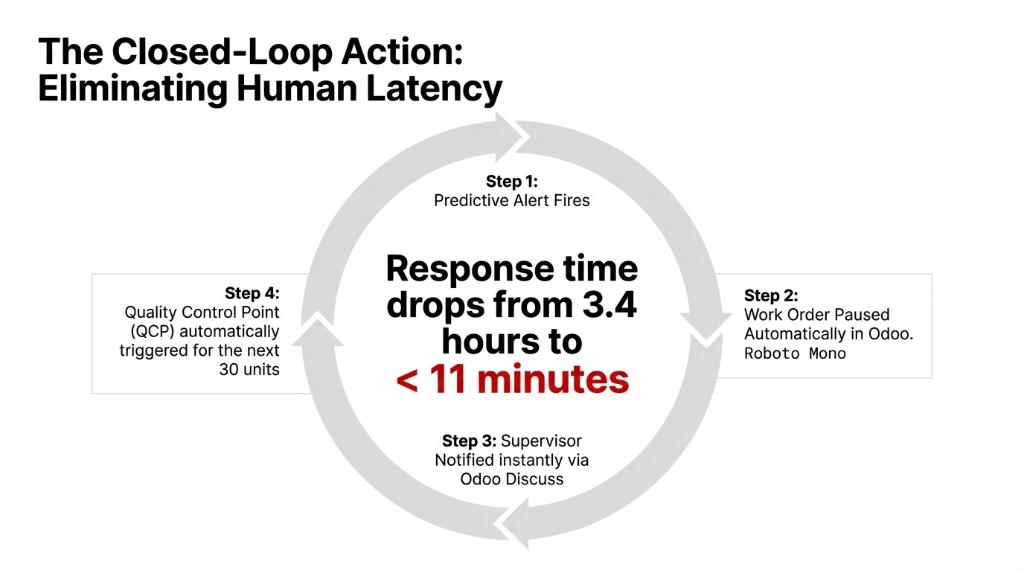
Closed-Loop Corrective Action Inside Odoo
When a quality alert fires, Odoo’s workflow engine automatically pauses the affected work order, notifies the floor supervisor via Odoo Discuss, triggers a QCP for the next 30 units, and logs a corrective action record — all without a human clicking anything.
Real Numbers From Real Odoo Manufacturing Deployments
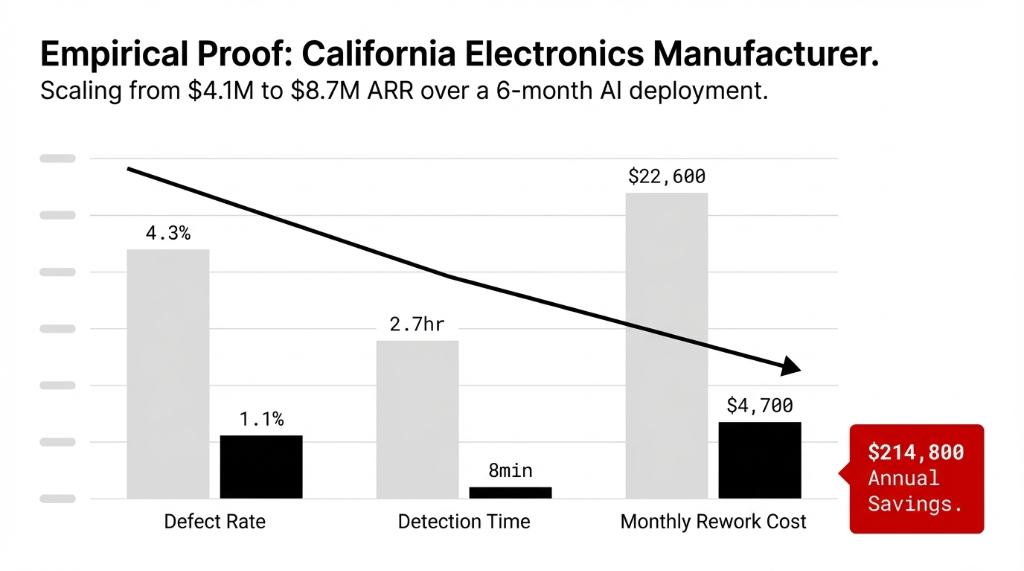
We implemented this stack for a consumer electronics manufacturer in California scaling from $4.1M to $8.7M ARR.
| Metric | Before AI | After AI (6 months) |
|---|---|---|
| End-of-line defect rate | 4.3% | 1.1% |
| Average detection time | 2.7 hours | 8 minutes |
| Monthly rework cost | $22,600 | $4,700 |
| Customer return rate | 2.1% | 0.4% |
One focused AI deployment inside their existing Odoo instance
$214,800
Annual savings. Implementation: 11 weeks. A fraction of what NetSuite charges for licensing alone.
The broader AI in manufacturing data backs this up. AI implementation improves product quality by up to 35%, and manufacturers using artificial intelligence report production throughput increases of 20% with the same physical headcount. The AI in supply chain and production floor aren’t separate conversations anymore — they’re the same conversation, and Odoo is the platform where they converge.
What "Go-Live" Actually Looks Like
11-Week Deployment Timeline
Weeks 1–3 — Odoo Audit + IoT Sensor Mapping
Identify highest-defect production lines, map existing QCPs, connect IoT feeds. Your team does not stop production for a single day.
Weeks 4–7 — AI Model Training
Training on your historical Odoo production data — work orders, quality check logs, maintenance records, BOM deviations. The AI model needs your data, not generic industry data.
Weeks 8–9 — Parallel Run
AI alerts fire alongside your existing QC process. Your team validates them. In our last 12 US deployments, AI alerts showed an average 87.4% true positive rate in this phase.
Weeks 10–11 — Full Switchover
Automated workflows active. Training for floor supervisors and QC leads. (Yes, the training takes 4 hours, not 4 weeks.)
Week 12+ — Monthly Refinement
AI learns from every new quality event. Detection accuracy compounds over time.
Where Most US Manufacturers Are Right Now
35% of manufacturers are already using AI technologies — mostly in predictive maintenance and quality control. The global AI in manufacturing market hits $34.18 billion in 2025 and is projected to reach $155.04 billion by 2030 at a 35.3% CAGR.
The manufacturers still "evaluating options" are now $214,800 behind the ones who acted. And if your current Odoo partner hasn’t had a single conversation with you about embedding AI tools into your manufacturing module, that’s a gap you should address this week — not next quarter.
Frequently Asked Questions
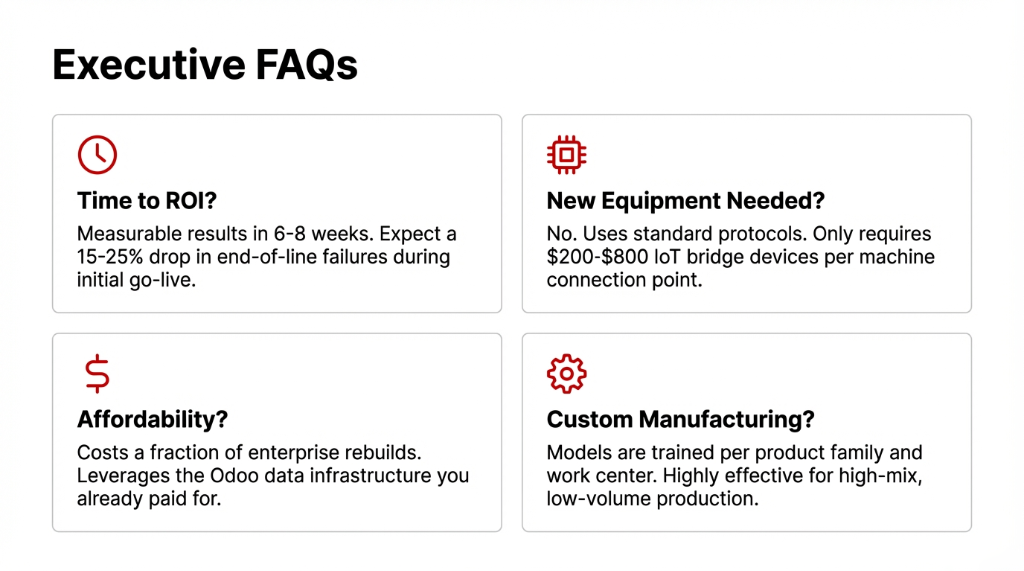
How long does AI predictive quality control in Odoo take to show measurable results?
Most manufacturers see measurable defect rate reductions within 6–8 weeks of the AI model going live — typically a 15–25% drop in end-of-line failures. Full ROI on the implementation usually lands between months 4 and 7, depending on production volume and existing data quality inside Odoo.
Does AI for Odoo Manufacturing require replacing existing shop floor equipment?
No. Odoo’s IoT module connects to your existing PLCs, sensors, and machines via standard protocols. In most deployments, zero new equipment purchases are required — only IoT bridge devices costing $200–$800 per machine connection point.
What’s the difference between AI predictive QC and Odoo’s built-in QC module?
Odoo’s native Quality Control Points are trigger-based and reactive — they tell operators when to inspect. AI predictive quality control adds a forecasting layer that analyzes production variables in real time and alerts the team before a defect-producing condition materializes. Fire alarm vs. smoke detector installed 3 rooms from the source.
Can small and mid-size US manufacturers actually afford this?
Yes. Unlike standalone platforms starting at $150,000+ in implementation costs, AI layers built inside existing Odoo instances cost a fraction. For manufacturers already on Odoo, the data infrastructure is already in place — the AI model is the incremental investment, not a full-stack rebuild.
How does AI handle multi-product or custom manufacturing?
AI models in Odoo are trained per product family and per work center, not as a one-size-fits-all algorithm. For custom or job-shop manufacturers, the model trains on order-specific parameters from BOMs and work orders, making it effective even in high-mix, low-volume production environments.