
You are running four AI tools in your enterprise right now. One handles customer support tickets. Another does demand forecasting. A third processes invoices. A fourth generates marketing copy. None of them share context. None of them hand off tasks to each other. Your developers are writing glue code every three weeks just to keep them from stepping on each other.
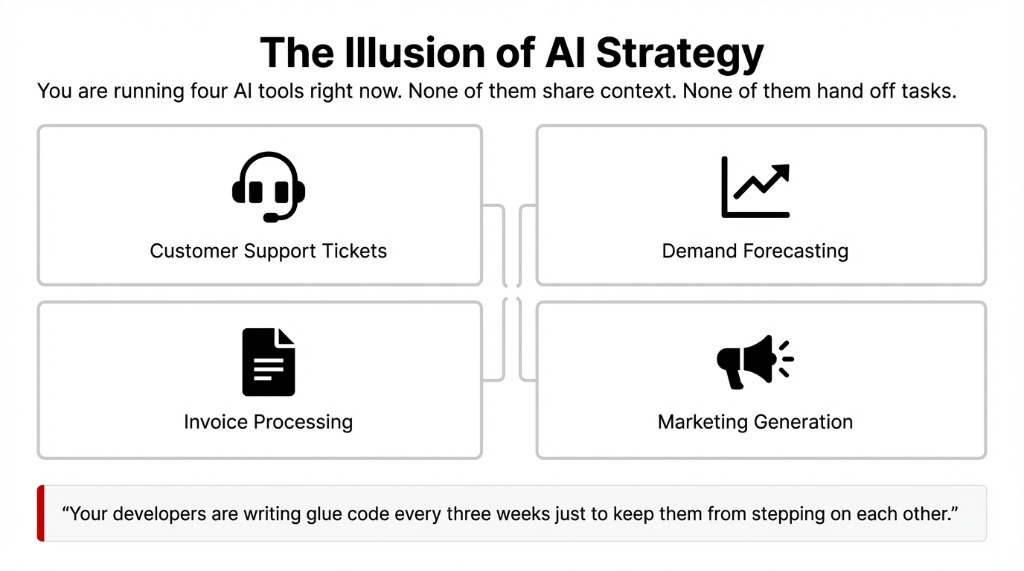
That fragmentation is costing you. Badly.
In our work building AI systems for enterprises across the US and UAE, we see this repeatedly: companies investing $150,000+ in AI tooling, then hemorrhaging $31,000/month in wasted compute, duplicated data pipelines, and manual oversight — because nobody built an orchestration layer.
The AI models exist. The intelligence exists. The ability to coordinate them does not.
Why Running Isolated AI Models Breaks at Scale
Here is the ugly truth most AI vendors will not tell you: a single AI model, no matter how good, cannot handle the complexity of a real enterprise workflow alone.
GPT-4 cannot simultaneously pull your CRM data, check inventory in real time, generate a personalized response, and log the interaction to Salesforce in one shot. That takes four different systems working together — a natural language model, a data retrieval agent, an API connector, and a logging module. Each has a different job. Each needs precise instructions about when to run, what to pass forward, and when to stop.
What Happens Without Orchestration
Stale Data Responses
A customer support AI answers a refund question using outdated inventory data because the data-fetch agent ran 47 minutes ago and nobody set a refresh trigger.
Lost Alerts
A document processing model flags a contract clause for legal review, but the alert disappears into a Slack channel nobody monitors at 2 AM.
Doubled Token Costs
Two LLMs run simultaneously on the same query, doubling your token costs. We have seen this add $8,300/month in unnecessary OpenAI bills for a mid-sized SaaS company.
Over 78% of enterprises deployed AI agents in 2024, but fewer than 30% had a centralized orchestration layer managing them
What AI Orchestration Actually Does (Not the Brochure Version)
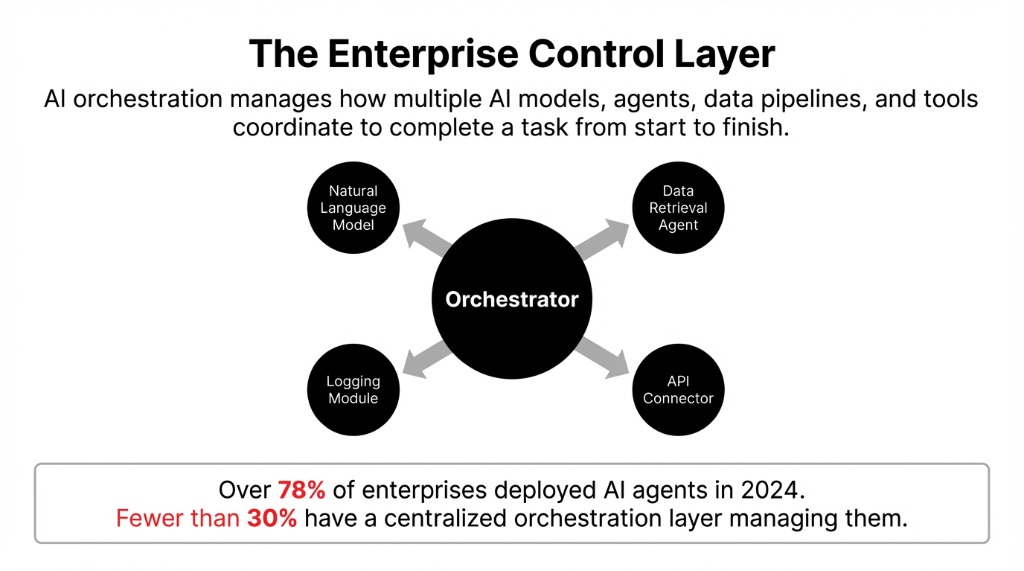
AI orchestration is the control layer that manages how multiple AI models, agents, data pipelines, and tools coordinate to complete a task from start to finish.
Think of it this way: if your AI models are specialized workers, orchestration is the operations manager who assigns tasks, tracks progress, handles exceptions, and ensures the right information reaches the right worker at the right moment. Without that manager, every worker is guessing.
The Five Jobs of a Proper Orchestration Layer
▸ Routes tasks to the correct model — a lightweight model for simple classification, a more powerful one for reasoning-heavy decisions, a specialized one for domain-specific work
▸ Manages context passing — so when Agent B picks up where Agent A left off, it has the full history, not a blank slate
▸ Enforces execution order — preventing two agents from writing to the same database record simultaneously (the kind of bug that corrupts $200k+ worth of enterprise data quietly)
▸ Handles failures gracefully — if the invoice-parsing agent times out, the orchestrator retries, escalates, or reroutes instead of silently failing
▸ Provides observability — full logs of what every agent did, when, and why (critical for regulatory compliance in BFSI, healthcare, and legal sectors)
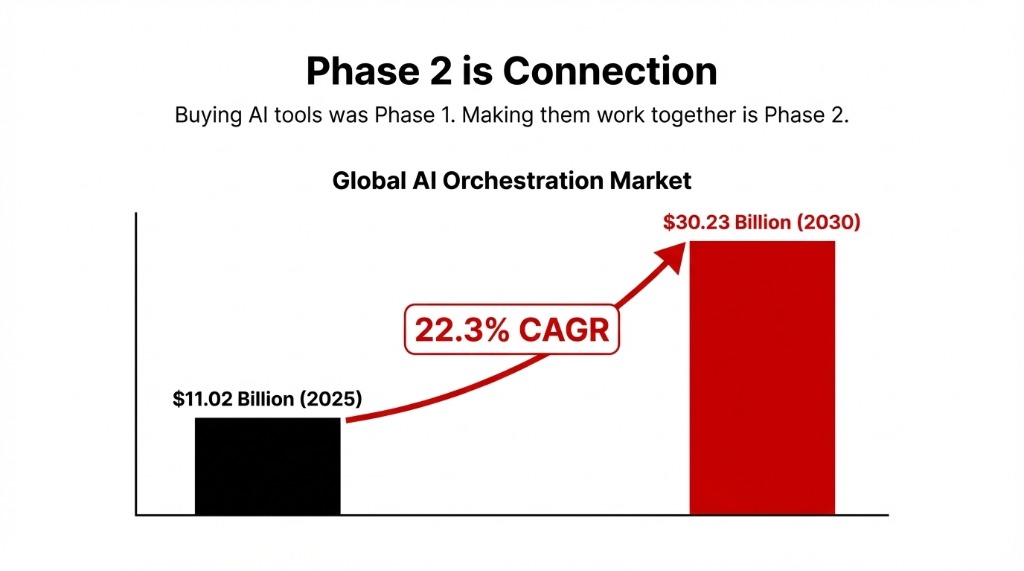
The global AI orchestration market sat at $11.02 billion in 2025 and is projected to hit $30.23 billion by 2030 — a 22.3% CAGR. That growth is not hype. It is enterprises finally realizing that buying AI tools was Phase 1, and making them actually work together is Phase 2.
The Frameworks Doing the Heavy Lifting
We get asked constantly: “Which orchestration tool should we use?” The honest answer is: it depends on your stack, your team, and how much control you need.
| Framework | Best For | Key Advantage |
|---|---|---|
| LangChain / LangGraph | Stateful, multi-step workflows with memory | 3–5x faster deployment, 60–80% less manual data engineering. Used in fraud detection pipelines combining transaction, risk, and compliance agents. |
| CrewAI | Role-based multi-agent collaboration | Assign each agent a role (researcher, writer, validator). Handles context handoffs and progress tracking without manual glue code. |
| Microsoft AutoGen | Research-heavy, developer-centric environments | Modular, asynchronous, decentralized agent framework. Not the easiest to deploy in production without engineering resources. |
| Workato | Non-technical teams, low-code/no-code | Combines traditional automation with AI agent orchestration. Connects cloud and on-premise enterprise tools. |
The Controversial Opinion Nobody Wants to Say
Most companies should not build their own orchestration layer from scratch. We see startups spending 6+ months building custom orchestration infrastructure using raw Python and Redis queues — only to realize that LangGraph solved 73% of their problem in week one.
That is $180,000 in engineering salary building something that already exists.
Where AI Orchestration Delivers the Most Measurable ROI
We have deployed AI orchestration across manufacturing, D2C e-commerce, healthcare admin, and financial services. The areas where companies see real dollar returns fastest:
Customer Support AI
Setup: Multi-agent system — intake agent, intent classifier, response generator, escalation router. Cuts average resolution time from 14 minutes to under 3 minutes per ticket.
For a company handling 4,000 tickets/month, that is $18,500/month recovered in support team capacity.
Document Processing
Setup: Orchestrating an OCR model, an NLP extraction agent, a validation agent, and an ERP sync module together. Processes invoices in 38 seconds instead of 7 minutes each.
At 600 invoices/month, finance teams get back 67 hours — previously spent on manual entry and error correction.
Enterprise AI Testing and Supply Chain
Testing: One AI model generates test cases, another executes them, a third validates outputs. Reduces QA cycles by 41% in software teams we have worked with.
Supply Chain and Forecasting
Multi-model orchestration combining demand forecasting + supplier risk + inventory optimization has helped mid-market manufacturers cut overstock costs by $47,000/year.
North America leads enterprise AI orchestration adoption, driven by banking, healthcare, and telecommunications sectors.
The Governance Problem Nobody Is Talking About
Here is something that will not show up in the AI orchestration sales pitch: multi-agent systems can write back to your databases autonomously, and if your orchestration layer has no guardrails, that is a compliance and data integrity disaster waiting to happen.
The $62,000 Cleanup We Witnessed
An agentic AI system auto-updated 1,200 customer records with incorrect billing codes because the orchestrator did not have a human-in-the-loop checkpoint before write operations. The cleanup took 3 weeks and cost $62,000 in manual audit work.
If your current orchestration setup does not have these controls, you are not running enterprise AI — you are running an experiment with production data.
Enterprise-Grade Orchestration Must Include
▸ Role-based access control (RBAC) so agents can only touch what they are authorized to touch
▸ Audit trails for every agent action (mandatory in HIPAA, SOC 2, and GDPR environments)
▸ Just-in-time (JIT) approvals for high-risk operations
▸ Policy enforcement engines that flag deviations in real time
Platforms like Kubiya handle this natively with embedded policy engines, SSO, and zero-trust security.
Building Your First AI Orchestration Layer: Where to Start
We tell every client the same thing: do not start by orchestrating 12 agents. Start with two.
Pick your highest-volume, most repetitive workflow — customer support intake or invoice processing are usually the easiest wins. Identify the two models or tools currently handling pieces of that workflow in isolation. Connect them with a lightweight orchestration framework like LangChain. Add a logging layer. Measure time-to-completion before and after.
The Numbers That Matter
Companies that start narrow and instrument properly see 31–44% efficiency gains in the first 90 days. Companies that try to orchestrate their entire AI stack at once are still debugging 8 months later.
The AI agents market hit $5.4 billion in 2024 and is on track to reach $47 billion by 2030. The enterprises winning are not the ones with the most AI tools — they are the ones that connected their AI tools into a single, observable, governed system.
That system is AI orchestration. And if you do not have one, someone in your competitive set already does. Your AI development partner should be building this from day one — not retrofitting it after your agents have already corrupted production data. Check your cloud infrastructure while you’re at it — orchestration runs on top of it.
The Challenge
Count how many AI tools your company is running right now. Can any of them pass context to another? Can any of them trigger the next step in a workflow without a human copying and pasting between dashboards?
If the answer is no, you are paying for AI. You are not getting AI.
Frequently Asked Questions
What is AI orchestration in simple terms?
The control layer that manages how multiple AI models, agents, and tools work together to complete a task. It routes tasks, passes context between agents, handles failures, and ensures every step executes in the right order — like an operations manager for your AI stack.
What is the difference between AI orchestration and AI automation?
AI automation executes a fixed, rule-based task. AI orchestration coordinates multiple AI models dynamically, making real-time decisions about which model runs next based on context and outcomes. Orchestration is what makes automation intelligent rather than just fast.
Which AI orchestration frameworks are most used?
LangChain and LangGraph for stateful multi-step workflows (3–5x faster deployment). CrewAI for role-based multi-agent collaboration. Microsoft AutoGen for research-heavy environments. Workato for non-technical teams needing low-code orchestration.
How much does an AI orchestration layer cost?
Open-source frameworks like LangChain and CrewAI are free but require engineering time. Commercial platforms range from $2,000 to $25,000/month. Most mid-market companies recoup implementation costs within 60–90 days through operational savings.
Is AI orchestration only for large enterprises?
No. Mid-market companies handling 500+ customer interactions/month, processing 300+ documents/month, or running more than two AI tools simultaneously have a clear ROI case. The break-even point is typically around $800,000 in annual revenue.