
The Multi-Channel Mess Nobody Tells You About
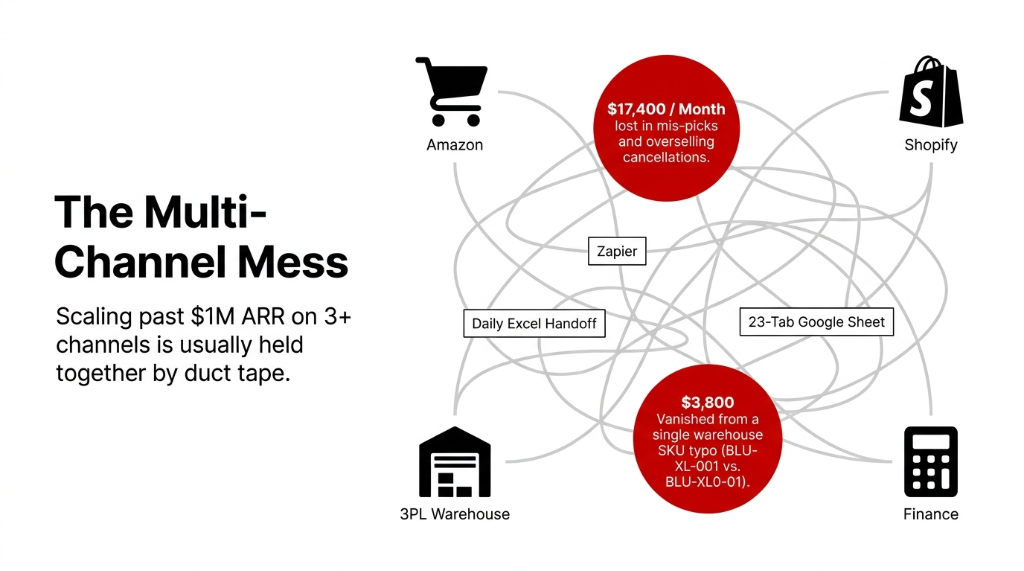
Here is the ugly truth: most brands scaling past $1M ARR across 3+ channels are running on duct tape.
They have Shopify syncing to Amazon via a half-broken Zapier flow. Their 3PL gets emailed a daily pick list (in Excel). And their finance team is reconciling payouts from 4 marketplaces inside a Google Sheet with 23 tabs.
The $3,800 SKU Typo Problem
When your warehouse manager types the wrong SKU — say BLU-XL-001 instead of BLU-XLO-01 — you just lost track of $3,800 worth of stock. Not "some inventory." $3,800. Gone from visibility until the next physical count.
Both Vinculum and Odoo exist to kill this chaos. But they kill it in very different ways — and picking the wrong one for your stage will cost you 6 months and $40,000+ in wasted implementation and re-migration costs.
What Vinculum Actually Does (And Who It Is Built For)
Vinculum is purpose-built for one thing: multi-channel and omnichannel order orchestration at scale.
It connects to 150+ sales channels natively — Amazon, Flipkart, Noon, Zalando, SHEIN, TikTok Shop — and aggregates all orders into a single pane. It then routes fulfillment intelligently: nearest warehouse, highest stock, lowest shipping cost. No manual intervention. No Excel handoffs.
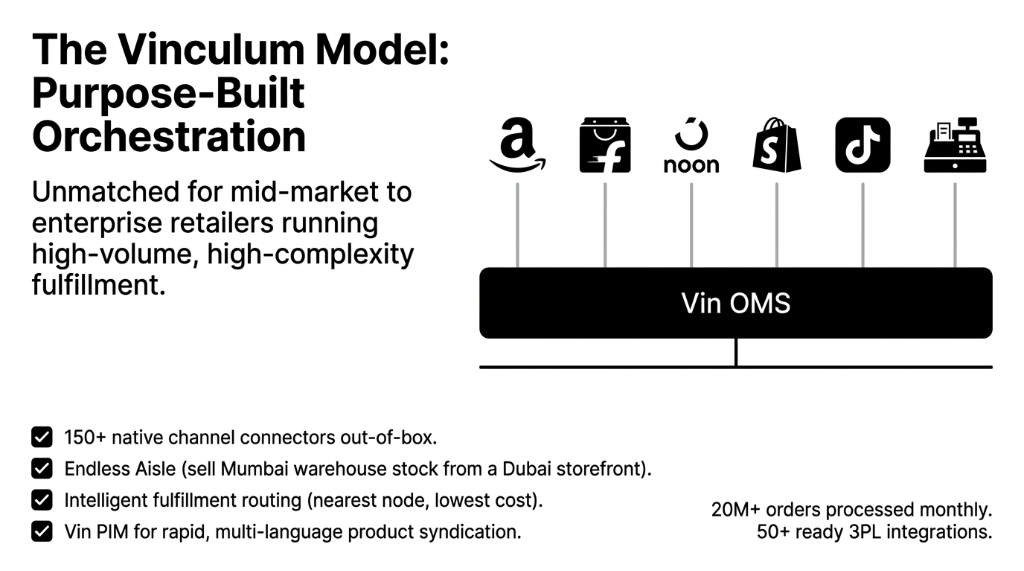
Their Vin OMS is genuinely strong for mid-market to enterprise retailers who already have warehouses, 3PL partners, and physical stores running simultaneously. If you are a fashion brand selling across India, UAE, and Southeast Asia through 8 channels with 3 fulfillment nodes — Vinculum was built for you.
What Vinculum Actually Delivers
1. Centralized order aggregation across all digital and physical channels in real time
2. Endless Aisle functionality — your store associate can sell a product from your Mumbai warehouse while standing in a Dubai store
3. Returns orchestration across any channel with loyalty point reconciliation
4. Vin PIM for syndicating product content to 150+ channels without manually reformatting attributes
The numbers: 20M+ orders processed monthly, 1,000+ brands, 50+ ready 3PL integrations. That is not marketing fluff — their infrastructure is genuinely designed for high-volume, high-complexity operations.
The Catch No Vinculum Salesperson Will Mention
Vinculum does not give you accounting, HR, CRM, procurement, or manufacturing. It is a specialist tool. You are still going to need a separate ERP running alongside it — which means you are paying for two systems, two integrations, and two support contracts. That "middleware tax" adds $600–$1,400/month in developer retainer fees alone.
What Odoo Actually Does for Multi-Channel (The Part That Surprises People)
Odoo surprises people here. Most brands think Odoo is "just an ERP." It is not.
With the right configuration — or with a partner like us at Braincuber who has done this across 150+ implementations — Odoo becomes your full-stack multi-channel command center. Orders from Amazon, eBay, Shopify, WooCommerce, and your own Odoo eCommerce site all consolidate into a single inventory pool. Every sale on one channel auto-updates stock across all others in real time. No Zapier. No API patches.
At Odoo Experience 2025, AdlerDo demonstrated exactly this: Odoo as a central multi-channel e-commerce and EDI control center, centralizing product, order, and inventory management across Amazon, eBay, Kaufland, and more — while automating VAT logic, shipping rules, and product mapping without third-party middleware.
What Odoo Gives You That Vinculum Never Will
Integrated Accounting
Multi-channel revenue, COGS, and payouts reconcile inside the same system that processes orders. No more Sunday reconciliation marathons in Tally.
CRM + Customer Data
Every buyer across every channel exists as one record. No data silos. No WhatsApp group serving as your CRM.
Manufacturing + Procurement
If you make what you sell, Odoo connects demand signals from your 5 channels directly to your production schedule. Vinculum cannot do this without a separate ERP.
Automated Stock Replenishment
When SKU X drops below 47 units across Shopify + Amazon, Odoo fires a PO to your supplier automatically. Zero human intervention.
In our last 23 multi-channel Odoo implementations, we consistently found that brands moving from a Vinculum + separate ERP setup to a unified Odoo instance cut their monthly software and integration spend by $2,300–$4,100. Not because Odoo is "cheap" — it is not, if configured properly — but because you are paying for one system instead of two.
The Head-to-Head: Where Each Tool Wins and Loses
| Dimension | Vinculum | Odoo (with Braincuber) |
|---|---|---|
| Native channel connectors | 150+ out-of-box | 20–50+ (extendable via apps) |
| Omnichannel store ops (BOPIS, ship-from-store) | Purpose-built | Configurable with custom work |
| Integrated ERP (accounting, HR, CRM) | Not included | Full-suite native |
| PIM / Product syndication | Vin PIM built-in | Requires add-on module |
| 3PL integrations | 50+ ready | Requires configuration |
| Pricing model | SaaS per-order or per-channel | Subscription + implementation |
| Best for scale | $5M–$100M+ retail/fashion | $500K–$50M D2C/omni |
| Total cost (system + ERP) | High (2 systems needed) | Lower (single system) |
Frankly, if you are a pure-play marketplace retailer running 12+ channels and 500,000+ SKUs with no manufacturing or complex finance requirements — Vinculum wins on channel depth.
But if you are a D2C brand selling on 3–6 channels with your own warehouse, a finance team that needs live P&L visibility, and plans to add B2B or manufacturing in the next 18 months — Odoo is the move. One system. One data model. No middleware tax.
The Real Cost Comparison (What Nobody Puts in a Brochure)
Here is what a $3M ARR brand typically pays when they choose Vinculum + a side-ERP (commonly Tally, QuickBooks, or SAP Business One):
Vinculum + Separate ERP: The Monthly Bill
Vinculum SaaS license: $1,200–$2,800/month
Separate ERP license: $800–$2,200/month
Integration maintenance between the two: $600–$1,400/month (developer retainer)
Total: $2,600–$6,400/month, plus 3–5 month implementation with two vendors
Odoo (Braincuber Implementation): The Monthly Bill
Odoo Enterprise license: $1,200–$2,400/month (based on user count)
One-time Braincuber implementation: $18,000–$35,000 (multi-channel + inventory + accounting)
Ongoing support: $400–$800/month
Year 1 effective monthly: $2,900–$5,700/month — with everything under one roof
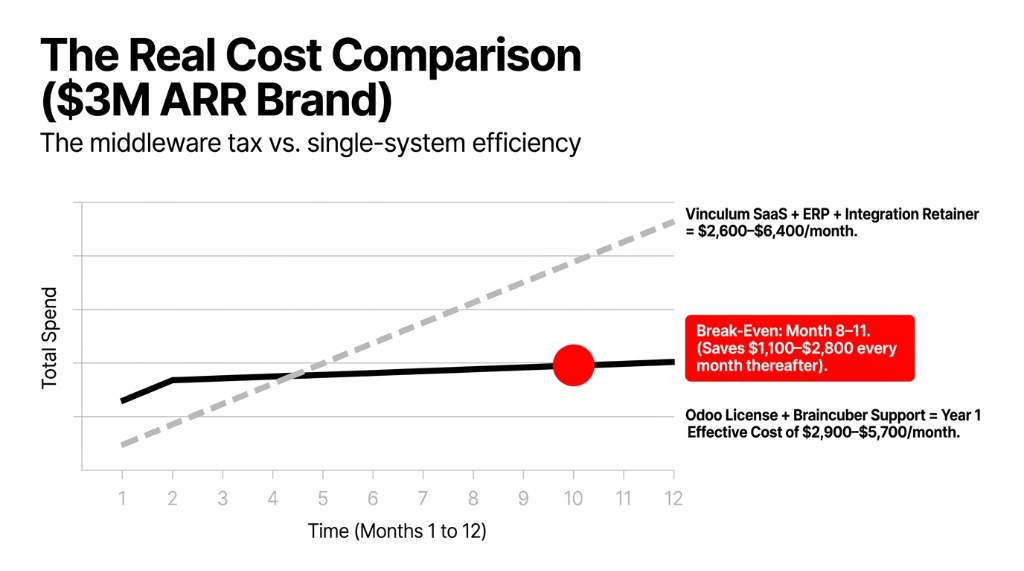
The break-even on a proper Odoo implementation vs. a dual-tool Vinculum stack typically hits at month 8–11. After that, you are saving $1,100–$2,800 every single month. (Yes, your CFO should see this chart.)
What Happened When a UAE Fashion Brand Chose Wrong
We worked with a fashion accessories brand out of Dubai — 6 channels (Amazon.ae, Noon, their Shopify store, two Instagram-linked boutiques, and a B2B wholesale portal). They had gone live with Vinculum 14 months earlier.
Their Vinculum OMS was working fine for order routing. But their accountant was reconciling revenue in Tally manually every Sunday. Their CRM was a WhatsApp group. And every time they wanted to add a new channel — say, TikTok Shop UAE — it was a separate Vinculum connector setup costing $400–$900 and 3–4 weeks.
The $14,600 Returns Limbo
When they came to us, they had $14,600 in unreconciled returns sitting in a limbo between Vinculum and Tally — neither system owned the problem. Returns data was "in transit" between two databases, and no one could tell the founder which returns had been processed and which had not.
After Migration to Odoo (Braincuber Implementation)
Orders from all 6 channels now land in one place — one inventory pool, one GL.
Month-end close: Dropped from 11 days to 2 days.
TikTok Shop UAE: Added as a channel in 9 days using a connector app.
The $14,600 in limbo returns? Reconciled inside Odoo's accounting module within the first month.
That is the difference between a specialist tool and an integrated operating system.
Who Should Choose Vinculum vs Odoo?
Choose Vinculum If:
1. You are a large-format retailer or 3PL with 10+ active channels and 1M+ monthly orders
2. Physical store omnichannel (Endless Aisle, BOPIS, BORIS) is your primary pain point
3. You already have a functioning ERP and just need a dedicated OMS layer on top
4. Your catalog requires heavy PIM syndication to international marketplaces in Arabic, French, or Bahasa
Choose Odoo (Braincuber) If:
1. You are a D2C or hybrid brand running 3–8 channels and need inventory + finance + CRM in one system
2. You are tired of paying for two platforms to do what one should do
3. You have plans to scale into manufacturing, B2B wholesale, or subscription commerce
4. You want AI-driven demand forecasting and purchase automation baked into the same system that processes orders
5 FAQs: Vinculum vs Odoo for Multi-Channel
Can Odoo replace Vinculum entirely for multi-channel management?
For most D2C and mid-market brands operating 3–8 channels, yes. Odoo handles real-time inventory sync, order routing, marketplace integration, and financial reconciliation natively. Where Vinculum still has an edge is in large-scale physical retail omnichannel with 10+ channels and Endless Aisle requirements at enterprise volumes above 500,000 orders/month.
How long does Odoo multi-channel implementation take with Braincuber?
A standard 4–6 channel setup with inventory, order management, and accounting integration typically goes live in 10–14 weeks. Brands migrating from Vinculum or a fragmented stack (Tally + Vinculum + Excel) usually require 12–16 weeks due to data migration and channel reconnection.
Is Vinculum more expensive than Odoo for a growing brand?
When you account for the ERP you still need alongside Vinculum, most brands at the $1M–$10M ARR range end up spending 23–41% more per year than a properly implemented Odoo instance — because they are maintaining two platforms, two integrations, and two support relationships.
What happens to my Shopify and Amazon data during an Odoo migration?
Your order history, product catalog, and customer records migrate into Odoo via structured data import. Braincuber runs a parallel-operation period (typically 2–3 weeks) where both systems run simultaneously before cutover, so zero orders are lost and no channel goes dark during migration.
Does Odoo support Endless Aisle and ship-from-store like Vinculum?
Odoo supports ship-from-store and multi-location fulfillment natively. True Endless Aisle (where a store associate taps enterprise-wide inventory to fulfil an in-store order from a different warehouse) requires custom configuration. Braincuber has built this for retail clients — it is not out-of-box, but it is absolutely achievable within Odoo's architecture.
Already on Vinculum and questioning the stack? Pull up your last 3 months of integration maintenance invoices. Add up the hours your accountant spends reconciling between Vinculum and your ERP. If that number makes you uncomfortable — you already know the answer.
Check your returns folder right now. If it is full of unreconciled entries between two systems, call us.
Stop running multi-channel on two platforms when one will do more.
Book our free 15-Minute Operations Audit — we will identify exactly where your current stack is leaking revenue before the call ends. No pitch. Just the math on what your Vinculum + ERP combo is actually costing you.
Book Your Free Audit