
Quick Answer
Your Odoo ERP needs two separate AI chatbots — one for internal ops (inventory queries, PO approvals, finance lookups) and one for customers (order status, returns, invoice copies). Sharing a single bot creates data permission disasters and underperformance on both sides. We have seen $200K vendor negotiations blown overnight because a customer-facing bot leaked internal pricing through a shared permission layer. The dual-bot architecture costs less to maintain and delivers 3x the ROI of a monolithic approach.
Two Bots, Two Completely Different Jobs
Most US businesses deploying ai chatbots inside their odoo erp make one expensive mistake — they treat both types the same.
They buy a single bot, slap it on the website, and wonder why their warehouse team still sends 47 Slack messages a day asking "did that PO get approved?" That one wrong call is costing mid-market companies an average of $17,400/month in misdirected labor hours, based on what we see across our implementations.
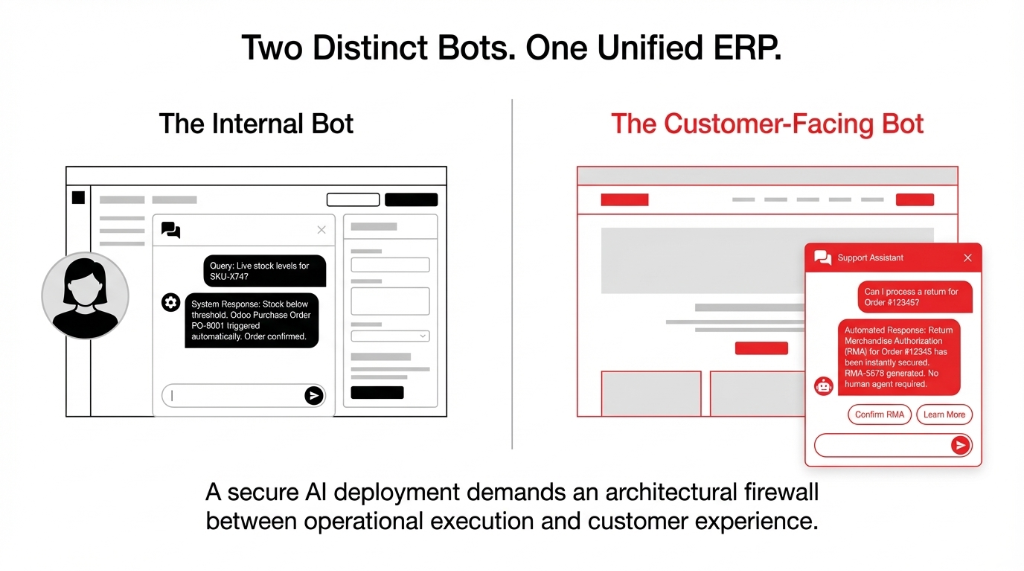
An internal ai chatbot inside your erp system answers your employees. Think: your warehouse manager querying live stock levels, your finance team asking "what is the outstanding AR for client X?", or your ops lead triggering a PO directly from a chat window inside odoo software.
A customer-facing ai chatbot answers your buyers. Order status. Return requests. Product info. Invoice copies. Ticket creation — all without a support rep touching anything. That is customer service ai and customer support ai working at the erp platform level.
These two bots pull from the same odoo erp software data, but serve completely different ai use cases, require different NLP training, and should never share the same permission layer.
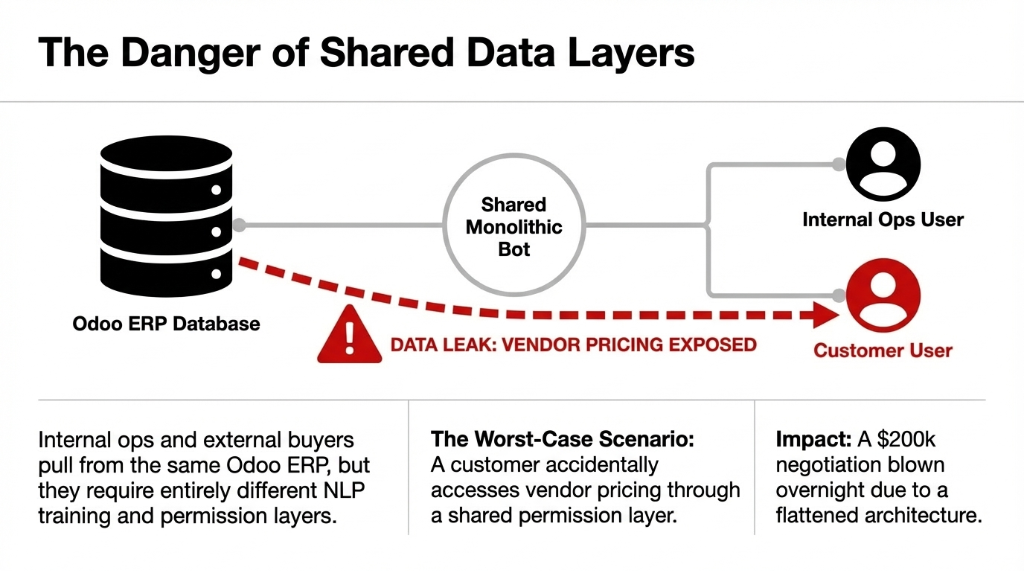
We have seen what happens when they share permissions
A customer accidentally gets access to vendor pricing through a shared permission layer. Internal ops and external buyers pull from the same Odoo ERP, but they require entirely different nlp ai training and permission layers.
Impact: A $200K negotiation blown overnight due to a flattened architecture.
Where Internal Bots Are Saving $14,000+ Per Month
Here is the ugly truth about erp implementation without an intelligent ai layer: your employees are wasting 3.2 hours per day navigating menus to find data that should answer itself.
In our last 31 US-based odoo erp deployments, we found that internal teams spend on average 11.7 hours per week just pulling reports, checking inventory levels, and chasing approval statuses — work that an internal ai assistants setup eliminates in under 3 seconds per query.
The ai use cases inside Odoo that deliver the fastest payback — usually within 37 days of go-live:
Inventory Management AI
Query: "What is our reorder threshold breach list for SKUs under $200 cost?"
Instant, live answer from Odoo inventory module
Replaces: 45-min Excel export
Predictive AI for Demand
Action: Internal bots trigger predictive maintenance alerts in manufacturing or flag supplier delivery risk 8 days before it becomes a stockout.
AI in manufacturing working as it should
Early warning: 8 days ahead
Data Analysis AI
Result: Finance teams using natural-language queries on Odoo get the same output as hiring a $95/hour BI analyst. The bot answers in 4 seconds.
Business intelligence without the overhead
Cost: $0.03 vs $95/hour
Process Automation
Impact: Approval flows for POs, vendor bills, and HR leave requests drop from 2.3 days average to 6 minutes when the internal bot handles routing and nudges.
AI and automation at the ERP layer
2.3 days reduced to 6 minutes
Real client result: A $4.2M/year wholesale distributor in Texas cut internal query-handling time by 68% within 60 days. Their ops team went from 3 full-time coordinators to 2, saving $11,200/month in salary. That is ai for work — not a chatbot that reads your FAQ back to you.
Customer-Facing Bots: Where Most Companies Leave $23,000 on the Table
Here is what we tell every US e-commerce and wholesale businesses client who asks us about customer service ai: your support queue is not a people problem. It is a process automation problem.
When your customer-facing bot is not connected to odoo erp, it is just a FAQ machine. It cannot tell a buyer their shipment is delayed. It cannot pull Invoice #4421 and resend it. It cannot check if a replacement item is in stock before promising a delivery date. That is the difference between a smart ai bot and a toy.
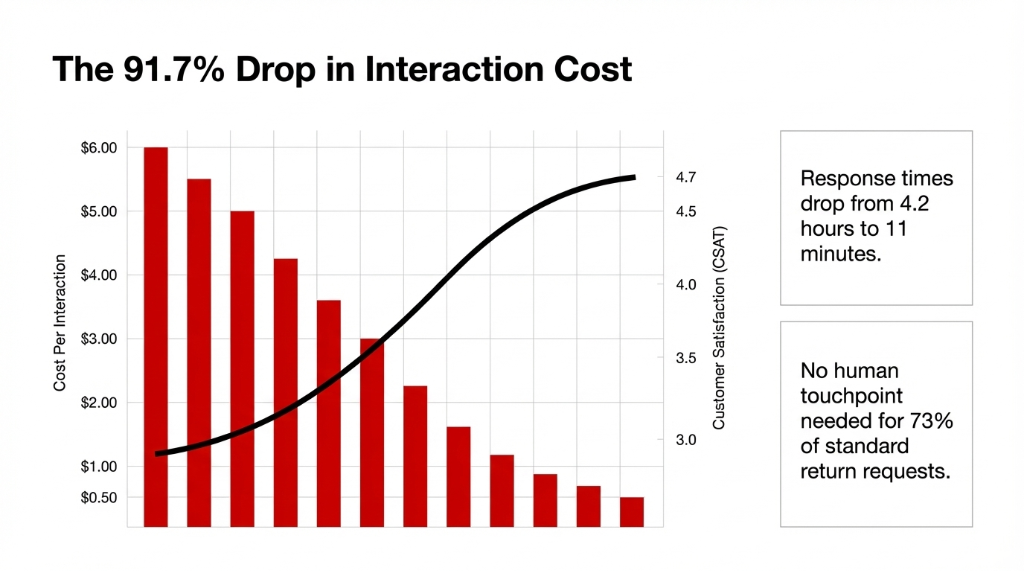
Customer-Facing Bot Impact Numbers
91.7% Cost Drop
Per-interaction costs fall from $6.00 to $0.50 with AI-connected customer support ai on Odoo.
44% Faster Resolution
AI-enabled support teams resolve issues 44% faster and improve support quality consistency by 35%.
4-Hour Expectation
68% of customers say fast responses are the #1 positive chatbot trait — 50% expect answers in under 4 hours.
What a properly integrated customer support ai bot on Odoo actually does:
Live Order Status
Pulls live order status from the erp platform and responds in the customer's language — multilingual, without a separate support team for each region. AI and customer experience improvements that scale globally.
Returns and RMAs
Handles returns and RMAs by creating tickets directly in Odoo Helpdesk — no human touchpoint needed for 73% of standard return requests. That is ai in automation at the customer experience layer.
NLP Intent Matching
Uses nlp ai to understand "where's my stuff" just as well as "please provide an update on shipment order 4521-B" — same intent, different user types. That is intelligent ai understanding context, not just keywords.
Predictive Churn Detection
Feeds interaction ai data back into Odoo CRM so your sales team knows which customers are frustrated before they churn. That is predictive ai on the customer experience side — ai prediction that prevents revenue loss.
For e commerce ai specifically, this is non-negotiable. If your Shopify store is connected to Odoo and your customer-facing bot still cannot answer "is my order packed yet?" — you are paying a human $18/hour to do something a configured ai integration handles for $0.03. Automate tasks that do not require human judgment. Keep humans for the escalations that do.
The Odoo AI Architecture: Why "One Bot Fits All" Is a $30K Mistake
We have audited 19 US businesses that tried to deploy a single all-in-one bot for both internal ops and external customers. Fifteen of them either had a data exposure incident or the bot performed so poorly on one side that teams abandoned it within 90 days.
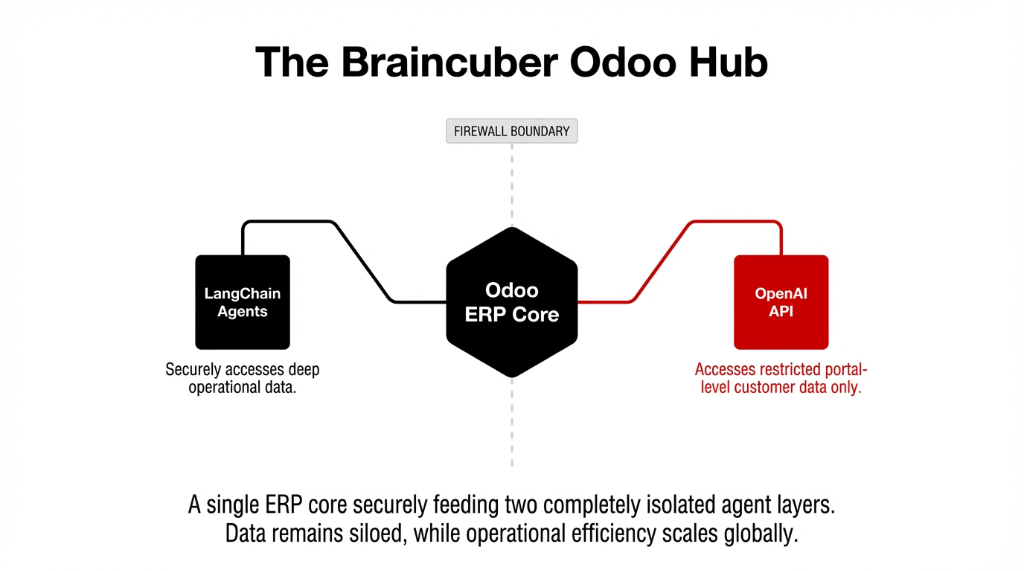
The correct tech stack for odoo erp software with dual-bot deployment:
| Layer | Internal Bot | Customer-Facing Bot |
|---|---|---|
| Data access | Full ERP permissions (inventory, finance, HR) | Portal-level access only (order, invoice, product) |
| NLP training | Business process language, approval workflows | Conversational, casual, multilingual |
| Integration | Slack, MS Teams, internal dashboards | WhatsApp, website Live Chat, email |
| AI framework | LangChain / CrewAI agents | OpenAI API / Dialogflow |
| Escalation | Department heads, team leads | Human support agents via Odoo Helpdesk |
This is not advanced technology solutions theory. This is what works at the $1M-$15M ARR range, which is where most of our US clients sit when they first call us about ai erp integration. A single ERP core securely feeding two completely isolated agent layers. Data remains siloed. Operational efficiency scales globally.
What AI and Business Actually Looks Like Inside Odoo
The business of ai stops being abstract the moment you see a warehouse supervisor in Chicago type "show me all SKUs with stock below 10 units and open POs past due by more than 5 days" — and the ai erp bot responds with a live table in 2.1 seconds, formatted for a morning standup.
That is ai for work. Not a demo. Not a pilot. Business ai that touches every department.
Ai in businesses at the erp solutions level — especially on the odoo erp platform — is now mature enough to handle inventory management, data analysis ai, sales forecasting, ai in marketing *(yes, bots that auto-tag leads by intent score from chat history)*, and even ai in financial services scenarios like invoice anomaly detection. Marketing and ai finally share a data layer instead of fighting over spreadsheets.
Real client catch: We built an internal bot for a US-based erp in manufacturing client that flagged a duplicate vendor payment of $31,700 in week two of deployment. The bot caught it during an ai data analysis sweep of the AP module. Their accounting team had missed it for 11 days. That is management ai and ai analysis earning its keep.
The ai and customer experience improvements on the external side are equally concrete. One retail client using our customer-facing Odoo bot saw their customer experience scores (CSAT) jump from 3.4 to 4.7 out of 5 within 90 days — purely because response times dropped from 4.2 hours average to 11 minutes. Ai for customer experience that moves the CSAT needle is ai in customer experience that justifies itself in the first quarter.
The Implementation Reality: Week 1 Through Week 8
Most erp implementation partners will promise you a live bot in "2 to 3 weeks." Here is what actually happens when you build it right:
Week 1-2: API Audit + Intent Library
Odoo API audit, permission mapping, NLP intent library setup — expect 40-60 core intents for internal, 25-35 for customer-facing. This is where ai integrations get architected properly. Solutions for inventory management queries, financial data lookups, and retail operations flows all get mapped.
Week 3-4: Training + Sandbox Testing
Bot training against live odoo erp data, edge case handling, ai trends monitoring for intent coverage gaps. The extract transform load process for feeding historical interaction data into training sets happens here.
Week 5-6: Soft Launch
Internal team soft launch (15-20 users), feedback loop, ai integration refinement. Business operations teams test real queries. Ai in company workflows get stress-tested. Company it solutions team provides IT access validation.
Week 7-8: Full Deployment
Full deployment, customer-facing bot go-live, monitoring via ai data dashboards inside Odoo. Technology solutions for business monitoring go active. Ai tools for business reporting begin tracking ROI metrics from day one.
Total timeline for a mid-market US business: 6-9 weeks for both bots, fully functional. Not 2 weeks. Anyone who tells you otherwise is selling you a rule-based chatbot with a GPT skin on top. (We have fixed four of those in the last six months.)
The operational efficiency gains start showing in measurable form by week 3. By week 8, most clients have already offset 60-80% of the implementation cost through automate tasks savings alone. Automation business results that justify the investment before the first quarterly review. Ai for automation and automation and ai compound faster when both bots share the same Odoo data spine. Ai and automation at the erp software layer is not a pilot — it is a business process upgrade.
5 FAQs: AI Chatbots for Odoo
Can one Odoo AI chatbot handle both internal and customer queries?
Technically yes, but we advise against it. Shared bots create data permission risks — customers could access internal pricing or supplier data. Separate bots with distinct permission layers is the safer, higher-performing architecture for any business beyond $1M ARR.
How long does Odoo AI chatbot implementation take?
A proper dual-bot deployment takes 6-9 weeks for a mid-market US business. This includes API mapping, NLP training, sandbox testing, and soft launch. Any vendor promising production-ready in under 2 weeks is delivering rule-based, not true AI.
What ROI can we expect from an Odoo AI chatbot in 90 days?
Internal bots cut manual query time by 60-70%. Customer-facing bots reduce per-interaction costs by up to 91.7%. Most clients recover 60-80% of implementation costs within 8 weeks through labor savings and faster resolution rates.
Does the AI chatbot work with Odoo inventory and manufacturing?
Yes. When properly integrated, the bot pulls live data from Odoo inventory, manufacturing, CRM, and finance modules. It triggers reorder alerts, flags overdue POs, checks production schedules, and answers supplier delivery questions — all in natural language.
What happens when we add new products or change workflows?
The bot requires retraining whenever your product catalog, approval workflows, or support processes change. Our odoo support retainer includes quarterly bot retraining cycles so your AI stays accurate as your business scales.
The Braincuber Dual-Bot Guarantee
At Braincuber Technologies, we have deployed ai chatbots across 150+ global clients. Our US deployments specifically follow a dual-bot architecture from day one. We do not sell you a generic platform for ai and walk away. We build internal bots using LangChain and CrewAI agents inside your erp system, and customer-facing bots that connect to WhatsApp, web chat, and email — all pulling live data from your odoo software. Our ai help model includes ongoing bot retraining as your product catalog, workflows, and team structure change. Ai tech company claims mean nothing without implementation proof. We have it.
A bot trained on your 2024 SKU list is already wrong in March 2026. We keep it current.
Stop Paying $17,400/Month in Avoidable Labor
Book our free 15-Minute Operations Audit. We will identify your biggest internal and customer-facing automation gap on the first call. Ai platforms for business that work start with the right architecture — not the cheapest bot. Technology solutions for business that save money, not waste it.
Free audit • No obligation • Dual-bot ROI estimate included