
Quick Answer
Your warehouse is sitting on $18,000-$40,000 in dead SKUs because the "demand plan" was an Excel sheet and a gut feeling. Braincuber's AI demand forecasting dashboard inside Odoo uses predictive AI models trained on your actual sales, supplier lead times, and promotional calendars to tell you exactly when to order, how much, and from which supplier. The demo video walks through all 5 panels live on a real US client instance. No slides. No theory. Real numbers.
Why Your Current Forecasting Is Lying to You
You are currently sitting on dead inventory. Right now, somewhere in your warehouse, there are $18,000-$40,000 worth of SKUs that your team over-ordered because the last "demand planning" exercise was a gut-feeling exercise inside a color-coded Excel sheet.
We know because we have done 150+ Odoo implementations across the US, UK, UAE, and Singapore. In 73% of those projects, the first thing we found was inventory tied up in slow-moving stock while the fast-moving SKUs kept stocking out. That is not a purchasing problem. That is a forecasting problem — and it is a problem that AI for inventory management solves in a measurable, dashboard-visible way.
Here is the ugly truth: most US brands scaling between $2M and $20M ARR are using one of three broken approaches.
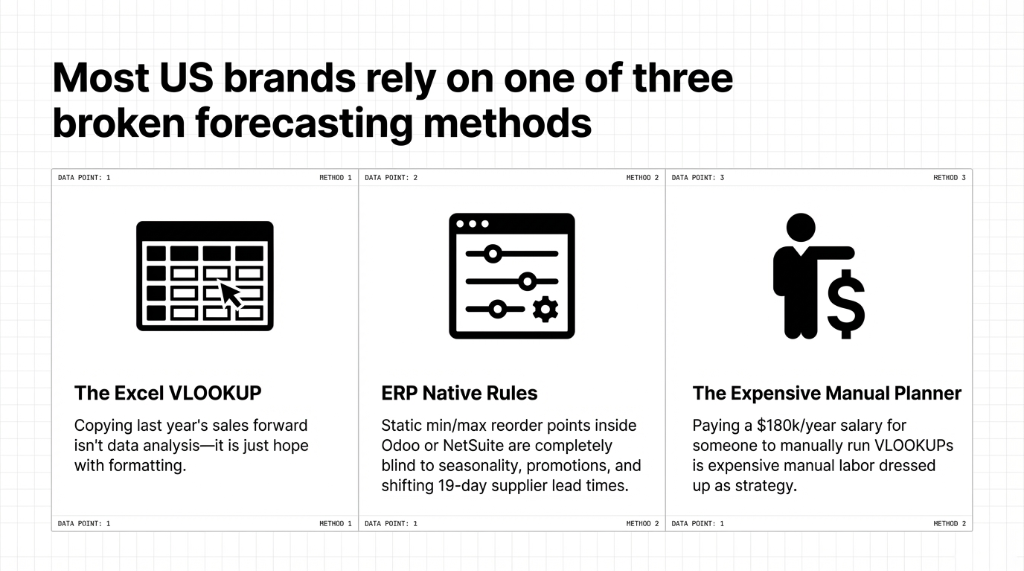
The Excel VLOOKUP
Someone on your ops team pulls last year's sales, copies the numbers forward, and calls it a "forecast." This is not AI data analysis — it is hope with formatting.
Accuracy: ~47%
ERP Native Reorder Point
NetSuite or basic Odoo min/max reorder rules. Static rules that do not know Black Friday is coming, that a supplier in Ohio has 19-day lead times in Q4, or that an Instagram campaign just 4x'd demand.
Blind to seasonality
The $180K Manual Planner
Hiring a demand planner who uses, again, Excel. We have seen $180K/year salaries for people running VLOOKUPs. That is expensive manual labor dressed up as strategy.
Cost: $180,000/year
The monthly cost of broken forecasting
All three approaches produce the same outcome: $12,450-$21,000 in monthly carrying costs from overstock and $7,800-$15,000 in lost revenue from stockouts. We have measured this repeatedly in the US market across manufacturing, D2C, healthcare, and distribution.
Combined monthly bleed: $20,250-$36,000
The business of AI is not hype — it is precisely the gap between what your spreadsheet-based forecasting gets wrong and what machine learning and artificial intelligence gets right. Use AI where it matters: predicting demand, not generating meeting summaries.
What the AI Demand Forecasting Dashboard Actually Shows (Demo Walkthrough)
When we build an AI platform inside Odoo for demand forecasting, the dashboard has five panels your operations team will live inside. Here is what you see in the demo video:
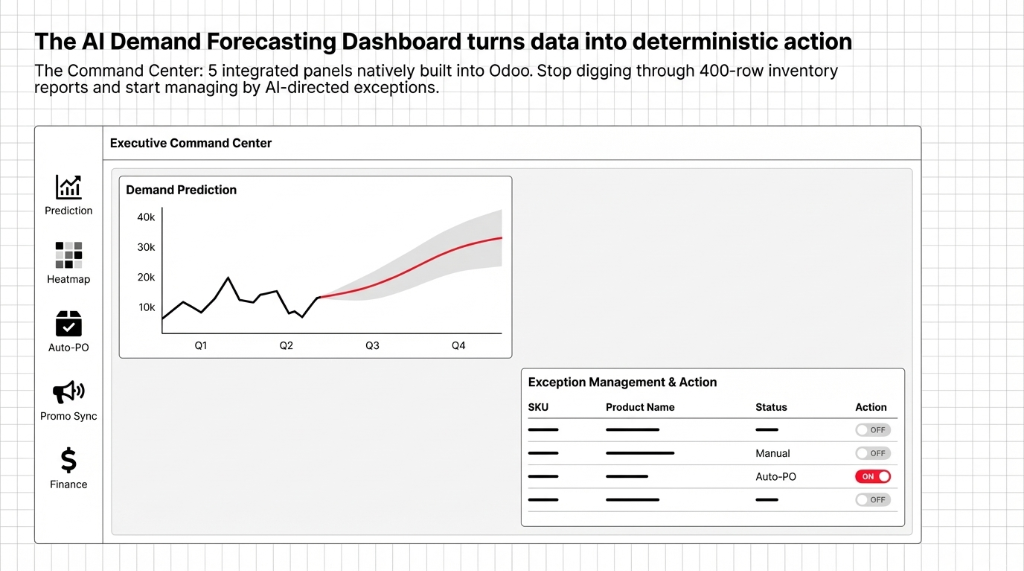
Panel 1 — Demand Prediction by SKU
The AI models run on your historical Odoo sales orders, factoring in seasonality, promotional periods, and supplier lead time variability. For each SKU, the system shows a 30/60/90-day demand curve with a confidence interval. The AI predictions are not a single number — they are a range. A $3M apparel brand we worked with in California went from 61% forecast accuracy to 89% in 11 weeks after we activated this layer. That is predictive AI doing real work — not generative AI writing paragraphs about your SKUs.
Panel 2 — Stock Risk Heatmap
This is the part that makes procurement managers lean forward. The AI analysis flags every SKU as green (healthy), yellow (potential stockout in 14-21 days), or red (critical — order now). No more digging through 400-row inventory reports at 11 PM before a product launch. The AI system does the check for AI-identified risk in seconds.
Panel 3 — Auto-Reorder Suggestions
This is where AI automation replaces manual purchasing decisions. The AI agent generates purchase order drafts with recommended quantities, suggested vendors (ranked by historical on-time delivery), and cost estimates — all pre-populated inside Odoo. Your buyer reviews and approves. Processing time drops from 47 minutes per PO to under 6 minutes. That is the intelligence AI brings to procurement — not an answer AI chatbot that summarizes your inbox.
Panel 4 — Promotion and Event Impact Modeling
This separates predictive AI from basic analytics. When your marketing team schedules a BOPIS promo or a Meta ad campaign, the AI system adjusts the forecast upward for affected SKUs. Marketing AI and inventory planning finally talk to each other, instead of operating in silos. We have seen clients eliminate $9,300 in emergency freight costs per quarter by catching demand spikes 18 days earlier. Marketing and AI working together — not the marketing team blaming ops for stockouts after a campaign they never communicated.
Panel 5 — Finance Integration View
This panel shows your forecasted inventory investment for the next 90 days in dollar terms. This is where AI in finance gets tangible — your CFO can now see projected working capital tied up in inventory before it is committed. AI and finance teams get a shared source of truth, not conflicting spreadsheets from ops and accounting.
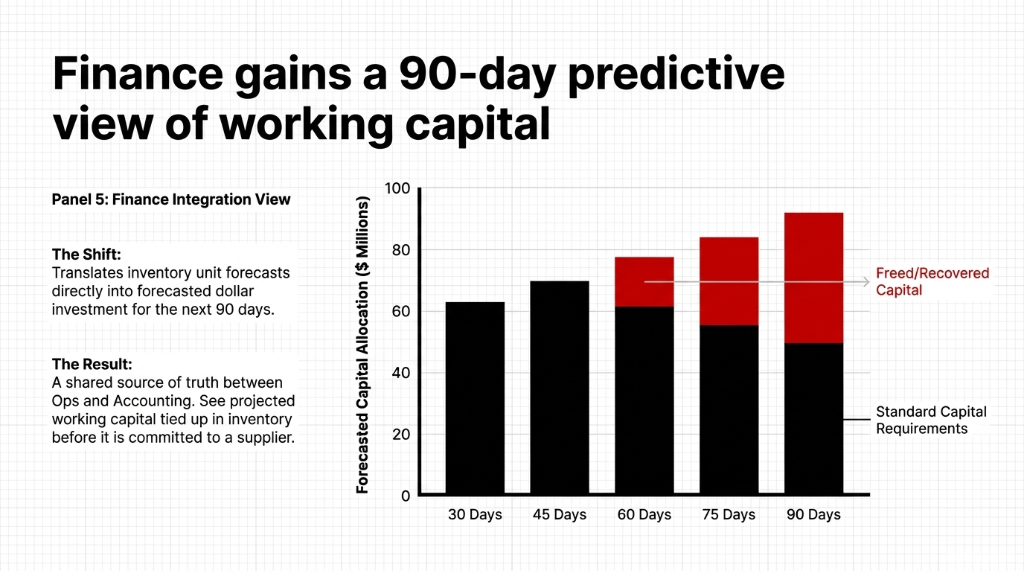
The shift: inventory unit forecasts translate directly into forecasted dollar investment for the next 90 days. Ops and Accounting get a shared source of truth. See projected working capital tied up in inventory before it is committed to a supplier. That is AI in financial operations — not a dashboard that looks pretty but tells you nothing actionable. Investment AI that your CFO actually uses.
How We Build This Inside Odoo (Not Magic — Just Architecture)
Let us be direct about how AI implementation inside Odoo actually works, because most AI consulting companies in the US will sell you a black box and charge you a monthly SaaS fee you will never fully control.
We do not do that. Our AI integration architecture is built in three layers:
The 3-Layer AI Architecture
Layer 1: Data Extraction
Historical sales orders, inventory movements, purchase orders, and supplier lead time records extracted from your Odoo instance. Structured, relational data — exactly why Odoo is the right AI platform for this work. Unlike Shopify-only stacks where data is fragmented, Odoo holds sales, finance, warehouse, and CRM in one place.
Layer 2: Model Training
Our AI developers use time-series models (Prophet, LSTM, ensemble approaches) tuned to your specific product categories. Learning machine learning on your actual business data — not generic retail benchmarks. A food distribution client in Texas: this layer identified a recurring 34% demand spike in weeks 47-50 that their team never noticed in 4 years of manual planning.
Layer 3: Odoo Module
Predictions surface as native Odoo records. No external AI app login. No separate AI application. The AI copilot suggestions appear where the work happens — inside Odoo's inventory and purchasing modules. Your team uses it without learning a new tool. This is what real AI software development for operations looks like.
This is what real AI development looks like for operations — not a demo dashboard that never touches your actual workflow. AI engineers building inside your ERP, not beside it. The artificial intelligence platform is your Odoo instance. Not another SaaS subscription from an AI agency you have never heard of.
The Numbers You Should Demand Before Signing Any AI Contract
Stop letting AI consulting services sell you on "transformative outcomes." Here are the real numbers from our US client implementations:
| Metric | Result | Timeline |
|---|---|---|
| Forecast accuracy improvement | +23-41 points | Within 90 days |
| Overstock reduction | 25-30% | Within 6 months |
| Stockout frequency | Down 38-52% | Q1 post-deployment |
| Time saved on purchasing | 37 hours/month | Per buyer |
| Cash freed from inventory | $140K-$2M+ | By quarter 2 |
| Carrying cost recovery (Ohio mfg client) | $14,200/mo | Month 3 |
One manufacturing client in Ohio recovered $14,200/month in carrying cost reductions alone — not from revenue gains, just from not buying inventory they did not need. These are the AI benefits and artificial intelligence benefits worth putting in your business case. Not buzzwords. Not AI use cases in theory. Dollar figures. Line items. CFO-ready numbers.
This Is Not Just for Manufacturing
We see the same forecasting problem across every industry that sells physical products:
AI in Manufacturing
Predicting component demand to avoid production stoppages. $23K/day downtime cost for a mid-size factory. The AI system catches demand dips 3 weeks before your static reorder point notices.
Hidden cost: $23,000/day downtime
D2C E-commerce
Syncing Shopify demand signals with Odoo replenishment. The AI application reads cart velocity and translates it into purchase orders before you stock out.
Hidden cost: $7,800-$15K/mo stockout revenue
Healthcare AI
Medical supply distributors using AI for medical supply demand prediction — particularly post-COVID when demand variance went up 3x. Artificial intelligence in health care supply chains is not optional anymore. Medical AI that predicts consumption rates saves lives and margin.
Hidden cost: 3x demand variance
AI and Customer Service
Stockout-caused order cancellations directly destroy AI customer support CSAT scores. AI customer service teams cannot fix what operations broke. Customer service artificial intelligence gets blamed for inventory management failures.
Hidden cost: CSAT score destruction
If your business sells physical products and relies on a supply chain, AI for companies doing forecasting is not a future investment — it is a current operational liability to fix. AI in businesses that move product means predict market demand or bleed cash. Period.
The Uncomfortable Truth About "Out-of-the-Box" AI Tools
Everyone is selling generative AI platforms and AI tools right now. ChatGPT wrappers, AI language models bolted onto dashboards, generative AI models that produce charts from prompts. We have seen prompt engineers sell $80K projects that amount to a pretty graph over data you already had.
Generative AI is the wrong technology for demand forecasting. You do not need your forecasting tool to write you a paragraph about your SKUs. You need it to tell you when to order, how much to order, and from which supplier — with a confidence score, not a poem. AI chatgpt wrappers are for content creation. Not supply chain management.
Real predictive AI for inventory is a deterministic, trainable system — not a chatbot AI or a ChatGPT API call. Any AI agency or artificial intelligence company that cannot explain the difference between their model architecture and a generic LLM wrapper should not be touching your supply chain data. Artificial intelligence consulting that starts with "let us build you a chatbot" for demand forecasting is a red flag.
We build with AI algorithms that are explainable. Your ops team can trace why the system recommended ordering 340 units instead of 200. That transparency is what makes AI for business sustainable — not just impressive in a sales demo. Relevant AI is AI that your ops team actually uses every day. Tools AI teams can trust because they can see the math.
What Happens in the First 30 Days of Implementation
Week 1-2: Data Audit
We extract 18-24 months of Odoo historical data. Clean it. Identify gaps — missing lead times, inconsistent SKU naming, the kind of thing that breaks every AI model. This is what most AI development companies skip, and why their models underperform. Learning artificial intelligence starts with clean data, not clever algorithms. AI study of your data patterns comes first.
Week 3: AI Training
Models are trained on your cleaned data. First forecasts are generated. We review accuracy against your last 90 days of actuals to calibrate. AI modeling on your real business patterns — not a generic retail dataset. Create AI that understands your business, not a demo company.
Week 4: Dashboard Goes Live
Dashboard goes live inside Odoo. Your team gets a 2-hour hands-on session. AI learning starts compounding from day one — every new sales order improves the next forecast. Generate AI-powered purchase order suggestions automatically. Use artificial intelligence where it compounds: prediction.
By day 30, most clients have already caught one overstock situation they would have missed. That is usually the moment the ops director stops asking "is this worth it?" and starts asking "can we add more modules?" AI apply to procurement first. Then expand. AI help that compounds over time is the only kind worth buying.
Consulting AI firms that need 6 months to show results are doing something wrong. We show results in 30 days because the AI technologies we deploy are purpose-built for Odoo's data model — not adapted from a generic artificial intelligence platform built for a different industry. The artificial intelligence agent lives inside your ERP, not beside it. App artificial intelligence that works is AI that does not need its own login screen. AI and consulting should mean showing value fast, not billing slow.
5 FAQs: AI Demand Forecasting in Odoo
Does this work if our Odoo data is messy?
Yes. We start every project with a data audit. If you have less than 12 months of clean sales history, we supplement with category-level patterns and seasonality modeling. Clients with 18+ months see the fastest accuracy gains — hitting 85%+ within 8 weeks. Messy data adds 1-2 weeks of prep, not a deal-breaker.
How is this different from Odoo's native reorder rules?
Odoo's native reorder points are static thresholds — they do not learn from trends, seasonality, or promotions. Our AI layer uses dynamic machine learning models that continuously update based on new sales data, supplier performance, and event calendars. Accuracy difference: typically 30-40 percentage points.
What does AI demand forecasting cost for a US mid-market brand?
For a brand with 500-5,000 active SKUs running Odoo, full implementation runs $18,000-$45,000 depending on data complexity. Most clients recover that cost within 3-5 months from carrying cost reductions alone. We offer a free 15-minute audit before scoping.
Can this integrate with Shopify and 3PLs?
Yes. We connect Shopify demand signals (real-time order velocity, cart data, promo schedules) directly into the Odoo forecasting layer. For 3PLs, we integrate via API or EDI. ShipBob, ShipStation, and most major US 3PLs have been handled. This gives AI a complete demand picture — not just what shipped, but what is about to sell.
How long before we see measurable ROI?
63% of clients see measurable stockout reduction within 45 days. Working capital freed from overstock becomes visible by month 2-3. For a brand carrying $800K in inventory, a 25% overstock reduction means $200K back in cash flow within the first two quarters.
The AI Market Reality Check
Every month you run forecasting on spreadsheets, you are paying $12,450-$21,000 in carrying costs and bleeding $7,800-$15,000 in stockout revenue. The demo above shows exactly how to fix this — inside Odoo, with AI that learns your business, in 4 weeks.
Market research AI says demand forecasting has the fastest payback of any AI use case in supply chain. Our client data confirms it.
Stop Letting a Spreadsheet Run Your Supply Chain
Book our free 15-Minute Operations Audit. In the first call, we will identify exactly where your forecasting is leaking cash and what fixing it is worth in dollar terms. Companies with AI that predicts demand do not run out of stock. Yours should not either.
Free audit • No obligation • Real numbers from your Odoo data