
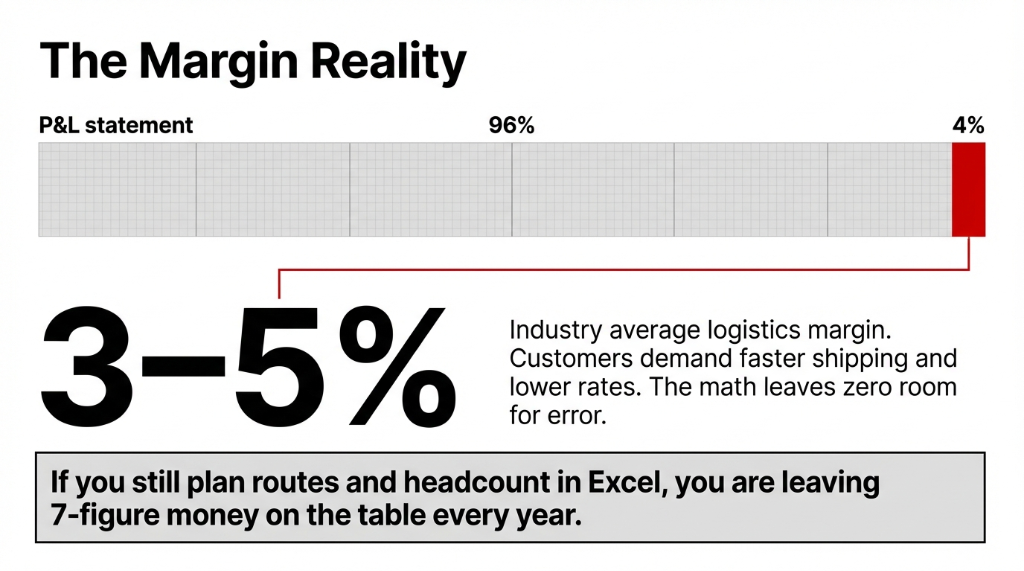
If you still plan routes and headcount in Excel, you are leaving 7-figure money on the table every year. AI in logistics is already cutting transportation and warehouse costs by 15-40% for operators who actually use it. Not talk about it.
This post breaks down our Industry Package: AI for Logistics like we would in a boardroom: what it does across your logistics stack, how it plugs into your TMS/WMS/ERP, and exactly what you pay at each tier.
If you are googling "logistics meaning" or "supply chain management definition," this package is not for you. If you want your EBIT to move, keep reading.
Why Your Logistics P&L Keeps Getting Squeezed
Margins in logistics sit around 3-5%. Customers demand faster shipping and lower rates. You call it supply chain management or just "getting product out the door" — the math is the same: tiny margin, huge risk.
AI has already shown it can reduce logistics and transportation costs by 15-30%, shrink excess inventory by 20-35%, and improve forecast accuracy by more than 70%. Yet most US logistics companies still treat artificial intelligence as a buzzword instead of wiring it into daily operations.
The Uncomfortable Math
Your competitors are moving. While you are debating AI strategy in quarterly meetings, operators on your lanes are already getting 1-2 percentage points of EBIT uplift from AI-driven routing and forecasting.
Every month you wait costs you ~$14,200 in recoverable margin.
What This Industry Package Actually Is
We built Industry Package: AI for Logistics as a pre-configured AI layer for logistics companies. Not a science experiment. It wraps three things around your existing stack:
Pre-built AI models for routing, inventory, labor, and exceptions tuned for transportation and logistics. Connectors into your TMS, WMS, ERP, and carrier systems *(yes, including Oracle Transportation Management and legacy stacks)*. A fixed-fee implementation and support model so your CFO knows the bill before the first workshop.
We don't care if you call it a chain management system or digital supply chains engine. We care that it sits between your data and your people and drives concrete supply chain optimization every single week.
Where AI Plugs Into Your Logistics Stack
Control Tower Across the Entire Chain
First piece: network visibility. You already have a pile of supply chain software throwing alerts at you. We unify that into a control tower that finally makes sense.
What the Control Tower Does
Data Consolidation: Pulls from TMS (including Oracle TMS), WMS, ERP, and carrier APIs into one real-time view.
Risk Flagging: Uses AI models to flag at-risk loads, lanes, and customers before they break SLAs.
Real Views: Gross margin by lane, by customer, by carrier. Not generic KPIs.
Oracle Fusion Cloud SCM is already embedding AI to predict ETAs, reduce costs, and respond to disruptions. We sit alongside that and extend it across your non-Oracle tools too.
AI for Inventory and Warehouse Performance
Second piece: inventory and warehouse. AI for inventory management is not nice-to-have. It's how you stop warehouses turning into dollar-burning storage units.
We plug into your logistics warehouse or Oracle WMS and focus on: AI inventory management that predicts ideal stock levels per SKU-location for 3PL and distribution contracts. Artificial intelligence inventory management that cuts over-stock, balances reverse logistics flows, and protects service levels. Labor and slotting optimization so warehousing teams move fewer miles for the same throughput.
The McKinsey Number That Matters
AI-powered supply chain management can reduce inventory by up to 35%.
That is your real data, not a generic "supply chain management explained" diagram.
AI in Transportation and TMS
Third piece: transport and TMS. This is where your fuel, linehaul, and last mile bills live.
Route optimization and load building using AI models that have already proven 15-30% cost reduction in transportation. Dynamic carrier selection based on cost, on-time performance, and emissions. Exception prediction: your TMS alerts you before a lane melts down, not after the customer calls.
Runs on Oracle supply chain, SCM Oracle, or whatever else you have. We integrate with the transportation management system you already own.
Customer Promises, Reverse Flows, and Shipping
Finally, we tighten everything between order and doorstep.
More accurate ETAs using AI models that learn from past failures. Smarter reverse logistics so shipping companies recover value from returns instead of stacking them in a dark corner. SLA tracking across domestic and international legs so 3PL contracts are priced on hard data, not optimism.
Pricing: What You Actually Pay
We learned the hard way: vague quotes kill trust. So we ship this as three Industry Package tiers for US logistics companies. These are reference numbers; your final proposal anchors to your actual network size, but the shape stays the same.
Three Tiers. Zero Ambiguity.
Tier 1 - Operator
From $7,900/mo
▸ AI routing + labor for 1 region or up to 2 warehouses
▸ Connectors to 1 TMS + 1 WMS
▸ Basic dashboards for logistics leadership
Typical: 3PL doing $18-40M/year, limited data team
Tier 2 - Network
From $18,750/mo
▸ Multi-site AI across up to 6 warehouses
▸ Advanced multi-carrier, multi-mode transport AI
▸ Margin views per client for contract logistics
Typical: Multi-state 3PL, LTL, US + Canada/Mexico flows
Tier 3 - Enterprise
From $42,300/mo
▸ Global network optimization: air, ocean, trucking
▸ Deep Oracle/SAP/tier-one stack integration
▸ Dedicated data science pod + 24/7 support
Typical: Global integrators, worldwide logistics brands
The uncomfortable truth:
If these numbers scare you but you move $120 million of freight each year, the problem is not pricing. The problem is accepting 2-3% margin while AI quietly gives your competitors 1-2 percentage points of EBIT uplift.
How This Plays with Your Existing Stack
We designed the package for coexistence, not "rip and replace."
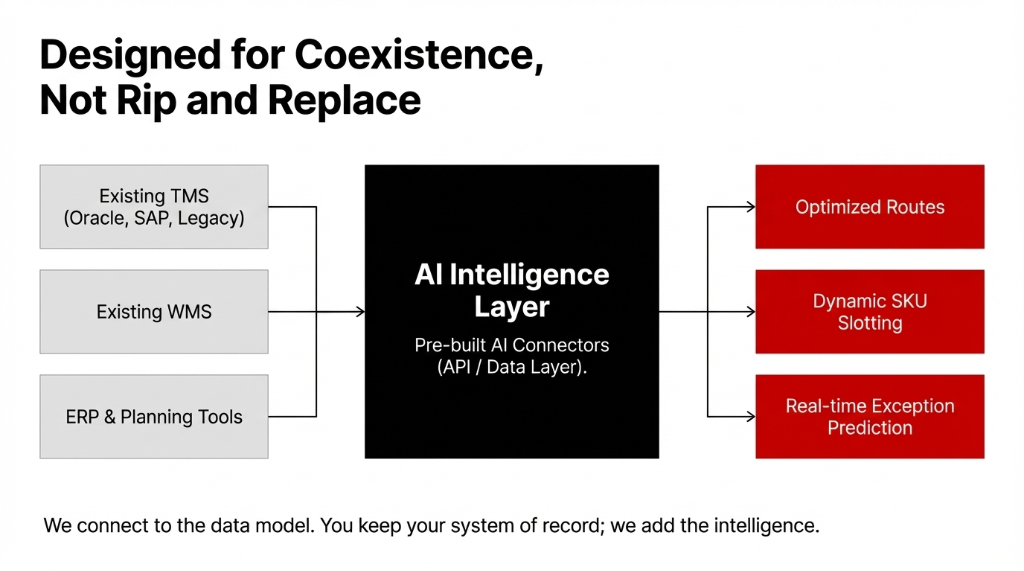
If you run Oracle Transportation Management or Oracle TMS, we use their AI-ready APIs and analytics stack instead of fighting it. If you are on another TMS vendor, we connect at the same level: loads, stops, events, costs.
Cloud-based supply chain management software or older on-prem chain software? We keep that as the system of record and layer AI on top.
We do not replace your supply chain technology. We connect to the data model and treat them as digital supply chain data sources. We support both cloud-native stacks and older deployments as long as we can get consistent data out.
You already pay Oracle, SAP, or others to handle supply chain management. Our role is to add AI intelligence that actually turns that spend into better routes, better inventory, and better pricing.
A 90-Day Story: From Chaos to Control
A US East Coast 3PL (call them "Third Logistics") handled e-commerce and retail distribution as a logistics service provider for 70+ brands.
Their Broken Reality
▸ On-time delivery hovering around 91.3%
▸ Inventory turns under 5, with one client stuck at 3.4
▸ No clear view of which contracts were bleeding cash
We deployed Tier 2 - Network. Connected TMS, WMS, and ERP into our AI layer. Turned on routing, load AI, ai inventory management, forecasting, plus exception prediction. Rolled out simple dashboards to supervisors - nothing fancy, just "red lane, red SKU, red customer" views.
90 Days Later
19.7%
Transport cost per shipment down. Certain lanes over 25.3%.
23.5%
Inventory reduced in targeted warehouses. Fill rates untouched.
96.9%
On-time performance. Clearer penalties in new contracts.
No extra headcount. No big-bang migration. Just artificial intelligence and supply chain data working together instead of living in slide decks.
Who This Package Is (Not) For
Built For:
✓ 3PLs, freight brokers, and asset-based carriers who understand logistics and want AI impact
✓ Operators who run serious volumes and know supply chain management means more than compliance checklists
✓ Leaders who want clear pricing, clear features, and a roadmap - not endless workshops
Not For:
✗ Companies still trying to define logistics or asking interns to google "supply chain management explained"
✗ Teams who think logistics will magically improve because they bought a new slide deck
✗ People who want AI theatre, not AI-driven EBIT
Quick FAQs on the Industry Package
How long does implementation usually take?
For a single-region setup (Tier 1), we typically go from contract to live AI in logistics routing and inventory in 10-14 weeks, assuming your TMS and WMS can give us usable data. Multi-network rollouts take longer but we still aim for first live value inside a quarter.
Do we need Oracle to benefit from this?
No. We integrate with Oracle Transportation Management, Oracle supply chain, and Oracle WMS if you have them, but we also work with other transportation management software, logistics software, and chain management vendors. The only hard requirement is consistent access to movement and cost data.
What kind of savings are realistic?
Across clients, AI-driven supply chain optimization has delivered 15-30% transportation savings, 20-30% lower inventory, and improved forecast accuracy in the 60-75% range when data quality is decent and teams actually follow recommendations. If you ignore the insights, nothing changes.
Is this only for large global logistics companies?
No. Tier 1 is designed for regional logistics companies and third party logistic companies doing as "little" as $15-20 million per year. The Enterprise tier exists for global operators with complex networks, but the feature core is the same.
What happens after go-live?
We do not disappear. You get ongoing tuning of AI models, support for new lanes and customers, and periodic reviews of your logistics and supply chain metrics. If your network or tech stack changes - new TMS, new logistics service provider partners - we adjust the integration so AI keeps paying back.
Pull Up Your Last P&L Right Now
If transport + warehouse + labor eats more than 94% of your revenue, you are the exact operator we built this for. Book a 15-minute diagnostic. We will show you where the recoverable margin hides - whether you hire us or not.