
Quick Answer
Migrating from manual operations to an AI-powered Odoo ERP requires a 5-phase approach: 1) Operational Audit to find bottlenecks, 2) Data Cleansing & Mapping using advanced database migration tools, 3) AI Module Configuration for Odoo CRM and supply forecasting, 4) Workflow Automation building triggers between modules, and 5) Continuous Improvement tracking. Dumping dirty data into an enterprise resource planning system guarantees failure. Clean the data, automate the worst pain points first, and expect a 12-24 month payback period.
The Real Cost of "We'll Do It Manually for Now"
A $4M/year distribution company in Texas is running their enterprise resource planning on Odoo — but with zero automation. The warehouse team manually updates inventory management records. The sales team enters lead data into Odoo CRM by hand.
Their finance director reconciles Odoo accounting reports against QuickBooks exports every Friday. That reconciliation takes 6.5 hours per week. That's $16,900 in pure labor cost just to cross-check numbers that an enterprise resource management system crosses in 0.3 seconds.
The £4,000 Transposed Digit
When your warehouse rep types a SKU wrong — one transposed digit — you lose visibility on $4,000 to $7,000 worth of inventory instantly. Your inventory monitoring system flags nothing. 73% of businesses report measurable efficiency gains after adding AI to their erp enterprise resource planning workflows. The ones who don't? They're still arguing over which version of the Excel file is current.
Why "Just Turning On Odoo Apps" Doesn't Work
This is where companies get burned. They buy Odoo ERP software, activate every module — Odoo accounting, the inventory management app, the human resource management system — and expect the AI to kick in.
The erp enterprise resource planning system needs clean customer data. If you migrate dirty data from your old accounting software into Odoo without data optimization, you've just moved your chaos into a more expensive tool.
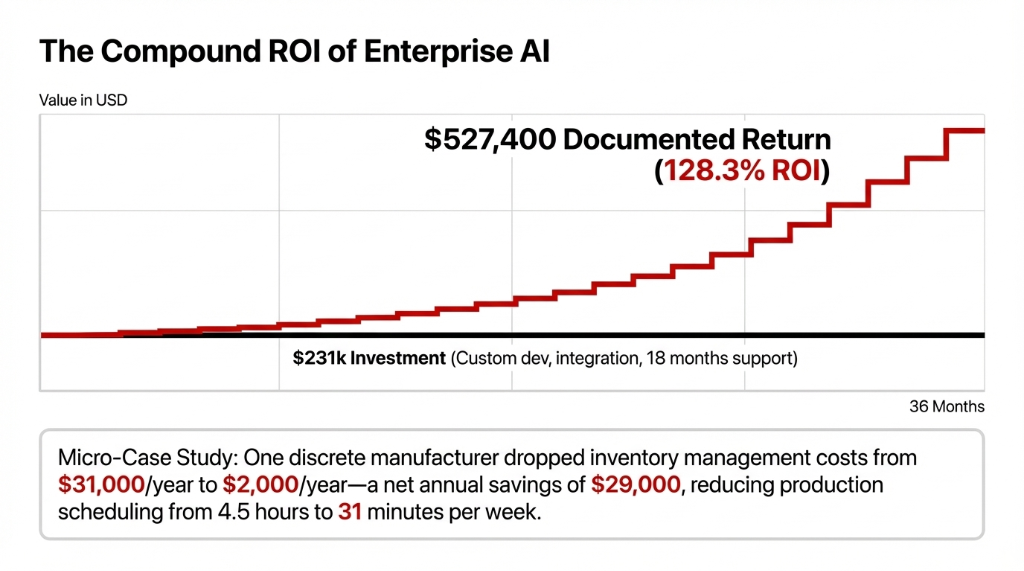
We constantly see clients who set up a new company environment in Odoo, import 11,000 customer records with duplicate entries, inconsistent business email addresses, and mismatched categories, and wonder why the AI module spits out nonsense. The ERP implementation failure rate sits at 47% primarily because of bad data migration.
The Braincuber Migration Playbook: Phase by Phase
Here is how we do this. No magic. Just a repeatable process across 150+ implementations.
Phase 1: Operational Audit (Week 1–2)
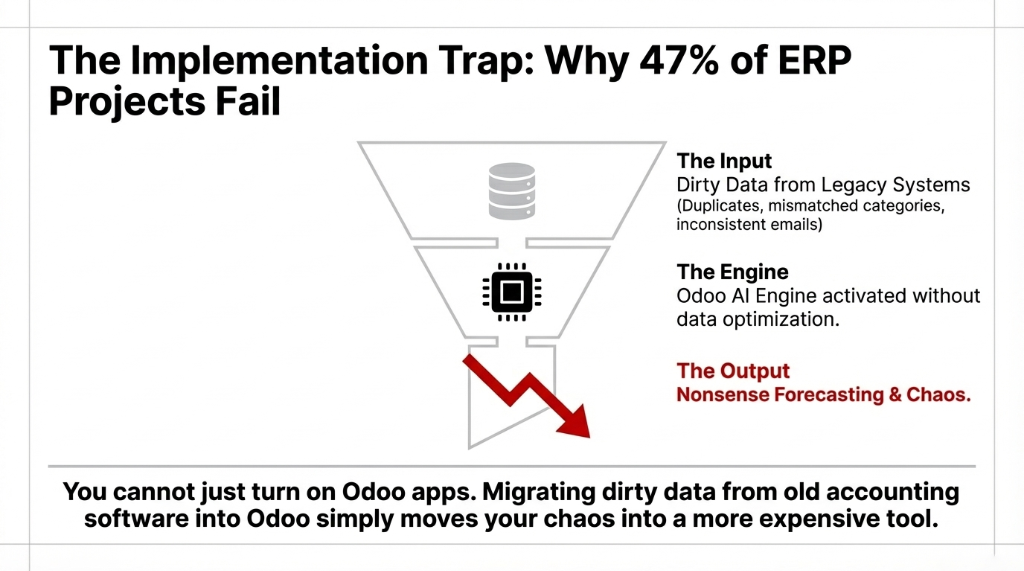
Before we touch a database migration tool, we map every manual business process. Where is time being wasted? Where is customer data duplicated? What is the lead time between an event and someone knowing about it? A mid-sized manufacturer audit found 56+ hours/month of manual data entry tying inventory software to sales. That was $227,000 in recoverable revenue hidden by disconnected data.
Phase 2: Data Cleansing and Migration (Week 3–5)
Using proper data migration software, we clean and map records before touching Odoo. We optimize database structures and align the chart of accounts for Odoo accounting. We build a contingency plan using testing staging servers so a failed migration doesn't cost you three days of downtime.
Phase 3: AI Module Configuration (Week 6–8)
Once data is live, we configure the AI layers:
- Odoo CRM gets AI lead scoring. The crm customer relationship management engine ranks probability, yielding an 85% reduction in qualification time.
- Inventory management gets demand forecasting. Stockouts drop by 65%.
- Odoo accounting gets invoice matching. Processing time drops by 75%.
- The human resource management system gets automated onboarding, cutting hiring cycle by 40%.
Phase 4: Workflow Automation (Week 8–10)
We build the workflow management system rules. A sale triggers an inventory check. A low-stock alert drafts a PO. A new record auto-populates the customer relationship management platform. We use native app integration to bridge external tools like Shopify for real-time ecommerce inventory management.
Phase 5: Timeline & Continuous Improvement (Week 10–12)
Go-live is not the end. We make a timeline for a 90-day review to audit performance and adjust AI thresholds. Continuous improvement in an enterprise resource planning system is a monthly cadence of checking what the system learned.
What the Numbers Look Like at 90 Days
| Metric | Before AI Odoo | After AI Odoo | Time Frame |
|---|---|---|---|
| Invoice processing time | 4 hrs/week | 45 min/week | 3 months |
| Inventory accuracy | 71% | 96.3% | 90 days |
| Lead qualification time | 3 hrs/day | 27 min/day | 60 days |
| Manual data entry hours | 56+ hrs/month | Under 4 hrs/month | 90 days |
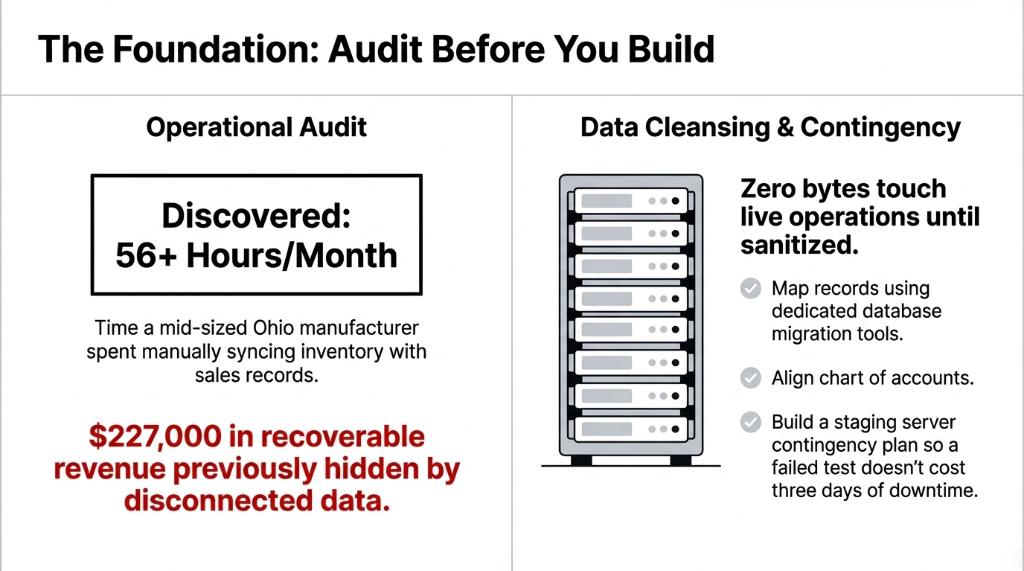
A $231,000 fully loaded automation software investment covering custom development and 18 months of Odoo support returned $527,400 in documented value over 36 months. That is a 128.3% ROI.
The Part Nobody Tells You About Going Live
The first two weeks after go-live are uncomfortable. Your team will hate the new workflow management software because it forces them out of old habits. Expect pushback.
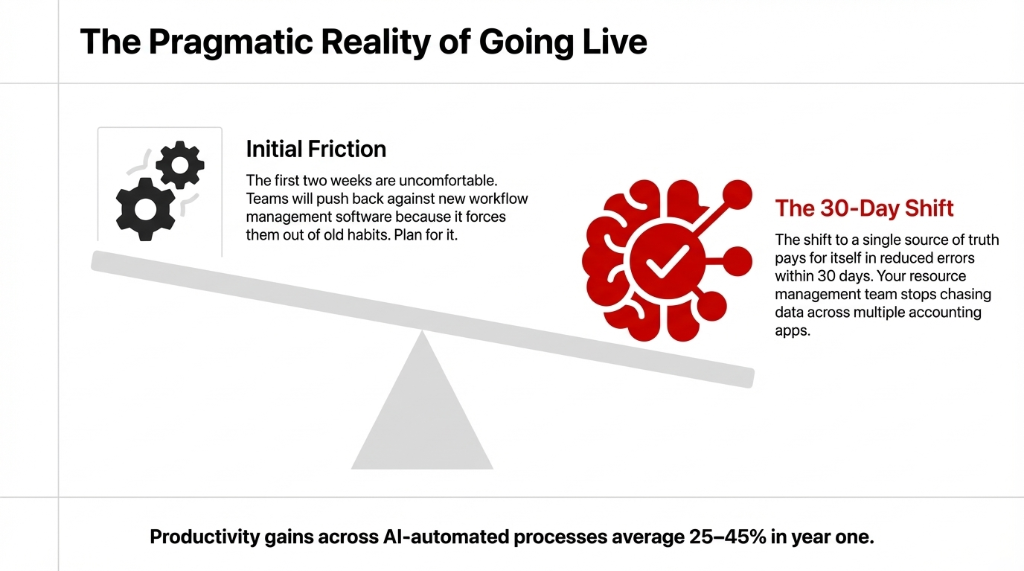
What gets easier immediately: your resource management team stops chasing data. Your sales team stops manually updating the customer management CRM. Your business management app becomes the single source of truth.
5 FAQs on Odoo AI Migration
How long does migrating from manual to AI-powered Odoo take?
For a mid-sized US business with 50-200 employees, the full migration from audit to go-live takes 10-12 weeks. Add 2-3 weeks if your old accounting software business data requires deep cleansing.
Do we have to replace all our existing tools at once?
No. We connect your stack first using data migration software and native Odoo apps. Starting with inventory management or Odoo accounting typically delivers the fastest ROI.
What happens to our historical data during migration?
Nothing is deleted. We use database migration tools to securely map your accounting platforms data to Odoo's structure, run parallel tests on staging, and validate accuracy before any cutover.
How much does AI Odoo migration cost for mid-market US companies?
A fully loaded implementation usually runs between $40,000 and $180,000. While substantial, manual operations and a disconnected inventory system likely cost you over $100,000/year currently.
What support does Braincuber provide after go-live?
We provide strict Odoo support covering AI tuning, module updates, business process optimization, and SLAs for mission-critical workflows like ecommerce inventory management integrations.
Stop Paying People to Do What Software Should Do for Free
We'll identify your single biggest manual process leak on the first call, put a dollar figure on it, and show exactly which Odoo module fixes it.
No sales pitch. Just numbers.