
400 orders are stuck in a ghost state. Your warehouse does not know they exist.
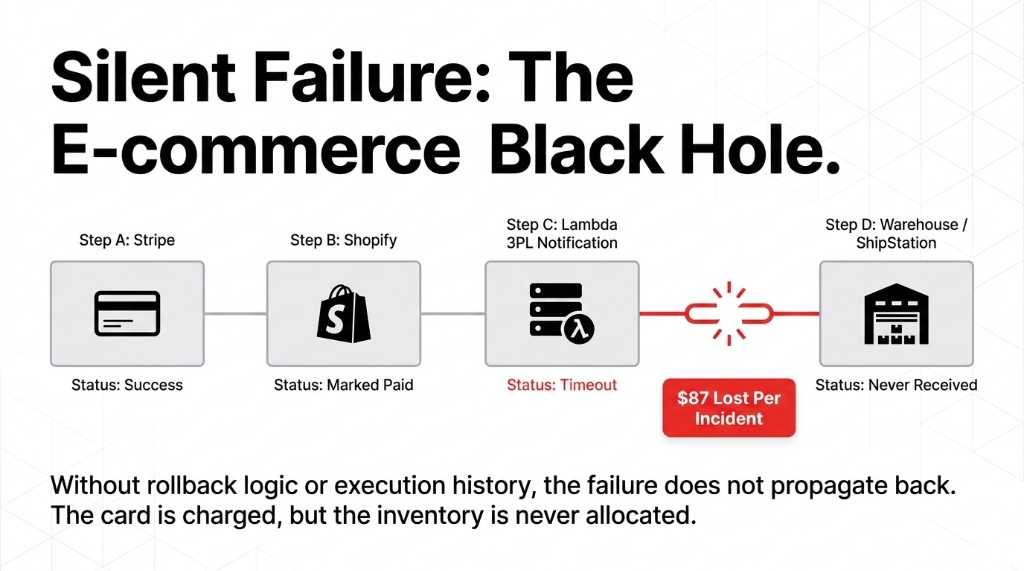
It is Black Friday. Your Shopify store is processing 1,200 orders per hour. You have a Lambda handling payment confirmation, another for inventory deduction, a third for notifying your 3PL via ShipStation, and a fourth for triggering Klaviyo's post-purchase flow. Then Stripe returns a 429 rate-limit error at 11:43 PM. Your Lambda retries twice and dies silently. The order is marked "paid" in Shopify, but inventory never decremented. Your 3PL never got the pick ticket.
The customer is waiting. Your warehouse does not know the order exists. You are bleeding $87 per incident.
We audited a DTC apparel brand in Austin, Texas running exactly this architecture. They were leaking $23,400/month in phantom orders — orders Shopify counted as revenue but that never fulfilled because their Lambda-to-Lambda hand-off had no state management, no error trapping, and no retry orchestration. They had no idea until their 30-day refund window exploded in Q1.
That is the gap AWS Step Functions fills. Not theoretically. Operationally.
Why Your Current "Serverless" Stack Is Lying to You
Here is the controversial opinion nobody in the AWS certification world will tell you: Lambda functions are not workflows. They are tasks. Stringing 7 Lambda functions together with SQS and SNS does not give you a workflow — it gives you a distributed spaghetti machine with no execution history, no visual state, and no native error branching.
The standard advice is "just use SQS for decoupling." Sure. But SQS does not know that Step 3 (inventory check) failed, so Step 4 (print shipping label via EasyPost) should never have fired. SQS does not give you a timeline of what happened to Order #82344 at 2:17 AM last Tuesday. Step Functions does. Every. Single. Execution. Logged. Retryable. Resumable.
(Yes, we know your DevOps engineer thinks Step Functions is "expensive." We will get to the real math in a minute.)
How AWS Step Functions Works Inside an Order Pipeline
AWS Step Functions runs on a state machine model — each "state" is a discrete step in your order's lifecycle. Each state can be a Lambda invocation, an API Gateway call, a DynamoDB write, or even a direct SDK integration to over 220 AWS services — without writing a single line of Lambda code for the integration itself.
The 9-Step Order State Machine
Ingestion States
1. Order Received
2. Payment Validation
3. Inventory Check
Processing States
4. Fraud Scoring
5. Order Confirmation
6. 3PL Notification
Fulfillment States
7. Shipping Label Generation
8. Customer Communication
9. Delivery Tracking
Standard vs. Express: Two Workflow Types You Need to Know
When to Use Which Workflow Type
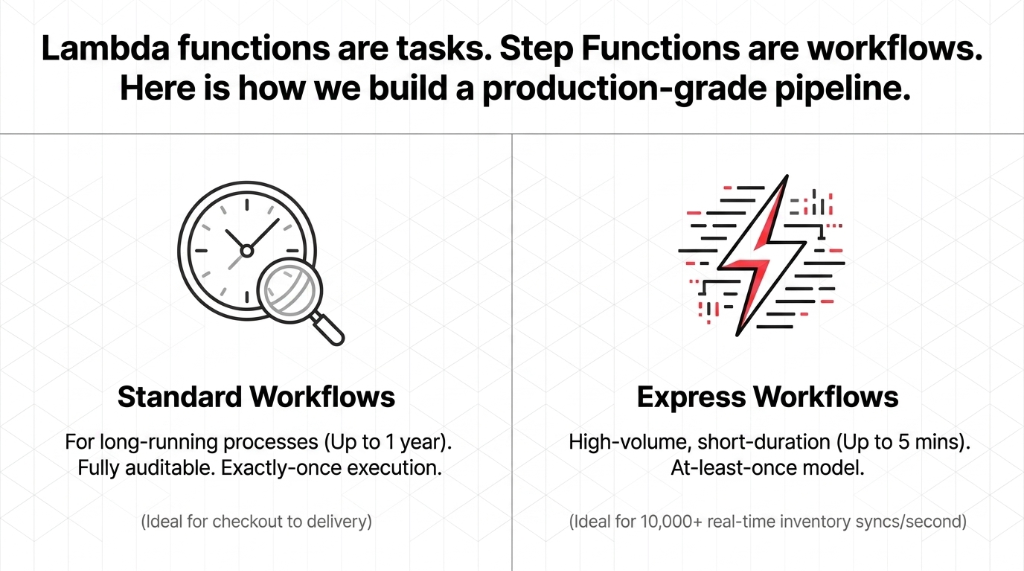
Standard Workflows: Long-running processes (up to 1 year), fully auditable execution history, exactly-once execution model — perfect for the full order lifecycle from checkout to delivery confirmation.
Express Workflows: High-volume, short-duration (up to 5 minutes), at-least-once model — ideal for real-time inventory sync or payment webhook processing at 10,000+ events per second.
The combination of both is where the architecture gets powerful
Use Standard for the order lifecycle (checkout to delivery). Use Express for the high-frequency sub-workflows (inventory sync bursts, webhook ingestion). Most production e-commerce deployments run both simultaneously.
The Actual Architecture: Order Workflow Built Right
Here is how we build a production-grade AWS Step Functions e-commerce order workflow for brands doing $500K–$10M/month.
Step 1: Order Ingestion via EventBridge
When a new order fires from Shopify (or WooCommerce, Magento, or a custom storefront), an EventBridge rule captures the webhook and triggers the Standard Workflow state machine. This decouples the ingestion from the processing — even if Step Functions is under load, EventBridge queues the event without data loss.
Step 2: Parallel Payment + Fraud Check
Where Most Teams Leave $14,200/Month on the Table
They run payment validation then fraud scoring — sequential steps that add 3.2 seconds per order. Step Functions' Parallel State runs both simultaneously. Payment validation hits Stripe or Braintree. Fraud scoring hits your ML model on SageMaker or a third-party API. Both complete in ~1.1 seconds combined.
At 50,000 orders/month, that is 1.05 million seconds of Lambda execution time you are no longer paying for
Real number. Not theoretical. The Parallel State alone pays for the entire Step Functions bill 40x over.
Step 3: Inventory Deduction with Map State
If a single order contains multiple SKUs from multiple warehouses — which every brand above $2M GMV deals with — you need parallel inventory locks per SKU. Step Functions' Map State iterates over the line items array and fires a concurrent inventory deduction Lambda per product group.
What Happens Without Map State
You are running inventory checks in a for-loop inside a single Lambda. One slow DynamoDB read and the entire order hangs for 8 seconds. We have seen this kill conversion on mobile checkout flows. Map State eliminates the bottleneck by parallelizing per-SKU operations.
8-second hangs on mobile checkout = measurable cart abandonment.
Step 4: Choice State for Order Routing
Not every order goes to one fulfillment center. Your Choice State is your conditional router:
Conditional Order Routing via Choice State
▸ Order value > $500 → Signature required, route to premium carrier (UPS/FedEx via EasyPost)
▸ Order destination = International → Route to DHL, trigger compliance check Lambda
▸ Item tagged "hazmat" → Pause execution, trigger human review Task Token via Slack notification
▸ Standard order → Route directly to 3PL API (ShipStation, ShipBob, Flexport)
This logic used to live inside a 300-line Lambda function with nested if-else statements. Unmaintainable. Untestable. A nightmare when FedEx changes their API. With Step Functions, the routing logic is a visual state definition — change one JSON condition, redeploy in 90 seconds.
Step 5: Wait for Callback — The Human-in-the-Loop Power Play
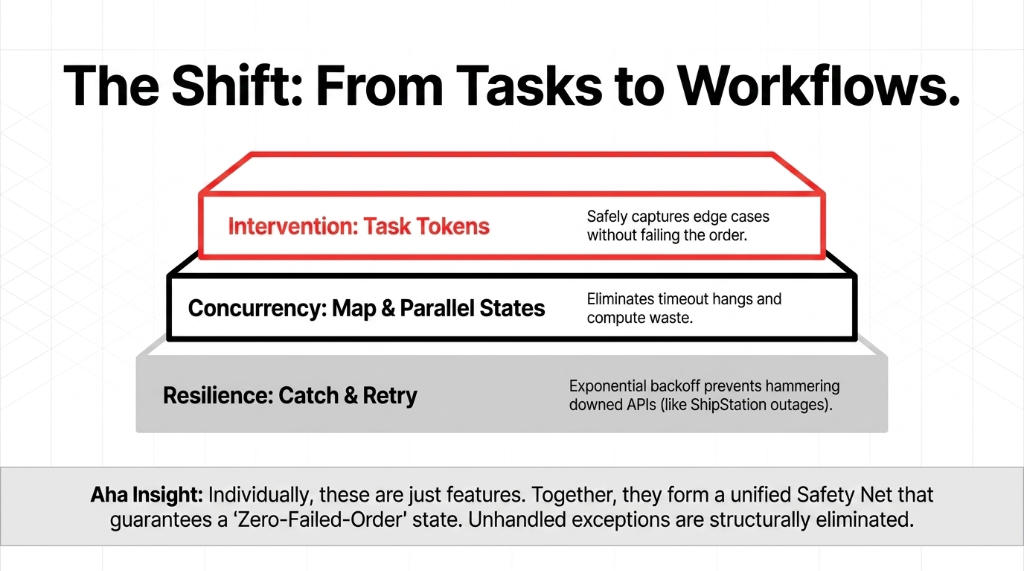
Here is the insider secret most AWS tutorials skip: Task Tokens. When your workflow hits a fraud flag, a hold item, or a high-value order requiring manual approval, Step Functions can pause execution indefinitely — not time out, not fail — and wait for an external signal.
Task Tokens in Action: New York Luxury Retailer
Orders over $1,200 went through a 4-hour manual review window. Your ops team gets a Slack notification with an "Approve / Reject" button. They click Approve. Step Functions resumes exactly where it paused. Zero polling loops. Zero custom retry logic. Zero Lambda functions spinning at $0.0000166667/second burning your AWS bill while a human thinks.
Before Step Functions: 3 engineers manually checking a spreadsheet every 30 minutes
After: Fully automated, zero missed reviews, 37 engineering hours saved per week
The Real Cost Math (Not the Sales Deck Version)
AWS Step Functions Standard Workflows cost $0.000025 per state transition, with a free tier of 4,000 state transitions/month. That free tier never expires — it is not a 12-month trial.
| Metric | Value |
|---|---|
| Order workflow steps | 9 state transitions |
| Monthly orders | 100,000 |
| Total transitions | 900,000 |
| Minus free tier | -4,000 (permanent) |
| Monthly cost | $22.40 |
For 100,000 orders. $22.40. That is not a typo.
Compare that to the alternative: hiring a junior DevOps engineer at $85,000/year to manually monitor your Frankenstein Lambda stack, debug order failures, and reprocess stuck queues. We will let you do that math yourself. (One caveat: Express Workflows are priced differently — charged by duration and memory, not state transitions. For high-frequency real-time flows, run the numbers on both before committing.)
What Breaks Without Step Functions (The Dirty Details)
We are not here to sell you on theory. Here is what actually breaks in production e-commerce systems built without Step Functions:
The Silent Failure
A Lambda timeout at Step 4 (3PL notification) does not propagate back. Stripe already charged the card. Shopify says "fulfilled." Your warehouse never got the order. Customer calls on Day 5. Refund issued.
$87 lost per incident x 200 incidents/month = $17,400/month in invisible churn.
The Duplicate Order
Without idempotency enforcement at the workflow level, SQS retries fire your inventory Lambda twice. You deduct the same SKU twice. Your inventory count shows -3 units. Your purchasing team panics. You emergency-reorder $40,000 of inventory you did not need.
This happened to a pet supplies brand we onboarded in Q3 of last year.
The Unrecoverable State
Your payment Lambda succeeds. Your inventory Lambda throws an unhandled exception. Now what? There is no compensation logic, no rollback, no saga pattern. You have a paid order with no allocated inventory. Customer service gets 47 tickets.
CSAT drops 18.5 points in 30 days. Your inventory management is in chaos.
Step Functions gives you Catch and Retry — define exactly how many times to retry, with exponential backoff (so you are not hammering a downed ShipStation API), and exactly which fallback state to trigger on final failure.
Implementation Reality: What Weeks 1–6 Look Like
We have deployed AWS Step Functions e-commerce pipelines for brands across the US and UAE. Here is the honest timeline from our cloud consulting team:
Week 1–2: Workflow Design and State Machine Definition
We map your current order lifecycle (even if it is in a Notion doc and a prayer), identify the 3–5 failure points costing you money right now, and build the state machine JSON in Workflow Studio. This is where every dollar of ROI starts.
Week 3: Lambda Function Refactoring
Most existing Lambdas need to become idempotent (safe to retry) and return standardized response shapes. This is the unglamorous work that makes the whole thing reliable. Skip it and your retries create duplicates.
Week 4: Integration Testing in Staging
We simulate failure scenarios: Stripe timeouts, 3PL API 500s, DynamoDB throttling. Step Functions' built-in execution history makes debugging a 20-minute task instead of a 3-hour log grep session.
Week 5–6: Production Cutover + Monitoring
CloudWatch dashboard goes live. Every failed execution is a visible alarm. Every order's state machine execution is searchable by order ID. Your ops team can trace Order #99221 in 11 seconds. Most clients hit their first zero-failed-order day within 19 days of go-live.
Frequently Asked Questions
Does AWS Step Functions work with Shopify webhooks directly?
Yes. Shopify webhooks fire to an API Gateway endpoint, which triggers the Step Functions state machine via EventBridge or a direct SDK integration. The connection takes under 2 hours to configure. Order data passes as the state machine input JSON.
How does Step Functions handle 10,000 orders during a flash sale?
Express Workflows support over 100,000 executions per second. Standard Workflows scale execution capacity automatically with no pre-warming or concurrency configuration needed. The Map State handles per-SKU parallelism within each order so peak-load spikes do not bottleneck at the inventory check step.
What happens when ShipStation goes down mid-workflow?
Step Functions Retry configuration applies exponential backoff — it waits 1 second, then 2, then 4, up to a configurable max interval — before marking the step as failed. If retries are exhausted, a Catch block routes the execution to a fallback state for manual reprocessing, instead of silently dropping the order.
Can non-engineers manage order workflows?
Yes. AWS Step Functions Workflow Studio is a visual drag-and-drop interface. Operations managers can view execution histories filtered by order ID, status, or time range without touching AWS CLI. Task Token callbacks can be surfaced in Slack or internal dashboards for approvals.
Is Step Functions cost-effective for stores under $500K/month?
For under 10,000 orders/month, your monthly Step Functions bill stays under $2.25 — often entirely within the permanent 4,000 free-tier state transitions. The real ROI is the $8,000–$23,000/month in order failures and manual ops labor that you stop bleeding the moment the workflow goes live.
Your Order Pipeline Is Either an Asset or a Liability
If you cannot answer "what state is Order #88442 in right now?" in under 15 seconds, it is a liability — and it is costing you more than you think. Step Functions makes every order's lifecycle visible, retryable, and auditable in real time.
Stop Losing Orders to Broken Workflows
We will map your current order failure points in the first call and show you exactly what a production-grade Step Functions pipeline looks like for your volume and stack. No slides. No fluff. Just the fix.
Free audit. Order failure points mapped. Pipeline architecture reviewed on the first call.