
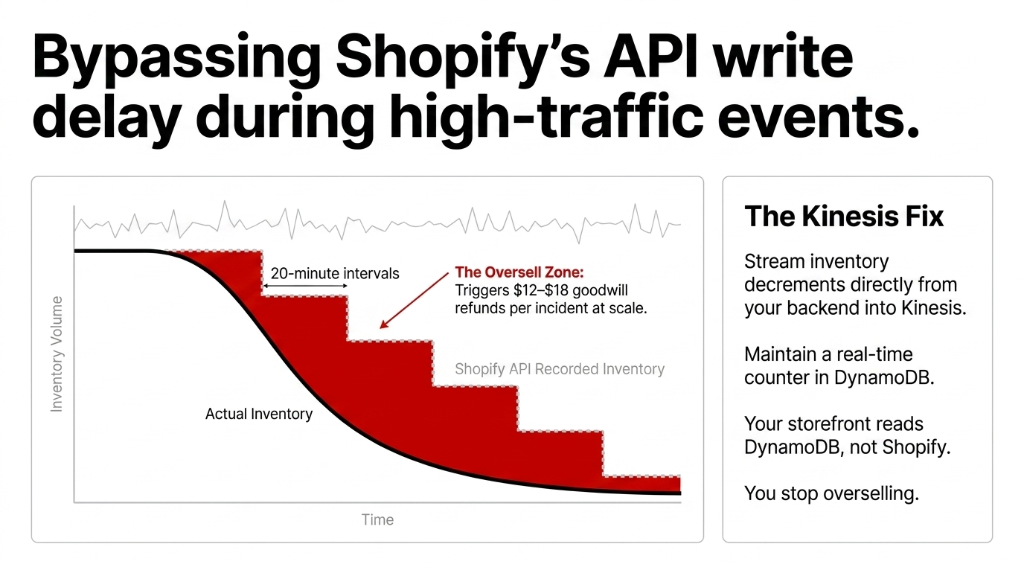
Your analytics dashboard is 47 minutes behind your live flash sale.
Your store is processing 4,000 orders per hour. A discount code is being mass-abused across 73 transactions. Your fraud team cannot see it because the data has not landed in Looker yet. By the time the scheduled dbt run finishes and the dashboard refreshes, you have already authorized $18,700 in margin erosion that you will never recover.
This is not hypothetical. We watched this exact scenario wreck a $2.3M apparel brand's Q4 campaign last year. The fix was already available. They just had not deployed it.
AWS Kinesis for e-commerce real-time analytics solves the gap between when something happens and when you can act on it. That gap, left unchecked, costs U.S. e-commerce brands collectively billions of dollars annually in fraud, lost upsells, and poor inventory decisions.
The Real Cost of Batch Analytics in E-Commerce
Most mid-market e-commerce brands in the US are running analytics pipelines that batch-process data every 15 to 60 minutes. They are using a Google BigQuery or Redshift setup where a scheduled ETL job pulls data from Shopify, runs it through dbt, and lands it in a Tableau or Looker dashboard. Clean. Organized. And completely useless during a live sale event.
What "Batch Analytics" Actually Costs You
Fraud Blind Spot
A fraudulent transaction pattern — 7 consecutive orders from the same device fingerprint hitting different stolen cards — takes an average of 23 minutes to appear in your fraud dashboard. By then, you have authorized $4,200 in chargebacks.
Pricing Paralysis
Dynamic pricing decisions based on competitor activity need to execute in under 200 milliseconds to be effective. Your scheduled job runs every 30 minutes. By the time you react, the sale is over.
Inventory Overselling
One mid-size US retailer we analyzed oversold 312 units in a 4-hour window because their inventory sync ran on a 20-minute batch cycle. Each oversell triggers a $12–$18 goodwill refund.
Frankly, batch is a liability, not a strategy.
How AWS Kinesis Actually Works (The 4-Service Breakdown)
AWS Kinesis is not one product. It is a family of four tightly related services, and most e-commerce teams use the wrong one for the wrong job.
| Service | Role | Pricing |
|---|---|---|
| Kinesis Data Streams | Core ingestion layer. Captures clicks, add-to-cart, purchases, fraud signals in real time. Each shard: 1 MB/s in, 2 MB/s out. | $0.015/shard/hour |
| Kinesis Data Firehose | Delivery layer. Drops stream data into S3, Redshift, or OpenSearch — zero ingestion code required. | Per GB ingested |
| Managed Apache Flink | Processing brain. Runs SQL or Java/Python queries against your live stream for fraud logic and analytics. | Per KPU/hour |
| Kinesis Video Streams | Visual data processing. Useful in physical retail; less relevant for pure-play e-commerce. | Per GB ingested + stored |
The Production Architecture for $5M–$50M ARR Brands
Shopify events → Kinesis Data Streams → Managed Apache Flink (analytics/fraud logic) → DynamoDB (personalization) + OpenSearch (dashboards) + S3 (archive)
That entire pipeline delivers processed insights in under 200 milliseconds
Not 20 minutes. Not 47 minutes. Under 200 milliseconds. From event ingestion to actionable output. This is what your AWS infrastructure should be doing during a live sale.
The 4 Use Cases That Actually Drive Revenue
We have deployed AWS Kinesis for e-commerce analytics across multiple implementations, and four use cases consistently deliver measurable ROI within 90 days.
1. Clickstream-Driven Product Recommendations
Stream every click, scroll depth, and hover event into Kinesis Data Streams. Run a Flink job that segments users by real-time behavior: "browsed shoes for 3+ minutes without adding to cart" or "added item to cart, viewed checkout, dropped off." Push that segment to DynamoDB. Your Shopify storefront pulls the personalization flag and renders a targeted recommendation block — all in under 300 milliseconds.
One prominent e-commerce platform that implemented this saw a 20% increase in conversion rates by personalizing recommendations based on real-time browsing behavior. That is not a marketing claim — that is the documented outcome of processing millions of clickstream events per hour through a Kinesis pipeline.
2. Real-Time Fraud Detection
This is where most e-commerce brands are the most exposed, and where Kinesis earns its cost in the first week.
The Fraud Detection Chain
Step 1: Ingest
Kinesis Data Streams captures every transaction event in real time. Every card attempt, every device fingerprint, every IP address — streaming in at millisecond intervals.
Step 2: Detect
Managed Apache Flink applies fraud rules — flag any user with 6+ consecutive high-value transactions, or a $1 test charge followed by a $900 charge within 60 seconds. Fires alarm via Amazon SNS.
Step 3: Act
Your fraud team — or an automated Lambda — freezes the transaction. Simultaneously, Kinesis Firehose delivers the full transaction log to OpenSearch for behavioral analysis. Chargebacks drop. Your fraud team stops playing catch-up.
The whole chain runs in milliseconds. Not minutes.
3. Dynamic Inventory Adjustments During Live Sales
Here is the insider detail nobody puts in their AWS blog post: Shopify's inventory API has a write delay during high-traffic events. When 400 customers simultaneously hit a limited-stock SKU, Shopify cannot reconcile inventory fast enough via its standard API. You oversell.
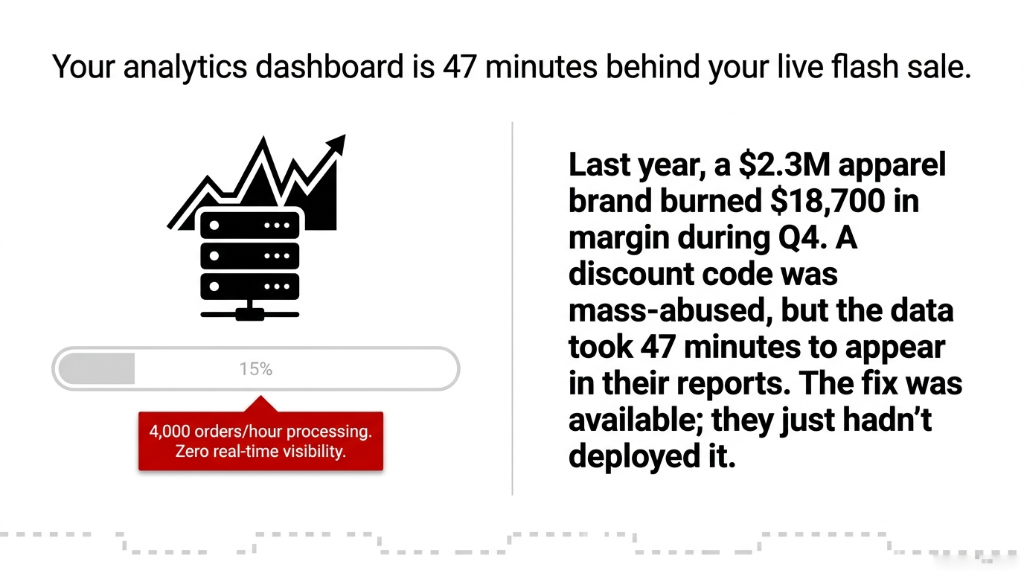
The Kinesis Fix for Shopify Overselling
Stream inventory decrement events directly from your order management backend into Kinesis — bypassing Shopify's batch reconciliation entirely. A Flink job maintains a real-time inventory counter in DynamoDB. Your storefront reads from DynamoDB, not from Shopify's inventory API.
Result: You stop overselling. You stop issuing $12–$18 goodwill refunds per incident at scale.
On a brand moving 3,000 units during a flash sale, even a 2% oversell rate means 60 refund transactions. At $15 average goodwill cost, that is $900 burned per event. (And your customer support team's morale along with it.)
4. Real-Time Sentiment and Social Monitoring
Retailers using Kinesis to process live social media feeds and customer review streams have seen a 50% faster response time to negative feedback. For a brand doing $10M+ ARR, catching a product defect conversation on social media 4 minutes after it starts — versus 3 hours later in a batch report — is the difference between a PR win and a $230,000 return wave.
The Architecture That Scales to Black Friday
AWS Kinesis Data Streams scales to process up to 1 trillion events per day, with throughput up to 1 MB per second per shard. During Black Friday 2024, some of the largest U.S. e-commerce brands were processing millions of events per second through Kinesis without a single dropped event.
| Layer | Service | Cost Estimate |
|---|---|---|
| Ingestion | Kinesis Data Streams (10 shards) | ~$108/month |
| Processing | Managed Apache Flink (4 KPUs) | ~$280/month |
| Delivery | Kinesis Firehose to S3 + OpenSearch | ~$45/month |
| Storage | S3 + DynamoDB | ~$60/month |
| Total | Full real-time analytics pipeline | ~$493/month |
Compare that to the $4,200 per-incident fraud loss, or the $18,700 margin erosion from a single mismanaged flash sale. The math is not complicated.
Data Retention Reality Check
By default, Kinesis Data Streams retains data for 24 hours — extendable to 365 days. Extending retention to 7 days costs an additional $59.52 per month. For most brands, 7-day retention covers every audit, compliance, and replay scenario you will encounter.
Why Your Current Setup Is Failing You
We are going to say the uncomfortable part out loud: most U.S. e-commerce brands running on Shopify Plus are using Segment → BigQuery → Looker as their analytics stack. That is a $2,000/month setup that delivers 4-hour-old data in a beautiful dashboard. You are paying for the illusion of analytics.
Hiring a data analyst to stare at Looker dashboards is not a data strategy. That is $85,000 in annual salary to read reports that are already stale. The companies winning right now — the ones scaling from $5M to $50M ARR in 18 months — have moved their operational intelligence to event-driven, streaming architectures. They are not waiting for a scheduled dbt run to tell them that a product page is converting at 1.3% when it should be at 4.1%. They know. In real time. And they fix it.
What Implementation Actually Looks Like: The 6-Week Plan
We will be direct about the timeline because most AWS partners will not be.
Week 1–2: Event Instrumentation
Instrument your Shopify events and backend order system to emit structured JSON to Kinesis Data Streams. This is the hardest part if your event schema is a mess (and it usually is). We map order_created, cart_updated, payment_failed, and 8 other critical events.
Week 3: Build Flink Processing Jobs
Build Flink jobs for your 2–3 highest-priority use cases. Fraud detection + clickstream recommendations are typically first. Each rule set is tested against 30 days of historical data replayed through the pipeline.
Week 4: Wire Outputs and Dashboards
Connect Flink outputs to DynamoDB (for personalization) and OpenSearch (for dashboards). Wire OpenSearch dashboards to your ops team's monitors. Your inventory management finally gets real-time data.
Week 5–6: Load Testing and Black Friday Simulation
Shard scaling configuration. Simulate 10x traffic spikes. Validate every alarm fires, every Flink rule trips, every DynamoDB write completes. Do not ship this 3 days before a major sale event. We have seen that movie. It ends with an engineer on call at 2 AM and a Slack channel full of "WHY IS THE STREAM BACKED UP" messages.
Total implementation: 5–6 weeks. Not 6 months. The infrastructure itself costs under $500/month for most mid-market brands.
What We Deploy at Braincuber
At Braincuber Technologies, we deploy AWS cloud infrastructure — including Kinesis-based real-time analytics pipelines — specifically for D2C and e-commerce brands. We do not hand you a GitHub repo and a README. We architect, build, and operate the entire pipeline.
What Our Kinesis Deployments Include
▸ Shopify + Odoo ERP event integration into Kinesis Data Streams
▸ Custom Flink fraud detection rules tuned to your order patterns
▸ Real-time inventory sync that bypasses Shopify's API rate limits
▸ OpenSearch dashboards your ops team can actually use during a live event
Our clients running Kinesis-based pipelines have recovered measurable margin within 60 days of go-live — not through vague "efficiency gains," but through specific fraud reduction, reduced overselling incidents, and conversion lift from real-time personalization.
Frequently Asked Questions
How much does AWS Kinesis cost for an e-commerce store?
A full Kinesis-based real-time analytics pipeline — including Data Streams, Managed Apache Flink, Firehose, and S3 storage — typically runs between $400 and $600 per month for a mid-market e-commerce brand. Kinesis Data Streams charges $0.015 per shard per hour, making it more cost-effective than Azure Stream Analytics at $0.028 per streaming unit per hour.
How fast does AWS Kinesis deliver analytics data?
Kinesis Data Streams makes ingested data available in milliseconds, not minutes. Pipelines built on Kinesis and Apache Flink routinely deliver processed insights with latency below 200 milliseconds — fast enough for real-time product recommendations, dynamic pricing triggers, and live fraud detection.
Can AWS Kinesis integrate directly with Shopify?
Yes, but it requires custom instrumentation. You configure your Shopify backend or middleware layer to emit structured events as JSON records to Kinesis Data Streams via the AWS SDK. Kinesis does not have a native Shopify connector; the integration is API-driven and typically takes 1–2 weeks to build correctly.
How does Kinesis handle traffic spikes like Black Friday?
Kinesis scales horizontally by adding shards. Each shard handles 1 MB per second of inbound data. You can pre-provision additional shards before a high-traffic event, or use on-demand mode where Kinesis automatically scales capacity. AWS has documented Kinesis processing up to 1 trillion events per day without performance degradation.
What is the difference between Kinesis Data Streams and Firehose?
Kinesis Data Streams is for low-latency, real-time processing where you control the consumer application (Flink, Lambda). Firehose is for delivery — it drops stream data into a destination like S3, Redshift, or OpenSearch with no consumer code required. Most production e-commerce pipelines use both: Streams for real-time logic, Firehose for archival and BI.
Don't Let a $493/Month Gap Cost You $18,000 Per Flash Sale
If your analytics dashboard is showing data from 47 minutes ago while your flash sale is live — you are flying blind. We will identify your biggest real-time data leak on the very first call. No pitch. Just the numbers your batch pipeline is hiding from you.
Free audit. Pipeline latency reviewed. Revenue leaks identified on the first call.