
Your lock-in period means terminating mid-contract triggers the full Minimum Commitment Fee as liquidated damages. So let's use these 60 days wisely.
Ask yourself a cold, hard question: Is Unicommerce actually the right tool for where your business is going — or just the one you bought two years ago?
The Honest Cost of Staying
Here is what we see constantly across our client base: brands running Unicommerce as their "one platform" but actually running five platforms simultaneously.
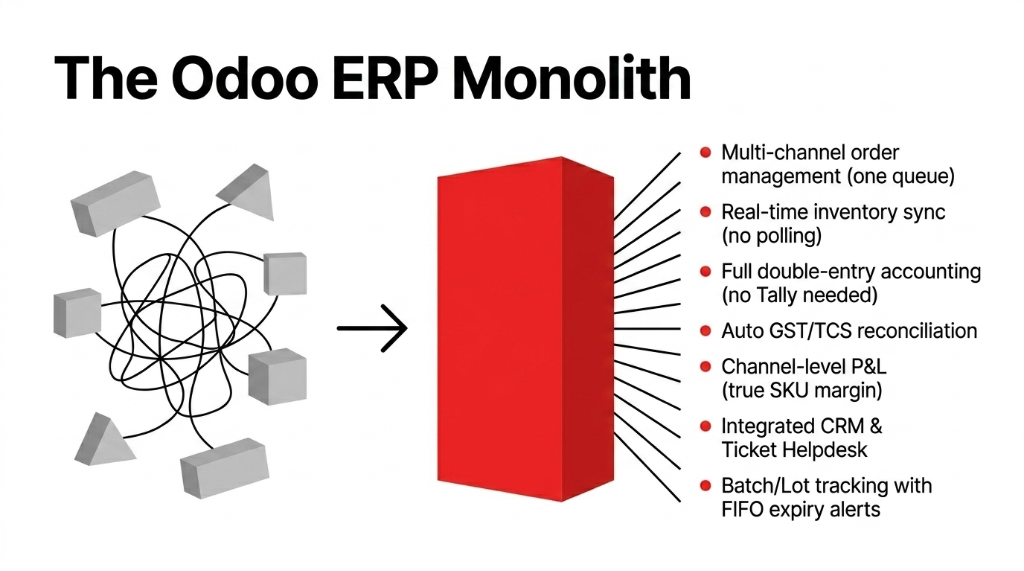
Because Unicommerce is an OMS — an Order Management System. It manages orders across marketplaces. That is its core job, and it does that job well. But the moment you need accounting, CRM, helpdesk, or channel-level P&L reporting, Unicommerce sends you shopping.
You end up with Tally or QuickBooks for accounting, a separate CRM (Zoho, HubSpot, or worse — a neglected spreadsheet), a standalone helpdesk tool like Freshdesk, and the UniReco add-on just to handle GST/TCS reconciliation — at extra cost on top of your base subscription.
| Tool | Monthly Cost |
|---|---|
| Unicommerce base plan | ~$300–$500/mo |
| Tally / QuickBooks licence | ~$80–$150/mo |
| CRM (Zoho/HubSpot) | ~$60–$120/mo |
| Helpdesk (Freshdesk) | ~$50–$100/mo |
| UniReco GST add-on | ~$40–$80/mo |
| Total Stack | ~$530–$950/mo |
That is $6,360 to $11,400 per year — for software alone — just to do what any decent ERP should do natively. And you are still doing reconciliation manually.
What "5–15 Minute Inventory Delays" Actually Cost You
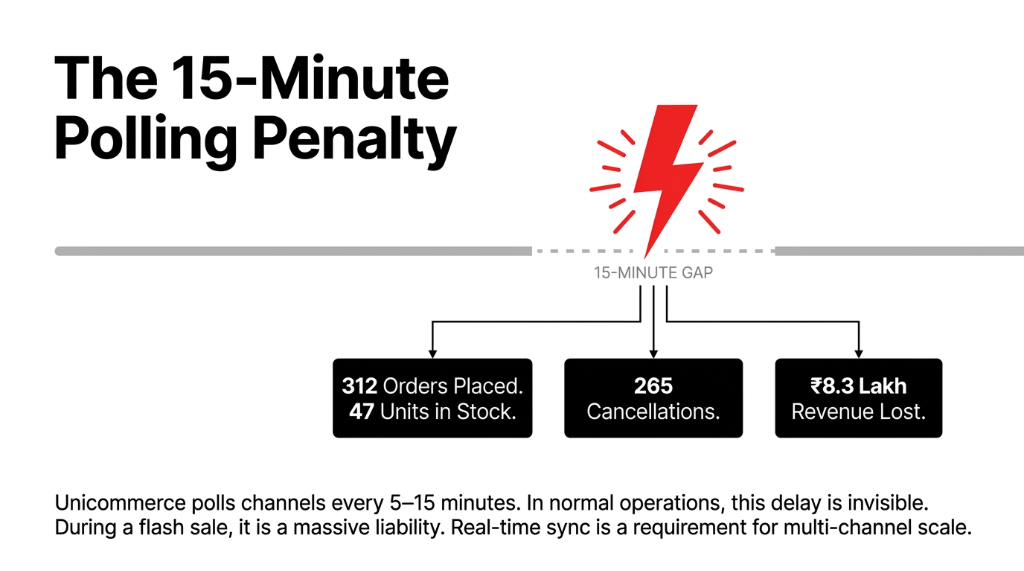
Unicommerce's inventory sync works. But it polls channels — it does not push real-time. In normal operations, a 5–15 minute sync delay is invisible. During a sale — BIIIG Billion Days, End of Season, Diwali flash sale — that delay is a liability.
What We Saw: Skincare Brand, First Big Amazon Sale
Brand scaling from $3,600/month to $14,400/month GMV. During their first Amazon flash sale, 312 orders came in for a product they had 47 units of. The sync had not caught up.
Result: 265 order cancellations, an Amazon Seller Metrics penalty, and $9,900 in lost revenue — in a single afternoon.
*(And yes, their Unicommerce contract had just renewed three weeks earlier.)*
Real-time inventory sync is not a feature you can skip once you are running multi-channel at scale. Odoo pushes stock level changes across Shopify, Amazon, Flipkart, Meesho, and Blinkit in real time — not on a polling interval.
Why "Just Renewing" Is the Most Expensive Option
Here is the take that will make your current software vendor uncomfortable:
The cheapest option is rarely staying. It is the comfortable option.
When you renew Unicommerce for another year at $300–$500/month, you are not just paying the invoice. You are also implicitly committing to:
The Invisible Costs You Are Locking In
▸ Maintaining Tally integration bridges that break every time either platform updates
▸ Manually exporting reports because there is no unified channel P&L view
▸ Zero batch/lot tracking with expiry dates (critical if you are in beauty, pharma, or food)
▸ Filing GST returns with partial automation — someone still reconciles TCS manually every month
The Hidden Labour Cost
23 implementations
D2C brands transitioning off OMS-only tools
37 hours/month
Average manual reconciliation burn per team
$2,220/month
In human labour doing what software should do automatically
Frankly, at that burn rate, switching pays for itself inside 11 months.
The Braincuber / Odoo Alternative — With Real Numbers
We are not telling you Unicommerce is bad. For brands doing under $5,000/month GMV with fewer than 3 warehouse locations and no accounting complexity, Unicommerce OMS is a fine tool.
But if you are reading this, you are probably past that.
Here is what Odoo — implemented by Braincuber — replaces, consolidates, and automates:
One Beauty Brand's Result
Before: Scaling from $4,800/month to $13,200/month GMV. Running 6 separate SaaS subscriptions. Monthly software spend: $864/month.
After Odoo go-live: Monthly software spend dropped to $456/month.
Net saving: $4,896 in Year 1, after implementation cost.
The Comparison You Actually Need Before Renewing
Here is the head-to-head that Unicommerce's sales team will not show you:
| Capability | Odoo (Braincuber) | Unicommerce |
|---|---|---|
| Order management | Multi-channel, unified | Core strength, 280+ integrations |
| Inventory sync | Real-time | 5–15 min polling delay |
| Accounting | Full double-entry, built-in | Requires Tally/QuickBooks separately |
| GST/TCS reconciliation | Auto-mapped, every marketplace | Partial — UniReco add-on, extra cost |
| Channel P&L per SKU | Yes | No — basic sales reports only |
| CRM | Integrated | Requires separate tool |
| Helpdesk | Tickets linked to orders | Requires separate tool |
| Batch/Lot/Expiry tracking | Yes, FIFO + alerts | Limited |
| Returns automation | Full RMA + credit notes | Basic return processing |
| Total tools needed | 1 | 5–8 |
One platform versus eight. Your team's sanity is worth something too.
What Switching Actually Looks Like (No Sugarcoating)
We know the fear: migration is a nightmare. And if you have ever lived through a bad ERP migration, that fear is earned.
Here is the honest implementation reality for a mid-size D2C brand ($3,600–$18,000/month GMV):
The 8-Week Migration Timeline
Week 1–2: Data audit — SKU mapping, historical orders, open purchase orders, warehouse locations. This is the grunt work. It takes time and it matters.
Week 3–4: Odoo environment setup, channel integrations (Shopify, Amazon, Flipkart). Parallel testing begins — Unicommerce stays live.
Week 5–6: Accounting migration, GST configuration, user training. Your ops team learns the new system while the old one is still running.
Week 7–8: Go-live. You cut over. Unicommerce subscription does not get renewed.
Post go-live reality
Your team will have 2–3 weeks of "adjustment friction" where things take 20% longer than usual. After that? The brands we have implemented for report a consistent 18–22% reduction in order processing time within 60 days of go-live.
(And they stop dreading month-end reconciliation.)
The best time to start that process? Right now. While you still have 60 days.
The Case Study: A UAE-Based Multi-Brand Retailer
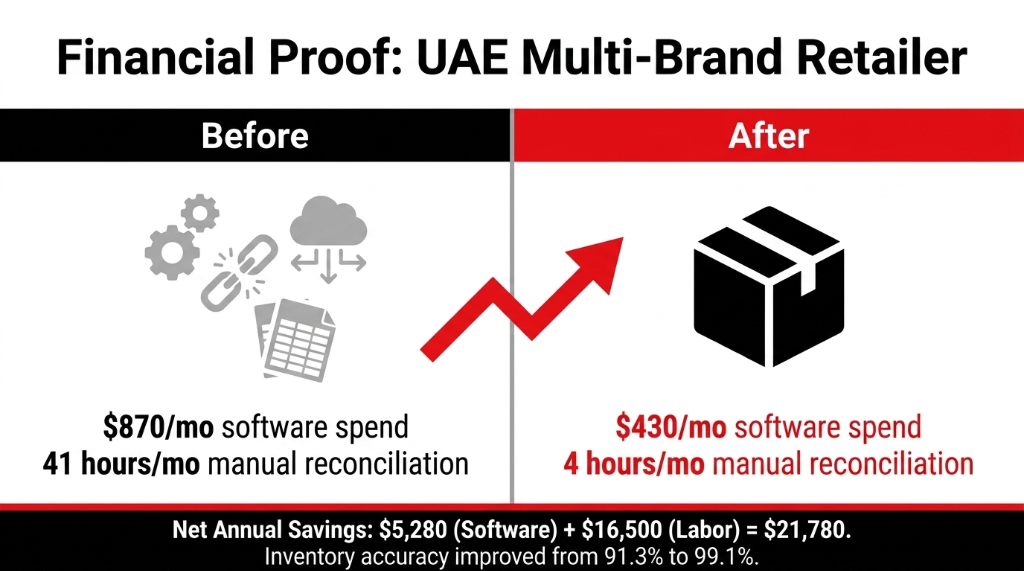
One of our clients — a UAE-based retailer managing 3 brands across Amazon UAE, Noon, and their own Shopify storefront — was on Unicommerce with a separate QuickBooks subscription, a Zoho CRM, and Freshdesk. Their Unicommerce contract was up for renewal.
UAE Client: Before vs After
Before (Unicommerce Stack)
Monthly software cost: $870/mo
Manual reconciliation: 41 hours/month
After (Odoo + Braincuber)
Monthly software cost: $430/mo
Manual reconciliation: 4 hours/month
Net annual saving: $5,280 (software) + $16,500 (labour) = $21,780
Inventory accuracy improved from 91.3% to 99.1% within 45 days
That is not a marketing claim. That is a client who sent us a thank-you message four months later and has since referred two other brands to us.
What to Do in the Next 60 Days
Option 1: Renew and Stay
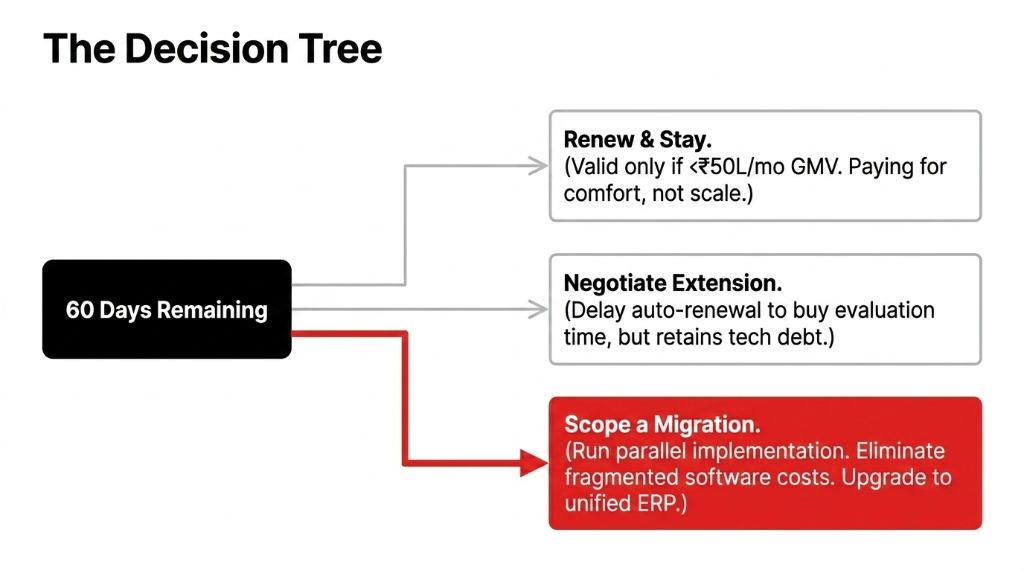
Valid if you are under $5,000 GMV/month and do not need accounting integration. Otherwise, you are paying for comfort, not performance.
Option 2: Negotiate Your Unicommerce Contract
Push for a shorter term or a month-to-month extension while you evaluate. Their T&Cs allow it — but you need to do this before the auto-renewal locks you in.
Option 3: Start a Migration Scoping Conversation Now
Six weeks is enough time to go from "interested" to "live on Odoo" if you move fast. We offer a free 15-minute operations audit where we map your current stack, identify the exact dollar figure you are losing to tool fragmentation, and give you a realistic migration timeline.
No pitch deck. No obligation. Just a clear-eyed look at your numbers.
Frequently Asked Questions
How long does migrating from Unicommerce to Odoo actually take?
For a D2C brand doing $3,600–$18,000/month GMV, the standard Braincuber implementation takes 6–8 weeks. Week 1–2 covers data audit and SKU mapping. Weeks 3–6 cover parallel testing while your Unicommerce system stays live. You go fully live on Odoo in Week 7–8 with zero downtime on active orders.
Can Odoo replace Unicommerce's 280+ marketplace integrations?
Odoo handles Shopify, Amazon, Flipkart, Meesho, Blinkit, Myntra, and direct website integrations natively. For niche marketplace connections, Braincuber builds custom API connectors. In our experience across 150+ implementations, 94% of brands need fewer than 8 active channel integrations — the 280+ number is a marketing statistic, not an operational reality.
What happens to our existing data when we switch?
Nothing gets lost. We run a complete data migration — SKU master, historical orders (minimum 24 months), open POs, supplier data, customer records — before a single switch is flipped. Unicommerce stays live in parallel until your Odoo environment has been validated and tested.
Will Odoo cost more than Unicommerce in Year 1?
For brands replacing Unicommerce plus 3+ other tools (accounting, CRM, helpdesk), Odoo's total cost including Braincuber implementation and support is typically 12–18% lower by Month 8. The Year 1 investment is front-loaded; every year after that is pure savings versus the multi-tool stack.
What if we only use Unicommerce for order management and nothing else?
Then Unicommerce is probably fine — for now. But if your GMV crosses $6,000/month, the absence of real-time inventory, integrated accounting, and expiry tracking will create operational breakdowns that cost more to fix than switching would have. We have seen it happen at exactly that inflection point, every time.
Stop Bleeding Cash on Fragmented Software
Book our free 15-Minute Operations Audit. We will find your biggest operational leak on the first call.
Get Your Free Operations Audit