
What You'll Learn From Our 150+ Implementations
1. The exact tool stack combination that creates 89% of month-end pain
2. Why hiring a "better CA" burns $35,520-$66,600/year fixing a systems problem
3. Real client data: 13 days to 2.3 days close time (UAE home goods, $4.2M revenue)
4. The industry-specific nightmares we see in Apparel, Supplements, and Home brands
5. What an 8-14 week Odoo implementation actually changes in your finance operations
The Month-End Nightmare Nobody Talks About
Here is the story we hear from almost every founder who comes to us after scaling past $1.5M ARR.
It's the 27th of the month. Your CA sends you a Slack message at 10:47 PM: "I can't close the books until I get the Shopify payout reconciliation from you." You have no idea what that means, so you forward it to your ops person. Your ops person exports a CSV from Shopify, sends it to your CA.
Your CA imports it into QuickBooks. QuickBooks doesn't match it against the bank statement because the dates are offset by 3 days *(Shopify batches payouts, not individual transactions — your CA has been manually adjusting for this every single month for the past 14 months).*
Then the inventory data. Your warehouse is on a separate system — let's say ShipStation or a basic WMS — that doesn't talk to QuickBooks in real time. So your CA has to manually enter COGS adjustments. If your warehouse team typed a "0" instead of an "O" in a SKU field, your CA now has $3,700 worth of inventory that exists in the system but cannot be found on the shelf.
The Returns Black Hole
Real Client Data: A D2C skincare brand in the UK doing $2.1M/year was sitting on $14,200 in un-reconciled return credits every single month. Shopify returns don't automatically reverse the revenue recognition. Every return sits as an unreconciled entry until someone manually matches it.
Not because their CA was incompetent.
Because their tools didn't talk to each other.
The month-end isn't late because your CA is slow. It's late because your tools were designed for someone else's business.
The Tool Stack That's Killing Your Finance Team
Let's name names. The most common "scaling D2C" stack we see looks like this:
The Typical Fragmented Stack
▸ Shopify for orders and inventory
▸ QuickBooks Online for accounting
▸ ShipStation for fulfillment
▸ Klaviyo for email/revenue attribution
▸ A Google Sheet for "everything else"
▸ Three Zapier automations that break every time either platform updates its API
This stack works fine at $400k ARR. At $2M ARR, it becomes a $23,000/year problem.
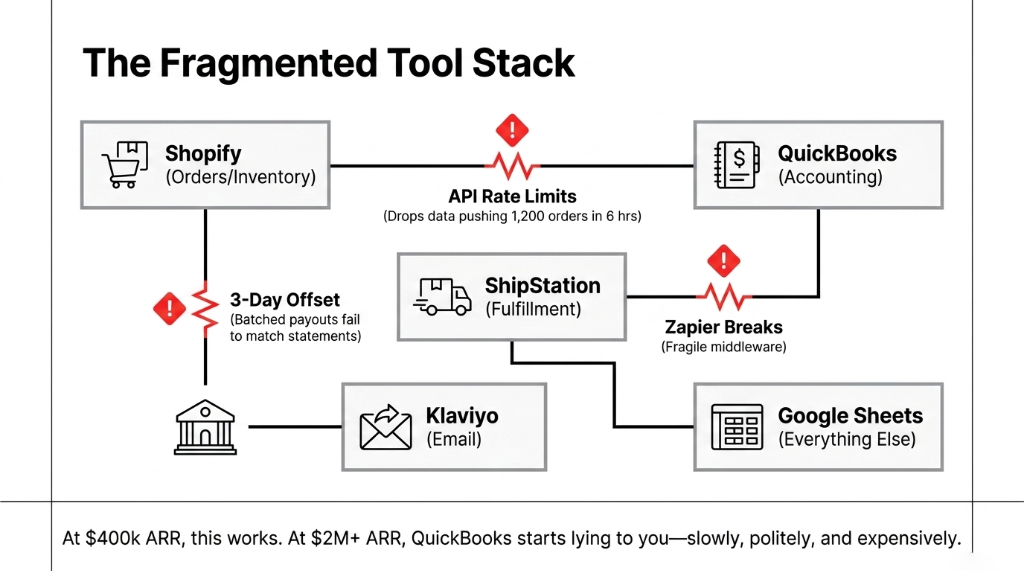
Here's the ugly truth nobody in the software industry wants to say: QuickBooks was not built for inventory-led D2C businesses. It was built for service firms. The moment you have more than 200 SKUs, live purchase orders, and multi-channel returns, QuickBooks starts lying to you — slowly, politely, and expensively.
Real Audit Finding
We have seen brands running at a $3.4M revenue rate whose P&L was off by $41,000 over a 6-month period — not due to fraud, not due to theft, but because QuickBooks was double-counting a Shopify app's discount logic. Their CA caught it. After 6 months.
Xero is better for some things. But Xero + Shopify still requires a middleware connector (A2X, Synder, or similar), and every middleware connector introduces a lag, a mapping error, or a failure point during high-volume periods like Black Friday.
Shopify's API rate limit hits a wall when you push 1,200 orders through in a 6-hour window, and suddenly your accounting data is 500 orders behind reality. That's not a minor inconvenience. That's your COGS being wrong for the entire Q4.
Why "Just Hire a Better CA" Is the Wrong Answer
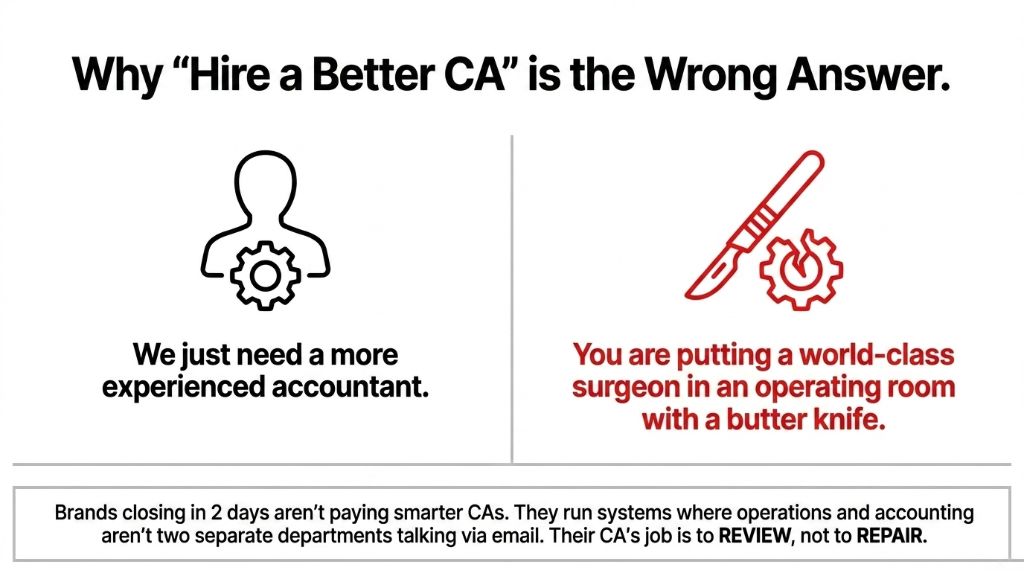
We hear this one constantly. "We just need a more experienced accountant."
No. You need to stop putting a top-tier surgeon in an operating room with a butter knife.
The Math Your CA Won't Tell You
Senior CA Rate: $80-$150/hour
Manual Reconciliation: 37 hours/month
Monthly Cost: $2,960-$5,550
Annual drain for work that an integrated ERP handles automatically:
$35,520 - $66,600/year
Here is the controversial opinion we will stand behind: Most D2C brands that think they have an accounting team problem actually have a data architecture problem. They're paying premium rates to fix broken system design every 30 days.
The brands that close their books in 2 days instead of 11 days are not paying smarter CAs. They're running systems where inventory, orders, returns, payments, and bank data all live in one place and update in real time. Their CA's job is to review, not to repair.
What the Comparison Actually Looks Like
Here's a direct comparison from our 150+ implementations globally. These numbers are from real client audits, not vendor marketing decks.
| Metric | Fragmented Stack (QuickBooks + Shopify + Sheets) | Odoo ERP (Unified) |
|---|---|---|
| Month-end close time | 9-14 days | 1.5-2 days |
| CA hours spent per month | 34-42 hours | 6-9 hours |
| Reconciliation errors per quarter | 17-31 entries | 0-3 entries |
| Real-time inventory accuracy | 71-78% | 97-99% |
| Cost of manual corrections/year | $28,000-$66,000 | $3,200-$7,000 |
| Returns auto-reconciled | No | Yes |
| Multi-channel revenue attribution | Manual | Automated |
The Odoo Fix: What Actually Changes
When we implement Odoo ERP for a D2C brand — whether they're in the US, UAE, UK, or Singapore — the first thing that changes is where data lives.
In Odoo, your inventory, your purchase orders, your Shopify orders, your bank feeds, and your accounting ledger all live in one system. When a Shopify order is placed, the inventory decrements immediately. When a return is processed, the revenue reversal happens automatically. When a vendor invoice is received, it matches against the PO without a human copying numbers from one screen to another.
Your CA logs in on the 1st. The books are 97% done. They review anomalies, approve entries, and sign off. That's it.
Case Study: UAE Home Goods Brand, $4.2M/Year Revenue
Before Odoo: Month-end took 13 days. CA logged 39 hours of close work every month.
After Odoo: Live in 11 weeks. Close time dropped to 2.3 days. CA hours dropped to 7 hours/month.
Result: Books now close on the 3rd of every month, not the 14th.
"I used to dread the end of every month. Now I actually look forward to the numbers." — Founder
That's not a feature. That's a business running the way it should.
Your Industry Determines Your Tool Disaster
D2C Apparel & Fashion
The Kill Shot: Size/color variant SKU management. QuickBooks cannot handle matrix SKUs. 45 products x 6 sizes x 4 colors = 1,080 SKUs.
One mapping error = $18,000 inventory valuation gap.
Health & Wellness / Supplements
The Kill Shot: Compliance + COGS complexity. Lot tracking, expiry dates, batch costing all need to be linked to the accounting layer.
If batch wastage isn't in COGS, your margins lie by 4-7%.
Home & Lifestyle Brands
The Kill Shot: Bundle deconstruction. A bundle of 3 items sold as one SKU has to be deconstructed into component COGS. QuickBooks doesn't do this natively.
Manual journal entries. Every. Single. Month.
In all three categories, the fix is the same: one system where operations and accounting aren't two different departments talking via email.
What Implementation Actually Takes
We are not going to pretend Odoo is a 2-day setup.
For a brand at $1M-$5M ARR with Shopify + basic inventory operations, a clean Odoo implementation runs 8-14 weeks, including data migration, Shopify integration, and CA training. Your existing QuickBooks or Xero data migrates in. Your Shopify catalogue maps across. Your CA gets 3-4 training sessions and a runbook.
The Implementation Timeline Reality
Month 1: The Hard Part
First month-end after go-live is the hardest. Your team compares new output to the old (broken) output and wonders why the numbers are different. They're different because the old numbers were wrong.
Month 3: The Payoff
Your CA is closing books in under 3 days. Reconciliation errors drop to near zero. The monthly dread disappears.
Month 6: CFO-Level Thinking
Margin by product line. Cash flow by channel. Profit per order by geography. That's when a $2M brand starts thinking like a $10M brand.
Stop Letting Your Tools Rob Your CA
If your CA dreads the last week of every month, that dread has a dollar value.
It costs you $35,000-$66,000/year in excess labor. It costs you decisions made on data that's 12 days old. It costs you the confidence to know, on the 3rd of every month, exactly where your business stands.
Odoo ERP — implemented correctly, integrated with Shopify, and configured for your actual inventory model — eliminates 89% of that manual work. We've done it 150+ times. We know exactly where the bodies are buried in a QuickBooks + Shopify stack.
The Braincuber Bet
Ask your CA one question tonight: "How many hours did you spend on manual reconciliation last month?"
If the answer is above 10, you're bleeding cash. And we can prove it in 15 minutes.
Stop Bleeding $35,000+/Year on Broken Tool Stacks
Book our free 15-Minute Operations Audit. We'll find your biggest accounting leak in the first call.
Book Your Free 15-Min AuditFrequently Asked Questions
How long does it take to migrate from QuickBooks to Odoo?
For a D2C brand at $1M-$5M ARR, migration takes 8-14 weeks from kickoff to first live close. This includes Shopify integration, historical data migration, chart of accounts mapping, and CA training. You won't lose historical data — it comes across.
Will my CA need to be retrained completely?
No. Odoo's accounting module follows standard double-entry principles your CA already knows. The 3-4 training sessions focus on Odoo-specific workflows, not accounting fundamentals. Most CAs are faster in Odoo by week three than they were in QuickBooks.
Does the same problem apply if we use Xero instead of QuickBooks?
Yes. Xero is a better product, but it's still a standalone accounting tool that requires middleware to connect to Shopify and your WMS. Every middleware connector is a failure point. Odoo eliminates the middleware because everything — inventory, orders, accounting — is native.
What does Odoo ERP implementation cost at our scale?
For a standard D2C brand ($1M-$10M ARR) with Shopify integration, expect $8,000-$25,000 one-time for implementation, with annual Odoo subscription ranging from $2,400-$7,200 depending on users and modules. Typically recovered within 4-6 months in CA labor savings alone.
Does Odoo handle multi-currency and multi-country operations?
Yes — natively. If you're selling in the US, UAE, and UK simultaneously with different currencies and tax rules, Odoo handles multi-currency accounting, VAT/GST calculation, and consolidated reporting in one ledger. No extra plugins, no manual FX journal entries, no surprises at audit time.