
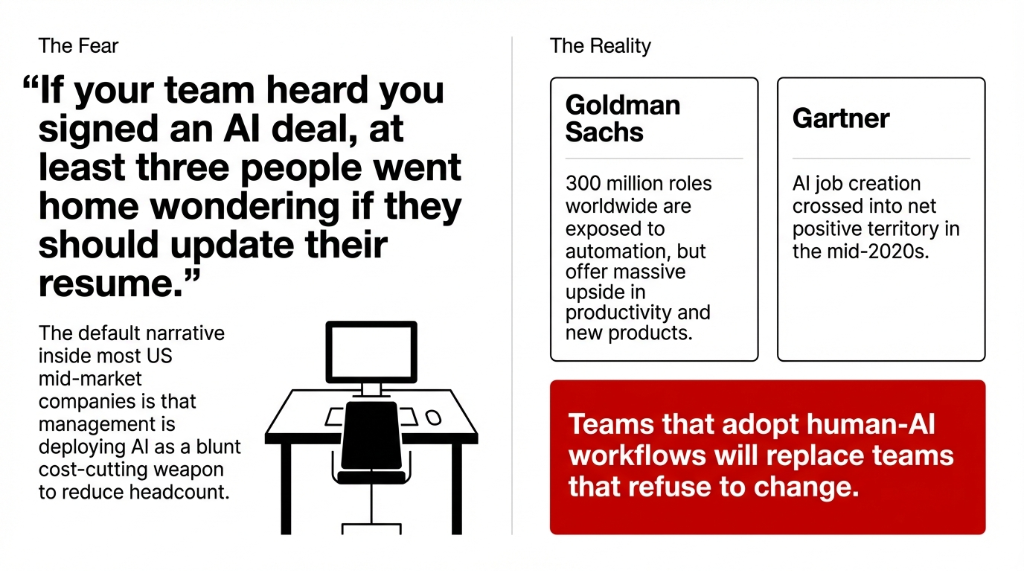
Gartner has been saying for years that AI will create more jobs than it eliminates, with net new roles turning positive around the mid-2020s. McKinsey estimates that current generative AI and related technologies could technically automate work activities that eat 60 to 70 percent of employees' time, but very few jobs can be fully automated end-to-end. Goldman Sachs warns that up to 300 million roles worldwide are exposed to some level of automation, yet also points out the upside in productivity, new products, and new kinds of work.
So no, the story is not "AI replaces humans." The real story is: teams that adopt human-AI workflows will replace teams that refuse to change.
Where AI Is Already Doing the Boring Work
Look at a typical US mid-market company. People burn entire days on email triage, status reports, data pulls, and copy-paste work inside tools like Excel, Salesforce, and NetSuite. This is exactly where data analysis AI and AI data processing shine.
The 37-Hour Problem
Data Entry & Copy-Paste
Point AI analytics tools at CRM exports, billing logs, and ticket history. Let AI data analysis handle the grunt work: cleaning data, running analysis on trends, surfacing anomalies. McKinsey's research shows a huge share of wasted time is tied up in information search, data entry, and basic content production.
Report Formatting
We plug AI tools for data analysis, AI data analytics tools, and broader analytics stacks into finance, ops, and marketing. We are not trying to invent Skynet. We are cutting the 37 hours a week your team wastes on lookup tables, spreadsheet stitching, and report formatting.
Status Reports
AI data management and AI analysis tools take over the mechanical part of the work so humans can decide what to do with the insight. That is prime territory for AI to handle. Your people should be thinking, not typing numbers into row 847 of a spreadsheet.
The Three Kinds of Work on Your Team
![The Augmentation Paradigm. Large text reads: [ HUMANS + AI ] is greater than [ AI ALONE ] is greater than [ HUMANS ALONE ]. Below is a horizontal bar chart with three bars: a short gray bar labeled Humans Alone, a medium black bar labeled AI Alone, and a long red bar labeled Humans + AI extending the furthest. Caption: AI can draft, but humans must sign. Used as an augmentation tool rather than a replacement tool, AI makes your existing people harder to replace, not easier.](https://zhpolgztzrrevlclsaaw.supabase.co/storage/v1/object/public/uploads/blog-images/will-ai-replace-our-team-augments-not-replaces/augmentation-paradigm-v1774690953651.png)
Mechanical Tasks
AI can automate. "Copy numbers from System A to System B." "Tag tickets based on keywords." If you are still making AI behave like a glorified intern for this, you are leaving money on the table. These tasks belong in the automation bucket — fully delegated to AI data processing tools.
Analytical Tasks
AI can assist. Predictive analytics, AI predictive analytics, forecasting models, anomaly detection. Use AI for data analytics to build AI pipelines around your real-world data. The job is not to replace analysts. The job is to give them a co-pilot.
Human Tasks
AI should not lead. Negotiations, hiring decisions, 7-figure customer escalations, and family-owned business politics will always need a human-AI combo: machines for pattern recognition, humans for context. You do not want an algorithm deciding which long-serving manager to fire because "KPI down 12%."
The AI Replacement Risk Test
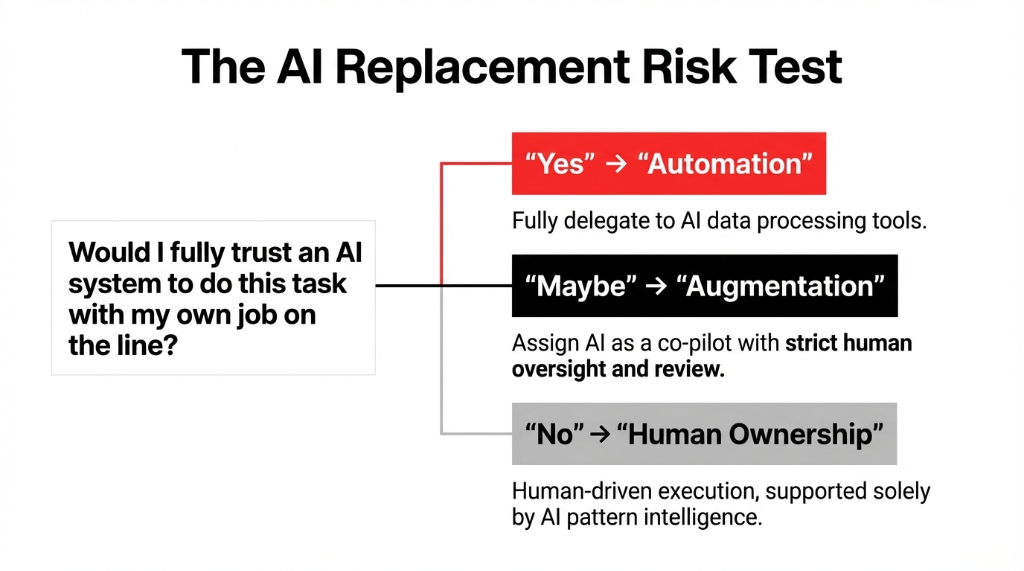
We use one blunt test with US leadership teams who worry about AI replacing their people. Ask: "Would I fully trust an AI system to do this task with my own job on the line?"
How to Apply the Test
If yes: It belongs in the automation bucket. Fully delegate to AI. Tag ticket routing, data reconciliation, invoice matching — these are automation plays. The model runs. You audit occasionally.
If maybe: It belongs in the augmentation bucket with human oversight. AI drafts, humans approve. AI scores leads, reps decide the approach. Gartner calls this AI augmentation: human workers plus artificial intelligence, not humans versus it.
If no: It belongs under human ownership, supported by AI intelligence, not driven by it. Hiring decisions, client negotiations, strategic pivots. AI provides data. Humans make the call. Your job as the AI management owner is to match AI capabilities to the right tasks.
Why Your Team Does Not Trust AI Yet
Most US teams do not fear artificial intelligence itself. They fear how leadership will use it. If the first time your staff hears about AI is when you buy an AI services platform, they will fill in the blanks for you. "We bought AI to cut payroll" becomes the default story.
Three Trust Failure Modes We See Every Week
1. No AI policy. Everyone imagines the worst. Rumors fill the vacuum. By the time you announce the real plan, half the team has already mentally checked out.
2. No communication about AI and decision-making. People do not know which decisions AI can and cannot make. That ambiguity breeds fear faster than any LinkedIn doomsday post.
3. No training. Only the loudest "AI professionals" benefit. Everyone else feels left behind. You cannot hand people an AI tool, say "go play," and pretend that counts as AI management.
You need written AI policy, training on AI and management basics, and very explicit guardrails on AI for decision-making. When people know which decisions AI can and cannot make, they breathe again.
How to Turn AI Into an Internal Co-Pilot
The 4-Phase Co-Pilot Rollout
Phase 1: Brutal data audit. Where does data for AI live today? What sources are clean enough for AI analysis? Which workflows already rely on data analytics but still use manual copy-paste?
Phase 2: Narrow domains. AI for data analysis in finance. AI analytics tools for marketing attribution. AI for data analytics in support ticket routing. AI tools for data analysis of churn data. In IT, AI for IT operations can cut mean time to resolution without changing your org chart.
Phase 3: Process wrapping. Define who owns which AI element, who approves AI-generated output, and how we log AI decisions versus human overrides. This is where policy meets planning: approving where AI can suggest, and where only humans can approve.
Phase 4: Role tuning. Instead of "data analyst," you get "AI-enhanced analyst" who owns AI analytical workflows. Instead of "operations manager," you get a manager who knows how to manage AI, including escalation when AI cannot see the full picture.
Real Examples Across Functions
| Function | What AI Does | What Humans Still Own |
|---|---|---|
| Finance | Reconcile payouts, flag tax anomalies, run cash flow simulations, scan thousands of investment positions | AI can draft. Humans still sign. Every final approval stays with a person. |
| Sales & Marketing | Score leads, write email drafts, run predictive analytics on pipeline health | Reps still build relationships. AI does not close deals. People do. |
| Operations | AI for IT operations, support routing, logistics-based AI, sensor feed processing | Humans decide when to roll trucks or shut down a line. AI and decision-making work together. |
| Real Estate | Tag listings, price deals, scan leases, underwrite faster, flag risk | No institutional US investor wires tens of millions because "the model said so." AI is a filter, not a judge. |
Careers in an AI-Heavy Company
The scary part: some roles will shrink. If your job is "copy data between systems 8 hours a day," AI can and should replace that. The opportunity: careers around AI augmentation are exploding.
New Roles We See Clients Hiring
AI Data Stewards — Own data for AI. Ensure data quality, access controls, and pipeline health. The person who makes sure the AI is not learning from garbage.
AI Product Owners — Align AI and management. Bridge the gap between what the model can do and what the business actually needs. Half product manager, half translator.
AI Trainers — Teach staff how to understand AI. Not just button-clicking workshops. Real training on how to question AI outputs, interpret confidence scores, and know when to override. Augmentation human workflows turn "regular" analysts into AI-enhanced analysts who can do the work of three people without burning out.
Governance: AI Policy That People Can Trust
You cannot bolt AI into a company without rules. If you try, you end up with rogue tools, shadow data, and legal risk. We push clients to publish a simple, blunt AI policy.
The Minimum Viable AI Policy
What data AI systems may access. Name the systems, name the data types, name the boundaries. No ambiguity.
Which AI analysis is allowed, banned, or needs review. Can AI score employee performance? Can it draft customer communications? Where does it need human sign-off? Write it down.
How compliance and ethics are handled. Can staff put family data into chatbots? Where are AI-augmented decisions allowed versus banned? When people see AI management rules in writing, they feel less like test subjects. *(Yes, you will need to update this quarterly. That is normal.)*
The Financial Reality: Funding and Payback
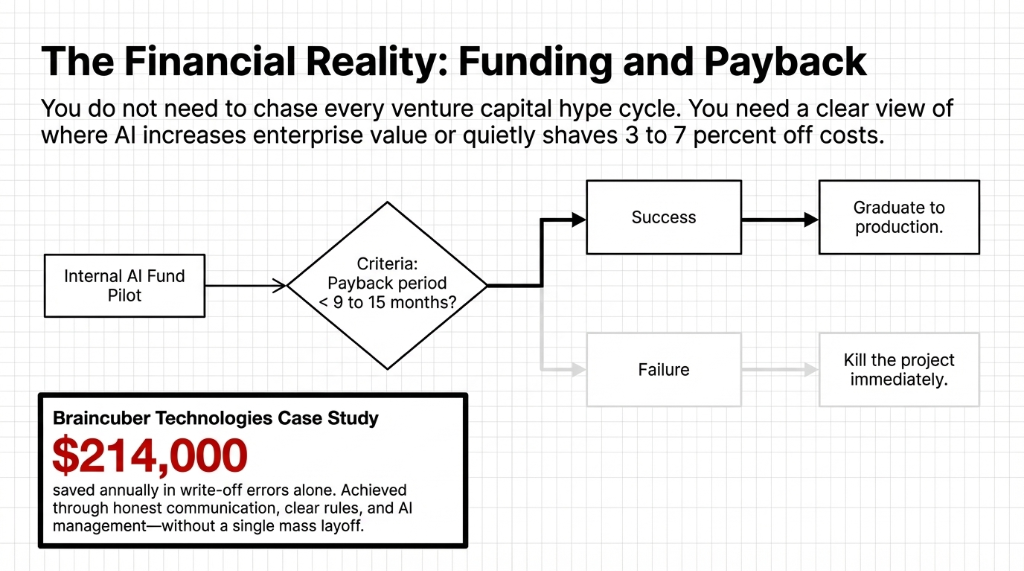
US investors are pouring AI venture capital into every based-AI startup they can find. You do not need to chase all of them. You need a clear view of AI investment management for your own portfolio: where AI can increase enterprise value, where it is hype, and where AI can quietly shave 3 to 7 percent off costs.
The Internal AI Fund Model
Some clients experiment with dedicated AI funds inside the business. Not Wall Street funds. Internal budgets earmarked for AI solutions pilots. If the pilot hits a payback period under 9 to 15 months, it graduates to production. If not, you kill it. Clean. No emotional attachment to failed experiments.
At Braincuber Technologies, we have implemented AI alongside Odoo ERP, Shopify, and cloud stacks for 150+ brands. We have seen AI management outcomes that saved one US brand around $214,000 a year in write-off errors alone. None of that required mass layoffs. It required honest communication, clear rules, and a plan.
The Human Moat AI Cannot Cross
There is one area AI cannot touch. Human trust. You can feed every research paper on artificial intelligence into a model. You can train AI systems on petabytes of logs. AI can answer questions faster than any intern. None of that makes a client feel heard in a tough call.
AI and human together beat either alone. AI-enhanced workflows should free people to do the work only humans can do: context, empathy, creative judgment. AI stands for "artificial intelligence," but for your team, AI should also stand for "augmented intelligence." And artificial intelligence used this way changes careers, not just cost lines.
What This Means for Your Team This Year
The Blunt Version for US Leadership
AI can shave 20-40% of busywork without a single layoff if you intentionally use AI augmentation rather than AI replacement.
You will need new AI roles: owners, data stewards, internal trainers, and compliance partners. These are not "innovation theater" hires. They are the people who make AI actually work.
You must publish and live by an AI policy that covers data for AI, AI and management, and environmental impact. If you do this, AI will feel like a career upgrade, not a threat. If you do not, you will get AI replacing rumors, job replacement anxiety, and quiet quitting every time someone mentions "new AI project."
FAQs
Will AI replace my entire team?
Highly unlikely. Goldman Sachs and McKinsey show that while many tasks can be automated, very few roles can be fully automated end-to-end. Most jobs will change shape, with AI augmentation taking over routine work and humans handling higher-value decisions.
Which roles are most exposed to AI?
Roles built purely on repeatable tasks like manual data entry or basic reporting. Hybrid roles that mix judgment, collaboration, and domain expertise are far safer when combined with AI analytical support.
How do I convince my team AI is not just about cuts?
Publish a clear AI policy that bans using AI as the only input for hiring, firing, or performance decisions. Pair that with training and visible examples of AI reducing overtime, not headcount.
Where should a US company start with AI?
Start where you have clean data and clear metrics: finance, support, or IT. Pilot AI for data analytics in one workflow. Measure concrete gains in hours saved or error reduction. Then expand.
What skills should my people build for an AI future?
Learn AI beyond buzzwords. Practice using AI tool stacks. Understand data analytics basics. Learn to question AI outputs instead of blindly accepting them. That combination makes employees very hard to replace.
Your Team Is Watching. What Will You Show Them?
Right now, at least three people on your team are wondering if AI means their job disappears. You have two choices: let the rumor mill run, or publish a clear AI policy and show them exactly how AI augments their work. One US brand saved $214,000 a year in write-off errors without a single layoff. We will show you how to run the same playbook in a 15-minute call. Bring your messiest workflow. We will map automation vs. augmentation vs. human ownership in real time.