
If you are running a 12-person company in Ohio or a 27-person shop in Texas and still telling yourself "we are too small for AI," you are already behind the small outfits that stopped saying that last year. They are using AI to cut boring work, tighten hiring, and open up better jobs inside the same payroll you are already paying for.
The Myth That Keeps Small Teams Stuck
We hear the same script from US founders again and again:
The Three Excuses We Hear Every Week
1. "AI is for Big Tech, not for our little manufacturing shop."
2. "We don't have data scientists or a software engineer on payroll."
3. "My HR is already overloaded; we can't take on another project."
Meanwhile, the same founders are drowning in hiring fires, messy job postings, late invoices, and a schedule that already runs past 7 pm most nights.
The ugly truth: staying "too small for AI" is a choice, not a constraint.
The Numbers: Small Really Is Adopting AI
Let us kill the myth with actual data, not vibes.
The Raw Adoption Data
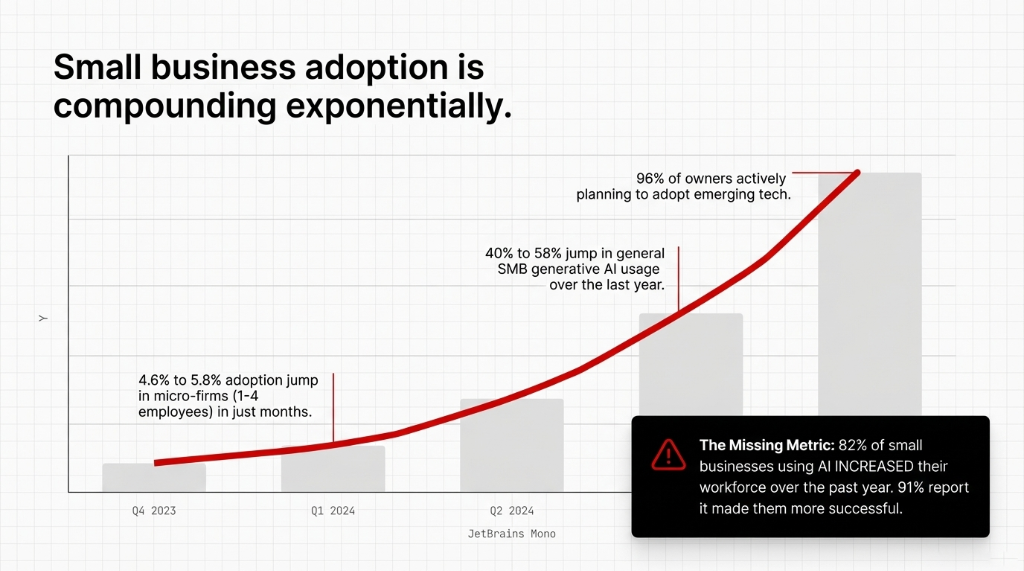
58%
US small businesses already use generative AI. Up from 40% in 2024. More than double 2023 levels.
82%
Of small businesses using AI increased their workforce over the past year. AI is not a job-killer at this scale.
91%
Of small businesses already using AI say it made their business more successful.
AI use among the very smallest firms (1-4 employees) in the US has already climbed from roughly 4.6% to 5.8% in a few months once generative tools became easy to access. 96% of US small-business owners say they plan to adopt emerging tech like AI.
You may feel "too small," but statistically you are now in the laggard half of the market if you are not doing anything with AI.
What "Small" Actually Has Going for It
Big enterprises have budgets, committees, and endless enterprise hiring cycles.
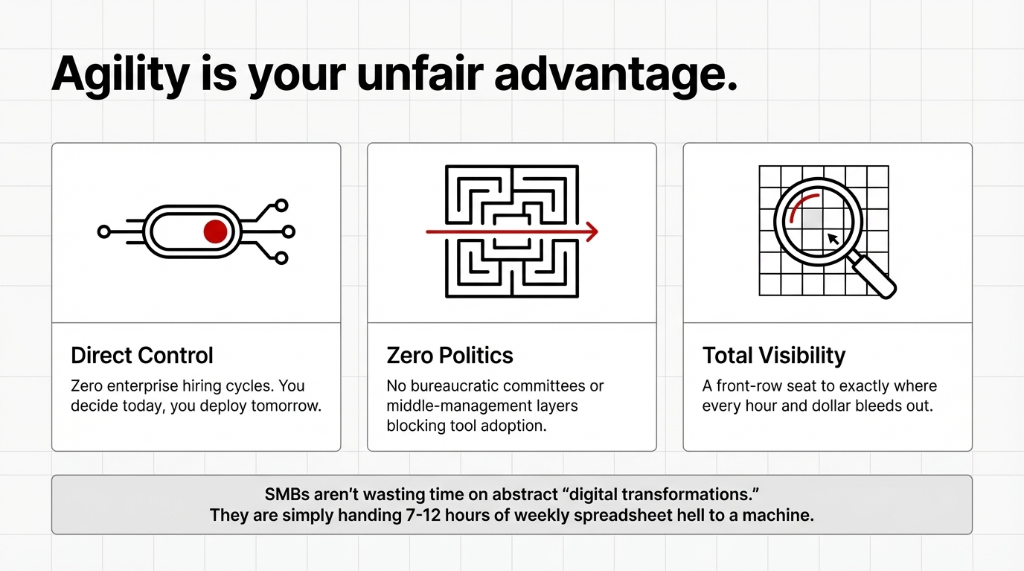
That is exactly why small teams in the US are quietly using AI to remove dozens of little cuts from their daily work rather than launching huge "digital transformation" projects. They are not chasing flashy AI positions or rebranding everyone. They are asking a blunt question:
"Where does my team waste 7-12 hours a week doing copy-paste work, job posts, or spreadsheet hell, and how do we hand that to a machine?"
AI and Jobs: What Actually Changes
There is a lot of noise around AI and jobs. Let us separate fear from math.
McKinsey and WEF Data
Automation: US generative AI could automate about 30% of hours worked and shift roughly 12 million people to different occupations by 2030.
Growth side: STEM roles expected to grow 23%. Healthcare to add around 5.5 million new jobs in that period.
Reskilling > Layoffs: Most organizations using AI expect to reskill more employees than they lay off, with almost four in ten expecting to retrain over 20% of their workforce.
AI is not "no more work." It is different work, different career paths, different stories.
Your choice as a small company in the US is simple: either let that shift happen to your people, or actively use AI for job redesign, training, and analytics so your team moves into higher-value roles instead of hanging onto tasks that will not exist.
Where AI Slots Into a Small HR and Hiring Reality
Hiring is usually job one for pain: messy job postings, weak job advertisement copy, random job listings across platforms, and a flood of unqualified applicants.
How Small HR and Talent Teams Are Using AI
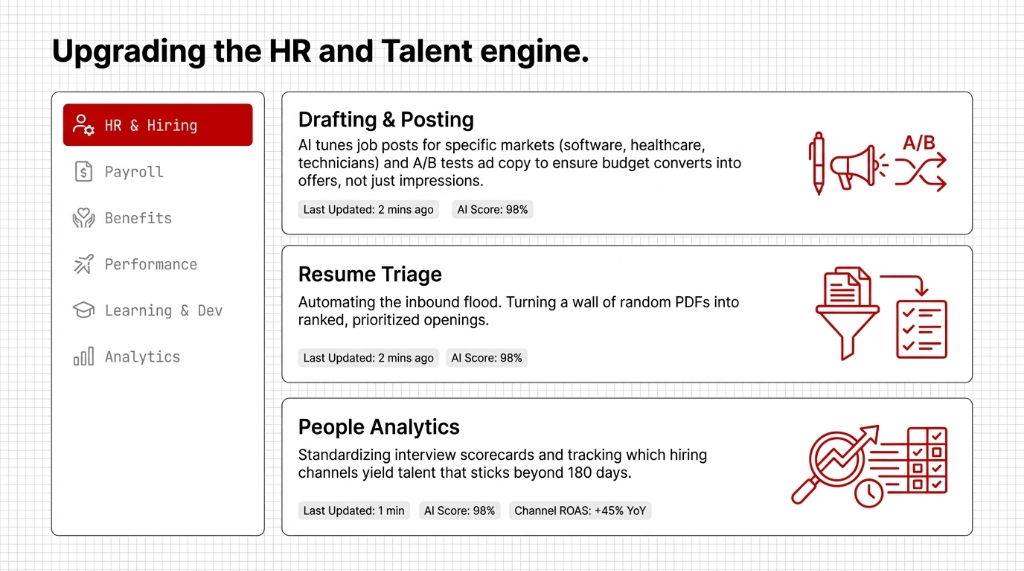
Job Posts: Drafting sharper job posts tuned to the job market for software engineers, healthcare applicants, or a single technicians opening instead of recycling boilerplate.
Resume Triage: Automating the chaos so the job search lands as ranked openings, not a wall of PDFs.
A/B Testing: AI helps write and test job advertisement text so your posting budget actually converts into job offers, not impressions.
People Analytics: Dashboards showing which hiring channel actually leads to talent that sticks beyond 180 days.
On the HR side, AI is becoming the sidekick for every HR role. Drafting interview scorecards and standardizing job families. Running simple analytics. Supporting onboarding checklists, policy FAQs, and internal mobility so people can move from jobs to careers instead of quietly planning to leave.
If your HR work currently means manually posting to ten boards, replying to every "my job application status?" email, and copying data between systems, AI is the intern you always wanted but never had budget for.
Career Paths, Not Just Seats
Most small companies do a poor job of giving people a path from "just a job" to "an actual career." AI tools can help by mapping internal career ladders, showing concrete steps for role transitions, and turning generic careers pages into targeted suggestions based on skills and demand.
Done well, this is how you move people from career confusion into clear transitions that actually pay a mortgage.
Tech Teams: AI Is Not Just for Giants with 500 Engineers
You do not need a floor of PhDs to benefit from AI in software engineering.
We see tiny US teams with a single overworked developer using AI to draft boilerplate code so they can focus on the 20% of work that is genuinely hard. Auto-generate test cases so a manual testing job shifts from clicking through screens all day to supervising what the AI missed. Keep documentation fresh so every new hire is productive in week one instead of week seven.
What AI Does for Small Engineering Teams
Write and review code across every engineer role from backend to embedded.
Forecast capacity so you have a data-backed view of the job market in your niche.
Turn vague specs into concrete tickets and job roles for each sprint.
For small teams, that means the same headcount covers more without burning people out, and you avoid panic hiring for every new project.
Beyond Coders: AI Touching Every Function
AI's impact goes way beyond writing code or automating job posting templates.
Sales and Marketing
AI generates targeted campaigns, saving 15-25 hours a month of work that used to live in slides and drafts.
Operations
From warehouse supervisors to management leads. Instant summaries, forecasts, and exception reports instead of waiting for monthly dashboards.
Service Teams
Healthcare, technicians, and professional services use AI assist tools to prep, summarize, and follow up on every client touch.
Every company is becoming a tech company whether you like it or not. Your technology careers will exist even if your legal entity sells plumbing, logistics, or cupcakes.
AI-Specific Roles vs AI-Powered Roles
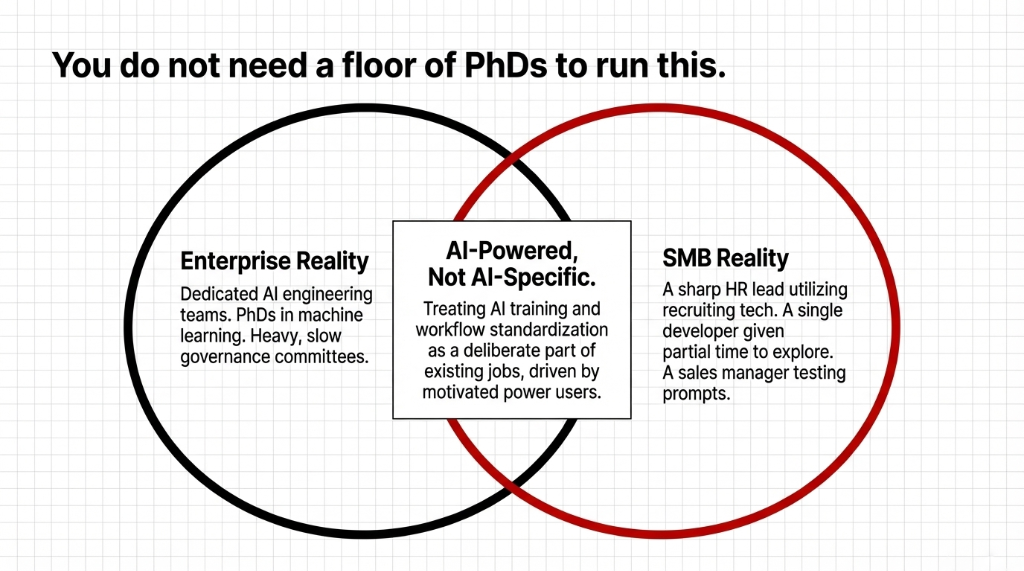
Do you need to hire for AI engineer jobs or a full-blown AI engineering team? Probably not. At least not at 30 employees.
What You Actually Need
Power users: A couple of people who treat AI training tasks as part of their role. Nudging prompts, standardizing workflows, documenting what works.
Clear ownership: Who in your org worries about AI design, governance, and the line between AI work and human judgment?
In larger US organizations, we already see formal titles like AI software engineer and hybrid technology jobs that blend product, data, and engineering. In your smaller world, it might just be one ambitious developer getting partial time to explore, or a sharp HR lead combining talent acquisition duties with recruiting technology choices.
Hiring and Recruiting: AI as Your Unfair Advantage
Most small US companies still run hiring like it is 2009: copy-paste old job posts, dump them on boards, and pray the right people find you before they get hired somewhere else.
Teams that are actually serious about recruiting are using AI to build smarter job listings targeting global markets while staying realistic about visas and remote rules. Segmenting candidates coming from AI-powered search tools versus referral channels. Automating outreach at scale so talent recruiting does not die when your recruiter goes on vacation.
AI-augmented enterprise hiring used to be something only Fortune 500 HR could touch. Now there are off-the-shelf tools designed for a 25-person shop in Kansas that wants to clean up every HR responsibility attached to growth.
Putting It Together: A Practical Path Forward
The Blunt Reality
1. The adoption wave has already hit US small businesses. You are not early. You are late.
2. The jobs and careers landscape is shifting whether you participate or not.
3. You do not need a hundred-person data team. You need one serious quarter of testing, with clear constraints.
Start Small
Pick three: One software engineering flow, one job hiring flow, and one operations flow.
Give ownership: Specific people with partial ownership tied to their career growth inside the company.
Track what matters: Hours saved, error rates, and employee sentiment. Not just cash.
Your goal is not to chase trendy AI jobs or rebrand everyone into technology careers overnight. Your goal is to make sure that in two years, when someone on your team says "my job is unrecognizable compared to 2024," they mean they have moved into higher-value roles, not that a competitor poached them because you refused to adapt.
FAQs
Are we really too small to benefit from AI?
No. Data from US surveys shows even firms with 1-4 employees are already adopting AI, and overall small-business AI use has more than doubled since 2023. If you have recurring admin, hiring, or customer work, you are big enough to get value.
Will AI replace our team or create new jobs?
AI will automate tasks, not whole humans, and research suggests more reskilling than layoffs over the next few years. Done deliberately, it lets you redesign roles into higher-value tech or hybrid job paths instead of cutting heads.
Which roles in a small company should touch AI first?
Start with overloaded functions: HR and job hiring, frontline support, sales and marketing, and any software engineering or software development work. These areas mix repetitive tasks with clear rules, so AI help is easy to measure and low-risk.
Do we need to hire an AI specialist?
Most small firms do not need a full-time AI software engineer at the start. You need a couple of motivated people in HR, operations, or engineering who treat "owning AI experiments" as part of their existing job and document what works.
How do we start without blowing our budget?
Begin with a tiny, 60-day experiment focused on one pain point like job posting and screening, or documentation for a software engineer career path. Use low-cost tools, set clear success metrics, and only expand once you see tangible time savings or better hiring outcomes.
Count Your Team's Wasted Hours This Week
If your 12- to 50-person team is burning 7-12 hours a week on copy-paste work, manual job posts, and spreadsheet reconciliation, that is $14,300 to $28,600 in annual salary waste per person. Book 15 minutes. We will tell you which one workflow to automate first. No slides. Just your numbers.