
The Real Problem With How D2C Brands Manage Customers
Most D2C founders running $1M–$5M ARR think they have a CRM. They don't. They have a contact list.
Klaviyo tracks opens and clicks. ShipStation tracks orders. QuickBooks tracks invoices. And none of them talk to each other in real time. So when a customer calls about a return, your support rep is staring at three browser tabs trying to piece together the customer's entire history.
The 12–18 Minute Data Lookup Tax
Per ticket: Your support rep spends 12–18 minutes cross-referencing Shopify admin, email threads, and accounting software just to understand who the customer is.
Multiply by 300 tickets/month
Total: $4,200+/month in wasted labor on data lookups alone
Acquiring a new customer costs 5–25x more than keeping an existing one, and the average D2C retention rate is only 28%. If your CRM setup can't tell you who bought twice, who is at risk of churning, and who responded to last week's SMS campaign — you are actively choosing to lose money.
Real Story: $14,800/Month in Lost Repeat Revenue
We worked with a $3.1M US-based skincare brand that was losing $14,800/month in repeat revenue because their post-purchase flows were firing on the wrong customer segments. The data was there. The CRM was not connecting it.
That is not a marketing problem. That is a data architecture problem disguised as a marketing problem.
Why HubSpot, Klaviyo, and Gorgias Won't Fix This
Stop trying to use a marketing tool as a CRM. That is not what it is built for.
HubSpot is excellent for B2B sales pipelines. Klaviyo is excellent for email flows. Gorgias is excellent for support tickets. But if you are a D2C brand trying to run customer lifecycle management — from first purchase to LTV maximization — none of these tools gives you a single, connected view of the customer.
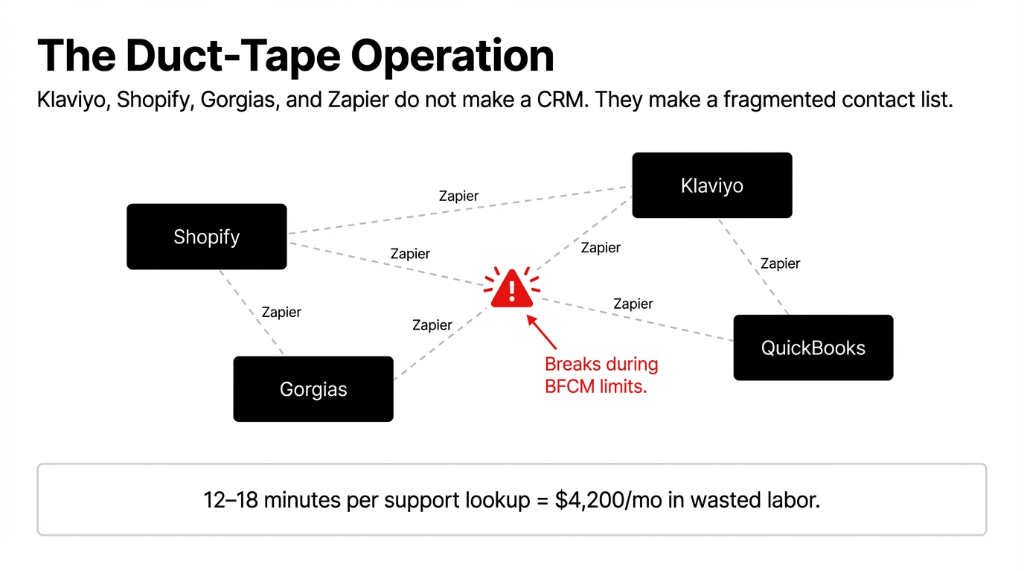
You end up building Zapier workflows to push data between them. Then Zapier hits its task limit during BFCM. Then 800 order updates don't sync. Then your email goes out to customers who already returned the product. (Yes, we have seen this. Multiple times. It is always embarrassing.)
The problem is architecture, not effort. You cannot bolt together four tools and call it a CRM strategy.
What an Odoo CRM Setup Actually Looks Like for a D2C Brand
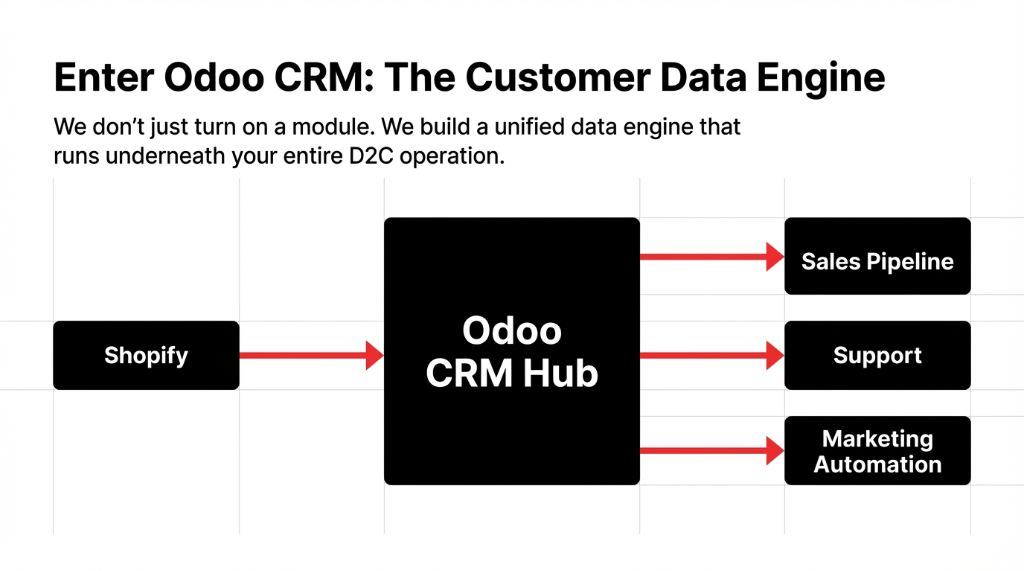
When we implement Odoo CRM for a D2C e-commerce brand, we are not just turning on a module. We are building a customer data engine that runs underneath your entire operation.
Stage 1 — Shopify to Odoo CRM Integration (Days 1–7)
The first thing we do is connect your Shopify store to Odoo via the native connector or a custom API bridge (depending on your order volume). Every order, every customer tag, every return — it flows directly into the CRM as a contact record with full transaction history.
What this fixes immediately
Your support team stops switching between Shopify admin and Gmail. Every customer call starts with full order history, lifetime spend, and last interaction visible in one screen. For a brand doing 3,000+ orders per month, this alone cuts average handle time from 14 minutes to under 4 minutes per ticket.
Stage 2 — Pipeline Configuration for Repeat Purchase Lifecycle
Out-of-the-box Odoo CRM pipelines are built for B2B sales. D2C is different. You need pipeline stages built around the customer lifecycle, not the sales cycle.
We configure custom stages like:
✓ New Customer — 1 order, no repeat
✓ Engaged — 2 orders within 90 days
✓ At Risk — no order in 60+ days for a brand with 30-day avg reorder cycle
✓ Churned — no order in 120+ days
✓ VIP — $500+ LTV, 4+ orders
Each stage triggers automated actions inside Odoo. "At Risk" customers get a follow-up task assigned to the CRM rep. "VIP" customers get tagged for personalized outreach, not mass email. This is not something Klaviyo can build without a significant data science investment on your end.
Stage 3 — Lead Source Tracking via UTM Parameters
Here is something most D2C brands miss completely: UTM-level tracking inside the CRM.
Why This Matters More Than You Think
The gap: Odoo CRM lets you attach UTM parameters to every incoming contact, so you know whether that $2,500 VIP customer originally came from a Meta ad, an influencer code, or organic search.
Over 6 months, this data tells you which acquisition channels produce your highest-LTV customers — not just your highest-converting ones.
CAC payback difference between those two segments: $31–$47 per customer
Stage 4 — Email + SMS Automation Directly From CRM
We connect Odoo's built-in Email Marketing module directly to the CRM pipeline. When a customer moves into the "At Risk" stage, a win-back sequence fires automatically — no Klaviyo dependency, no Zapier, no manual export.
The CRM + Marketing Automation ROI
Industry benchmark: Businesses earn $8.71 for every $1 spent on CRM when it is connected to active marketing automation. That is not a number you hit with a disconnected stack.
For brands doing $3M+ in annual revenue
Recovered: $18,000–$23,000/quarter from lapsed customers who would have been re-acquired at full CAC
Stage 5 — Reporting Dashboards Built for D2C Operators
The default Odoo CRM dashboard shows sales team performance. That is not what a D2C founder needs to see on Monday morning.
We build custom dashboards that show repeat purchase rate by cohort month, LTV progression at 30/60/90-day intervals, pipeline conversion rate by customer acquisition source, churn risk count by segment updated daily, and average days between first and second order by SKU category.
This Is Where the Data Gets Dangerous (In a Good Way)
Real insight: When you can see that customers who bought your hero SKU first have a 41% repeat rate versus 17% for bundle buyers, you change your acquisition strategy immediately.
This turns Odoo CRM from a contact manager into a genuine decision-making tool.
The Results You Should Realistically Expect
We are not going to promise you a 10x ROI in 30 days. Here is what we actually see from our US-based D2C clients in the first 90 days post-implementation:
Verified 90-Day Implementation Results
Repeat Purchase Rate
Improves by 6–9 percentage points for brands below 25% retention
Support Handle Time
Drops by 58–67% after the Shopify sync goes live
Win-Back Revenue
Averages $11,400–$19,700/quarter for brands with 8,000+ customer contacts
Customer Retention
CRM boosts retention by 27% when properly configured — your most direct lever for profitability
The Math That Should Keep You Up at Night
A 5% increase in customer retention alone can increase profits anywhere from 25% to 95%. At $2M ARR, that is $50,000–$190,000 in incremental profit from a system setup that costs a fraction of that.
The system pays for itself before Week 5 ends.
The Implementation Reality (No Sugarcoating)
Odoo CRM for a D2C brand of $1M–$5M ARR takes 3–5 weeks to implement properly when done by an experienced partner.
Week 1: Data Migration & Shopify Integration
Customer data hygiene, duplicate removal, Shopify connector setup, full order history import.
Weeks 2–3: Pipeline Configuration & Automation
Custom lifecycle stages, automated actions for At Risk and VIP segments, UTM parameter mapping, email/SMS sequence wiring.
Weeks 4–5: Team Training & Dashboard Calibration
D2C-specific reporting dashboards, team onboarding, sync reliability QA, parallel run validation.
The #1 mistake we see brands make: going live without cleaning existing customer data first. If your Shopify has 14,000 contacts with duplicate emails and broken order IDs, that mess transfers directly into Odoo. We spend Week 1 on data hygiene, not just migration — and that is the difference between a CRM that actually works and one that sits unused in six months.
The Cost Comparison That Ends the Debate
| Tool Stack | Monthly Cost | Unified Customer View? |
|---|---|---|
| HubSpot CRM ($90+) + Gorgias ($60+) + Zapier ($49+) | $199+/month | No — Zapier breaks during BFCM |
| Klaviyo ($150+) + ShipStation ($59+) + Spreadsheets | $209+/month | No — 12-18 min per support lookup |
| Odoo CRM Full Suite (per user) | $24.90/month | Yes — native, real-time, no Zapier |
More importantly, the revenue recovered from proper retention automation typically covers implementation costs within the first quarter. Stop paying $199/month for four tools that don't talk to each other.
FAQ
Does Odoo CRM integrate natively with Shopify?
Yes. Odoo has a native Shopify connector that syncs orders, customers, and product data in real time. For high-volume stores doing 3,000+ orders/month, we build a custom API bridge for tighter control over sync frequency and error handling, preventing data loss during peak sales events like BFCM.
How is Odoo CRM different from using Klaviyo for customer management?
Klaviyo is a marketing automation tool, not a CRM. It tracks opens and clicks but has no real-time sales pipeline, no support ticket history, and no inventory context. Odoo CRM connects marketing, sales, support, and order data in one system so every team sees the same customer record — eliminating the 12–18 minute lookup problem entirely.
How long does Odoo CRM implementation take for a D2C brand?
For a brand doing $1M–$5M ARR on Shopify, a properly configured Odoo CRM implementation takes 3–5 weeks. This includes data migration, Shopify integration, pipeline setup, automation configuration, and team training. Rushing to under 2 weeks almost always results in messy data and low adoption.
What happens to existing customer data during migration?
Shopify customer records, order history, and tags are migrated and mapped to Odoo contact records. We run a data hygiene pass before import to remove duplicates, fix broken fields, and standardize tags. No customer data is deleted. Everything is preserved and enriched with CRM-specific fields like LTV, purchase frequency, and churn risk score.
Is Odoo CRM cost-effective for a D2C brand under $5M revenue?
Yes. Odoo pricing starts at $24.90/user/month for the full suite, significantly less than running separate subscriptions for HubSpot CRM ($90+), Gorgias ($60+), and Zapier automation ($49+). The revenue recovered from proper retention automation typically covers implementation costs within the first quarter.
Stop Losing Repeat Buyers to a Broken Stack
Book a free 15-Minute Operations Audit with Braincuber Technologies. We will identify your biggest CRM leak in the first call — no pitch deck, no fluff. Just the exact fix your D2C brand needs.