
Key Takeaways
Why Q3 Breaks Most US Brands Before It Starts
Here's the ugly truth about how most US businesses enter Q3: no one owns it.
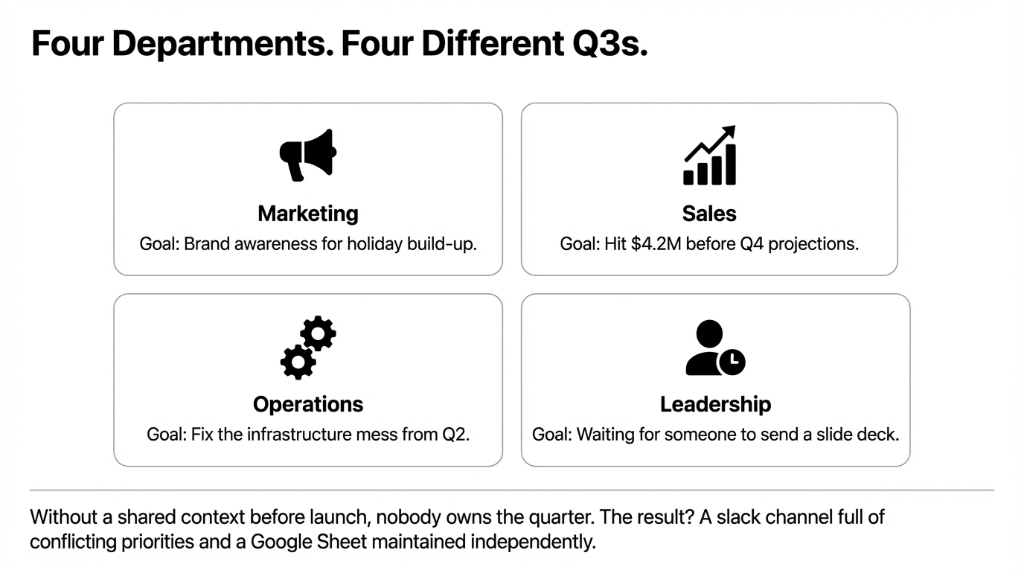
Marketing thinks Q3 is about brand awareness for holiday build-up. Sales thinks Q3 is about hitting $4.2M before Q4 projections kick in. Operations is still fixing the mess from Q2. And leadership? Leadership is waiting for someone to send a slide deck.
Gartner found that poor data quality and misaligned strategic decisions cost organizations an average of $12.9 million per year. But in our 500+ projects, we've seen something worse than bad data — no shared context at all. A $7M/year software company we worked with in Texas had four department heads who gave us four completely different answers when we asked, "What is Q3's primary success metric?" They were 11 weeks into the quarter.
The Wasted Hours Math
SDRs waste 27% of their potential selling time chasing bad pipeline intel. Add the 3–4 weeks it takes most US teams to course-correct mid-quarter, and you're burning somewhere between $38,000 and $91,000 in wasted hours alone — depending on team size and average fully-loaded cost per employee.
(And that's before we get to the $532 billion the US economy loses annually to meetings that produce no decisions.)
The Dangerous Myth: "We'll Sync When Q3 Starts"
Everyone tells you to kick off planning on July 1st. That's the worst advice in business strategy, and we'll tell you exactly why.
By July 1st, your budget is already locked. Your engineering sprint for Q3 is already committed. Your paid media agency already has the brief. The moment Q3 begins, you're executing someone else's half-formed plan — not building a strategy together.
Real Q3 planning requires a minimum of 3 structured working sessions before the quarter opens: one for goal alignment, one for resource mapping, and one for risk and contingency review. If those three sessions haven't happened by June 15th, you are going into Q3 reactive instead of proactive.
The Controversial Opinion Nobody Will Say on LinkedIn
Most "quarterly planning" meetings are theater. They're 90-minute slide reviews where the CEO speaks for 70 minutes and calls it alignment. That is not a strategy call. That is a performance.
Real strategy calls have pre-work, specific decision rights, and someone assigned to challenge every assumption on the revenue forecast.
Case Study: $12M ARR E-Commerce Brand, Chicago
Previous "planning" process: a shared Notion doc and a two-hour all-hands. After introducing a structured strategy call framework in May, they hit Q3 revenue targets 19 days early — for the first time in three years.
What a Real Q3 Strategy Call Actually Looks Like
A strategy call for Q3 planning is not a status update. It is a decision-making session with a specific agenda, specific pre-work, and specific outputs that every function can act on immediately.
Pre-Call (48 Hours Before)
Every function lead submits exactly three things — their top Q3 goal, the one assumption that could break it, and the resource they're short on. No narratives. No slide decks. Three items, written, submitted before anyone gets on a call.
The Call Itself (90 Minutes Maximum)
The first 20 minutes are spent stress-testing every assumption from the pre-work. Not validating them — stress-testing them. If your VP of Sales assumes a 34% conversion rate from qualified pipeline because Q2 hit that number, someone in that room needs to ask: "What changes in Q3 that could break this?"
Post-Call (24 Hours After)
A single document with three columns — Decision Made, Owner Assigned, Deadline Set. Not action items. Decisions. There's a difference. Action items get ignored. Decisions get executed because they have a name on them.
Case Study: SaaS Company, Austin
Reduced mid-quarter pivots by 61% after switching from "planning meetings" to structured strategy calls before Q3. Q3 miss-rate dropped from 43% of OKRs to 11% in one year.
The Cross-Functional Problem No One Admits
Q3 planning fails hardest at the cross-functional seam. Marketing and Sales both think they own pipeline. Product and Engineering fight over sprint capacity without a shared priority framework. Finance locks the budget before Operations has submitted its true Q3 cost baseline. Each function is optimizing for their Q3 — and no one is optimizing for the business's Q3.
This is where the strategy call format becomes non-negotiable. You cannot fix cross-functional misalignment with a shared spreadsheet or a project management tool. Asana, Monday.com, and Notion are great for tracking work that's already been aligned. They are useless for creating alignment.
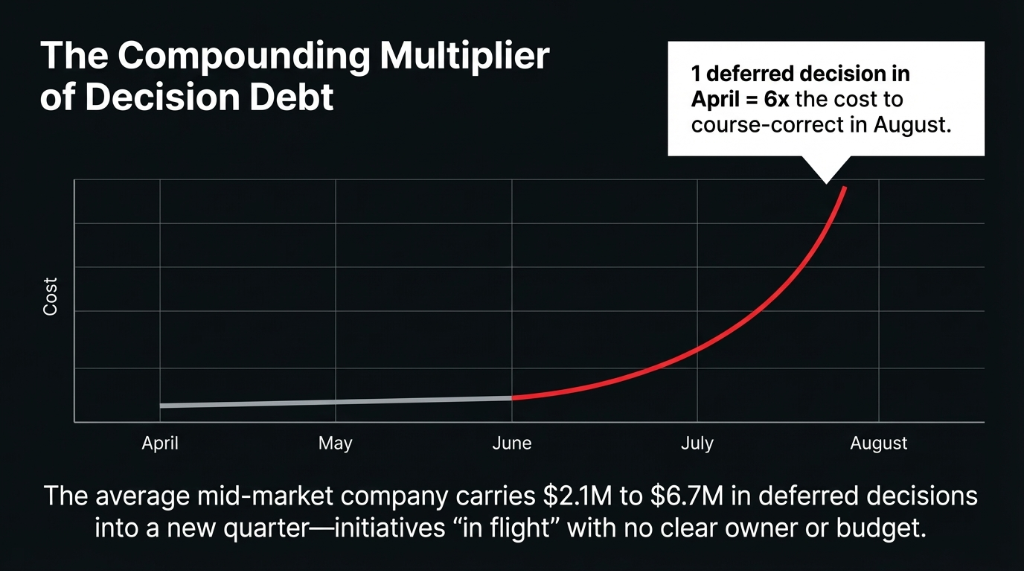
At Braincuber, when we engage with a US enterprise for cross-functional planning support, the first thing we do is map the "decision debt" from Q2: every decision that should have been made but got deferred. The average mid-market company we work with carries $2.1M to $6.7M in deferred decisions entering a new quarter — initiatives that are technically "in flight" but have no clear owner, no clear budget, and no clear tie to Q3 goals.
One deferred decision in April costs you six times more to course-correct in August. That's not a metaphor — that's what we see in the data every time.
What You Should Expect After Scheduling the Call
If you schedule your Q3 strategy call for the week of June 9th–13th and run it properly, here is what the first 30 days of Q3 should look like:
| With a Structured Strategy Call | Without One |
|---|---|
| Budget confirmed and allocated by June 20th | Budget conversations still happening July 14th |
| OKRs finalized across all functions | Each function tracking different metrics |
| Top 3 risks documented with mitigation owners | Firefighting replaces planning by Week 3 |
| First weekly review at July 7th with variance data | First review happens after the first miss |
| Q3 revenue confidence: 73–87% | "We'll see how July goes" |
We've run this exercise with 150+ brands across the US, UK, and UAE. The brands that formally schedule and structure a pre-quarter strategy call hit their quarterly targets at 2.3x the rate of brands that begin planning on day one of the quarter.
The Braincuber Framework: How We Run It
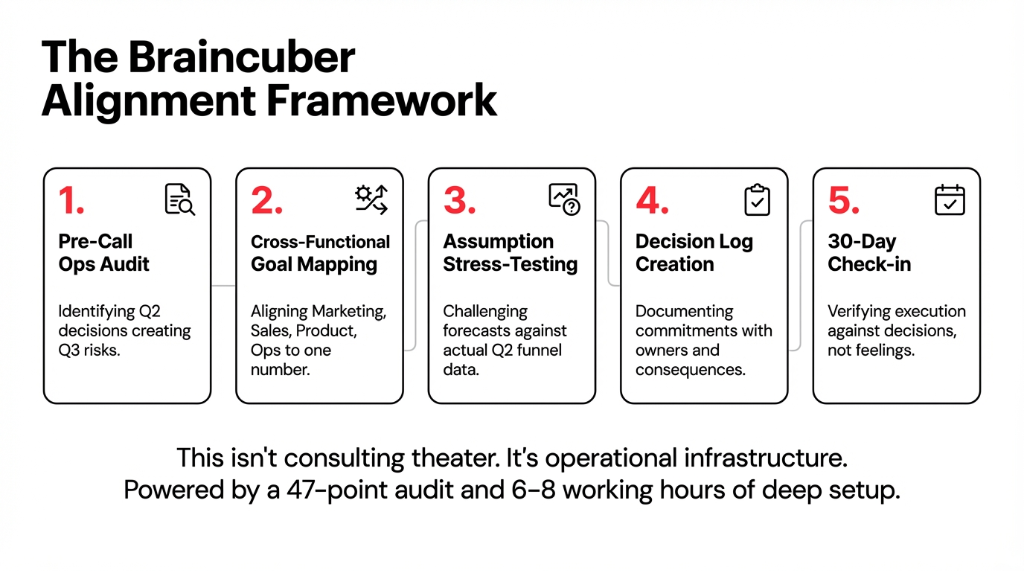
When a US-based client comes to Braincuber to support their Q3 planning, we don't come in with a slide deck full of generic frameworks. We come in with your Q2 data, your team's specific bottlenecks, and a 47-point cross-functional alignment audit we complete before the call even starts.
Our Q3 Strategy Call Engagement
Pre-Call Operations Audit
We identify where your Q2 decisions created Q3 risks before anyone knows to ask.
Cross-Functional Goal Mapping
We make sure Marketing, Sales, Product, and Ops are pointing at the same number.
Assumption Stress-Testing
Every revenue assumption gets challenged against your actual Q2 funnel conversion data — not last year's benchmark.
Decision Log + 30-Day Check-in
Every commitment gets documented with an owner, a deadline, and a consequence if missed. We verify execution against decisions made, not feelings.
This isn't consulting theater. It's operational infrastructure. And it takes 6–8 working hours to set up properly — which is why companies that try to do it themselves in one afternoon keep having the same Q3 post-mortem conversations in October.
FAQs
How early should we schedule our Q3 strategy call?
Schedule it no later than 6 weeks before Q3 begins — ideally the first week of June for a July 1st quarter start. You need at least 3 working weeks between the call and Q3 launch to act on decisions made. Anything less and you're retrofitting strategy into an already-moving quarter, which costs you 3–5 weeks of lost velocity.
Who should be in the Q3 strategy call?
Every function that owns a Q3 budget line or deliverable needs a seat. That means Sales, Marketing, Product, Operations, and Finance at minimum. Leaving out one key function is how you end up with a "finalized" Q3 plan that gets blown up by an Engineering sprint conflict in Week 2.
What is the difference between a strategy call and a planning meeting?
A planning meeting reviews what exists. A strategy call makes decisions. Specifically: a strategy call produces a decision log with owners and deadlines. If you leave a session without a documented decision and a named owner, you had a meeting — not a strategy call. Most US companies mistake the two, which is why 67% of quarterly planning initiatives fail to produce measurable outcomes.
How does Braincuber support Q3 strategy calls for cross-functional teams?
We run the pre-call audit, facilitate the session, and document every decision in a structured accountability framework. We also integrate your existing tools — HubSpot, Salesforce, Odoo, or Slack-heavy workflows — so the outputs flow directly into systems your team already uses. No extra project management layer.
What happens if we miss the window to plan before Q3 starts?
Schedule the call immediately — even on July 1st itself. We've run emergency Q3 alignment sessions as late as Week 3 of July. Even at that stage, clarifying cross-functional ownership and resetting shared metrics recovered an average of $340,000 in redirected spend that was otherwise heading toward misaligned initiatives.
The difference between a Q3 that hits and a Q3 that misses is almost never the market. It's almost always the meeting that didn't happen in June.
Want to see how we helped a $9.3M US brand reduce Q3 missed OKRs from 41% to 8% in a single quarter? Ask us on the call.
Don't Let Q3 Become Another Post-Mortem
One call. Six weeks out. That's it.
Book a free 15-Minute Strategy Audit with Braincuber — we'll show you exactly where your cross-functional plan is going to break before Q3 begins.